K M Solutions
08/19/2025
•Nested Function
• Function return function
• References
• Function as parameters
3.
K M Solutions
08/19/2025
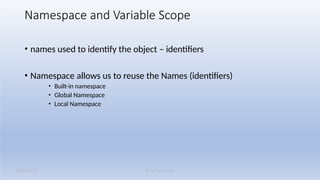
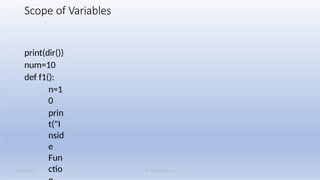
Namespaceand Variable Scope
• names used to identify the object – identifiers
• Namespace allows us to reuse the Names (identifiers)
• Built-in namespace
• Global Namespace
• Local Namespace
K M Solutions
08/19/2025
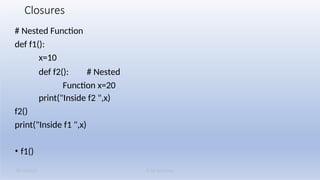
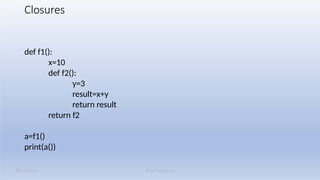
Closures
#Nested Function
def f1():
x=10
def f2(): # Nested
Function x=20
print("Inside f2 ",x)
f2()
print("Inside f1 ",x)
• f1()
K M Solutions
08/19/2025
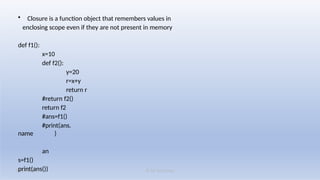
•Closure is a function object that remembers values in
enclosing scope even if they are not present in memory
def f1():
x=10
def f2():
y=20
r=x+y
return r
#return f2()
return f2
#ans=f1()
#print(ans.
name )
an
s=f1()
print(ans())
8.
K M Solutions
08/19/2025
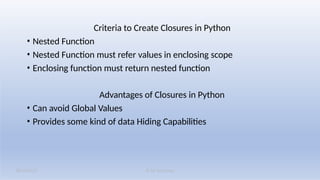
Criteriato Create Closures in Python
• Nested Function
• Nested Function must refer values in enclosing scope
• Enclosing function must return nested function
Advantages of Closures in Python
• Can avoid Global Values
• Provides some kind of data Hiding Capabilities
9.
K M Solutions
08/19/2025
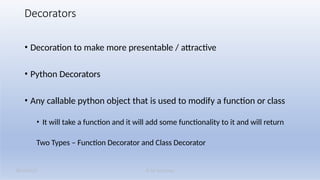
Decorators
•Decoration to make more presentable / attractive
• Python Decorators
• Any callable python object that is used to modify a function or class
• It will take a function and it will add some functionality to it and will return
Two Types – Function Decorator and Class Decorator
10.
K M Solutions
08/19/2025
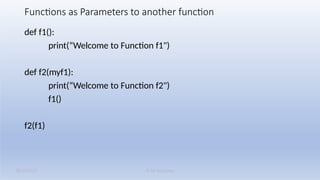
Functionsas Parameters to another function
def f1():
print(“Welcome to Function f1")
def f2(myf1):
print(“Welcome to Function f2")
f1()
f2(f1)
11.
K M Solutions
08/19/2025
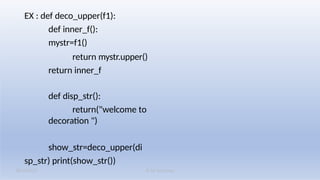
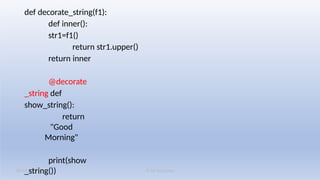
EX: def deco_upper(f1):
def inner_f():
mystr=f1()
return mystr.upper()
return inner_f
def disp_str():
return("welcome to
decoration ")
show_str=deco_upper(di
sp_str) print(show_str())
12.
K M Solutions
08/19/2025
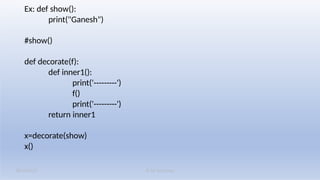
Ex:def show():
print("Ganesh")
#show()
def decorate(f):
def inner1():
print('---------')
f()
print('---------')
return inner1
x=decorate(show)
x()
K M Solutions
08/19/2025
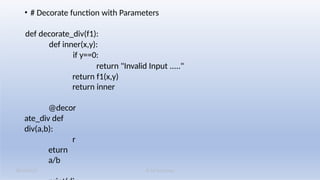
•# Decorate function with Parameters
def decorate_div(f1):
def inner(x,y):
if y==0:
return "Invalid Input ....."
return f1(x,y)
return inner
@decor
ate_div def
div(a,b):
r
eturn
a/b
15.
K M Solutions
08/19/2025
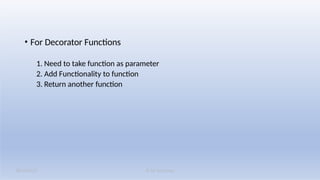
•For Decorator Functions
1. Need to take function as parameter
2. Add Functionality to function
3. Return another function
16.
K M Solutions
08/19/2025
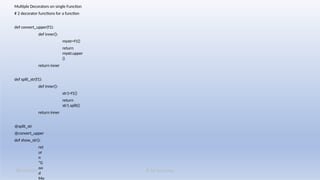
MultipleDecorators on single Function
# 2 decorator functions for a function
def convert_upper(f1):
def inner():
mystr=f1()
return
mystr.upper
()
return inner
def split_str(f1):
def inner():
str1=f1()
return
str1.split()
return inner
@split_str
@convert_upper
def show_str():
ret
ur
n
"G
oo
d
Mo
17.
K M Solutions
08/19/2025
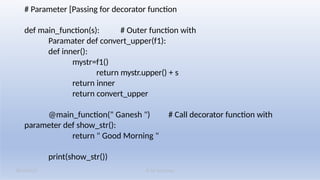
#Parameter [Passing for decorator function
def main_function(s): # Outer function with
Paramater def convert_upper(f1):
def inner():
mystr=f1()
return mystr.upper() + s
return inner
return convert_upper
@main_function(" Ganesh ") # Call decorator function with
parameter def show_str():
return " Good Morning "
print(show_str())
18.
K M Solutions
08/19/2025
#Genaral Decorator function for multiple functions
def general_decorator_f(f): # General decorator function
def inner(*args):
L1=[]
L1=args[1:]
for i in L1:
if i==0:
return "Zero in
Denomin
ator....inv
alid!!!"
return f(*args)
return inner
@general_decorator_f
def divide_f1(x,y):
return x/y
@general_decorator_f
def divide_f2(x,y,z):
return x/y/z
print(divide_f1(10,0))

![K M Solutions
08/19/2025
# Genaral Decorator function for multiple functions
def general_decorator_f(f): # General decorator function
def inner(*args):
L1=[]
L1=args[1:]
for i in L1:
if i==0:
return "Zero in
Denomin
ator....inv
alid!!!"
return f(*args)
return inner
@general_decorator_f
def divide_f1(x,y):
return x/y
@general_decorator_f
def divide_f2(x,y,z):
return x/y/z
print(divide_f1(10,0))](https://image.slidesharecdn.com/pythonfunctionsadvanced2-250819070135-daec987d/85/Python_Functions_Advanced2_KMSolutions-pptx-18-320.jpg)


![The Power of Decorators in Python [Meetup]](https://cdn.slidesharecdn.com/ss_thumbnails/decoratorsmeetup20200519-200520112225-thumbnail.jpg?width=640&height=640&fit=bounds)


