Cloud computing
.
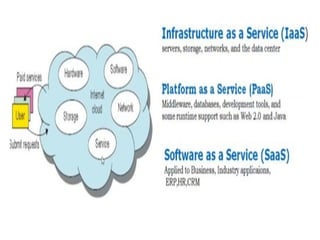
• Cloud computing is the use of hardware and
software to deliver a service over a network. It
is on demand computing resources in which
users can access files and use application from
any device that can access the internet on a
pay for use basis. Instead of computers hard
drive we are using it.
Cloud Architecture :
System models for distributed and cloud
computing
• Cluster Computing
• Peer-to-Peer networks
• Grid computing Infrastructures
• Cloud Computing over an internet
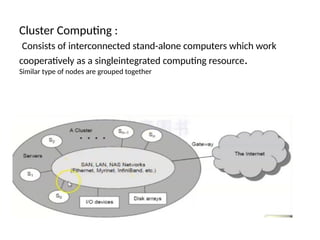
Cluster Computing :
Consists of interconnected stand-alone computers which work
cooperatively as a singleintegrated computing resource.
Similar type of nodes are grouped together
• Figure shows the architecture of a typical
server cluster built around a low-latency, high
bandwidth interconnection network
• The network of compute nodes are connected
by LAN/SAN,etc
• They are typically homogeneous with
distributed control running Unix/Linux
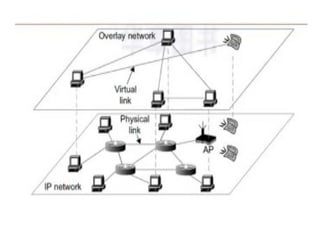
Peer-to-Peer networks :
• The P2P architecture offers a distributed model of
networked systems.
• Each system is connected by each other and each
data is shared to each system
• In a P2P system, every node acts as both a client and
a server, providing part of the system resources.
• Peer machines are simply client computers
connected to the Internet. All client machines act
autonomously to join or leave the system freely.
• In P2P network, every node (peer) acts as
both a client and server.
• No central coordination or central database is
needed.
• The system is self-organizing with distributed
control.
• Unlike the cluster or grid, a P2P network does
not use dedicated interconnection network.
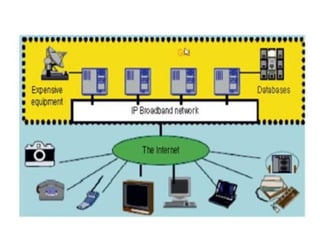
Grid computing Infrastructures
• Infrastucture,Grids are heterogeneous clusters interconnected by
high-speed networks
• Infrastucture
• It does easy task with large scale company.
• They have centralized control and are server-oriented with
authenticated security.
• They are suited to distributed supercomputing. The grid is
constructed across LANs, WANs or Internet backbones at a regional,
national or global scale.
• The computers used in a grid include servers, clusters, and super-
computers.
• PCs, laptops, and mobile devices can be used to access a grid system.
Cloud Computing over an internet
• A Cloud is a pool of virtualized computer
resources.
• Workloads can be deployed and scaled out
quickly through rapid Virtual Machines.
• Virtualization of server resources has enabled
cost effectiveness and allowed cloudsystems to
low costs to benefit both users and providers.
• Cloud computing applies a virtualized platform
with hardware, software, and data sets
dynamically.
Cloud Architecture and cloud models in the internet

Cloud Architecture and cloud models in the internet

  • 1.
    Cloud computing . • Cloudcomputing is the use of hardware and software to deliver a service over a network. It is on demand computing resources in which users can access files and use application from any device that can access the internet on a pay for use basis. Instead of computers hard drive we are using it.
  • 2.
    Cloud Architecture : Systemmodels for distributed and cloud computing • Cluster Computing • Peer-to-Peer networks • Grid computing Infrastructures • Cloud Computing over an internet
  • 3.
    Cluster Computing : Consistsof interconnected stand-alone computers which work cooperatively as a singleintegrated computing resource. Similar type of nodes are grouped together
  • 4.
    • Figure showsthe architecture of a typical server cluster built around a low-latency, high bandwidth interconnection network • The network of compute nodes are connected by LAN/SAN,etc • They are typically homogeneous with distributed control running Unix/Linux
  • 5.
    Peer-to-Peer networks : •The P2P architecture offers a distributed model of networked systems. • Each system is connected by each other and each data is shared to each system • In a P2P system, every node acts as both a client and a server, providing part of the system resources. • Peer machines are simply client computers connected to the Internet. All client machines act autonomously to join or leave the system freely.
  • 7.
    • In P2Pnetwork, every node (peer) acts as both a client and server. • No central coordination or central database is needed. • The system is self-organizing with distributed control. • Unlike the cluster or grid, a P2P network does not use dedicated interconnection network.
  • 8.
    Grid computing Infrastructures •Infrastucture,Grids are heterogeneous clusters interconnected by high-speed networks • Infrastucture • It does easy task with large scale company. • They have centralized control and are server-oriented with authenticated security. • They are suited to distributed supercomputing. The grid is constructed across LANs, WANs or Internet backbones at a regional, national or global scale. • The computers used in a grid include servers, clusters, and super- computers. • PCs, laptops, and mobile devices can be used to access a grid system.
  • 10.
    Cloud Computing overan internet • A Cloud is a pool of virtualized computer resources. • Workloads can be deployed and scaled out quickly through rapid Virtual Machines. • Virtualization of server resources has enabled cost effectiveness and allowed cloudsystems to low costs to benefit both users and providers. • Cloud computing applies a virtualized platform with hardware, software, and data sets dynamically.