
CLOUD ANTI-
PATTERNS
DevOpsDays Ohio
November 2015
whoami Mallika Iyer
Cloud Foundry Specialist @ Pivotal
Twitter @cloudfoundryart
LinkedIn in/imallika
@cloudfoundryart
Certified TRX trainer | Fitness junkie | German Shepherd Fanatic
@cloudfoundryart
@cloudfoundryart
Agenda
• Cloud Anti-Patterns
• #1 Ignoring the Sweet Spot
• #2 Risk Mitigation v/s Innovation
• #3 The Monolithic Microservice
• #4 The Microservice Smell
• #5 The 3 musketeers of cloud-native apps
• #6 Boil tea, not the ocean
• #7 The micro-service push & shove
• #8 Build Pipelines are your BFFs
• #9 Siloed Search
• Summary
@cloudfoundryart
Before we begin…
• Let’s define things!
@cloudfoundryart
Microservices
Microservices is a software
architecture design pattern, in
which complex applications are
composed of small,
independent processes
communicating with each other
using language-agnostic APIs.
These services are small,
autonomous, highly
decoupled, work together and
focus on doing a small task.
@cloudfoundryart
Containers
A container is an isolated
and lightweight environment
that can run a service or
application without reliance
on a separate operating
system
eg: Docker,
Warden,
Garden…
@cloudfoundryart
Continuous Integration
The practice of merging all
developer working copies to a
shared mainline several
times a day
@cloudfoundryart
Continuous Delivery
An approach where teams
produce valuable software in
short cycles and release the
software reliably,
predictably and at times,
automatically
eg:
Concourse,
Jenkins,
Bamboo…
@cloudfoundryart
Cloud Anti-Patterns
#1 Finding the sweet spot
Sweet spot
cnp
CNP= Cloud Native Platform as a Service like Cloud Foundry
@cloudfoundryart
#1 Ignoring the sweet spot
@cloudfoundryart
#1 Ignoring the sweet spot
If I close my
eyes it doesn’t
exist…
cnp
CNP= Cloud Native Platform as a Service like Cloud Foundry
@cloudfoundryart
#2 Risk Mitigation v/s Innovation
• Problem
• Need to innovate
• Want to release cool features to production NOW
• Ops simply cannot support this because of uptime, HA, DR
and other concerns
• Result
• Everyone is unhappy
• Business is angry
• Everyone blames IT-Ops
• It’s not really fair...
@cloudfoundryart
Hai ya! New
cool features
tomorrow!!
No more
github for
you…
Code Ninjas/Developers
Special Ops/Operations
@cloudfoundryart
#2 Risk Mitigation v/s Innovation
• Solution
• You don’t have to choose!
• Select the right platform
• Something like Cloud Foundry…
• Self-healing
• Application distribution across Availability Zones
• Application resurrection
• Self-monitoring and resurrection
• VM recreation
• Inherently HA
• Visibility into all development activity
@cloudfoundryart
#3 The Monolithic Microservice
• Temptation:
• Grouping similar microservices in the same container
• Problem:
• Unable to scale
• Unable to deploy changes
• The monolithic creep
• Solution:
• ONE Micro Service Per container
@cloudfoundryart
#4 The Microservice Smell
Temptation:
Premature decomposition of microservices
• Problem:
• Company ‘Amazing-Stuff!!!’
has a product called
‘Awesome’
• They plan to create a new
offering called ‘Super-
Awesome’
• Similarities between the 2
products cause them to split
microservices and consume
them across both products
• ‘Super-Awesome’ really
KICKS off…takes a life of its
own
• Causing the developers to
rewrite the microservices for
the new product 
@cloudfoundryart
This micro service smells
of too many beers and
sweat…
@cloudfoundryart
#4 The Microservice Smell
• Lesson Learned:
• DON’T BE IN A HURRY to GO MICRO – Let it be
gradual!
@cloudfoundryart
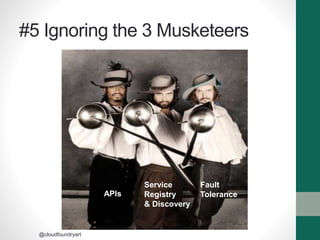
#5 Ignoring the 3 Musketeers
APIs
Service
Registry
& Discovery
Fault
Tolerance
@cloudfoundryart
#5 The 3 Musketeers : APIs
Problem
• 100+ microservices
need to talk to each
other
• Many are changing
simultaneously
• And they are in about
5 different languages
Solution
• Use language-
independent APIs and
API interfaces like
swagger.io
• Honor the contract
between microservices
• Interactively document
the API and integrate it
with your project tracker
@cloudfoundryart
#5 The 3 Musketeers : Service
Discovery & Registry
Problem
• 100+ microservices are
now talking to each
other…
• Every time a new
microservice is added, all
the others must manually
be informed of its presence
Solution
• Use a service discovery
and registry tool like
Eureka (part of Spring
Cloud Services)
• Automate Service
Discovery and
Registration
• No errors at scale
@cloudfoundryart
#5 The 3 Musketeers : Fault
Tolerance
Problem
• A couple of internal
services that feed your
application fail for some
reason
• The failure has now
propagated to the API
• Your customers now
experience a disruption in
service causing $$$$$$
loss in revenue
Solution
• Use a circuit breaker like
Hystrix (part of Spring
Cloud Services)
• Isolate the point of origin of
the failure
• Contain the error and
prevent cascading failure
• Graceful degradation of
service while we work
furiously behind the scenes
to fix it
@cloudfoundryart
#6 Boil Tea, Not the Ocean
• Problem:
• The temptation to lift and shift a monolith
• Trying to rewrite the entire application
• Too much, too fast, too soon
• Challenges:
• Unrealistic
• Might not even be possible due to IaaS restrictions
• Moving a problem from a place you (kind of) understand to a
place you absolutely don’t
• Result:
• The Cloud Native Initiative lives on PowerPoint for
eternity
@cloudfoundryart
#6 Boil Tea, Not the Ocean
• Solution:
• Identify a function that can be rebuilt
• Something that would benefit from innovation
• Something that is hard to modify
• Something new
• With minimum impact on the rest of the monolith
• Clearly outline the technical debt associated with that
function
• Rewrite following best practices for microservices
• Start really…really small
• Or really…really new
@cloudfoundryart
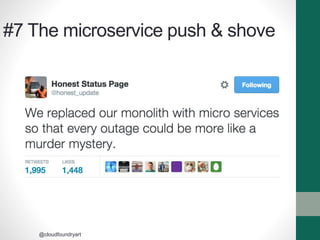
#7 The microservice push & shove
@cloudfoundryart
#7 The microservice push &
shove
• Problem:
• In a distributed application architecture, how do you figure
out where to look?
• Solution:
• It doesn’t have to be that way…
• Logging is your friend…
• Pivotal Ops Metrics
• New Relic, App Dynamics, Sumo Logic, ELK,
Splunk…and so many more
• Dynamic Tracing is your friend…
• Explore Zipkin
• Application Performance Monitoring tools…
• New Relic, Drip Stat…
@cloudfoundryart
#8 Build Pipelines are your BFFs
KEEP CALM
AND
HUG
YOUR
BUILD PIPELINES
@cloudfoundryart
#9 Siloed Search
• Problem:
• Users cannot perform unified search
across data silos
• Search data is stale
@cloudfoundryart
#9 Cloud-Native Federated
Search
Solution:
• Create an Enterprise-Wide Data Bus with RabbitMQ
or Kafka
• Multiple microservices can asynchronously publish
interesting data points
• Search Event Listeners will listen to these events
and update the search indices in real-time
• Basically going from a data push model to Real-
time Data Pull Model
@cloudfoundryart
Summary
• Don’t ignore the sweet spot – A Cloud Native Platform as a
Service like Cloud Foundry is your best friend
• You don’t have to choose between Risk Mitigation and
Innovation – A Cloud Native Platform is your ally
• The Monolithic Micro service – don’t be THAT guy
• Be wary of the micro service smells – Know When to
Repeat Yourself
• The 3 Musketeers are your best friends: APIs(swagger.io),
Service Registry & Discovery (Eureka – Spring Cloud
Services), Fault Tolerance (Hystrix-Spring Cloud Services)
@cloudfoundryart
Summary
• Boil tea, not the ocean – Start small, start new
• Microservices need not be murder mysteries –
Logging and Tracing are your friends
• Automation is your friend – Keep calm and hug your
build pipelines across environments
• Siloed Search will ruin your customer experience –
Search should NEVER been an afterthought
@cloudfoundryart
Thank you!
Mallika Iyer @ Pivotal
Twitter @cloudfoundryart
LinkedIn in/imallika

Cloud anti-patterns

  • 1.
  • 2.
    whoami Mallika Iyer CloudFoundry Specialist @ Pivotal Twitter @cloudfoundryart LinkedIn in/imallika @cloudfoundryart
  • 3.
    Certified TRX trainer| Fitness junkie | German Shepherd Fanatic @cloudfoundryart
  • 4.
  • 5.
    Agenda • Cloud Anti-Patterns •#1 Ignoring the Sweet Spot • #2 Risk Mitigation v/s Innovation • #3 The Monolithic Microservice • #4 The Microservice Smell • #5 The 3 musketeers of cloud-native apps • #6 Boil tea, not the ocean • #7 The micro-service push & shove • #8 Build Pipelines are your BFFs • #9 Siloed Search • Summary @cloudfoundryart
  • 6.
    Before we begin… •Let’s define things! @cloudfoundryart
  • 7.
    Microservices Microservices is asoftware architecture design pattern, in which complex applications are composed of small, independent processes communicating with each other using language-agnostic APIs. These services are small, autonomous, highly decoupled, work together and focus on doing a small task. @cloudfoundryart
  • 8.
    Containers A container isan isolated and lightweight environment that can run a service or application without reliance on a separate operating system eg: Docker, Warden, Garden… @cloudfoundryart
  • 9.
    Continuous Integration The practiceof merging all developer working copies to a shared mainline several times a day @cloudfoundryart
  • 10.
    Continuous Delivery An approachwhere teams produce valuable software in short cycles and release the software reliably, predictably and at times, automatically eg: Concourse, Jenkins, Bamboo… @cloudfoundryart
  • 11.
  • 12.
    #1 Finding thesweet spot Sweet spot cnp CNP= Cloud Native Platform as a Service like Cloud Foundry @cloudfoundryart
  • 13.
    #1 Ignoring thesweet spot @cloudfoundryart
  • 14.
    #1 Ignoring thesweet spot If I close my eyes it doesn’t exist… cnp CNP= Cloud Native Platform as a Service like Cloud Foundry @cloudfoundryart
  • 15.
    #2 Risk Mitigationv/s Innovation • Problem • Need to innovate • Want to release cool features to production NOW • Ops simply cannot support this because of uptime, HA, DR and other concerns • Result • Everyone is unhappy • Business is angry • Everyone blames IT-Ops • It’s not really fair... @cloudfoundryart
  • 16.
    Hai ya! New coolfeatures tomorrow!! No more github for you… Code Ninjas/Developers Special Ops/Operations @cloudfoundryart
  • 17.
    #2 Risk Mitigationv/s Innovation • Solution • You don’t have to choose! • Select the right platform • Something like Cloud Foundry… • Self-healing • Application distribution across Availability Zones • Application resurrection • Self-monitoring and resurrection • VM recreation • Inherently HA • Visibility into all development activity @cloudfoundryart
  • 18.
    #3 The MonolithicMicroservice • Temptation: • Grouping similar microservices in the same container • Problem: • Unable to scale • Unable to deploy changes • The monolithic creep • Solution: • ONE Micro Service Per container @cloudfoundryart
  • 19.
    #4 The MicroserviceSmell Temptation: Premature decomposition of microservices • Problem: • Company ‘Amazing-Stuff!!!’ has a product called ‘Awesome’ • They plan to create a new offering called ‘Super- Awesome’ • Similarities between the 2 products cause them to split microservices and consume them across both products • ‘Super-Awesome’ really KICKS off…takes a life of its own • Causing the developers to rewrite the microservices for the new product  @cloudfoundryart
  • 20.
    This micro servicesmells of too many beers and sweat… @cloudfoundryart
  • 21.
    #4 The MicroserviceSmell • Lesson Learned: • DON’T BE IN A HURRY to GO MICRO – Let it be gradual! @cloudfoundryart
  • 22.
    #5 Ignoring the3 Musketeers APIs Service Registry & Discovery Fault Tolerance @cloudfoundryart
  • 23.
    #5 The 3Musketeers : APIs Problem • 100+ microservices need to talk to each other • Many are changing simultaneously • And they are in about 5 different languages Solution • Use language- independent APIs and API interfaces like swagger.io • Honor the contract between microservices • Interactively document the API and integrate it with your project tracker @cloudfoundryart
  • 24.
    #5 The 3Musketeers : Service Discovery & Registry Problem • 100+ microservices are now talking to each other… • Every time a new microservice is added, all the others must manually be informed of its presence Solution • Use a service discovery and registry tool like Eureka (part of Spring Cloud Services) • Automate Service Discovery and Registration • No errors at scale @cloudfoundryart
  • 25.
    #5 The 3Musketeers : Fault Tolerance Problem • A couple of internal services that feed your application fail for some reason • The failure has now propagated to the API • Your customers now experience a disruption in service causing $$$$$$ loss in revenue Solution • Use a circuit breaker like Hystrix (part of Spring Cloud Services) • Isolate the point of origin of the failure • Contain the error and prevent cascading failure • Graceful degradation of service while we work furiously behind the scenes to fix it @cloudfoundryart
  • 26.
    #6 Boil Tea,Not the Ocean • Problem: • The temptation to lift and shift a monolith • Trying to rewrite the entire application • Too much, too fast, too soon • Challenges: • Unrealistic • Might not even be possible due to IaaS restrictions • Moving a problem from a place you (kind of) understand to a place you absolutely don’t • Result: • The Cloud Native Initiative lives on PowerPoint for eternity @cloudfoundryart
  • 27.
    #6 Boil Tea,Not the Ocean • Solution: • Identify a function that can be rebuilt • Something that would benefit from innovation • Something that is hard to modify • Something new • With minimum impact on the rest of the monolith • Clearly outline the technical debt associated with that function • Rewrite following best practices for microservices • Start really…really small • Or really…really new @cloudfoundryart
  • 28.
    #7 The microservicepush & shove @cloudfoundryart
  • 29.
    #7 The microservicepush & shove • Problem: • In a distributed application architecture, how do you figure out where to look? • Solution: • It doesn’t have to be that way… • Logging is your friend… • Pivotal Ops Metrics • New Relic, App Dynamics, Sumo Logic, ELK, Splunk…and so many more • Dynamic Tracing is your friend… • Explore Zipkin • Application Performance Monitoring tools… • New Relic, Drip Stat… @cloudfoundryart
  • 30.
    #8 Build Pipelinesare your BFFs KEEP CALM AND HUG YOUR BUILD PIPELINES @cloudfoundryart
  • 31.
    #9 Siloed Search •Problem: • Users cannot perform unified search across data silos • Search data is stale @cloudfoundryart
  • 32.
    #9 Cloud-Native Federated Search Solution: •Create an Enterprise-Wide Data Bus with RabbitMQ or Kafka • Multiple microservices can asynchronously publish interesting data points • Search Event Listeners will listen to these events and update the search indices in real-time • Basically going from a data push model to Real- time Data Pull Model @cloudfoundryart
  • 33.
    Summary • Don’t ignorethe sweet spot – A Cloud Native Platform as a Service like Cloud Foundry is your best friend • You don’t have to choose between Risk Mitigation and Innovation – A Cloud Native Platform is your ally • The Monolithic Micro service – don’t be THAT guy • Be wary of the micro service smells – Know When to Repeat Yourself • The 3 Musketeers are your best friends: APIs(swagger.io), Service Registry & Discovery (Eureka – Spring Cloud Services), Fault Tolerance (Hystrix-Spring Cloud Services) @cloudfoundryart
  • 34.
    Summary • Boil tea,not the ocean – Start small, start new • Microservices need not be murder mysteries – Logging and Tracing are your friends • Automation is your friend – Keep calm and hug your build pipelines across environments • Siloed Search will ruin your customer experience – Search should NEVER been an afterthought @cloudfoundryart
  • 35.
    Thank you! Mallika Iyer@ Pivotal Twitter @cloudfoundryart LinkedIn in/imallika

Editor's Notes

  • #18 Elaborate on visibility into all development activity
  • #31 The goal is to deliver tested, mature software after every development iteration, without being a burden on Ops – Ops needs to be the invisible glue that is holding this together, hardening it constantly with every change, every automation, and the focus should be on building great software, not worry about HOW to deploy it. If you get to that point, Ops has most definitely ‘arrived’
  • #32  When you have a lot of data, and accuracy and relevance of the search results are important to you – the likelihood is that you will use large scale search technologies like Solr. This was a problem I saw at one of the largest users of Solr in the world And a lot of microservices simultaneously updating the data – you start to get search silos , and stale data is the result How do you get around this