 http://www2.ed.gov/about/offices/list/oela/
english-learner-toolkit/chap4.pdf
 Six Key Principles for Teaching English Learners,
will help guide LEAs as they work to develop
standard-aligned instruction for ELs.
 “These principles are applicable to any type of
instruction regardless of grade, proficiency level,
or program type. Finally, no single principle
should be considered more important than any
other. All principles should be incorporated into
the planning and delivery of every lesson or unit
of instruction.” However, in this presentation we
will focus on two of the principles.
 Instruction moves ELs forward by taking into
account their English proficiency level(s) and
prior schooling experiences.
 ELs within a single classroom can be
heterogeneous in terms of home language(s)
proficiency, proficiency in English, literacy
levels in English and student’s home
language(s), previous experiences in schools,
and time in the U.S.
 Teachers must be attentive to these
differences and design instruction
accordingly.
How do we take
into account home
language and
prior school
experiences?
Oral Language (Listening & Speaking)
 LAS Links Español A - CTB/McGraw-Hill
Reading
 Sistema de evaluación de la lectura – Heinemann
Writing
 Spanish writing sample collected and scored with
WIDA rubric
 Informal Home Language Interview & other
district made assessments
How can we use
English Proficiency
levels to inform
instruction?
(WIDA Speaking Levels)
 file:///C:/Users/chobae03/Downloads/WIDA_
Performance%20Definitions_SpeakingWriting.
pdf
WIDA
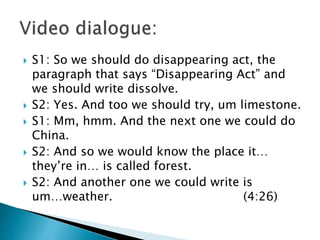
 S1: So we should do disappearing act, the
paragraph that says “Disappearing Act” and
we should write dissolve.
 S2: Yes. And too we should try, um limestone.
 S1: Mm, hmm. And the next one we could do
China.
 S2: And so we would know the place it…
they’re in… is called forest.
 S2: And another one we could write is
um…weather. (4:26)
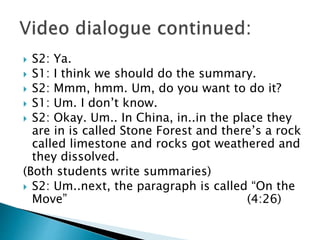
 S2: Ya.
 S1: I think we should do the summary.
 S2: Mmm, hmm. Um, do you want to do it?
 S1: Um. I don’t know.
 S2: Okay. Um.. In China, in..in the place they
are in is called Stone Forest and there’s a rock
called limestone and rocks got weathered and
they dissolved.
(Both students write summaries)
 S2: Um..next, the paragraph is called “On the
Move” (4:26)
Teacher moves: Student moves:
 Teacher as facilitator in
classroom
 Students grouped with
language like partners
 Gradual release model
I DO/WE DO/YOU DO
 Turn taking
 Exercising all four
domains (L, S, R & W)
 Monitoring their own
pace of learning
 Standards-aligned instruction for ELs is
rigorous, grade-level appropriate, and
provides deliberate and appropriate scaffolds.
 Such shifts require that teachers provide
students with opportunities to describe their
reasoning, share explanations, make
conjectures, justify conclusions, argue from
evidence, and negotiate meaning from
complex texts.
 Students with developing levels of English
proficiency will require instruction that
carefully supports their understanding and
use of emerging language as they participate
in these activities.
 Instruction that is rigorous and standards-
aligned reflects the key shifts in the CCSS,
NGSS and WIDA.
 http://www.corestandards.org/
 http://www.nextgenscience.org/
 https://www.wida.us/
How can we
scaffold language
in the classroom?
Fairbairn, Shelley, and Jones-Vo, Stephaney. 2010. Differentiating
Instruction and Assessment for English Language Learners.
Philadelphia, PA: Caslon, Inc.
 T: We were talking about how the window
changed at the beginning of the story.
 S1: It was in a dream.
 T: You’re right. We talked about how it
changed from…the city-to the river-back to
the city. It looks like he is falling asleep.
 S1: It was a dream because it says the title is
“A River Dream.”
 S2: He is dreaming. (00:30)
Teacher moves: Student moves:
 Using pictures
 Providing repetition
 Creating an environment
of comprehensible input
 Discourse variances
(short phrases and
complete sentences,
change of partners)
 Exercising L, S, R & W
 Using spontaneous
language
 Pointing to text evidence
 Students using copies of
the text and organizers
with language scaffolds
Video (00:30)
About This Book:
A little boy takes a
fantasy trip up the
river by his house
to fly-fish with his
uncle.
Reading Level:
Grade level Equivalent: 3.8
Lexile® Measure: 490L
DRA: 24
Guided Reading: M
Genre:
General Fiction
A RIVER DREAM
BY: ALLEN SAY
Sample of student reading grade level text
during the close reading process
(1:22)
 https://vimeo.com/61971077
Watch it the first time to record literal observations
and inferences
Pause times:
0:40
1:00
1:25
1.55
2:38
Watch it again to document supporting evidence.
 http://www.literacyshed.com/
 Great resource for finding short videos
 Sample:
http://www.literacyshed.com/the-christmas-
truce.html
Share some of your thoughts and ideas about
using short videos for close reading.
 “Close, analytic reading stresses engaging with a
text of sufficient complexity directly and
examining meaning thoroughly and methodically,
encouraging students to read and reread
deliberately. Directing student attention on the
text itself empowers students to understand the
central ideas and key supporting details. It also
enables students to reflect on the meanings of
individual words and sentences; the order in
which sentences unfold; and the development of
ideas over the course of the text, which
ultimately leads students to arrive at an
understanding of the text as a whole.”(PARCC,
2011, p. 7)
 The goal of Close Reading is to teach readers
how to read and reread with a purpose.
 As time goes on, and students become more
familiar with the close reading strategy they will
begin to read and reread independently. Thus,
mastering the strategy and having a deeper
understanding of the content of the text they are
reading.
www.parcconline.org
Providing a structure, or ritual, allows students to
quickly acquire the habits of close reading that
lead to independence.
• Providing a structure, or ritual, promotes the
development of habits
• Habits can lead to independence in students’
reading
Lehman, Christopher, and Kate Roberts. 2014 Falling In Love
With Close Reading. Portsmouth, NH: Heinemann.
 1. Read through lenses.
• What will you pay attention to while reading ?
• What details do you notice?
 2. Use lenses to find patterns.
• Look at the details that you have collected.
• What patterns do you notice?
 3. Use patterns to develop new ideas and deeper
understandings about the text.
• Look at patterns in light of what you have already
read. What new understandings do you have?
Close reading instruction:
• involves clear language
• is highly engaging
• is responsive to student needs
• must transfer to students’ own reading
Close reading is not:
• requiring students to read a complex piece of text
again and again until they understand it (Fisher &
Frey, 2012, p.8)
Lehman, Christopher, and Kate Roberts. 2014. Falling In Love With Close Reading.
Portsmouth, NH: Heinemann.
 Doug Part 1
http://www.youtube.com/watch?v=5w9v6-
zUg3Y
 Doug Part 2
http://www.youtube.com/watch?v=JhGI5zdjp
vc
What are your ideas, thoughts, questions, wonderings
about close reading?
 https://www.engageny.org/resource/close-
reading-strategies-with-informational-text-
by-expeditionary-learning
I can get the gist and
determine the main
idea in a newspaper
article about the
Seneca people.
(1:34)
 Read the entire text, without stopping to get
the “flow.”
 Read and circle important and unfamiliar
words. Write the GIST for each section or
paragraph in the margin.
 Read and record important details.
(1:30)
 A text worth reading
 Related to a unit of study
 Complex enough to push
students
(3:15)
Read
Think
Write
Talk
(4:47)
Is this an important
detail? Explain.
(5:29)
Students share thinking
Debrief: What detail did
you think was important?
How did it connect to the
main idea?
(6:11)
Please discuss with a partner something that you saw or heard in the
Engage NY video that you may try with your students.
 http://www.coolcatteacher.com/close-
reading-activities/
Discuss with a partner how you are using one of the tips with
your students and/or how you plan to use one of the tips.
 http://www.teachingthecore.com/non-
freaked-out-common-core-close-reading/
Close Reading with ELLs 2015

Close Reading with ELLs 2015

  • 2.
  • 3.
     Six KeyPrinciples for Teaching English Learners, will help guide LEAs as they work to develop standard-aligned instruction for ELs.  “These principles are applicable to any type of instruction regardless of grade, proficiency level, or program type. Finally, no single principle should be considered more important than any other. All principles should be incorporated into the planning and delivery of every lesson or unit of instruction.” However, in this presentation we will focus on two of the principles.
  • 4.
     Instruction movesELs forward by taking into account their English proficiency level(s) and prior schooling experiences.
  • 5.
     ELs withina single classroom can be heterogeneous in terms of home language(s) proficiency, proficiency in English, literacy levels in English and student’s home language(s), previous experiences in schools, and time in the U.S.  Teachers must be attentive to these differences and design instruction accordingly.
  • 6.
    How do wetake into account home language and prior school experiences?
  • 7.
    Oral Language (Listening& Speaking)  LAS Links Español A - CTB/McGraw-Hill Reading  Sistema de evaluación de la lectura – Heinemann Writing  Spanish writing sample collected and scored with WIDA rubric  Informal Home Language Interview & other district made assessments
  • 8.
    How can weuse English Proficiency levels to inform instruction? (WIDA Speaking Levels)
  • 9.
  • 10.
  • 11.
     S1: Sowe should do disappearing act, the paragraph that says “Disappearing Act” and we should write dissolve.  S2: Yes. And too we should try, um limestone.  S1: Mm, hmm. And the next one we could do China.  S2: And so we would know the place it… they’re in… is called forest.  S2: And another one we could write is um…weather. (4:26)
  • 12.
     S2: Ya. S1: I think we should do the summary.  S2: Mmm, hmm. Um, do you want to do it?  S1: Um. I don’t know.  S2: Okay. Um.. In China, in..in the place they are in is called Stone Forest and there’s a rock called limestone and rocks got weathered and they dissolved. (Both students write summaries)  S2: Um..next, the paragraph is called “On the Move” (4:26)
  • 13.
    Teacher moves: Studentmoves:  Teacher as facilitator in classroom  Students grouped with language like partners  Gradual release model I DO/WE DO/YOU DO  Turn taking  Exercising all four domains (L, S, R & W)  Monitoring their own pace of learning
  • 15.
     Standards-aligned instructionfor ELs is rigorous, grade-level appropriate, and provides deliberate and appropriate scaffolds.
  • 16.
     Such shiftsrequire that teachers provide students with opportunities to describe their reasoning, share explanations, make conjectures, justify conclusions, argue from evidence, and negotiate meaning from complex texts.  Students with developing levels of English proficiency will require instruction that carefully supports their understanding and use of emerging language as they participate in these activities.
  • 17.
     Instruction thatis rigorous and standards- aligned reflects the key shifts in the CCSS, NGSS and WIDA.  http://www.corestandards.org/  http://www.nextgenscience.org/  https://www.wida.us/
  • 18.
    How can we scaffoldlanguage in the classroom?
  • 19.
    Fairbairn, Shelley, andJones-Vo, Stephaney. 2010. Differentiating Instruction and Assessment for English Language Learners. Philadelphia, PA: Caslon, Inc.
  • 20.
     T: Wewere talking about how the window changed at the beginning of the story.  S1: It was in a dream.  T: You’re right. We talked about how it changed from…the city-to the river-back to the city. It looks like he is falling asleep.  S1: It was a dream because it says the title is “A River Dream.”  S2: He is dreaming. (00:30)
  • 21.
    Teacher moves: Studentmoves:  Using pictures  Providing repetition  Creating an environment of comprehensible input  Discourse variances (short phrases and complete sentences, change of partners)  Exercising L, S, R & W  Using spontaneous language  Pointing to text evidence  Students using copies of the text and organizers with language scaffolds
  • 22.
  • 23.
    About This Book: Alittle boy takes a fantasy trip up the river by his house to fly-fish with his uncle. Reading Level: Grade level Equivalent: 3.8 Lexile® Measure: 490L DRA: 24 Guided Reading: M Genre: General Fiction A RIVER DREAM BY: ALLEN SAY
  • 24.
    Sample of studentreading grade level text during the close reading process (1:22)
  • 26.
     https://vimeo.com/61971077 Watch itthe first time to record literal observations and inferences Pause times: 0:40 1:00 1:25 1.55 2:38 Watch it again to document supporting evidence.
  • 27.
     http://www.literacyshed.com/  Greatresource for finding short videos  Sample: http://www.literacyshed.com/the-christmas- truce.html
  • 29.
    Share some ofyour thoughts and ideas about using short videos for close reading.
  • 30.
     “Close, analyticreading stresses engaging with a text of sufficient complexity directly and examining meaning thoroughly and methodically, encouraging students to read and reread deliberately. Directing student attention on the text itself empowers students to understand the central ideas and key supporting details. It also enables students to reflect on the meanings of individual words and sentences; the order in which sentences unfold; and the development of ideas over the course of the text, which ultimately leads students to arrive at an understanding of the text as a whole.”(PARCC, 2011, p. 7)
  • 31.
     The goalof Close Reading is to teach readers how to read and reread with a purpose.  As time goes on, and students become more familiar with the close reading strategy they will begin to read and reread independently. Thus, mastering the strategy and having a deeper understanding of the content of the text they are reading. www.parcconline.org
  • 32.
    Providing a structure,or ritual, allows students to quickly acquire the habits of close reading that lead to independence. • Providing a structure, or ritual, promotes the development of habits • Habits can lead to independence in students’ reading Lehman, Christopher, and Kate Roberts. 2014 Falling In Love With Close Reading. Portsmouth, NH: Heinemann.

  • 33.
     1. Readthrough lenses. • What will you pay attention to while reading ? • What details do you notice?  2. Use lenses to find patterns. • Look at the details that you have collected. • What patterns do you notice?  3. Use patterns to develop new ideas and deeper understandings about the text. • Look at patterns in light of what you have already read. What new understandings do you have?
  • 34.
    Close reading instruction: •involves clear language • is highly engaging • is responsive to student needs • must transfer to students’ own reading Close reading is not: • requiring students to read a complex piece of text again and again until they understand it (Fisher & Frey, 2012, p.8) Lehman, Christopher, and Kate Roberts. 2014. Falling In Love With Close Reading. Portsmouth, NH: Heinemann.
  • 35.
     Doug Part1 http://www.youtube.com/watch?v=5w9v6- zUg3Y  Doug Part 2 http://www.youtube.com/watch?v=JhGI5zdjp vc
  • 37.
    What are yourideas, thoughts, questions, wonderings about close reading?
  • 38.
  • 39.
    I can getthe gist and determine the main idea in a newspaper article about the Seneca people. (1:34)
  • 40.
     Read theentire text, without stopping to get the “flow.”  Read and circle important and unfamiliar words. Write the GIST for each section or paragraph in the margin.  Read and record important details. (1:30)
  • 41.
     A textworth reading  Related to a unit of study  Complex enough to push students (3:15)
  • 42.
  • 43.
    Is this animportant detail? Explain. (5:29)
  • 44.
    Students share thinking Debrief:What detail did you think was important? How did it connect to the main idea? (6:11)
  • 46.
    Please discuss witha partner something that you saw or heard in the Engage NY video that you may try with your students.
  • 47.
  • 49.
    Discuss with apartner how you are using one of the tips with your students and/or how you plan to use one of the tips.
  • 50.

Editor's Notes

  • #4 LEAs=Local Education Agencies