Download as PDF, PPTX
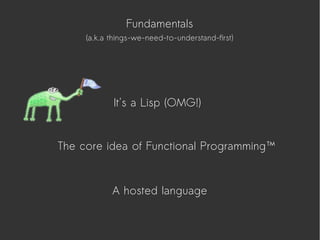
![Lispy syntax
Ordered
Associative
Function
Invocation
var x = [1,2,3];(def x [1 2 3])
(def m {:a “Foo“}) var m = {a: “Foo“};
function bar (a) {
return a + 42;
}
(defn bar [a]
(+ a 42))
bar(0);(bar 0)](https://image.slidesharecdn.com/clojurescriptintroduction-150823120942-lva1-app6892/85/ClojureScript-Introduction-7-320.jpg)

![Mutability causes cognitive load
var x = [1,2,3];
foo(x);
After foo,
what's in x?](https://image.slidesharecdn.com/clojurescriptintroduction-150823120942-lva1-app6892/85/ClojureScript-Introduction-11-320.jpg)
![ClojureScript is built on immutability
(def x [1 2 3])
(foo x)
(assert (= x [1 2 3]))](https://image.slidesharecdn.com/clojurescriptintroduction-150823120942-lva1-app6892/85/ClojureScript-Introduction-12-320.jpg)

![CSP* with core.async = channels + go blocks
Communicating Sequential Processes, Tony Hoare (1978)
*
(def c1 (chan))
(go-loop [xs []]
(let [x (<! c1)]
(println "Got" x ", xs so far:" xs)
(recur (conj xs x))))
(put! c1 "foo")
;; outputs: Got bar , xs so far: [foo]
a blocking read
make a new channelcreates a
lightweight
process
async write](https://image.slidesharecdn.com/clojurescriptintroduction-150823120942-lva1-app6892/85/ClojureScript-Introduction-24-320.jpg)
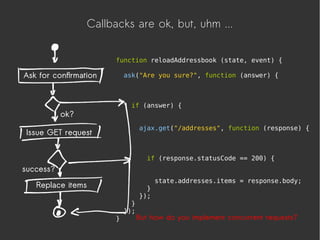
![core.async: no need for callbacks
Ask for confirmation
ok?
Issue GET request
success?
Replace items
(defn <addressbook-reload
[state event]
(go (if (= :ok (<! (<ask "Are you sure?")))
(let [{s :status addresses :body}
(<! (http/get "/addresses"))]
(if (= 200 s)
(assoc-in state
[:addresses :items]
addresses)
state)))](https://image.slidesharecdn.com/clojurescriptintroduction-150823120942-lva1-app6892/85/ClojureScript-Introduction-25-320.jpg)

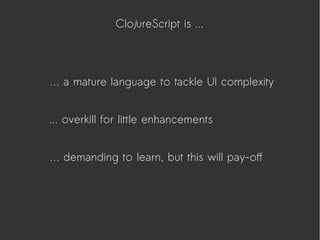

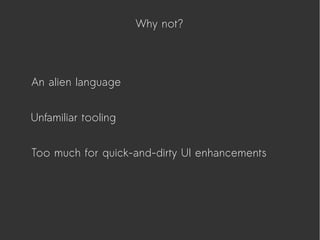
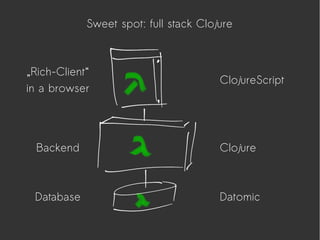
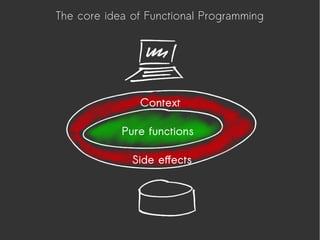
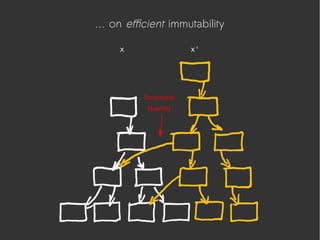
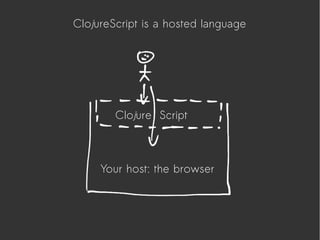
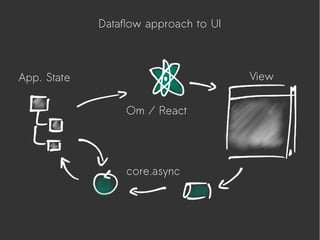
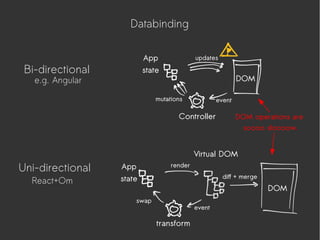
ClojureScript allows developers to use Clojure to build rich client applications that run in browsers. It offers powerful functional programming concepts like immutability, pure functions, and core.async for asynchronous programming. The presentation introduces ClojureScript fundamentals like Lisp syntax, REPL, and how it is a hosted language that runs on the browser. It also discusses recommended tools for getting started and explores Om and React for building UIs and core.async for managing asynchronous code. In the end, ClojureScript is concluded to be overkill for simple enhancements but mature for tackling complex UIs while being demanding to learn initially.


![Getting Started with Apache Spark: Big Data Made Simple [Free Meetup]](https://cdn.slidesharecdn.com/ss_thumbnails/apachesparkgettingstarted-260203175547-8361bcc3-thumbnail.jpg?width=640&height=640&fit=bounds)