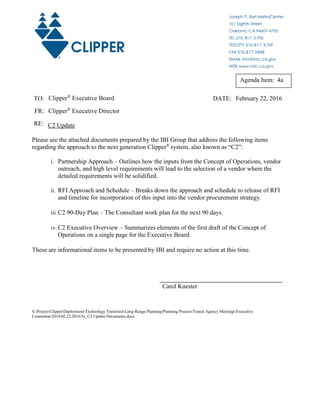
TO: Clipper®
Executive Board DATE: February 22, 2016
FR: Clipper®
Executive Director
RE: C2 Update
Please see the attached documents prepared by the IBI Group that address the following items
regarding the approach to the next generation Clipper®
system, also known as “C2”:
i. Partnership Approach – Outlines how the inputs from the Concept of Operations, vendor
outreach, and high level requirements will lead to the selection of a vendor where the
detailed requirements will be solidified.
ii. RFI Approach and Schedule – Breaks down the approach and schedule to release of RFI
and timeline for incorporation of this input into the vendor procurement strategy.
iii.C2 90-Day Plan – The Consultant work plan for the next 90 days.
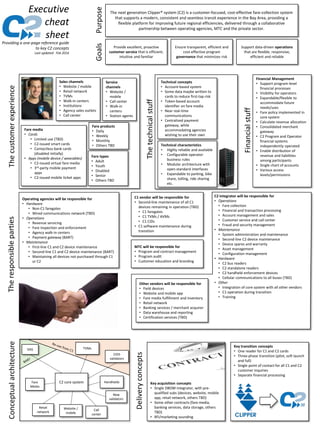
iv. C2 Executive Overview – Summarizes elements of the first draft of the Concept of
Operations on a single page for the Executive Board.
These are informational items to be presented by IBI and require no action at this time.
Carol Kuester
S:ProjectClipperDeploymentTechnology TransitionLong-Range PlanningPlanning ProcessTransit Agency MeetingsExecutive
Committee201602.22.20163a_C2 Update Documents.docx
Agenda Item: 4a
Integrator “Partnering” Approach
Partnering Approach
ConOps
RFI
Results
– 30-40% level
requirements
– Full breadth of
C2 functions
– Requirements
finalization
process
– Contract,
payment terms,
and conditions
Integrator
RFP &
Award
Requirements
Detailing
Integrator
Solution
Contract
Iterative
Design
Conformed
Design
– Firm fixed price for design
– Min-max for implementation
– Incentives to share cost savings
– Final price prior to “build”
Build
Requirements defined to the
level needed to select partner
Detail and finalize requirements based on
capabilities of the vendors solution
1.
2.
3.
RFI Approach and Schedule
RFI Development
RFI Response
Period
Conduct Analysis &
Create Interview List
Analyze, Present to Executives &
Finalize Procurement Strategy
Integrator
Discussions
Update ConOps
ConOps
for RFI C2 Technical Requirements Development
Integrator RFP and Subcontractor Prequalification Procurement Documents
2016
Feb Mar Apr May June Jul Aug Sep Oct
Abbreviated ConOps for Industry Discussion
– Technical concepts
– Operational concepts
– Open items for industry feedback (e.g. transition approach)
Possible questions and topics for RFI and Integrator discussion
Technical Work
Contracts and Procurement
Vendor Interaction
Updates
– Taking over C1 operations
– C1-C2 transition and account
migration
– Integration with BART and others
– Account versus card based operation
– Retail network
– Mobile applications
– Contract conditions
– Incentives and penalties
– Partnering and iterative
design process
Must meet MQs
Others at Executive discretion based on
exceptional value or innovation
Example MQs
– At least one major North American project
– Proven account-based system
– Financial capability
– Flexibility and innovation
Shortlisting for Discussions
02/15 – 03/11/2016 03/12 – 04/08/2016 04/09 – 05/15/2016
90-day Look Ahead
Last updated: 02/11/2016
Executive Committee Meeting
(03/21) – primary topic: project
schedule and any issues arising
out of ConOps update
Executive Committee Meeting
(04/18) – primary topic: RFI
and process
Looking farther ahead...
June:
 Receive RFI
Responses (06/15)
 Review RFI
Responses
Steering Committee Meeting
(05/06) – primary topic: TBD
Steering Committee
Meeting (03/04) – primary
topic: ConOps comments
Dispostion
PROGRAM MANAGEMENT
Executive Committee Meeting
(02/22) – primary topic:
ConOps Summary and RFI
Approach
Steering Committee Meeting
(04/01) – primary topics:
project schedule and
materials for Integrator RFI
CONCEPT REFINEMENT
 Deliver Draft
Final 100%
ConOps
(anticipate
mid-March)
 SE Team works
through Draft
Concept comments
and decomposes
 SE Team begins work
on updating ConOps
 ConOps Updates
following Steering
Committee Meeting
 Repackage comments
to identify those being
carried forward
FIRST-LEVEL REQUIREMENTS DEVELOPMENT
 C2 Top Level Requirements Development (ongoing through Q3 2016)
 Procurement and RFI preparation meetings (ad hoc)
Focus on: (1) Goals and initial approach (2) Contracting options (3) Operations (4) Review and discuss draft package
 Prepare “Reduced Scope” Concept for
Integrator RFI
 Issue Integrator
RFI late April/
early May
RFI/ VENDOR OUTREACH
 Pre-RFI Vendor outreach
 Develop RFI Package (iterative process)
Focus on: (1) Integrator role/agile development (2) Contract terms (3) Technical and Operational Concepts
 Pull
together
Draft RFI
Package
The next generation Clipper® system (C2) is a customer-focused, cost-effective fare-collection system
that supports a modern, consistent and seamless transit experience in the Bay Area, providing a
flexible platform for improving future regional efficiencies, delivered through a collaborative
partnership between operating agencies, MTC and the private sector.
Provide excellent, proactive
customer service that is efficient,
intuitive and familiar
Ensure transparent, efficient and
cost-effective program
governance that minimizes risk
Support data-driven operations
that are flexible, responsive,
efficient and reliable
Thecustomerexperience
Goals
Sales channels
• Website / mobile
• Retail network
• TVMs
• Walk-in centers
• Institutions
• Agency sales outlets
• Call center
Fare media
• Cards
• Limited use (TBD)
• C2-issued smart cards
• Contactless bank cards
(disabled initially)
• Apps (mobile device / wearables)
• C2-issued virtual fare media
• 3rd-party mobile payment
apps
• C2-issued mobile ticket apps
Fare types
• Adult
• Youth
• Disabled
• Senior
• Others TBD
Fare products
• Daily
• Weekly
• Monthly
• Others TBD
Purpose
Operating agencies will be responsible for
• Hardware
• Non-C1 faregates
• Wired communications network (TBD)
• Operations
• Revenue servicing
• Fare inspection and enforcement
• Agency walk-in centers
• Payment gateway (BART)
• Maintenance
• First-line C1 and C2 device maintenance
• Second-line C1 and C2 device maintenance (BART)
• Maintaining all devices not purchased through C1
or C2
C1 vendor will be responsible for
• Second-line maintenance of all C1
devices remaining in operation (TBD)
• C1 faregates
• C1 TVMs / AVMs
• C1 CIDs
• C1 software maintenance during
transition
Key acquisition concepts
• Single DBOM integrator, with pre-
qualified subs (devices, website, mobile
app, retail network, others TBD)
• Some other contracts (fare media,
banking services, data storage, others
TBD)
• RFI/marketing sounding
Key transition concepts
• One reader for C1 and C2 cards
• Three-phase transition (pilot, soft launch
and full)
• Single point of contact for all C1 and C2
customer inquiries
• Separate financial processing
Service
channels
• Website /
mobile
• Call center
• Walk-in
centers
• Station agents
Technical concepts
• Account-based system
• Some data maybe written to
cards to reduce first-tap risk
• Token-based account
identifier on fare media
• Near real-time
communications
• Centralized payment
gateway, while
accommodating agencies
wishing to use their own
Technical characteristics
• Highly reliable and available
• Configurable operator
business rules
• Modular architecture with
open-standard interfaces
• Expandable to parking, bike
share, tolling, ride sharing
etc.
Thetechnicalstuff
Other vendors will be responsible for
• Field devices
• Website and mobile app
• Fare media fulfillment and inventory
• Retail network
• Banking services / merchant acquirer
• Data warehouse and reporting
• Certification services (TBD)
MTC will be responsible for
• Program and contract management
• Program audit
• Customer education and branding
C2 integrator will be responsible for
• Operations
• Fare collection
• Financial and transaction processing
• Account management and sales
• Customer service and call center
• Fraud and security management
• Maintenance
• System administration and maintenance
• Second-line C2 device maintenance
• Device spares and warranty
• Asset management
• Configuration management
• Hardware
• C2 bus readers
• C2 standalone readers
• C2 handheld enforcement devices
• Cellular communications to all buses (TBD)
• Other
• Integration of core system with all other vendors
• C1 operation during transition
• Training
Theresponsibleparties
Deliveryconcepts
Executive
cheat
sheet
Providing a one-page reference guide
to key C2 concepts
Last updated: Feb 2016
Conceptualarchitecture
New
validators
TVMs
Handhelds
Call
center
Website /
mobile
Fare
Media
Retail
network
CID5
validators
DAS
C2 core system
Financial Management
• Support program-level
financial processes
• Visibility for operators
• Expandable/flexible to
accommodate future
needs/uses
• Fare policy implemented in
core system
• Calculate revenue allocation
• Consolidated merchant
gateway
• C2 Program and Operator
financial systems
independently operated
• Enable distribution of
revenue and liabilities
among participants
• Single chart of accounts
• Various access
levels/permissions
Financialstuff

Clipper 2.0 planning

  • 1.
    TO: Clipper® Executive BoardDATE: February 22, 2016 FR: Clipper® Executive Director RE: C2 Update Please see the attached documents prepared by the IBI Group that address the following items regarding the approach to the next generation Clipper® system, also known as “C2”: i. Partnership Approach – Outlines how the inputs from the Concept of Operations, vendor outreach, and high level requirements will lead to the selection of a vendor where the detailed requirements will be solidified. ii. RFI Approach and Schedule – Breaks down the approach and schedule to release of RFI and timeline for incorporation of this input into the vendor procurement strategy. iii.C2 90-Day Plan – The Consultant work plan for the next 90 days. iv. C2 Executive Overview – Summarizes elements of the first draft of the Concept of Operations on a single page for the Executive Board. These are informational items to be presented by IBI and require no action at this time. Carol Kuester S:ProjectClipperDeploymentTechnology TransitionLong-Range PlanningPlanning ProcessTransit Agency MeetingsExecutive Committee201602.22.20163a_C2 Update Documents.docx Agenda Item: 4a
  • 2.
    Integrator “Partnering” Approach PartneringApproach ConOps RFI Results – 30-40% level requirements – Full breadth of C2 functions – Requirements finalization process – Contract, payment terms, and conditions Integrator RFP & Award Requirements Detailing Integrator Solution Contract Iterative Design Conformed Design – Firm fixed price for design – Min-max for implementation – Incentives to share cost savings – Final price prior to “build” Build Requirements defined to the level needed to select partner Detail and finalize requirements based on capabilities of the vendors solution 1. 2. 3.
  • 3.
    RFI Approach andSchedule RFI Approach and Schedule RFI Development RFI Response Period Conduct Analysis & Create Interview List Analyze, Present to Executives & Finalize Procurement Strategy Integrator Discussions Update ConOps ConOps for RFI C2 Technical Requirements Development Integrator RFP and Subcontractor Prequalification Procurement Documents 2016 Feb Mar Apr May June Jul Aug Sep Oct Abbreviated ConOps for Industry Discussion – Technical concepts – Operational concepts – Open items for industry feedback (e.g. transition approach) Possible questions and topics for RFI and Integrator discussion Technical Work Contracts and Procurement Vendor Interaction Updates – Taking over C1 operations – C1-C2 transition and account migration – Integration with BART and others – Account versus card based operation – Retail network – Mobile applications – Contract conditions – Incentives and penalties – Partnering and iterative design process Must meet MQs Others at Executive discretion based on exceptional value or innovation Example MQs – At least one major North American project – Proven account-based system – Financial capability – Flexibility and innovation Shortlisting for Discussions
  • 4.
    02/15 – 03/11/201603/12 – 04/08/2016 04/09 – 05/15/2016 90-day Look Ahead Last updated: 02/11/2016 Executive Committee Meeting (03/21) – primary topic: project schedule and any issues arising out of ConOps update Executive Committee Meeting (04/18) – primary topic: RFI and process Looking farther ahead... June:  Receive RFI Responses (06/15)  Review RFI Responses Steering Committee Meeting (05/06) – primary topic: TBD Steering Committee Meeting (03/04) – primary topic: ConOps comments Dispostion PROGRAM MANAGEMENT Executive Committee Meeting (02/22) – primary topic: ConOps Summary and RFI Approach Steering Committee Meeting (04/01) – primary topics: project schedule and materials for Integrator RFI CONCEPT REFINEMENT  Deliver Draft Final 100% ConOps (anticipate mid-March)  SE Team works through Draft Concept comments and decomposes  SE Team begins work on updating ConOps  ConOps Updates following Steering Committee Meeting  Repackage comments to identify those being carried forward FIRST-LEVEL REQUIREMENTS DEVELOPMENT  C2 Top Level Requirements Development (ongoing through Q3 2016)  Procurement and RFI preparation meetings (ad hoc) Focus on: (1) Goals and initial approach (2) Contracting options (3) Operations (4) Review and discuss draft package  Prepare “Reduced Scope” Concept for Integrator RFI  Issue Integrator RFI late April/ early May RFI/ VENDOR OUTREACH  Pre-RFI Vendor outreach  Develop RFI Package (iterative process) Focus on: (1) Integrator role/agile development (2) Contract terms (3) Technical and Operational Concepts  Pull together Draft RFI Package
  • 5.
    The next generationClipper® system (C2) is a customer-focused, cost-effective fare-collection system that supports a modern, consistent and seamless transit experience in the Bay Area, providing a flexible platform for improving future regional efficiencies, delivered through a collaborative partnership between operating agencies, MTC and the private sector. Provide excellent, proactive customer service that is efficient, intuitive and familiar Ensure transparent, efficient and cost-effective program governance that minimizes risk Support data-driven operations that are flexible, responsive, efficient and reliable Thecustomerexperience Goals Sales channels • Website / mobile • Retail network • TVMs • Walk-in centers • Institutions • Agency sales outlets • Call center Fare media • Cards • Limited use (TBD) • C2-issued smart cards • Contactless bank cards (disabled initially) • Apps (mobile device / wearables) • C2-issued virtual fare media • 3rd-party mobile payment apps • C2-issued mobile ticket apps Fare types • Adult • Youth • Disabled • Senior • Others TBD Fare products • Daily • Weekly • Monthly • Others TBD Purpose Operating agencies will be responsible for • Hardware • Non-C1 faregates • Wired communications network (TBD) • Operations • Revenue servicing • Fare inspection and enforcement • Agency walk-in centers • Payment gateway (BART) • Maintenance • First-line C1 and C2 device maintenance • Second-line C1 and C2 device maintenance (BART) • Maintaining all devices not purchased through C1 or C2 C1 vendor will be responsible for • Second-line maintenance of all C1 devices remaining in operation (TBD) • C1 faregates • C1 TVMs / AVMs • C1 CIDs • C1 software maintenance during transition Key acquisition concepts • Single DBOM integrator, with pre- qualified subs (devices, website, mobile app, retail network, others TBD) • Some other contracts (fare media, banking services, data storage, others TBD) • RFI/marketing sounding Key transition concepts • One reader for C1 and C2 cards • Three-phase transition (pilot, soft launch and full) • Single point of contact for all C1 and C2 customer inquiries • Separate financial processing Service channels • Website / mobile • Call center • Walk-in centers • Station agents Technical concepts • Account-based system • Some data maybe written to cards to reduce first-tap risk • Token-based account identifier on fare media • Near real-time communications • Centralized payment gateway, while accommodating agencies wishing to use their own Technical characteristics • Highly reliable and available • Configurable operator business rules • Modular architecture with open-standard interfaces • Expandable to parking, bike share, tolling, ride sharing etc. Thetechnicalstuff Other vendors will be responsible for • Field devices • Website and mobile app • Fare media fulfillment and inventory • Retail network • Banking services / merchant acquirer • Data warehouse and reporting • Certification services (TBD) MTC will be responsible for • Program and contract management • Program audit • Customer education and branding C2 integrator will be responsible for • Operations • Fare collection • Financial and transaction processing • Account management and sales • Customer service and call center • Fraud and security management • Maintenance • System administration and maintenance • Second-line C2 device maintenance • Device spares and warranty • Asset management • Configuration management • Hardware • C2 bus readers • C2 standalone readers • C2 handheld enforcement devices • Cellular communications to all buses (TBD) • Other • Integration of core system with all other vendors • C1 operation during transition • Training Theresponsibleparties Deliveryconcepts Executive cheat sheet Providing a one-page reference guide to key C2 concepts Last updated: Feb 2016 Conceptualarchitecture New validators TVMs Handhelds Call center Website / mobile Fare Media Retail network CID5 validators DAS C2 core system Financial Management • Support program-level financial processes • Visibility for operators • Expandable/flexible to accommodate future needs/uses • Fare policy implemented in core system • Calculate revenue allocation • Consolidated merchant gateway • C2 Program and Operator financial systems independently operated • Enable distribution of revenue and liabilities among participants • Single chart of accounts • Various access levels/permissions Financialstuff