CLINICAL EXAMINATION
introduction
 Difference in procedure and technique.
 Type of patient .(old age , chronic illness).
 Dentist responsibility.(Example patient with
heart failure).
 The key to successful dental management of a
medically compromised patient is a thorough
evaluation and assessment of risk to
determine whether a patient can safely
tolerate a planned procedure.
Risk assessment involves
 evaluation of the nature, severity, and
stability of the patient's medical condition.
 the functional capacity of the patient.
 the emotional status of the patient.
 the type of the planned procedure (invasive
or noninvasive).
The risk assessment achieved
by
 medical history.
 physical examination.
 laboratory tests.
 medical consultation.
 Symptom: refers to what the patient feels.
Which are described by the patient to clarify the
nature of the illness.( Shortness of breath, chest
pain, nausea, diarrhea).
Sign : refers to that which the examiner finds
during physical examination. Like
anemia,jaundice cyanosis all are signs observed
by the doctors
Medical history
 History mean the interview.
 looking for symptoms.
General roles
 the doctor must establish a good relationship
with the patients.
 The doctor has to respect all patients regardless
of their age, gender, beliefs, economic state,
intelligence, educational background, culture or
legal status.
Medical history
 It must be taken on every patient who is to
receive dental treatment.
 There two basic techniques used to obtain a
medical history.
 1) the interview in which the interviewer
questions the patient and then records the
patient's answers on sheet.
 2) printed questionnaire that the patient fills
out.
History
 Introductory information (name ,age
occupation residency … ).
 Chief complaint.duration
 History of present illness.
 systemic Review .
 Past medical & surgical history.
 Family history.
 Current treatment and drug history.
 social and personal history.
1)Introductory questions:
 age.
 Occupation.
 Residency.
 marital status .
Chief Complain and duration
 it is a problem or set of problem that make
the patient to consult a doctor.
 This is to find out the patient's major
complaint or complaints .
 The questions should be general and easily
understood('What has been the trouble or
problem recently).("Chest pain for the past 5
hours).
History of present illness
 This mean the scientific and logical
expansion and detailed of the chief
complaint.
 Direct Questions it is commonly used in
history of present illness. For example
"Where does it hurt?" "When do you get the
burning?."
 a number of facts have to be uncovered about
each symptom(chief complaint).These include
 time of onset and duration,
 mode of onset.
 site .
 radiation (especially of pain).
 character, severity, aggravating or relieving
factors.
 associated symptoms
Systemic Review :
 Cardiovascular system:
 History of :
 congenital heart disease (CHD).
 rheumatic fever.
 valvular heart disease. Artificial valve
 Hypertension.
 angina.(acute myocardial infarction (AMI). bypass
operation.
 heart failure.
 Arrhythmia.
Make sure is the disease
control or not
 Chest pain
 SOB.(shortness of breath).
 Praxysmal nocturnal dyspnea.
 Orthopnea.
 Palpitation.
 leg edema.
 Fatique.
Respiratory systems
 Emphysema.
 Chronic Bronchitis.
 Bronchial asthma.
 Tuberculosis.
 History of allergy.
Ask the patient about:
 Are you ever short of breath?
 Have you had any cough?
 Have you coughed up blood?
 Do you ever have wheezing when you are
short of breath?
 Why ???
Hematological system
 History of Hemophilia or Inherited Bleeding
Disorder or von Willebrand's disease,
 They are at risk for severe bleeding following
any type of dental treatment that causes
bleeding, including scaling and root planing.
 BloodTransfusion.
 Anemia.
 Leukemia.
 Taking a “BloodThinner.
Neurologic Disorders
 Ask about:
 Stroke.
 Epilepsy, Seizures, and Convulsions.
 Specific triggers of seizures (e.g., odors,
bright lights) should be identified and
avoided.
Gastrointestinal systems
 Check for Gastrointestinal Diseases (Stomach
or Intestinal Ulcers, Gastritis, and Colitis. ).
 History of jaundice,liver disease like cirrhosis
Endocrine Disease
 Diabetes:Symptoms suggestive of diabetes
include excessive thirst and hunger, frequent
urination, weight loss, and frequent
infections.
 Genitourinary system Kidney Failure.
 Operations or Hospitalizations
History of previous
operation&hospitalization
 the reason for the procedure and any
associated complications with it such as
anesthetic emergencies, unusual
postoperative bleeding, infection, and drug
allergy should be addressed.
Drug history:
 Corticosteroid.
 Blood thinner drug
 Drug allergy.
7)Family history
 Medical problems in family, including the
patient's disorder. Asthma, coronary artery
disease, heart failure, cancer, tuberculosis
and DM.
8)The social and personal
history.
 Occupation, education
 Smoking, alcohol
 immunisation
 Marital status
 Living conditions.
 Occupational history
PHYSICAL EXAMINATION
The purpose of the examination is detection of an abnormality and not
diagnosis. If an abnormal finding is look significant, the patient should
be referred to a physician for further evaluation.
Physical exam.
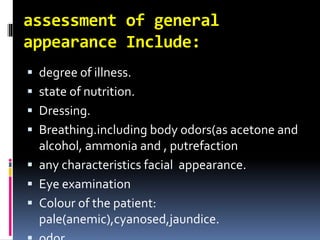
 assessment of general appearance.
 measurement of vital signs.
 examination of the head and neck.
assessment of general
appearance Include:
 degree of illness.
 state of nutrition.
 Dressing.
 Breathing.including body odors(as acetone and
alcohol, ammonia and , putrefaction
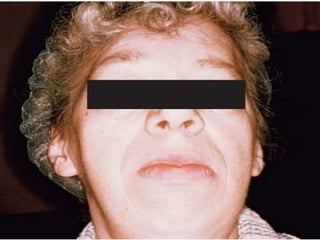
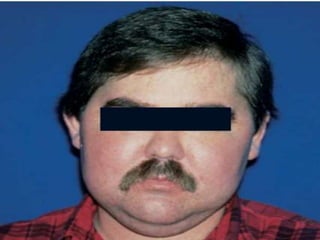
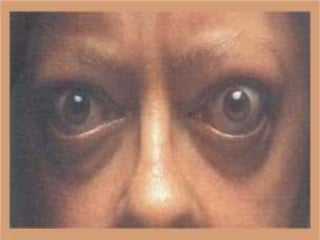
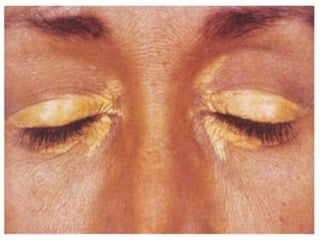
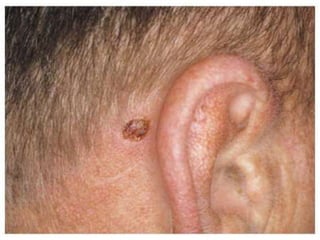
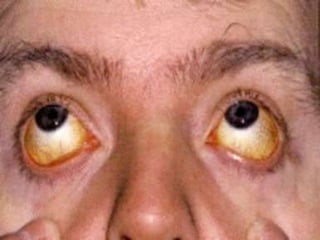
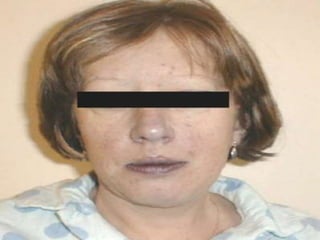
 any characteristics facial appearance.
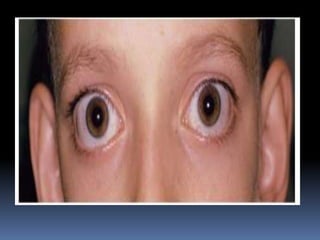
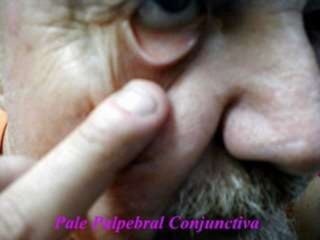
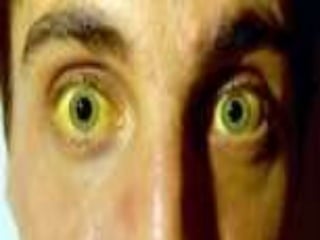
 Eye examination
 Colour of the patient:
pale(anemic),cyanosed,jaundice.
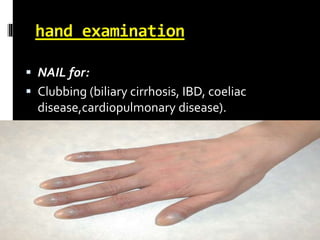
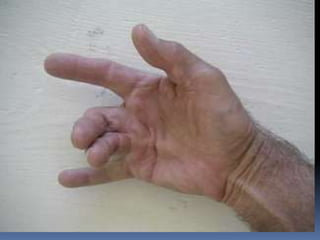
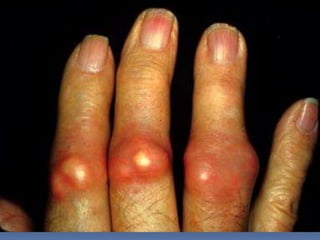
hand examination
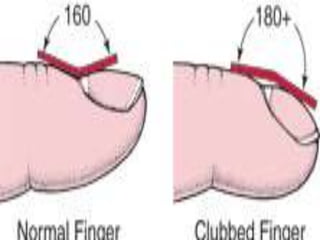
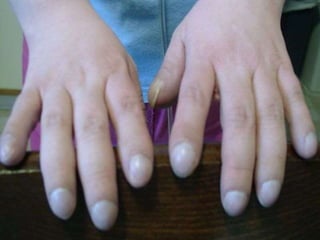
 NAIL for:
 Clubbing (biliary cirrhosis, IBD, coeliac
disease,cardiopulmonary disease).
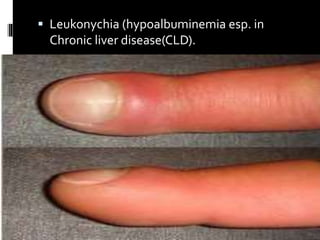
 Leukonychia (hypoalbuminemia esp. in
Chronic liver disease(CLD).
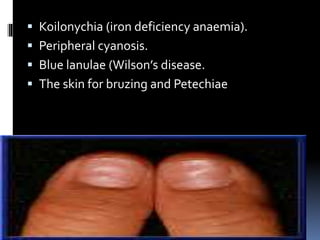
 Koilonychia (iron deficiency anaemia).
 Peripheral cyanosis.
 Blue lanulae (Wilson’s disease.
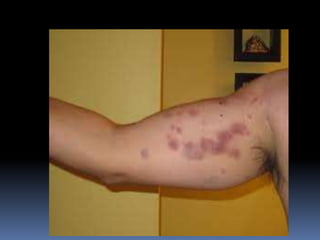
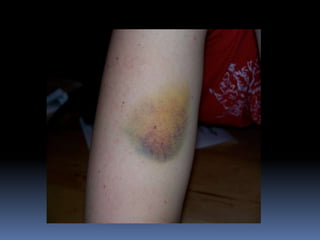
 The skin for bruzing and Petechiae
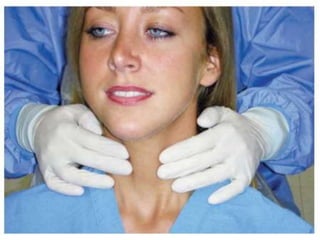
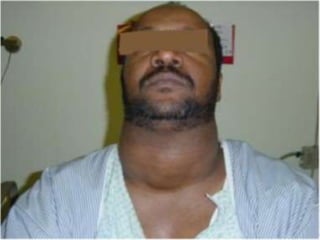
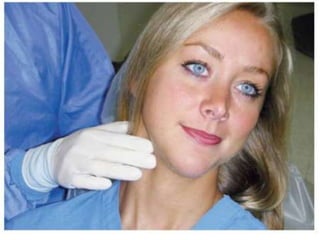
Neck examination
 Thyroid gland.
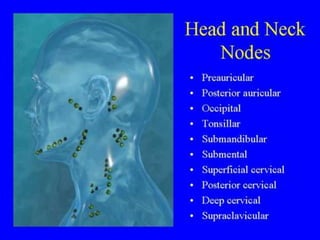
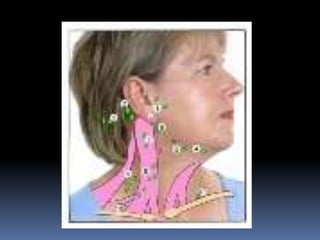
 Lymph node.
Neck examination
 The neck should be inspected for
enlargement and asymmetry .
 then palpation of enlarged thyroid gland (
goiter) .
 palpate for enlarged lymph nodes.

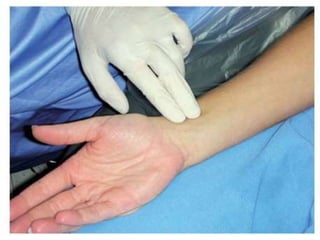
Examine the vital signs
 RADIAL PULSE.
 BLOOD PRESSURE.
 TEMPERATURE.
 RESPIRATORY RATE.
The benefits of vital sign
measurement:
 the establishment of baseline normal values .
 screening to identify abnormalities, either
diagnosed or undiagnosed.
Pulse examination.
Pulse exam.
 Rate. (60 – 100 bpm)
 Tachycardia > 100 bpm.causes.
 Bradycardia > bpm.(vasovagal attack).causes.
Rhythm.
Regular .
Irregular .
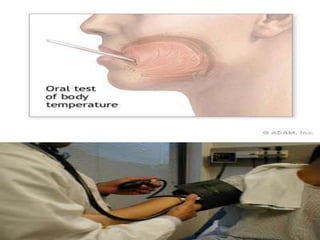
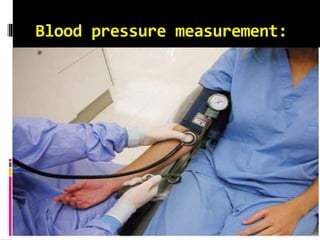
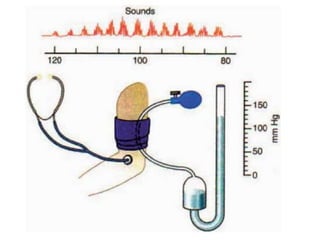
Blood pressure measurement:
 Auscultation method.
 cuff width for an average adult arm is 12 to 14 cm.
 Patient position.
 Site of cuff and stethoscope.
 Tachnique.
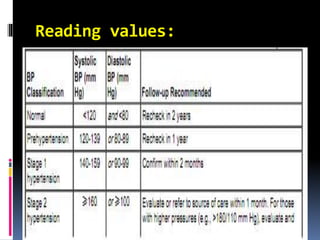
Reading values:
Breathing rate 14 – 18 :
CLINICAL LABORATORY TESTS
 Aiding in the detection of suspected disease
(HF,DM.CRF).
 Screening high-risk patients for undetected
disease .(DM).
 Establishing normal baseline values before
treatment (coagulation screen).
Medical consultation
 PHYSICIAN REFERRALAND CONSULTATION
Requests for information should be made in
writing by letter.
RISK ASSESSMENT
 the data must be assessed to determine
whether the patient can safely undergo
dental treatment and what, if any,
modifications in the delivery of dental care
are required.
American Society of Anesthesiologists
(ASA) Physical Classification System.
 ASA I Normal healthy patient.
 ASA II Patient with mild systemic disease that
does not interfere with daily activity, or patient
with a significant health risk factor (e.g.,
smoking, alcohol abuse, gross obesity).
 ASA III Patient with moderate to severe systemic
disease that is not incapacitating but that may
alter daily activity.
ASA IV Patient with severe systemic disease that is
incapacitating and is a constant threat to life .
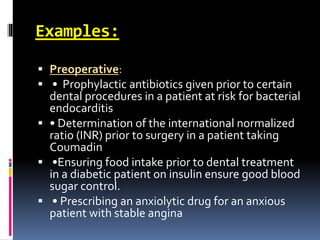
Examples:
 Preoperative:
 • Prophylactic antibiotics given prior to certain
dental procedures in a patient at risk for bacterial
endocarditis
 • Determination of the international normalized
ratio (INR) prior to surgery in a patient taking
Coumadin
 •Ensuring food intake prior to dental treatment
in a diabetic patient on insulin ensure good blood
sugar control.
 • Prescribing an anxiolytic drug for an anxious
patient with stable angina
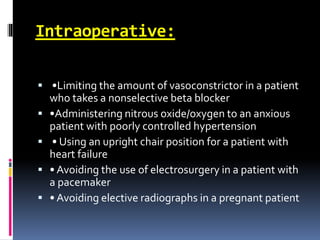
Intraoperative:
 •Limiting the amount of vasoconstrictor in a patient
who takes a nonselective beta blocker
 •Administering nitrous oxide/oxygen to an anxious
patient with poorly controlled hypertension
 • Using an upright chair position for a patient with
heart failure
 • Avoiding the use of electrosurgery in a patient with
a pacemaker
 • Avoiding elective radiographs in a pregnant patient
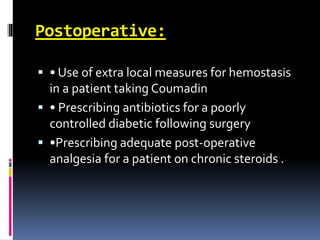
Postoperative:
 • Use of extra local measures for hemostasis
in a patient taking Coumadin
 • Prescribing antibiotics for a poorly
controlled diabetic following surgery
 •Prescribing adequate post-operative
analgesia for a patient on chronic steroids .
the goal is to reduce the
risk of complication as much
as possible by simple
modifications in the
delivery of dental treatment
The end of lecture

Clinical examination.ppt

  • 1.
  • 2.
    introduction  Difference inprocedure and technique.  Type of patient .(old age , chronic illness).  Dentist responsibility.(Example patient with heart failure).  The key to successful dental management of a medically compromised patient is a thorough evaluation and assessment of risk to determine whether a patient can safely tolerate a planned procedure.
  • 3.
    Risk assessment involves evaluation of the nature, severity, and stability of the patient's medical condition.  the functional capacity of the patient.  the emotional status of the patient.  the type of the planned procedure (invasive or noninvasive).
  • 4.
    The risk assessmentachieved by  medical history.  physical examination.  laboratory tests.  medical consultation.
  • 5.
     Symptom: refersto what the patient feels. Which are described by the patient to clarify the nature of the illness.( Shortness of breath, chest pain, nausea, diarrhea). Sign : refers to that which the examiner finds during physical examination. Like anemia,jaundice cyanosis all are signs observed by the doctors
  • 6.
    Medical history  Historymean the interview.  looking for symptoms.
  • 7.
    General roles  thedoctor must establish a good relationship with the patients.  The doctor has to respect all patients regardless of their age, gender, beliefs, economic state, intelligence, educational background, culture or legal status.
  • 8.
    Medical history  Itmust be taken on every patient who is to receive dental treatment.  There two basic techniques used to obtain a medical history.
  • 9.
     1) theinterview in which the interviewer questions the patient and then records the patient's answers on sheet.  2) printed questionnaire that the patient fills out.
  • 10.
    History  Introductory information(name ,age occupation residency … ).  Chief complaint.duration  History of present illness.  systemic Review .  Past medical & surgical history.  Family history.  Current treatment and drug history.  social and personal history.
  • 11.
    1)Introductory questions:  age. Occupation.  Residency.  marital status .
  • 12.
    Chief Complain andduration  it is a problem or set of problem that make the patient to consult a doctor.  This is to find out the patient's major complaint or complaints .  The questions should be general and easily understood('What has been the trouble or problem recently).("Chest pain for the past 5 hours).
  • 13.
    History of presentillness  This mean the scientific and logical expansion and detailed of the chief complaint.  Direct Questions it is commonly used in history of present illness. For example "Where does it hurt?" "When do you get the burning?."
  • 14.
     a numberof facts have to be uncovered about each symptom(chief complaint).These include  time of onset and duration,  mode of onset.  site .  radiation (especially of pain).  character, severity, aggravating or relieving factors.  associated symptoms
  • 15.
    Systemic Review : Cardiovascular system:  History of :  congenital heart disease (CHD).  rheumatic fever.  valvular heart disease. Artificial valve  Hypertension.  angina.(acute myocardial infarction (AMI). bypass operation.  heart failure.  Arrhythmia.
  • 16.
    Make sure isthe disease control or not  Chest pain  SOB.(shortness of breath).  Praxysmal nocturnal dyspnea.  Orthopnea.  Palpitation.  leg edema.  Fatique.
  • 17.
    Respiratory systems  Emphysema. Chronic Bronchitis.  Bronchial asthma.  Tuberculosis.  History of allergy.
  • 18.
    Ask the patientabout:  Are you ever short of breath?  Have you had any cough?  Have you coughed up blood?  Do you ever have wheezing when you are short of breath?  Why ???
  • 19.
    Hematological system  Historyof Hemophilia or Inherited Bleeding Disorder or von Willebrand's disease,  They are at risk for severe bleeding following any type of dental treatment that causes bleeding, including scaling and root planing.  BloodTransfusion.  Anemia.  Leukemia.  Taking a “BloodThinner.
  • 20.
    Neurologic Disorders  Askabout:  Stroke.  Epilepsy, Seizures, and Convulsions.  Specific triggers of seizures (e.g., odors, bright lights) should be identified and avoided.
  • 21.
    Gastrointestinal systems  Checkfor Gastrointestinal Diseases (Stomach or Intestinal Ulcers, Gastritis, and Colitis. ).  History of jaundice,liver disease like cirrhosis
  • 22.
    Endocrine Disease  Diabetes:Symptomssuggestive of diabetes include excessive thirst and hunger, frequent urination, weight loss, and frequent infections.  Genitourinary system Kidney Failure.  Operations or Hospitalizations
  • 23.
    History of previous operation&hospitalization the reason for the procedure and any associated complications with it such as anesthetic emergencies, unusual postoperative bleeding, infection, and drug allergy should be addressed.
  • 24.
    Drug history:  Corticosteroid. Blood thinner drug  Drug allergy.
  • 25.
    7)Family history  Medicalproblems in family, including the patient's disorder. Asthma, coronary artery disease, heart failure, cancer, tuberculosis and DM.
  • 26.
    8)The social andpersonal history.  Occupation, education  Smoking, alcohol  immunisation  Marital status  Living conditions.  Occupational history
  • 27.
    PHYSICAL EXAMINATION The purposeof the examination is detection of an abnormality and not diagnosis. If an abnormal finding is look significant, the patient should be referred to a physician for further evaluation.
  • 28.
    Physical exam.  assessmentof general appearance.  measurement of vital signs.  examination of the head and neck.
  • 29.
    assessment of general appearanceInclude:  degree of illness.  state of nutrition.  Dressing.  Breathing.including body odors(as acetone and alcohol, ammonia and , putrefaction  any characteristics facial appearance.  Eye examination  Colour of the patient: pale(anemic),cyanosed,jaundice.
  • 42.
    hand examination  NAILfor:  Clubbing (biliary cirrhosis, IBD, coeliac disease,cardiopulmonary disease).
  • 45.
     Leukonychia (hypoalbuminemiaesp. in Chronic liver disease(CLD).
  • 46.
     Koilonychia (irondeficiency anaemia).  Peripheral cyanosis.  Blue lanulae (Wilson’s disease.  The skin for bruzing and Petechiae
  • 51.
    Neck examination  Thyroidgland.  Lymph node.
  • 52.
    Neck examination  Theneck should be inspected for enlargement and asymmetry .  then palpation of enlarged thyroid gland ( goiter) .  palpate for enlarged lymph nodes.
  • 57.
    Examine the vitalsigns  RADIAL PULSE.  BLOOD PRESSURE.  TEMPERATURE.  RESPIRATORY RATE.
  • 58.
    The benefits ofvital sign measurement:  the establishment of baseline normal values .  screening to identify abnormalities, either diagnosed or undiagnosed.
  • 59.
  • 63.
    Pulse exam.  Rate.(60 – 100 bpm)  Tachycardia > 100 bpm.causes.  Bradycardia > bpm.(vasovagal attack).causes. Rhythm. Regular . Irregular .
  • 64.
  • 66.
    Blood pressure measurement: Auscultation method.  cuff width for an average adult arm is 12 to 14 cm.  Patient position.  Site of cuff and stethoscope.  Tachnique.
  • 67.
  • 68.
  • 69.
    CLINICAL LABORATORY TESTS Aiding in the detection of suspected disease (HF,DM.CRF).  Screening high-risk patients for undetected disease .(DM).  Establishing normal baseline values before treatment (coagulation screen).
  • 70.
    Medical consultation  PHYSICIANREFERRALAND CONSULTATION Requests for information should be made in writing by letter.
  • 71.
    RISK ASSESSMENT  thedata must be assessed to determine whether the patient can safely undergo dental treatment and what, if any, modifications in the delivery of dental care are required.
  • 72.
    American Society ofAnesthesiologists (ASA) Physical Classification System.  ASA I Normal healthy patient.  ASA II Patient with mild systemic disease that does not interfere with daily activity, or patient with a significant health risk factor (e.g., smoking, alcohol abuse, gross obesity).  ASA III Patient with moderate to severe systemic disease that is not incapacitating but that may alter daily activity. ASA IV Patient with severe systemic disease that is incapacitating and is a constant threat to life .
  • 73.
    Examples:  Preoperative:  •Prophylactic antibiotics given prior to certain dental procedures in a patient at risk for bacterial endocarditis  • Determination of the international normalized ratio (INR) prior to surgery in a patient taking Coumadin  •Ensuring food intake prior to dental treatment in a diabetic patient on insulin ensure good blood sugar control.  • Prescribing an anxiolytic drug for an anxious patient with stable angina
  • 74.
    Intraoperative:  •Limiting theamount of vasoconstrictor in a patient who takes a nonselective beta blocker  •Administering nitrous oxide/oxygen to an anxious patient with poorly controlled hypertension  • Using an upright chair position for a patient with heart failure  • Avoiding the use of electrosurgery in a patient with a pacemaker  • Avoiding elective radiographs in a pregnant patient
  • 75.
    Postoperative:  • Useof extra local measures for hemostasis in a patient taking Coumadin  • Prescribing antibiotics for a poorly controlled diabetic following surgery  •Prescribing adequate post-operative analgesia for a patient on chronic steroids .
  • 76.
    the goal isto reduce the risk of complication as much as possible by simple modifications in the delivery of dental treatment
  • 77.
    The end oflecture