“It is change, continuing change, inevitable change, that is the dominant factor in society today. No sensible decision can be made any longer without taking into account not only the world as it is, but the world as it will be....”  Isaac AsimovSeth KaplanVice President for Policy and Climate Advocacy Conservation Law FoundationPower Options Annual MeetingJune 8, 20111
Context and key facts2Global Warming is a fundamental threat – and MA is taking action (as we should)Our aging nuke fleet is going away, only question is how quickly.  No one is building any new nukes, especially in New England – cost is top reason, of manyNatural Gas is, and will be for quite a while, the dominant and price setting fuelRise of Demand Resources (Efficiency and Demand Response) and Distributed Gen (esp. CHP) offers customers unprecedented opportunities to be masters of own fateNew markets (energy sales by efficiency, “frequency regulation” continue to appear Wind offers price stability – as with any hedge key question is whether you are willing to pay the risk premium, it is above market now . . . but . . . Pulverized Coal (the kind of coal plants we have) is doomed – twin pincers of environmental mandate and current gas prices are converging
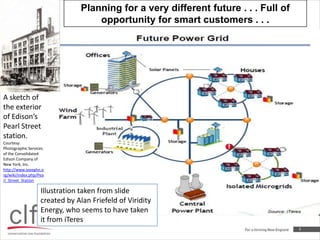
Planning for a very different future . . . Full of opportunity for smart customers . . .3A sketch of the exterior of Edison’s Pearl Street station. Courtesy: Photographic Services of the Consolidated Edison Company of New York, Inc.http://www.ieeeghn.org/wiki/index.php/Pearl_Street_StationIllustration taken from slide created by Alan Friefeld of Viridity Energy, who seems to have taken it from iTeres
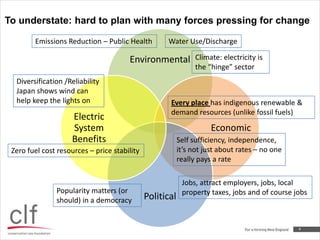
To understate: hard to plan withmany forces pressing for change4Emissions Reduction – Public HealthWater Use/DischargeClimate: electricity is the “hinge” sectorDiversification /ReliabilityJapan shows wind can help keep the lights onEvery place has indigenous renewable & demand resources (unlike fossil fuels)Self sufficiency, independence, it’s not just about rates – no one really pays a rateZero fuel cost resources – price stabilityJobs, attract employers, jobs, local property taxes, jobs and of course jobsPopularity matters (or should) in a democracy
A Few Unexpected Realities and lessons to be learned5EPA regulations of power plants is good for our economy (and AIM agrees)Coal fired generation has been poisoning and killing people with impunity or cost for generations, ending that implicit subsidy will raise price of power elsewhere – leveling the economic playing field is good for economy of places like Mass and New England Increased presence of federally regulated entities in retail market can help customersRegional markets and system planning  and reliability processes (“Non-Transmission  Alternatives”)  in some cases have and in other cases offer new revenue streams for energy resources that  are sited in customer facilities (like energy efficiency and demand response) that directly and tangibly benefits those customers – this is very different from past conventional wisdom of wanting decisions and control to rest more in state handsThe only totally untenable course is inaction – the choice is whether to be a diner or whether to be the entrée

Clf power options annual mtg june 2011

  • 1.
    “It is change,continuing change, inevitable change, that is the dominant factor in society today. No sensible decision can be made any longer without taking into account not only the world as it is, but the world as it will be....” Isaac AsimovSeth KaplanVice President for Policy and Climate Advocacy Conservation Law FoundationPower Options Annual MeetingJune 8, 20111
  • 2.
    Context and keyfacts2Global Warming is a fundamental threat – and MA is taking action (as we should)Our aging nuke fleet is going away, only question is how quickly. No one is building any new nukes, especially in New England – cost is top reason, of manyNatural Gas is, and will be for quite a while, the dominant and price setting fuelRise of Demand Resources (Efficiency and Demand Response) and Distributed Gen (esp. CHP) offers customers unprecedented opportunities to be masters of own fateNew markets (energy sales by efficiency, “frequency regulation” continue to appear Wind offers price stability – as with any hedge key question is whether you are willing to pay the risk premium, it is above market now . . . but . . . Pulverized Coal (the kind of coal plants we have) is doomed – twin pincers of environmental mandate and current gas prices are converging
  • 3.
    Planning for avery different future . . . Full of opportunity for smart customers . . .3A sketch of the exterior of Edison’s Pearl Street station. Courtesy: Photographic Services of the Consolidated Edison Company of New York, Inc.http://www.ieeeghn.org/wiki/index.php/Pearl_Street_StationIllustration taken from slide created by Alan Friefeld of Viridity Energy, who seems to have taken it from iTeres
  • 4.
    To understate: hardto plan withmany forces pressing for change4Emissions Reduction – Public HealthWater Use/DischargeClimate: electricity is the “hinge” sectorDiversification /ReliabilityJapan shows wind can help keep the lights onEvery place has indigenous renewable & demand resources (unlike fossil fuels)Self sufficiency, independence, it’s not just about rates – no one really pays a rateZero fuel cost resources – price stabilityJobs, attract employers, jobs, local property taxes, jobs and of course jobsPopularity matters (or should) in a democracy
  • 5.
    A Few UnexpectedRealities and lessons to be learned5EPA regulations of power plants is good for our economy (and AIM agrees)Coal fired generation has been poisoning and killing people with impunity or cost for generations, ending that implicit subsidy will raise price of power elsewhere – leveling the economic playing field is good for economy of places like Mass and New England Increased presence of federally regulated entities in retail market can help customersRegional markets and system planning and reliability processes (“Non-Transmission Alternatives”) in some cases have and in other cases offer new revenue streams for energy resources that are sited in customer facilities (like energy efficiency and demand response) that directly and tangibly benefits those customers – this is very different from past conventional wisdom of wanting decisions and control to rest more in state handsThe only totally untenable course is inaction – the choice is whether to be a diner or whether to be the entrée