FLASCO Spring Session
April 1, 2017
Orlando, FL
Anti-HER2 Therapies in Breast Cancer: Adjuvant and Neoadjuvant.
Michel Velez, MD
No relevant financial relationships in the past twelve months by presenter or spouse/partner
The speaker will directly disclosure the use of products for which are not labeled (e.g.,
off label use) or if the product is still investigational.
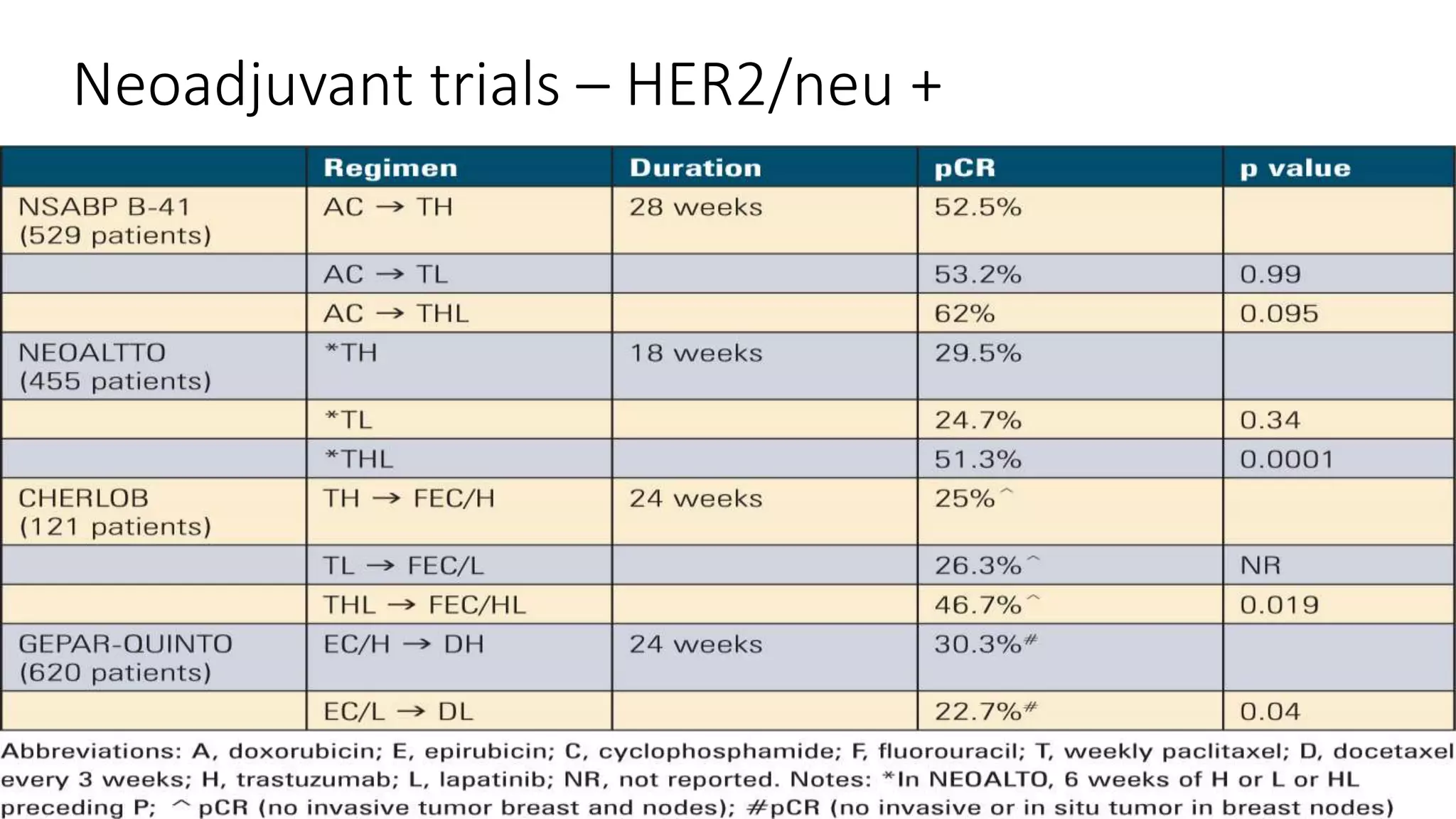
Neoadjuvant trials – HER2/neu +
T-DM1 and Pertuzumab Mechanisms of Action
Study Schema
TH q 3w x 4
(n = 107)
Surgery
THP q 3w x 4
(n = 107)
HP q 3w x 4
(n = 107)
TP q 3w x 4
(n = 96)
H q 3w x 13
+
FEC q 3w x 3
H q 3w x 13
+
FEC q 3w x 3
H q 3w x 17
+
FEC q 3w x 3
H q 3w x 13
+
T q3w x 4
FEC q 3w x 3
T = Docetaxel, H = Trastuzumab, P = Pertuzumab
F = 5-fluorouracil, E = Epirubicin, C = Cyclophosphamide
SurgerySurgerySurgery
R
Gianni L et al. Proc SABCS 2010;Abstract S3-2.
Efficacy Results by Breast
and Lymph Nodal Status
TH
(n = 107)
THP
(n = 107)
HP
(n = 107)
TP
(n = 96)
pCR in breast 29.0% 45.8% 16.8% 24.0%
pCR in breast and node negative
at surgery
21.5% 39.3% 11.2% 17.7%
pCR in breast and node positive at
surgery
7.5% 6.5% 5.6% 6.3%
The differences between the THP arm and other arms for pCR were
statistically significant, with all the p-values being <0.05.
Gianni L et al. Proc SABCS 2010;Abstract S3-2.
Efficacy Results by ER/PR Status
TH THP HP TP
pCR (ER- or PR-positive) 22.0% 26.0% 5.9% 17.4%
pCR (ER- and PR-negative) 36.8% 63.2% 29.1% 30.0%
Gianni L et al. Proc SABCS 2010;Abstract S3-2.
Safety Results
Gianni L et al. Proc SABCS 2010;Abstract S3-2.
TH
(n = 107)
THP
(n = 107)
HP
(n = 108)
TP
(n = 94)
Grade 3-4 neutropenia 57.0% 44.9% 0.9% 55.3%
Febrile neutropenia 7.5% 8.4% 0.0% 7.4%
Grade 3-4 diarrhea 3.7% 5.6% 0.0% 4.3%
Grade 3-4 rash 1.9% 1.9% 0.0% 1.1%
Grade 3-4 increased ALT 2.8% 0.0% 0.0% 1.1%
Serious adverse events 16.8% 10.3% 3.7% 17.0%
Any changes in left ventricular ejection fraction did not appear clinically meaningful and were similar among all
the four arms.
Tryphaena
ADAPT HER2+/HR-: Design
ADAPT HER2+/HR+: <br />Endpoints
ADAPT HER2+/HR-: <br />Baseline characteristics
ADAPT HER2+/HR+: pCR (no <br />invasive tumor in breast and nodes)
KRISTINE Study Design
Primary Endpoint: pCR (ypT0/is, ypN0)
pCR by Central ER/PR Receptor Status
Maintenance of HRQoL and Physical Function
I-SPY 2 TRIAL Schema:<br />Her2+ Patients
pCR Probability Distributions by Signature<br />
Slide 7
APHINITY: CT and Trastuzumab ±
Pertuzumab in HER2+ BC
Chemotherapy (6-8 cycles)*
Trastuzumab (1 yr)
Pertuzumab 840 mg in cycle 1, then
420 mg q3w
Chemotherapy (6-8 cycles)*
Trastuzumab (1 yr)
Placebo
Patients with resected HER2+
primary
breast cancer
(planned N = 4800)
10-yr follow-
up
Randomization within 7 wks of surgery
*Anthracycline or nonanthracycline. Radiotherapy and/or endocrine therapy may be started after completion of adjuvant chemotherapy.
ClinicalTrials.gov. NCT01358877.
Primary endpoint: invasive DFS
Secondary endpoints: invasive DFS, including second non-breast cancer, DFS, OS, RFI, distant RFI, safety, QoL
• Low-molecular-weight, irreversible, pan-
HER inhibitor (ErB 1,2,4
• Interferes with ligand-induced
dimerization of HER receptors
• Disrupts previously formed receptor
dimers
Mechanism of Action Of Neratinib
ExteNET : Final study design
Chan et al, SABCS 2015
3-year iDFS analysis : Centrally confirmed HER 2+ &
According to Hormone receptor status
Chan et al, SABCS 2015
CLEOPATRA: Study Design
CLinical Evaluation Of Pertuzumab And TRAstuzumab study
 Randomization stratified by geographic region and previous treatment status (neo/adjuvant chemotherapy
received or not)
 Study dosing q3w:
– Pertuzumab/placebo 840-mg loading dose, 420-mg maintenance
– Trastuzumab 8-mg/kg loading dose, 6-mg/kg maintenance
– Docetaxel 75 mg/m2, escalating to 100 mg/m2 if tolerated
Patients with
HER2-positive MBC
centrally confirmed
(n = 808)
Placebo + Trastuzumab
(n = 406)
1:1
(n = 402)
Docetaxel*
≥6 cycles recommended
PD
Pertuzumab + Trastuzumab
Docetaxel*
≥6 cycles recommended
PD
*<6 cycles allowed for unacceptable toxicity or PD; >6 cycles allowed at
investigator discretion.
Baselga J, et al. N Engl J Med. 2012;366:109-119
Cleopatra OS
Swain , SM et al. ESMO 2014
Cleopatra PFS
Select Adverse Events (Grade ≥ 3), % Pertuzumab
(n = 407)
Placebo
(n = 397)
Neutropenia 48.9 45.8
Febrile neutropenia 13.8 7.6
Leukopenia 12.3 14.6
Diarrhea 7.9 5.0
Peripheral neuropathy 2.7 1.8
Left ventricular systolic dysfunction 1.2 2.8
Baselga J, et al. N Engl J Med. 2012;366:109-119.
Trastuzumab and Docetaxel ± Pertuzumab in HER2+ MBC
(CLEOPATRA): Safety
Conclusions
• Neoadjuvant systemic therapy in Her2neu positive Breast Cancer is a safe
and effective strategy with various regimens available including dual
Her2neu blockade
• PCR improves outcomes especially in adverse breast cancer histology such
as Her2neu positive disease
• TDM-1 with Pertuzumab is not indicated for the treatment of Her2neu
positive breast cancer in the neoadjuvant setting but provides an attractive
strategy where tolerance may be an issue
• New therapies continue to emerge in an aim to continue to improve
outcomes in patients with high risk Her2nue positive breast cancer
(Residual disease after neoadjuvant therapy)
• First line treatment of Her2neu positive must include
Trastuzumab/Pertuzumab/Taxane combination unless tolerance is an issue.
• Trastuzumab and Pertuzumab can be safely continued until PD

Anti-HER2 Therapies in Breast Cancer

  • 1.
    FLASCO Spring Session April1, 2017 Orlando, FL Anti-HER2 Therapies in Breast Cancer: Adjuvant and Neoadjuvant. Michel Velez, MD No relevant financial relationships in the past twelve months by presenter or spouse/partner The speaker will directly disclosure the use of products for which are not labeled (e.g., off label use) or if the product is still investigational.
  • 2.
  • 3.
    T-DM1 and PertuzumabMechanisms of Action
  • 4.
    Study Schema TH q3w x 4 (n = 107) Surgery THP q 3w x 4 (n = 107) HP q 3w x 4 (n = 107) TP q 3w x 4 (n = 96) H q 3w x 13 + FEC q 3w x 3 H q 3w x 13 + FEC q 3w x 3 H q 3w x 17 + FEC q 3w x 3 H q 3w x 13 + T q3w x 4 FEC q 3w x 3 T = Docetaxel, H = Trastuzumab, P = Pertuzumab F = 5-fluorouracil, E = Epirubicin, C = Cyclophosphamide SurgerySurgerySurgery R Gianni L et al. Proc SABCS 2010;Abstract S3-2.
  • 5.
    Efficacy Results byBreast and Lymph Nodal Status TH (n = 107) THP (n = 107) HP (n = 107) TP (n = 96) pCR in breast 29.0% 45.8% 16.8% 24.0% pCR in breast and node negative at surgery 21.5% 39.3% 11.2% 17.7% pCR in breast and node positive at surgery 7.5% 6.5% 5.6% 6.3% The differences between the THP arm and other arms for pCR were statistically significant, with all the p-values being <0.05. Gianni L et al. Proc SABCS 2010;Abstract S3-2.
  • 6.
    Efficacy Results byER/PR Status TH THP HP TP pCR (ER- or PR-positive) 22.0% 26.0% 5.9% 17.4% pCR (ER- and PR-negative) 36.8% 63.2% 29.1% 30.0% Gianni L et al. Proc SABCS 2010;Abstract S3-2.
  • 7.
    Safety Results Gianni Let al. Proc SABCS 2010;Abstract S3-2. TH (n = 107) THP (n = 107) HP (n = 108) TP (n = 94) Grade 3-4 neutropenia 57.0% 44.9% 0.9% 55.3% Febrile neutropenia 7.5% 8.4% 0.0% 7.4% Grade 3-4 diarrhea 3.7% 5.6% 0.0% 4.3% Grade 3-4 rash 1.9% 1.9% 0.0% 1.1% Grade 3-4 increased ALT 2.8% 0.0% 0.0% 1.1% Serious adverse events 16.8% 10.3% 3.7% 17.0% Any changes in left ventricular ejection fraction did not appear clinically meaningful and were similar among all the four arms.
  • 10.
  • 11.
  • 12.
  • 13.
    ADAPT HER2+/HR-: <br/>Baseline characteristics
  • 14.
    ADAPT HER2+/HR+: pCR(no <br />invasive tumor in breast and nodes)
  • 15.
  • 16.
    Primary Endpoint: pCR(ypT0/is, ypN0)
  • 17.
    pCR by CentralER/PR Receptor Status
  • 18.
    Maintenance of HRQoLand Physical Function
  • 19.
    I-SPY 2 TRIALSchema:<br />Her2+ Patients
  • 20.
  • 21.
  • 24.
    APHINITY: CT andTrastuzumab ± Pertuzumab in HER2+ BC Chemotherapy (6-8 cycles)* Trastuzumab (1 yr) Pertuzumab 840 mg in cycle 1, then 420 mg q3w Chemotherapy (6-8 cycles)* Trastuzumab (1 yr) Placebo Patients with resected HER2+ primary breast cancer (planned N = 4800) 10-yr follow- up Randomization within 7 wks of surgery *Anthracycline or nonanthracycline. Radiotherapy and/or endocrine therapy may be started after completion of adjuvant chemotherapy. ClinicalTrials.gov. NCT01358877. Primary endpoint: invasive DFS Secondary endpoints: invasive DFS, including second non-breast cancer, DFS, OS, RFI, distant RFI, safety, QoL
  • 25.
    • Low-molecular-weight, irreversible,pan- HER inhibitor (ErB 1,2,4 • Interferes with ligand-induced dimerization of HER receptors • Disrupts previously formed receptor dimers Mechanism of Action Of Neratinib
  • 26.
    ExteNET : Finalstudy design Chan et al, SABCS 2015
  • 27.
    3-year iDFS analysis: Centrally confirmed HER 2+ & According to Hormone receptor status Chan et al, SABCS 2015
  • 28.
    CLEOPATRA: Study Design CLinicalEvaluation Of Pertuzumab And TRAstuzumab study  Randomization stratified by geographic region and previous treatment status (neo/adjuvant chemotherapy received or not)  Study dosing q3w: – Pertuzumab/placebo 840-mg loading dose, 420-mg maintenance – Trastuzumab 8-mg/kg loading dose, 6-mg/kg maintenance – Docetaxel 75 mg/m2, escalating to 100 mg/m2 if tolerated Patients with HER2-positive MBC centrally confirmed (n = 808) Placebo + Trastuzumab (n = 406) 1:1 (n = 402) Docetaxel* ≥6 cycles recommended PD Pertuzumab + Trastuzumab Docetaxel* ≥6 cycles recommended PD *<6 cycles allowed for unacceptable toxicity or PD; >6 cycles allowed at investigator discretion. Baselga J, et al. N Engl J Med. 2012;366:109-119
  • 29.
    Cleopatra OS Swain ,SM et al. ESMO 2014
  • 30.
  • 31.
    Select Adverse Events(Grade ≥ 3), % Pertuzumab (n = 407) Placebo (n = 397) Neutropenia 48.9 45.8 Febrile neutropenia 13.8 7.6 Leukopenia 12.3 14.6 Diarrhea 7.9 5.0 Peripheral neuropathy 2.7 1.8 Left ventricular systolic dysfunction 1.2 2.8 Baselga J, et al. N Engl J Med. 2012;366:109-119. Trastuzumab and Docetaxel ± Pertuzumab in HER2+ MBC (CLEOPATRA): Safety
  • 32.
    Conclusions • Neoadjuvant systemictherapy in Her2neu positive Breast Cancer is a safe and effective strategy with various regimens available including dual Her2neu blockade • PCR improves outcomes especially in adverse breast cancer histology such as Her2neu positive disease • TDM-1 with Pertuzumab is not indicated for the treatment of Her2neu positive breast cancer in the neoadjuvant setting but provides an attractive strategy where tolerance may be an issue • New therapies continue to emerge in an aim to continue to improve outcomes in patients with high risk Her2nue positive breast cancer (Residual disease after neoadjuvant therapy) • First line treatment of Her2neu positive must include Trastuzumab/Pertuzumab/Taxane combination unless tolerance is an issue. • Trastuzumab and Pertuzumab can be safely continued until PD