Clean Electricity From Photovoltaics Series On
Photoconversion Of Solar Energy Volume 4 1st
Edition Mary D Archer download
https://ebookbell.com/product/clean-electricity-from-
photovoltaics-series-on-photoconversion-of-solar-energy-
volume-4-1st-edition-mary-d-archer-2436822
Explore and download more ebooks at ebookbell.com
Here are some recommended products that we believe you will be
interested in. You can click the link to download.
Clean Electricity From Photovoltaics 2nd Edition 2nd Edition Mary D
Archer
https://ebookbell.com/product/clean-electricity-from-
photovoltaics-2nd-edition-2nd-edition-mary-d-archer-4937956
Clean Electricity From Photovoltaics Volume 4 2015th Edition Mary D
Archer
https://ebookbell.com/product/clean-electricity-from-photovoltaics-
volume-4-2015th-edition-mary-d-archer-59070314
Clean Electricity Through Advanced Coal Technologies Nicholas P
Cheremisinoff
https://ebookbell.com/product/clean-electricity-through-advanced-coal-
technologies-nicholas-p-cheremisinoff-4411562
Free Energy Secrets Of Cole Electricity Peter Lindemann
https://ebookbell.com/product/free-energy-secrets-of-cole-electricity-
peter-lindemann-1318772
Clean Energy Investments For Zero Emission Projects An Analysis On How
To Reduce The Carbon Footprint Hasan Diner
https://ebookbell.com/product/clean-energy-investments-for-zero-
emission-projects-an-analysis-on-how-to-reduce-the-carbon-footprint-
hasan-diner-45334218
Clean Getaway Squeaky Clean Mysteries Book 13 Christy Barritt
https://ebookbell.com/product/clean-getaway-squeaky-clean-mysteries-
book-13-christy-barritt-46252150
Crock Pot 2000 Crock Pot Recipes Cookbook Clean Eating
https://ebookbell.com/product/crock-pot-2000-crock-pot-recipes-
cookbook-clean-eating-46472632
Clean Paleo Onepot Meals 100 Delicious Recipes From Pan To Plate In 30
Minutes Or Less Christina Shoemaker
https://ebookbell.com/product/clean-paleo-onepot-meals-100-delicious-
recipes-from-pan-to-plate-in-30-minutes-or-less-christina-
shoemaker-47098770
Clean Eating Weeknight Dinner Plan Quick Healthy Meals For Any
Schedule Michelle Anderson
https://ebookbell.com/product/clean-eating-weeknight-dinner-plan-
quick-healthy-meals-for-any-schedule-michelle-anderson-47436308
Series on Photoconversion of Solar Energy — Vol. 1
CLEAN ELECTRICITY
FROM PHOTOVOLTAICS
/ /
Imperial College Press
CLEAN ELECTRICITY
FROM PHOTOVOLTAICS
Series on Photoconversion of Solar Energy — Vol, 1
CLEAN ELECTRICITY
FROM PHOTOVOLTAICS
Editors
Mary D. Archer
Imperial College, UK
Robert Hill
University of Northumbria, UK
Imperial College Press
Published by
Imperial College Press
57 Shelton Street
Covent Garden
London WC2H 9HE
Distributed by
World Scientific Publishing Co. Pte. Ltd.
P O Box 128, Farrer Road, Singapore 912805
USA office: Suite IB, 1060 Main Street, River Edge, NJ 07661
UK office: 57 Shelton Street, Covent Garden, London WC2H 9HE
British Library Cataloguing-in-Publication Data
A catalogue record for this book is available from the British Library.
Index prepared by Indexing Specialists, Hove, BN3 2DJ, UK
CLEAN ELECTRICITY FROM PHOTOVOLTAICS
Series on Photoconversion of Solar Energy — Vol. 1
Copyright © 2001 by Imperial College Press
All rights reserved. This book, or parts thereof, may not be reproduced in anyform or by any means,
electronic or mechanical, includingphotocopying, recording or any information storage and retrieval
system now known or to be invented, without written permission from the Publisher.
For photocopying of material in this volume, please pay a copying fee through the Copyright
Clearance Center, Inc., 222 Rosewood Drive, Danvers, MA 01923, USA. In this case permission to
photocopy is not required from the publisher.
ISBN 1-86094-161-3
Printed in Singapore.
This volume is dedicated
with the affection and respect of its authors
Robert Hill
24 June 1937 — 26 November 1999
CONTENTS
About the authors xm
Preface xxiii
1 The past and present 1
M. D. Archer
1.1 Milestones in photovoltaic technology 4
1.2 Evolution of the PV market 11
1.3 Overview of photovoltaic cell operation 14
1.4 Other junction types 24
1.5 Sources of further information 28
2 Device physics of silicon solar cells 33
J. O. Schumacher and W. Wettling
2.1 Introduction 33
2.2 Semiconductor device equations 35
2.3 Thep-n junction model of Shockley 37
2.4 Real diode characteristics 55
2.5 Numerical solar cell modelling 67
2.6 Concluding remarks 86
3 Principles of cell design 91
J. Poortmans, J. Nijs and R. Mertens
3.1 Introduction 91
3.2 Main cell types 93
3.3 Optical design of cells 99
3.4 Surface recombination losses and their reduction 108
3.5 Bulk recombination losses and their reduction 121
3.6 Design and fabrication of the metal contacts 133
3.7 Conclusions 140
4 Crystalline silicon solar cells 149
M. A. Green
4.1 Overview 149
4.2 Silicon cell development 151
Vll
viii Contents
4.3 Substrate production 164
4.4 Cell processing 173
4.5 Cell costs 178
4.6 Opportunities for improvement 180
4.7 Silicon-supported thin films 185
4.8 Summary 189
5 Amorphous silicon solar cells 199
C. R. Wronski and D. E. Carlson
5.1 Introduction 199
5.2 Background 201
5.3 Amorphous silicon-based materials 202
5.4 Growth and microstructure 209
5.5 Solar cells 211
5.6 Solar cell structures 221
5.7 PV modules 225
5.8 Manufacturing costs 231
5.9 Long-term reliability 232
5.10 Environmental issues 235
5.11 Challenges for the future 236
6 Cadmium telluride solar cells 245
D. Bonnet
6.1 Introduction 245
6.2 Early work 246
6.3 The potential of the base material 246
6.4 Diodes and cells 249
6.5 Cell production 251
6.6 Module production 262
6.7 Industrial status—achievements and projections 264
6.8 Economic aspects 267
6.9 Health and environmental aspects 268
6.10 Conclusions 269
7 Cu(In,Ga)Se2 solar cells 277
U.RauandH. W. Schock
7.1 Introduction 277
IX
7.2 Material properties 279
7.3 Cell and module technology 286
7.4 Device physics 306
7.5 Wide-gap chalcopyrites 325
7.6 Conclusions 332
8 Super-high efficiency III-V tandem and multijunction cells 347
M Yamaguchi
8.1 Introduction 347
8.2 Principles of super-high efficiency multijunction solar cells 349
8.3 Candidate materials for multijunction cells and their present status 355
8.4 Epitaxial technologies for growing III-V compound cells 363
8.5 Monolithic vs. multi-terminal connection modes 364
8.6 Cell interconnection 365
8.7 Possible applications of multijunction cells 368
8.8 Predictions 369
9 Organic photovoltaic devices 377
J. J. M. Halls andR. H. Friend
9.1 Introduction 377
9.2 Background—early work on photoresponsive organic 383
semiconductors
9.3 Conjugated molecules: a new class of semiconductors 384
9.4 Basic organic photovoltaic cells 390
9.5 Photogeneration and charge transport in organic PV cells 398
9.6 The characteristics of organic photovoltaic cells 405
9.7 Heterojunction photovoltaic cells 413
9.8 Dispersed heterojunction photovoltaic cells 421
9.9 Diffuse interface photovoltaic cells 428
9.10 Towards future applications 429
9.11 Conclusions 432
10 Quantum well solar cells 447
J. Nelson
10.1 Introduction 447
10.2 Device design, materials and technology 448
10.3 Physics of QWs 451
X Contents
10.4 Performance characteristics of QWSCs 462
10.5 Limits to efficiency 472
10.6 Applications 474
10.7 Conclusions 476
11 Thermophotovoltaic generation of electricity 481
T. J. Coutts
11.1 Introduction 481
11.2 Radiators 487
11.3 Optical control elements 490
11.4 Device modelling 497
11.5 Potentially suitable materials 506
11.6 System modelling 512
11.7 Summary 518
12 Concentrator cells and systems 529
A. Luque
12.1 Introduction 529
12.2 Concentrator solar cells 531
12.3 Tracking concentrators 556
12.4 Performance and cost considerations 570
12.5 Conclusion: under what circumstances is concentration 574
worthwhile?
13 Cells and systems for space applications 585
C. M. Hardingham
13.1 Space systems 585
13.2 The space environment 588
13.3 History of solar arrays in space 592
13.4 Market trends and drivers in satellite power requirements 593
13.5 Satellite solar arrays 596
13.6 Space solar cell technology 599
13.7 New approaches for satellite solar arrays 604
13.8 Long-term directions 605
Contents XI
14 Storage of electrical energy 609
R. M. Dell
14.1 Introduction 609
14.2 Electricity storage options 610
14.3 Kinetic energy storage 614
14.4 Hydrogen energy storage 618
14.5 Storage batteries 633
14.6 Super- and ultra-capacitors (electrochemical capacitors) 662
14.7 Conclusions 663
15 Photovoltaic modules, systems and applications 671
N. M. Pearsall andR. Hill
15.1 Introduction 671
15.2 Photovoltaic modules 672
15.3 The photovoltaic array 683
15.4 The photovoltaic system 688
15.5 Costs of PV components and systems 704
15.6 Conclusions 710
16 The photovoltaic business: manufacturers and markets 713
B. McNelis
16.1 Introduction 713
16.2 Origins and structure of the industry 715
16.3 Growth in PV production 716
16.4 Manufacturers 718
16.5 Markets 726
16.6 Future market growth 732
16.7 International financing and new initiatives 734
16.8 Concluding remarks 736
17 The economics of photovoltaic technologies 741
D. Anderson
17.1 Introduction 741
17.2 Economics of PV applications 742
17.3 The policy framework 754
17.4 Conclusions
xii Contents
18 The outlook for PV in the 21st century 771
E. H. Lysen andB. Yordi
18.1 The changing outlook for PV 771
18.2 PV and world energy supply 773
18.3 PV can play an impressive local role 774
18.4 The ultimate PV system 779
18.5 Market development 781
18.6 Barriers to the introduction of PV 784
18.7 Costs 786
18.8 International co-operation 787
18.9 The future of PV 788
Appendices
I Fundamental Constants 791
II Useful Quantities and Conversion Factors 792
HI List of Symbols 793
IV Acronyms and Abbreviations 797
Index 799
ABOUT THE AUTHORS
Dennis Anderson is a Professorial Research Fellow and Director of the Centre for
Energy Policy and Technology in the T. H. Huxley School of Imperial College, London.
At the time of writing his chapter, he was a Fellow of the UK Economic and Social
Science Research Council (Global Environment Change Programme), undertaking
research on innovation and the environment. He has previously held posts as the Energy
and Industry Adviser of the World Bank, Chief Economist of Shell, and as an engineer
in the electricity generating industry. He has published widely on the subjects of energy,
economic growth and development.
Mary Archer read chemistry at Oxford University and received her PhD on hetero-
geneous catalysis from Imperial College, London in 1968. Her interest in solar energy
was sparked by attendance at the 1972 International Solar Energy Society in Paris,
following which she founded the UK Section of ISIS, of which she is currently President.
Her research at The Royal Institution, London (1972-1976), and Cambridge University
(1976-1986) has centred on photoelectrochemical methods of solar energy conversion.
Since leaving full-time academia in 1986, she has served on a number of energy policy-
making bodies, including the UK Department of Energy's Renewable Energy Advisory
Group (1991-92), the Department of Trade & Industry's Energy Advisory Panel
(1993-98) and the Steering Committee of the Scolar Programme for Photovoltaics in the
UK. She is a visiting professor in the Centre for Energy Policy and Technology at
Imperial College, a Fellow of the Royal Society of Chemistry, and President of the
National Energy Foundation, which promotes energy efficiency and the renewables.
Dieter Bonnet was born in Stuttgart, Germany in 1937 and obtained his PhD on photo-
electric properties of organic materials atFrankfurt University in 1963. In 1965, hejoined
Battelle Institute in Frankfurt, and in 1968 started work on thin-film solar cells based on
II-VI compounds, including CdTe. In 1970, he made the world's first CdTe/CdS thin-
film solar cell in the presently known configuration. In June 1972—over 25 years
ago—this cell had an AMO efficiency of 6%. In 1990, he resumed work on CdTe thin-
film cells, and in 1992 initiated the EUROCAD CdTe thin-film solar cell project, which
is funded by the EU's Joule programme. Ten partners, among them three industrial
companies, have since collaborated very successfully under this programme to develop
CdTe cell technology. In 1993, after Battelle Frankfurt terminated business, Dieter
Bonnet co-founded ANTEC GmbH, and he is presently leading efforts to set up a 10
MWp/year production plant using ANTEC's proprietary thin-film technology.
Xlll
XIV About the Authors
David Carlson is Chief Scientist of BP Solarex. He received his BS in physics from
Rensselaer Polytechnic Institute, New York in 1963, and his PhD in physics from
Rutgers University in 1968. After serving in the US Army for two years, hejoined RCA
Laboratories in 1970, where he invented the amorphous silicon solar cell in 1974 and
became Group Head of Photovoltaic Device Research in 1977. In 1983, he joined
Solarex Corporation (now BP Solar) as Director of Research of the Thin-Film Division,
becoming General Manager in 1987. He was promoted to Vice-President in 1988, and
to Chief Scientist in 1999. He received the Ross Coffin Purdy Award in 1975, the
Walton Clark Medal in 1986, the IEEE William R. Cherry Award in 1988, and the
ISES/University of Delaware Karl W. Boer Medal in 1995. He was co-recipient (with
Christopher Wronski) of the 1984 IEEE Morris N. Liebmann Award. He is a Fellow of
the IEEE and a member of the American Physical Society, the American Vacuum
Society, the Materials Research Society and Sigma Xi. He has published more than 110
technical papers and holds 25 US patents.
Timothy Courts was born in Newcastle upon Tyne, UK and gained his bachelor's and
doctoral degrees in 1965 and 1969. He has worked on many topics, including charge
transfer in thin copper films, discontinuous, continuous and cermet thin films, and
surface scattering in thin metal films. He has been involved in solar cell research since
about 1970. He joined the US National Renewable Energy Laboratory (NREL), where
he is now a Research Fellow, in 1984. He helped to develop ITO/InP cells for space
application, and InP/InGaAs cells with a record efficiency of 31.8%. He has had a keen
interest in thermophotovoltaics (TPV) since 1992, and initiated TPV research and
chaired four conferences on the topic at NREL. He is currently interested in CdTe cells
and novel transparent conducting oxide (TCO) electrodes. Recently, his work in TCOs
has broadened to include new materials and characterisation techniques. He was
awarded the John A. Thornton Memorial Award by the American Vacuum Society in
1999. He has published over 170 papers, written one book and edited ten others.
Ronald Dell is a chemist, educated at the University of Bristol, UK After several years
in the US working on chemisorption and catalysis and two years in the Royal Naval
Scientific Service, he joined the UK Atomic Energy Authority in 1959 and remained
there until he retired in 1994. At Harwell he spent almost 20 years working in solid-
state chemistry, especially of the actinide elements. In 1978, he switched to become
head of the Applied Electrochemistry Department with particular interests in power
sources and the use of electrochemical techniques to solve environmental problems. He
is the author of nearly 100 scientific papers and reports and co-author of the book
Batteriesfor Electric Vehicles (Research Studies Press, Baldock, Herts, UK, 1998).
About the Authors xv
Richard Friend is the Cavendish Professor of Physics at the University of Cambridge.
He has pioneered the study of organic polymers as semiconductors, and demonstrated
that these materials can be used in wide range of semiconductor devices, including
light-emitting diodes, transistors and photocells. He has been very active in the process
of technology transfer of this research to development for products. He was one of the
founders of Cambridge Display Technology (CDT), which is developing light-emitting
diodes and other optoelectronic devices based on organic semiconductors, and he
currently serves as Director and Chief Scientist of CDT.
Martin Green is a Scientia Professor at the University of New South Wales, Sydney,
the Director of the University's Photovoltaics Special Research Centre, and the
Research Director of Pacific Solar Pty. Ltd., established to commercialise the
University's silicon thin-film solar cell technology. He was born in Brisbane and
educated at the University of Queensland and then McMaster University, Canada. His
contributions to photovoltaics include the improvement of silicon solar cell performance
by over 50% in the past 15 years. Major international awards include the IEEE William
R. Cherry Award in 1990, the IEEE J. J. Ebers Award in 1995 and the 1999 Australia
Prize, shared with his colleague and former student, Stuart Wenham, for "outstanding
achievements in energy science and technology". He is a Fellow of the Australian
Academy of Science, the Australian Academy of Technological Sciences and
Engineering and the Institute of Electrical and Electronic Engineers. He is the author
of four books on solar cells, several book chapters and numerous reports and papers in
the area of semiconductor properties, microelectronics and solar cells.
Jonathan Halls was born in Lincoln in 1972. After reading physics at Cambridge
University, he began research for a PhD under the supervision of Professor Richard
Friend in the Optoelectronics Group of the Cavendish Laboratory in Cambridge. His
main field of research was that of photovoltaic cells based on conjugated polymers, and
he investigated a number of approaches to increase their efficiency. In doing so, he
pioneered a technique in which electron- and hole-accepting polymers are blended
together, yielding a high surface area of active interface at which charge separation is
efficient. This work resulted in a publication in Nature and the filing of a patent. In
1997, he began postdoctoral research in the same research group, during which time he
has worked on organic light-emitting diodes, and is currently continuing to work with
organic photovoltaic cells.
XVI About the Authors
Chris Hardingham was born in Essex in 1963. Following a physics degree at
Cambridge University, he worked at EEV (now Marconi Applied Technologies) on
semiconductor process development for GaAs and related materials. He was awarded
his PhD by Imperial College, London in 1998, for research into the use of electron beam
techniques for semiconductor materials analysis. Following responsibilities for solar cell
R&D, and solar cell engineering and project management, he moved to his present
position of solar cell product manager at Marconi Applied Technologies in 1999. His
interests include III-V materials for solar cells and other applications, and device and
subsystems engineering for use in space. He holds several patents and patent
applications in the field of III-V space solar cells, and has presented and written many
papers in the field for technical conferences and peer-reviewed journals.
Robert Hill (1937-1999) took his first degree in physics at Imperial College, London,
and a PhD in solid-state luminescence. He worked in photovoltaics from 1971,
originally on the science and technology of thin-film cells. He then widened his interests
to include the economic and environmental aspects of production and applications, PV
in developing countries and on buildings, and the policy aspects of PV dissemination.
He founded the Newcastle Photovoltaics Applications Centre in 1984, and was its
director until his retirement in 1998. In January 1999, he was appointed director of the
Renewable Energy Agency for the North East (of the UK), funded by Government
Office North East, with a remit to increase the use of renewable energy sources and
promote the development of industrial capabilities in these technologies. He was a
founder member of the British Photovoltaics Association and its chairman for the year
1999-2000.
Antonio Luque obtained his Doctor of Engineering degree from the Polytechnic
University of Madrid in 1967. In 1969, he joined the university staff and founded its
Semiconductor Laboratory. In 1979, this centre became the Institute of Solar Energy
that he leads at present. In 1981, he founded the company Isofoton to manufacture the
bifacial cells he had invented, and he chaired its board until 1990. Professor Luque has
written some 200 papers and registered some 12 patents, of which four are in
exploitation. He has obtained 12 scientific awards, among which are the Spanish
National Prize for Technology in 1989, the Becquerel Prize awarded by the European
Commission for PV in 1992 and the Rey Jaime I Prize for the protection of the
environment in 1999. He has been a member of the Spanish Academy of Engineering
since 1995, and a member of the Advisory Council for Science and Technology, which
advises the Spanish Prime Minister, since 1996.
About the Authors xvn
Erik Lysen has been managing director of the Utrecht Centre for Energy Research
since mid-1998. He received his master's degree in electrical engineering from
Eindhoven University of Technology in 1972. In the seventies, he worked on wind
power projects in developing countries, first as head of the CWD Wind Energy Group
at the University of Groningen, and later at Eindhoven University of Technology. As
senior project engineer for DHV Consultants, Amersfoort, and later as an independent
consultant, he carried out energy projects for a number of clients such as the World
Bank. From 1992 until 1998, he was Head of New Developments for the Netherlands
Agency for Energy and the Environment (Novem). He has chaired the Executive
Committee of the IEA Photovoltaic Power Systems Programme (IEA-PVPS) since
1998. He is a member of the Energy and Environment Steering Committee of the World
Bank, and the Advisory Boards of the Solar Investment Fund of Triodos Bank and the
PV Global Approval Program (PV-GAP).
Bernard McNelis is managing director of IT Power, Eversley, UK, an international
renewable energy research and consulting firm which he co-founded 20 years ago. After
research in battery electrochemistry, he joined Solar Power Corporation in 1973. He
moved on to work on solar buildings and large-scale solar thermodynamic power
generation. He is one of the longest serving members of the British renewable energy
industry, with more than 25 years experience of renewable energy
technologies—photovoltaics, solar-thermal, solar-thermodynamic, wind and biomass.
He has been an active member of the International Solar Energy Society since 1974,
serving as chairman of UK-ISES in the period 1993-1996, director of ISES 1993-99,
and Vice-President 1995-1997. He is currently chairman of the British Photovoltaic
Association (PV-UK) and of the British Standards Institution PV Committee. He is also
a member of the International Electrotechnical Commission PV Standards Committee
(TC/82) and British representative for a number of International Energy Agency (IEA)
PV activities. He led the IEA Photovoltaic Power Systems project on co-operation with
developing countries. He has published more than 100 papers and contributed to five
books on solar technology.
Robert Mertens received his PhD from the Katholieke Universiteit of Leuven, Belgium
in 1972 and was a visiting scientist at the University of Florida in 1973. On his return
to Belgium in 1974, he became a senior research associate of the National Foundation
for Scientific Research of Belgium. In 1984, he joined the Inter-University
Microelectronics Centre (IMEC) in Leuven as Vice-President, later becoming senior
Vice-President responsible for research on materials, components and packaging,
including research on micro-systems, photovoltaics and solid-state sensors. Since 1984,
XV111 About the Authors
he has also served as a professor at the University of Leuven, where he teaches courses
on electronic devices and the technology of electronic systems. In 1995, he was elected
a Fellow of the IEEE for his "contributions to heavily doped semiconductors, bipolar
transistors and silicon solar cells".
Jenny Nelson is an EPSRC Advanced Research Fellow in the Department of Physics,
Imperial College, London. She has been involved in photovoltaics research for over ten
years, focussing on the theory, characterisation and optimisation of novel multi-band-
gap and heterojunction photovoltaic devices. With Professor Keith Barnham, she was
a pioneer of the quantum well solar cell, and more recently has extended her research
to dye-sensitised photovoltaic systems. Her work has been supported by the Engineering
and Physical Sciences Research Council and the Greenpeace Environmental Trust.
Johan Nijs took his MS in electronic engineering, his PhD in applied sciences, and his
MBA from the Katholieke Universiteit of Leuven (K.U. Leuven), Belgium in 1977,
1982 and 1994 respectively. In 1977, after a trainee period of two months at Philips, he
joined the Electronics, Systems, Automation and Technology (ESAT) laboratory of K.U.
Leuven, working on the fabrication of silicon solar cells. In 1982-83, he worked on
amorphous silicon technology as a postdoctoral visiting scientist at the IBM Thomas J.
Watson Research Center, Yorktown Heights, New York. In 1984, he joined the Inter-
University Micro-Electronics Centre (IMEC) in Leuven as head of the Silicon Materials
Group, working on solar cells, bipolar transistors, low-temperature silicon epitaxy and
polysilicon thin-film transistors on glass. He is currently Director of the Photovoltaics
Department at IMEC, which undertakes long-term research on photovoltaic materials,
concepts and technologies, industrial crystalline silicon cell fabrication technologies and
photovoltaic systems integration. In 1990, he was appointed part-time assistant
professor at K.U. Leuven. He has authored or co-authored more than 200 papers, and
is the inventor or co-inventor on 10 patents or patent applications.
Nicola Pearsall is Director of the Newcastle Photovoltaics Applications Centre at the
University of Northumbria, having taken over on the retirement of Professor Robert Hill
in the summer of 1998. She holds a degree in physics from the University of Manchester
Institute of Science and Technology and obtained her PhD from Cranfield Institute of
Technology for research on indium phosphide cells for satellite applications. She has
been involved in research in photovoltaics for over 20 years, and has worked on the
development of devices for space and terrestrial applications, testing methods, system
design and performance analysis. Much of her current work is in the area of building-
integrated photovoltaics.
About the Authors xix
Jozef Poortmans received his degree in electronic engineering from the Katholieke
Universiteit of Leuven, Belgium, in 1985, and then joined the new Inter-University
Microelectronic Centre (IMEC) in Leuven, working on laser recrystallisation of
polysilicon and amorphous silicon for solar cells and thin-film transistors. In 1993, he
received his PhD for a study of strained Si/Ge layers. He then joined the Photovoltaics
Group (later Department) of IMEC, where he is currently in charge of the Advanced
Solar Cells Group. This group has three main activities: low-thermal-budget processes
(rapid thermal processing and plasma deposition), the fabrication of thin-film
crystalline Si solar cells on Si and foreign substrates, and organic solar cells. He has
authored or co-authored more than 140 papers, as well as two book chapters on the
properties of Si/Ge alloys and heterojunction bipolar transistors.
Uwe Rau received his PhD in physics in 1991 from the University of Tubingen,
Germany, for his work on temporal and spatial structure formation in the low-
temperature electronic transport of bulk semiconductors. From 1991 to 1994, he worked
at the Max Planck-Institut fiir Festkorperforschung, Stuttgart on Schottky contacts,
semiconductor heterojunctions and silicon solar cells. From 1994 to 1997, he worked
at the University of Bayreuth, Germany, on electrical characterisation and simulation
of Si and CuInSe2 solar cells. In 1997, he joined the Institut fiir Physikalische
Elektronik at the University of Stuttgart, where he became leader of the Device Analysis
Group. His research interests centre on transport phenomena, especially electrical
transport in solar cell heterojunction devices and interface and bulk defects in
semiconductors. He has authored or co-authored more than 100 scientific publications.
Hans-Werner Schock leads the compound semiconductor thin-film group of the
Institute of Physical Electronics at the University of Stuttgart, Germany. He received his
diploma in electrical engineering in 1974, and doctoral degree in electrical engineering
in 1986, from the University's Faculty of Electrical Engineering. Since the early 1970s,
he has worked on the development of polycrystalline II-VI and I—III—VI2 compound
semiconductor thin-film solar cells, from basic investigations to the transfer to pilot
fabrication. He also developed chalcogenide compound phosphors for tnin-film electro-
luminescence. Since 1986, he has co-ordinated the research on chalcopyrite-based solar
cells in the European photovoltaic programme. He is the author or co-author of more
than 250 contributions in books, scientific journals and conference proceedings.
XX About the Authors
Jiirgen Schumacher studied physics in Frankfurt/Main and Freiburg in Germany. He
is currently working toward completion of his PhD on the simulation and character-
isation of novel and high-efficiency solar cell devices at the Fraunhofer Institute for
Solar Energy Systems in Freiburg. As part of his studies, he worked as a visiting
scientist at the University of New South Wales, Sydney, Australia in the Photovoltaics
Special Research Centre headed by Professor Martin Green.
Wolfram Wettling is head of the Department of Solar Cells Materials and Technology
of the Fraunhofer Institute for Solar Energy Systems (ISE) in Freiburg, Germany, which
is the largest institute devoted to solar energy R&D in Europe. He also teaches
semiconductor physics at the University of Freiburg. After studying physics in Freiburg
and Karlsruhe and a post-doctoral year at the Technical University of Copenhagen, he
joined the Fraunhofer Institute for Applied Solid State Physics in 1970, working in
various fields of solid-state physics such as magnetism, magneto-optics, light scattering,
electron-phonon and magnon-phonon interaction, laser development and III-V
semiconductors. He has also worked as a visiting scientist at the Hebrew University,
Jerusalem and Colorado State University, Fort Collins. In 1988, he joined the
Fraunhofer ISE and since then has been involved in the development of highly efficient
crystalline silicon and III-V solar cells. He is the author or co-author of about 150
papers, half of them in the field of photovoltaics.
Christopher Wronski is Leonhard Professor of Microelectronic Materials and Devices
and co-director of the Center for Thin Film Devices at Pennsylvania State University.
He received his BS in physics from Imperial College, London in 1960, and his PhD from
London University in 1963. From 1963 to 1967, he worked at 3M Research Laboratories.
In 1967, he joined the RCA David Sarnoff Research Laboratory, where he collaborated
with David Carlson in making the first amorphous silicon solar cells in 1974. His
collaboration with David Staebler led to the discovery in 1976 of the reversible light-
induced changes in amorphous silicon known as the Staebler-Wronski effect. Professor
Wronski initiated a number of research programmes on amorphous silicon cells at RCA,
and later at Exxon Corporate Research Laboratories, which hejoined in 1978. At Exxon
he was a member of the team that pioneered the development of optical enhancement for
amorphous silicon cells. He was also active in studies on multi-layered amorphous
superlattices for application to solar cells and photoreceptors. In 1984, he was co-
recipient (with David Carlson) of the IEEE Morris N. Liebmann Award. He has over 250
publications and ten US patents, and is a Fellow of the IEEE and the American Physical
Society.
About the Authors xxi
Masafumi Yamaguchi is a professor at the Toyota Technological Institute, Nagoya,
Japan. He received his BS and PhD degrees from Hokkaido University in 1968 and 1978
respectively. In 1968, he joined the NTT Electrical Communications Laboratories in
Tokyo, working on radiation damage in Si and III-V compounds, ZnSe blue-light-
emitting diodes and III-V solar cells. In 1983, he discovered the superior radiation
resistance of InP, and in 1987 his group developed high-efficiency InP, GaAs-on-Si and
AlGaAs/GaAs tandem cells. As chairman of NEDO's Super High-Efficiency Solar Cell
Committee, he has contributed to the attainment of very high efficiency InGaP/GaAs
dual-junction cells. His research interests include high-efficiency multijunction,
concentrator, polycrystalline and thin-film Si cells, radiation damage to solar cells and
materials and new carbon-based materials for photovoltaics. He is the chairman of the
Photovoltaic Power Generation Technologies Research Committee of the Institute of
Electrical Engineers of Japan, and will serve as the Programme Chairman of the Third
World Conference on Photovoltaic Energy Conversion, to be held in Osaka in 2003. He
received the Vacuum Science Paper Award in 1981, and the Irving Weinberg Award for
contributions to space photovoltaics in 1997.
Beatriz Yordi has been responsible for the PV sector of the European Commission's
Directorate-General for Energy and Transport since October 1994. She was born in La
Coruna, Spain and took her Bachelor's Degree in physics at the University of Santiago
de Compostela in 1987. Following a year of research in the Department of Optics and
Materials Structure at the University of Santiago, she joined the Research Centre for
Energy, Environment and Technology (Ciemat) in Madrid, working in the Institutes of
Energy Studies and Renewable Energy. From 1991 to 1994, she served as Chief
Engineer for the Toledo 1 MW photovoltaic plant, a project with several technical
innovations (novel PV cells and a novel tracking system) that was co-funded by the
European Commission, the Spanish and German governments and three European
utilities.
PREFACE
And there the unregulated sun
Slopes down to rest when day is done
And wakes a vague, unpunctual star ...
Rupert Brooke, The Old Vicarage, Grantchester, May 1912.
Since the dawn of history, man has been fascinated by the Sun, the provider of the light
and warmth that sustains life on Earth. In pre-industrial times, our major sources of
energy—wood, wind and water power—derived from solar energy. The subsequent
discovery and massive exploitation of fossil fuels laid down in the Earth's crust by early
aeons of photosynthetic activity have conditioned the developed world to be dependent
on convenient, readily available energy. But we are living on our energy capital. The
Earth's reserves of coal, oil and gas are finite and likely to become resource-depleted
in the course of this century. A sense of living on borrowed time was therefore
appropriate even before concerns about global climate change, sustainability and energy
security combined to raise interest in renewable energy to its current encouraging level.
This book is the first in a series of four multi-authorial works on the photo-
conversion of solar energy. It was created from my long-held conviction that, despite
slow starts and setbacks, solar energy—broadly defined to encompass other renewable
energy forms that derive from solar—will become the Earth's major energy source
within this century. The Sun is a source of both radiant heat and light, and techniques
for using solar energy correspondingly divide into thermal methods (solar power towers,
water heaters and so on) and photoconversion (sometimes called direct) methods.
Photoconversion is the subject of this book series. A photoconverter is a device that
converts sunlight (or any other source of light) into a useful form of energy, usually
electrical power or a chemical fuel, in a process that relies, not on a raised temperature,
but on the selective excitation of molecules or electrons in a light-absorbing material
and their subsequent de-excitation in a way that produces energy in a useful form.
Volume I covers the most developed of the man photoconversion devices, photovoltaic
(PV) cells, which are solid-state semiconductor devices that produce electrical power
on illumination. Volume II will cover the natural photoconversion system of
photosynthesis, the potential of biomass as an energy source and the global carbon
budget. Volume III will explore the less developed but exciting possibilities of
synthesising artificial 'molecule-based' photoelectrochemical or photochemical
photoconverters. Finally, Volume IV will draw together the common themes of
photoconversion and provide some background material.
XXlll
XXIV Preface
The series is intended mainly for senior undergraduates, graduate students and
scientists and technologists working on solar photoconversion. Chapters 1-12 of this
book deal with PV cell design, device physics and the main cell types—crystalline and
amorphous silicon, cadmium telluride and copper indium diselenide—as well as more
advanced or less developed options such as quantum-well and thermophotovoltaic cells.
These chapters are mainly technical, requiring sound knowledge of physics, chemistry
or materials science for ready understanding. Chapters 13-18 deal with PV systems,
manufacturers, markets and economics and are accessible without specialist knowledge.
A multi-authorial work owes its very existence to its authors, and my wholehearted
thanks must go to the twenty-five distinguished individuals, all recognised authorities
in their own fields, who have contributed to this book and patiently answered my
queries during the editing stage. I have also been helped by discussions about PV with
many friends and colleagues, and visits to installations throughout the world: I have
been up Swiss mountains, onto Japanese rooftops and into the Arizona desert, and
thoroughly enjoyed every minute. I am most grateful to those who have read and
commented on various parts of this book or provided specialist information in advance
of publication: Dennis Anderson, Jeffrey and William Archer, Stephen Feldberg, Martin
Green, Eric Lysen, Larry Kazmerski, Bernard McNelis and Nicola Pearsall. I also
warmly thank Alexandra Anghel, Barrie Clark, Stuart Honan and my PA Jane Williams
for editorial assistance, and Ellen Haigh and John Navas of IC Press and Alan Pui of
World Scientific Press for guiding the book to publication.
For me the sad part of writing this preface is that I must do so in the first person, for
my co-editor Professor Robert Hill died suddenly on 26 November 1999. Bob was the
most knowledgeable champion of photovoltaics in the UK, and his premature death has
deprived the British PV community of its cornerstone. He had drafted his chapter with
Nicky Pearsall some months before he died, and the flow of emails delivering his astute
editorial comments on other chapters continued until the day before his death.
Bob believed unshakeably in the future of PV. Although he knew that system costs
will have to fall by another factor of 2-3 if PV is to become cost-competitive in major
new grid-accessible markets, there are good grounds for believing this is possible. PV
technology is still young, and significant further economies of scale from larger
manufacturing facilities, as well as further advances in the fundamental science, can
confidently be expected. The world's first-generation televisions and mobile telephones
were at least as uncommon and expensive as PV is now.
The Old Vicarage, Grantchester
December 2000
Mary Archer
CHAPTER 1
THE PAST AND PRESENT
MARY D. ARCHER
Centrefor Energy Policy and Technology,
Imperial College of Science, Technology and Medicine, London SW7 2AZ, U.K.
mdal2@cam. ac. uk
Time present and time past
Are both perhaps present in timefuture.
T. S. Eliot Burnt Norton, Four Quartets, 1935-1942.
Photovoltaic (PV) cells generate electric power when illuminated by sunlight or artificial
light. They are by far the most highly developed of the man-made photoconversion
devices. Born of the space age in the 1950s, their earliest terrestrial applications emerged
in the 1970s and they are now poised for significant market expansion in the new
millennium.
PV technology is elegant and benign, with a number of striking advantages over
conventional methods of electricity generation. First and foremost, solar energy is the
world's major renewable energy resource. PV power can be generated from the Sun
anywhere—in temperate or tropical locations, in urban or rural environments, in
distributed or grid-feeding mode—where the insolation is adequate. As a fuel-free
distributed resource, PV could in the long run make a major contribution to national
energy security and carbon dioxide abatement. In the UK, for example, each kWp of PV
installed avoids the emission of about 1 tonne C02 per year. PV is uniquely scalable, the
only energy source that can supply power on a scale of milliwatts to megawatts from an
easily replicated modular technology with excellent economies of scale in manufacture.
A typical crystalline silicon PV cell generates about 1.5 peak watts1
(Wp) of DC power,
a typical PV module about 50 Wp, and the world's largest multimodule arrays (for
example, the 3.3 MWe plant at Serre, Italy) generate upward of a megawatt apiece.
' The power output of a PV cell or module is rated in peak watts (Wp), meaning the power output at 25 C under
standard AMI.5 solar radiation of global irradiance 1 kW m"2
. To convert from peak watt output to 24-hour
average power output in a sunny location, divide by ~5.
1
2 M. D. Archer
PV cells are made of thin semiconductor wafers or films. They contain small amounts
only of (usually non-toxic) materials and, when manufactured in volume, have modest
embedded energy. They possess no moving parts, generate no emissions, require no
cooling water and are silent in operation. PV systems are reliable, easy to use and long-
lived if properly maintained (most commercial modules have lifetime guarantees of
25 years, though some balance-of-system components, notably storage batteries, are less
reliable and long-lived than this). Carefully designed, PV arrays are not visually
intrusive, and can indeed add architectural merit to the aesthetic of a built structure.
PV really has only three drawbacks. First is the intermittence and seasonality of
sunlight. As President Gerald Ford is alleged to have remarked, "Solar energy isn't going
to happen overnight." The lack of inexpensive and efficient methods of storing electrical
energy, and the poor match between the solar and electrical demand peaks in many
locations and applications, are stumbling blocks for PV. For small stand-alone
applications, battery storage, unsatisfactory as it is, is the only practical storage option.
This can be avoided in grid-connected applications where surplus power can be sold to
the grid; where there are many distributed or embedded PV generators spread over a
geographic region, this has the additional benefit of'integrating out' the fluctuations in
local PV contributions. For PV to contribute to global electricity supply on a very large
scale, cost-effective means of intercontinental transmission of electrical power (or
perhaps of a chemical vector, such as hydrogen, derived from electrical power) would
need to be developed.
Another characteristic of solar energy that is sometimes perceived as a difficulty is its
low power density. The solar power received at Earth's surface, averaged over day and
night, winter and summer, varies from about 100 W m 2
in temperate locations to about
300 W m"2
in sunbelt regions. All solar technologies therefore require substantial areas
to be covered by solar converters, or by optical concentrators coupled to solar converters,
for substantial amounts of power to be generated.2
Taking the UK as an example, the
south of England receives insolation of roughly 1 TWh per square kilometre per year,
so an area of-2,500 km2
would need to be covered with 15% efficient PV modules to
generate the UK's present electricity consumption of-350 TWh/y. The most elegant and
cost-effective method of deploying such area-intensive technology is on the surfaces of
built structures, rather than as free-standing arrays. This is the more attractive if the PV
facade replaces, and avoids the cost of, conventional cladding.
2
Hydroelectric power is, however, considerably more area-intensive than solar power (Anderson and Ahmed,
1993).
The Past and Present 3
This brings us to the second difficulty with PV—its cost. Manufacture of most cell
types is an intricate operation, requiring careful control of semiconductor growth and
purity and many processing steps. PV systems are expensive, although module costs
have fallen substantially—about five-fold in the last twenty years—as the market has
grown. In 1999, the PV modules market was worth $665m, and the total value of the
business—systems, installation and so forth—was about $2billion (SU, 2000). Current
module manufacturing costs are 3-4/Wp, and balance-of-system (BOS) costs can raise
the total system cost to 6$/Wp if no battery storage is needed, and 8-10$/Wp if storage
is needed. A capital cost of 6$/Wp translates to a PV electricity cost of ~60e7kWh in low-
insolation areas such as western Europe, and ~250/kWh in southern Europe, the USA
and much of the developing world.3
These high costs for PV-generated electricity are
often compared unfavourably with typical retail prices of -10-150/kWh for grid
electricity, and do indeed make PV seem expensive in locations with immediate access
to the grid, particularly where (as is often the case) distribution costs are subsidised.
But reinforcing or extending the grid to supply increased or new demands is also
expensive. The fairer question is under what circumstances the life-cycle costs of
supplying a given load by reinforcing or extending the grid would exceed those of
installing a stand-alone PV system to supply the same demand. In grid-connected
locations, the cost of strengthening the grid to meet increased peak demands is usually
concealed by cross subsidy, but can be 15-300/kWh or even more. Provision of peak
electricity from a PV substation can therefore become cost-competitive where there is
good coincidence between the demand peak and the solar peak. As for grid extension,
it is generally cheaper to electrify an isolated village-sized community by PV than extend
the grid by 5 km or more to reach it. Access to the grid is in any case not an option for
2 billion or so people (40% of world population) in the developing world. Their
conventional small-power options—batteries and diesel generators—compare even less
favourably with PV. The current life-cycle costs of PV systems (even with battery
storage included) are only about one-tenth to one-half those of secondary batteries, and
less than those of diesel generators for loads of under ~30 kWh/day.
The third difficulty for PV is one faced by many emergent technologies—ignorance.
It is often said that familiarity breeds contempt, but unfamiliarity breeds it too, together
with scepticism over manufacturers' claims, veiled or unveiled hostility from established
3
The unit cost of PV electricity depends not only on the capital cost and lifetime of the system components,
but also on the local insolation and the cost ofborrowing money to finance the system. Energy costs and prices
vary widely within and between countries. The costs and assertions in this section are baldly stated, but derive
from the detailed costings and assessments of Chapters 15 and 17.
4 M. D. Archer
suppliers and inappropriate regulatory and market structures. Even if consumers are
aware of the potential benefits of PV, they can seldom buy 'plug and play' systems off
the shelf, and are understandably reluctant to purchase non-standard components for
one-off systems.
Thus PV faces a dilemma. It is the second fastest growing energy technology in the
world, but it is unfamiliar and—in the eyes of many—untested. In 1999 the global PV
market grew by 31.5% {PVNews, February 2000), a growth rate exceeded only by wind
power, which grew by 35% (IEA, 1999). Were a 30% growth rate to be maintained, PV
would meet 1% of projected global electricity demand in 2018, and 10% in 2028.
However, such a high growth rate is achievable only because and while PV is growing
from a tiny base. In the USA, for example, PV currently provides less than 0.005% of
total electricity consumption (KPMG, 1999). Worldwide, about 200 MWp of PV
capacity was installed in 1999, and cumulative installed PV capacity is only just over 1
GWp. On average, this supplies -0.2 GWe of PV-generated power, which is only a tiny
proportion of the world's current electrical consumption of ~3000 GWe.
Although PV is in a virtuous cycle where costs decline as markets expand, its future
growth will not be driven by market forces alone at anything like a 30% growth rate.
Public policies have played an important role in the development of the industry to date.
In Chapter 17, Dennis Anderson argues that further subsidy or tax incentives for PV will
be economically efficient and politically justifiable so long as cost curves are declining,
the level of prospective use is large and the environmental advantages are demonstrable.
1.1 Milestones in photovoltaic technology
The discovery of photovoltaism is commonly, if inaccurately,4
ascribed to Becquerel
(1839), who observed that photocurrents were produced on illuminating platinum
electrodes coated with silver chloride or silver bromide and immersed in aqueous
solution. The observation by Smith (1873) of photoconductivity in solid selenium led to
the discovery of the photovoltaic effect in a purely solid-state device by Adams and Day
(1877), who observed photovoltages in a selenium rod to which platinum contacts had
been sealed, which they (incorrectly) ascribed to light-induced recrystallisation of the
selenium. The first practical photovoltaic device—a light meter consisting of a thin layer
4
Becquerel's observation was strictly speaking a photoelectrochemical effect, but its basis—the rectifying
junction formed between two dissimilar electric conductors—is the same as that ofthe photovoltaic effect in
purely solid-state devices.
The Past and Present 5
of selenium sandwiched between an iron base plate and a semi-transparent gold top layer
made by Fritts (1883)—was promoted by the German industrialist Werner von Siemens
as demonstrating "for the first time, the direct conversion of the energy of light into
electrical energy" (Siemens, 1885). Photometers based on selenium photocells were
commercialised in Germany in the 1930s and are still in use.
The selenium photocell is an example of a barrier layer cell, so called because it
contains an electrical barrier that is highly resistive to current flow in one direction—a
rectifying junction, in modern parlance. Two further barrier layer cells, the thallous
sulphide cell (Case, 1920) and the copper oxide cell (Grondahl and Geiger,1927), were
developed during the 1920s, but all had solar conversion efficiencies well below 1%.
The book by Lange (1938) gives an account of these early devices.
The electrical barrier of barrier layer cells was originally thought to lodge in an
interfacial foreign layer of high resistivity such as an oxide, but Schottky (1938), and
independently Davydov (1939) and Mott (1939), showed that a third phase was not
necessarily involved. Rather, metal | semiconductor junctions could in themselves be
rectifying by virtue of the space-charge layer created in the semiconductor by charge
redistribution when contact was made with a metal of different work function.
Metal | semiconductor devices make inefficient solar converters because their dark
currents are relatively large and this diminishes the photovoltaic response.
Semiconductor!semiconductor junctions a r e
better in this regard. The father of the
modern photovoltaic cell is Russell Ohl, a metallurgist at Bell Telephone Laboratories
in New Jersey, who observed that crystallisation of a melt of commercial 'high purity'
silicon produced a "well-defined barrier having a high degree of photovoltaic response"
(Ohl, 1941). This barrier was in fact ap-n junction formed from the unequal distribution
of impurities as the Si crystal grew from the melt. From this discovery, after a delay
occasioned by World War II, grew the seminal work of Chapin et al. (1954) on the
diffused p-n junction in single-crystal silicon and Bell Lab's successful drive to develop
photovoltaic devices suitable for use in the infant space industry. The first p-n junctions
to be reported, however, were the germanium homojunction of Lark-Horovitz's group
at Purdue University (Benzer, 1946, 1947) and the quasi-homojunction formed by
pressing together a wafer of lead-enriched lead sulphide with one of sulphur-enriched
lead sulphide (Sosnowski et al., 1947).
The modern era of silicon photovoltaics is described by Martin Green in Chapter 4,
and Fig. 1.1 shows the evolution of silicon cell efficiency. Silicon (Si) is the material
with which the electronics industry feels most at home, and Si single-crystal and
6 M. D. Archer
32
28
24
20
E 16 -
12 "
8
NREL
Multijunction concentrators
T 3-junction (2-termina! monolithic)
A 2-junction (2-terminal monolithic)
Westinghouse
Crystalline Si cells
• Single-crystal
• Multicrystalline
• Thin Si
ARCO
Solarex
AstroPower
„ D"
Q-- D
Georgia UNSW
Georgia shar
P
Tech
1975 1980 1985 1995 2000
Year
Figure 1.1 Best research cell efficiencies for single-crystal, multicrystalline and thin c-Si cells, and for
multijunction (III—V) concentrator cells. Source: Kazmerski (2000).
multicrystalline homojunction cells dominate the PV market, between them holding
-80% of 1999 sales. In the past, the silicon needed by the cell manufacturing industry
all came from the 10 ohm cmp-type waste material discarded by the electronics industry,
which can provide sufficient good-quality feedstock silicon to make up to about
200 MWp/y of Si solar cells. The PV market is now expanding past this level, so new
entrants in the field must seek new sources of silicon feedstock.
Despite their longevity, reliability and environmental compatibility, crystalline silicon
cells remain relatively complex and heavy devices with significant materials and
fabrication costs. One drawback of Si is its relatively poor light absorption, which means
that unsophisticated cells must be at least 250 pm thick to absorb all the active
wavelengths in sunlight with reasonable efficiency. Surface texturisation of cells to
produce light-trapping geometries allows Si cells to be made much thinner (less than
80 //m) and still perform excellently, but it is impossible to use conventional cell
fabrication technology to cut such thin wafers from crystal boules. There are various
ways of growing thin crystalline Si films directly, but in the past these have led to cells
of only modest performance. However, the advanced silicon ribbon and film deposition
The Past and Present 7
technologies, described in Chapter 4, now promise thin Si devices of useful efficiency.
Fig. 1.1 shows recent advances in thin c-Si (crystalline silicon) cell efficiency).
From the 1970s, when terrestrial applications of crystalline silicon technology began
to emerge, there has been a parallel effort to develop semiconductors other than Si in
order to make thin-film (polycrystalline) devices of lower cost and better light-absorbing
properties. The original motive for investigating thin-film cells was not, however, lower
cost but their better power-to-weight ratio for space applications. The first thin-film PV
device was the cuprous sulphide/cadmium sulphide (p-Cu2S/«-CdS) heterojunction,
made in single-crystal form by Reynoldsef al. (1954), and in thin-film form by Carlson
(1956) at the Clevite Research Center, Cleveland, Ohio. The thin-film cell excited much
interest because of the simplicity of its manufacture and low intrinsic costs. Clevite
Corporation mounted a major development effort on thin-film CdS technology in 1964,
and several others followed suit. However, in spite of some promising results, reviewed
by Hill and Meakin (1985), these cells suffered from poor stability arising from the high
diffusivity of copper, and there were also serious problems in making ohmic contacts to
Cu2S. Cadmium sulphide lives on, however, as the window layer of the cadmium
telluride and copper indium diselenide cells, despite problems with the use of the toxic
metal cadmium in what is intended as an environmentally benign product.5
The Japanese had effectively already delivered the coup de grace to Cu2S/CdS
technology by the early 1980s, by commercialising small amorphous hydrogenated
silicon (a-Si:H) PV panels of modest but sufficient efficiency to power small consumer
goods such as watches and calculators, thus providing PV with an assured market of
~1 MW/y and the cash flow to drive further R&D. Amorphous silicon of good quality
(with sufficiently few mid-gap states to be dopable either n- orp-type) had been made
by Spear and Le Comber (1975) in Dundee. Independently, David Carlson and Chris
Wronski, then both at RCA, made several square centimetre n-i-p andp-i-n cells of-2%
efficiency (Carlson and Wronski, 1976), and smaller area MIS cells of 5.5% efficiency.
The n-i-p and p-i-n cells were to be the forerunner of modern a-Si:H photovoltaic
technology. The Staebler-Wronski effect, which is the -10-20% diminution of
efficiency that occurs on the first prolonged exposure of a cell to light, was discovered
soon afterwards, in 1977. Puzzling and unwelcome as this was, ways to mitigate its
impact by using thin cells (in which this volume recombination effect is diminished) in
multijunction, light-trapping structures have been successfully developed, as Wronski
and Carlson describe in Chapter 5.
5
CdS also lives on in the paintings of impressionists such as Monet, whose favourite yellow pigment it was.
8 M. D. Archer
While there is still a market for single-junction a-Si:H modules of modest (4-6%)
stabilised efficiency in consumer applications where the cost per watt delivered is more
important than the watts per unit area, they are being supplanted by dual- and triple-
junction devices of much better performance. Figure 1.2 shows the evolution of a-Si:H
module efficiency and Fig. 1.3 that of research-cell efficiency. The initial efficiency of
the best laboratory triple-junction cells is now -15%, their stabilised efficiency is -12%,
and the stabilised efficiency of commercial dual- and triple-junction modules is -10%.
Amorphous Si technology has the potential for further cost reduction with the current
scale-up of manufacturing facilities, and now seems poised to break into the power
market.
Efficiency/%
14
12
10
8
6
4
2
-
i
I stabilised efficiency _ _ a
4
A A . « V
< a
•
••
. D i J i-
* m tf
®®
* • ®o °°
D
• i
• D
-1 cm2
• -100 cm2
A -
• O
r
1000 cm2 A
DuaHunction
I
-1
1976 1978 1980 1982 1984 1986 1988 1990 1992 1994 1996 1998
Year
Figure 1.2 Evolution of efficiency of amorphous silicon modules. Source: Kazmerski (2000).
One of the problems with thin-film materials other than a-Si:H is that they are not
used elsewhere in the electronics industry so there is little accumulated expertise about
them. Nevertheless, two other thin-film materials, cadmium telluride (CdTe) and copper
indium diselenide (CuInSe2, also referred to as CIS) are currently offering real
competition to amorphous silicon in the PV field. CdTe was familiar to the
semiconductor industry from its use, in very pure crystalline form, as a photoconductive
y-ray detector. Although it can be doped both n- and p-type, it is hard to make an
efficient p-n homojunction CdTe cell because of the difficulty of forming a shallow
The Past and Present 9
junction with an active top layer in the face of the material's high surface recombination
velocities. The way forward has proved to be the «-CdS/p-CdTe heterojunction cell, in
which CdTe forms the active, light-absorbing base layer and CdS the front window layer.
This device structure combines good optical transparency with sufficiently close lattice
and thermal matching to form a 'good' (spike-free) junction to CdTe, albeit after a
special activation process. Single-crystal w-CdS//?-CdTe cells of up to 8% efficiency had
been prepared in the 1970s (Saraie etal., 1972; Yamaguchi etal, 1977; Mitchell etal,
1977), but the CdTe cell really came into its own in polycrystalline form. Both CdS and
CdTe can be laid down as good quality thin films by methods such as sublimation,
vapour deposition and electrodeposition. Development efforts from the mid-1970s
onwards have improved thin-film CdTe cells to the point where the best laboratory cells
are -16% efficient (see Fig. 1.3), and new commercial ventures, described by Dieter
Bonnet in Chapter 6, are offering CdTe modules of 8-10% efficiency as an alternative
to a-Si:H.
20
16
^ 12
I
Culn(Ga)Se2
CdTe
o a-Si:H (stabilised)
Univ. of
S. Florida '
Kodak
1975 1980 1985 1990 1995 2000
Year
Figure 1.3 Best research cell efficiencies for thin-film polycrystalline CdTe, CuIn(Ga)Se2 and a-Si:H cells.
Source: Kazmerski (2000).
10 M. D. Archer
Copper indium diselenide has a high optical absorptivity compared with most other
semiconductors. Although, like CdTe, CIS can exhibit both n- and p-type conductivity
arising from intrinsic defects, it is better used in the p-type form in a heterojunction
device with an «-CdS window layer. 12% efficient single-crystal heterojunction n-
CdS/p-CuInSe2 cells were made by Wagner et al. (1974) and Shay et al. (1975), and
thin-film cells of 4-5% efficiency quickly followed (Kazmerski, 1976). By the end of
1980s, commercialisation efforts by Arco through its subsidiary Arco Solar had achieved
thin-film CIS modules with areas of up to 1 x4 ft2
and -10% efficiency. Persistent
problems with the process yield were later overcome by control of sodium impurities in
the CIS film and improved junction fabrication processes. The pioneering work of the
EuroCIS consortium in the early 1990s resulted in significant efficiency increases to
-16%, and the US National Renewable Energy Laboratory (NREL) has recently reported
an 18.8% efficient cell (see Fig. 1.3). Current commercialisation efforts with different
techniques for the deposition of the CIS film are underway in the USA, Germany and
Japan, as described by Uwe Rau and Hans Schock in Chapter 7, aiming at module
efficiencies above 15%. The space hardness of CIS is superior to that of GaAs and InP,
and space applications are also being pursued.
Gallium arsenide (GaAs) is a younger and faster semiconductor than silicon, valued
in the optoelectronics industry for the high hole mobility of the «-type material. A PV
effect in GaAs p-n homojunction was first reported by Welker (1954), followed a year
later by Gremmelmaier (1955), who obtained - 1 % efficiency in a polycrystallinep-w
homojunction cell. The first efficient (>6%) p-n GaAs device was the monocrystalline
cell of Jenny et al. (1956). The /?-AlGaAs/w-GaAs heterojunction cell was reported by
Alferov et al. (1971), and the p- AlGaAs/p-GaAs/«-GaAs heteroface cell, which quickly
achieved an AMI efficiency of 15.3%, by Woodall and Hovel (1972). From then on, the
story of GaAs for space applications is taken up by Chris Hardingham in Chapter 13, and
its use in conjunction with other III-V semiconductors in high-efficiency tandem cells
is described by Masafumi Yamaguchi in Chapter 8 (Fig. 1.3 shows some recent
efficiency records).
Organic semiconductors have in the past been plagued by high resistivity and poor
reproducibility, leading to very disappointing efficiencies of <0.1% in all-organic thin-
film cells. There has been recent dramatic improvement, with the successful development
of high-quality dopable polymers for LED displays and other optoelectronic applications.
Jonathan Halls and Richard Friend describe the new generation of organic cells, based
on co-blends of these polymers and now approaching 3% efficiency, in Chapter 9. Other
advanced concepts that promise improved efficiencies are quantum-well cells, discussed
by Jenny Nelson in Chapter 10, and thermophotovoltaics, covered by Tim Courts in
The Past and Present 11
Chapter 11. Concentrator cells and systems, described by Antonio Luque in Chapter 12,
are at an early, pre-commercial stage of development but merit more attention in that they
could undercut flat-module arrays on costs if a market (estimated by Luque at 10 MWp/y
or more) for them existed.
1.2 Evolution of the PV market
PV technology and markets have developed fitfully against a shifting background of
energy policies and perceptions. The initial impetus that brought PV into being in the
1950s was the need for electrical power in space, where performance was crucial and
cost irrelevant. By the early 1970s, PV was still too expensive to benefit from the flurry
of anxiety (misplaced, as it turned out) about the imminent depletion of fossil fuel
reserves inspired by the Club of Rome. Following the oil price hikes of 1973 and 1979,
the main driver for PV became energy costs, with the inevitable result that investment
slumped when the price of oil dropped in the mid-80s in response to the weakening of
energy cartels, the discovery and exploitation of new oil and gas resources and the
competitive pressures of utility deregulation and privatisation. Since then, the low price
of oil, which currently accounts for about 40% of world commercial energy supplies, has
held back the market growth of PV (and other renewables). In 1998, the price of oil
collapsed further following increases in oil supply, and recession in South East Asia and
the FSU; 1999 prices fell as low as $12 per barrel. In the course of year 2000, the price
of oil has risen sharply to ~$35 per barrel, as OPEC (excluding Iraq) and key non-OPEC
producers Mexico and Norway have implemented plans to cut oil production. It remains
to be seen whether this price level will be sustained.
Cost reduction remains key to the future—as to the past—growth of PV. In 1970, PV
cells for use in space cost several hundred dollars per peak watt. By the mid-1970s, the
efforts of Elliot Berman and his Solar Power Corporation (backed by Exxon) had
reduced the cost of cells made specifically for terrestrial applications to $20/Wp. Since
then, the cost of crystalline silicon modules has fallen to its current level of ~$4/Wp, and
module lifetimes in excess of twenty years have been demonstrated. Successive markets
have opened up for PV along the way, as discussed by Bernard McNelis in Chapter 16.
In round terms, the RAPS (remote area power supplies) market opened up in the 1980s
at module costs of $10/Wp. Solar lighting in grid-remote locations opened up in the early
1990s at $5/Wp. The BIPV (building-integrated photovoltaic) cladding market would
open up at module costs of $3/Wp, and grid-connected applications at ~$1/Wp.
12 M. D. Archer
Several studies, discussed by Nicola Pearsall and Bob Hill in Chapter 15, have shown
that mass production would bring module costs down to these levels, even with no
further improvements in cell performance. Larger PV manufacturing facilities are being
constructed today than hitherto, but even these have capacities of only -20 MWp/y.
Much larger plants still would be needed to capture the remaining economies of
scale—wafer silicon modules could be produced for $1/Wp in a plant of 500 MWp/y
capacity, and thin-film modules for only $0.6/Wp in a plant of 100 MWp/y capacity
(KPMG, 1999). But the global market for PV would have to grow by an order of
magnitude from its current volume of about -200 MWp/y tojustify investment in plants
of this scale. In Chapter 18, Erik Lysen and Beatriz Yordi consider how the PV market
might evolve towards this size.
The cost of PV system comprises the cost of the module itself plus the costs of BOS
(balance-of-system) components such as power conditioners, wiring and inverters.
Present BOS costs are around $3-4/Wp without battery storage, and market expansion
and a continued R&D drive would be needed to bring them down to $1/Wp. The further
development of inexpensive module inverters that can handle thin-film modules as well
as crystalline silicon modules would be helpful in this context.
The battery storage needed for stand-alone PV systems adds considerably to BOS
costs. Battery costs obviously depend on the amount of storage required, with 3
—
4 days
storage being typical of home systems and 10 days or more for communications and
essential power supplies. To provide 3—4 days storage in sunny areas (which receive the
equivalent of about 4-5 'peak hours' of sunlight per day), battery capacity of-15 kWh
per kWp of PV capacity would be needed. Lead-acid batteries cost 150-200 $/kWh, so
this would add $2/Wp to capital costs if the batteries were as long-lived as the PV
modules. Unfortunately they are not, and allowing for this the effective addition would
be about $3/Wp. In less sunny areas and where more storage capacity is required, battery
costs rise proportionately, to perhaps $10/Wp for high-specification systems. These high
battery costs, and the weight, chemical hazardous nature and maintenance requirements
of lead-acid batteries are, it must be said, unattractive aspects of PV/battery systems. The
development of inexpensive, long-lived, environmentally friendly batteries, or other
means of storing electricity economically, would be helpful to PV. Ron Dell discusses
the important topic of electricity storage in Chapter 14.
The price of a PV system to the end user contains not only manufacturing costs, but
also marketing costs, sales taxes and (sometimes) import duties, as well as distributors'
costs and profits. While competition is the best way of avoiding excess cost-price
differentials, the industry will not grow sustainably unless it is profitable. Against this
background, the goals set in 1999 by the US PV Industry Roadmap (Roadmap, 1999),
The Past and Present 13
of end-user prices of $3 per watt AC in 2010, and approaching $1.50 per watt AC in
2020, must be regarded as quite challenging.
In Chapter 17, Dennis Anderson discusses the most economically efficient ways of
growing the market to achieve further economies of scale and bring PV to commercial
viability in major new markets. One necessary ingredient will be continued public
investment (that is, subsidy). Public expenditure on PV, although generally rising since
the early 1970s, has been at the mercy of changing political priorities. President Carter
arguably put too much money—$173 million—into PV in his final year in office, which
was in part responsible for the 'Reagan effect' on subsequent renewables funding in the
USA. Cumulatively, the USA and Japan have made the greatest public investment in PV,
spending $1.5 bn and $1.25 bn (¥140.1 bn) respectively over the period 1975-1997
(Palmers et ai, 1998). Over almost the same period, 1975-1998, the European Union
and its member states spent some $300-350 million (300-350 million ECU).
National PV programmes vary widely. Japan, with no indigenous fuel sources, has the
most vigorous government programme, spending $180 million (¥20 bn) in 1997
(PV-UK, 1999). Germany, where the Chernobyl accident of 1986 cast a particularly long
shadow, has increased public support for PV sharply in recent years, spending $49
million (DM 97 million) in 1996. The Netherlands, Switzerland, India, Brazil and
Mexico also have sizeable national programmes. The USA government spends roughly
the same as Japan and Germany on R&D, but far less on commercialisation: $3 million
in 1997 compared with $109 million by Japan and $45-50 million by Germany (SIJ,
1998). As for the UK, government support for PV is recent and modest, amounting to
about $4.5 million (£3 million) in 1999.
The scale of private investment in PV is hard to assess. Certainly it has lagged behind
public programmes in the past, and the industry has not historically been profitable for
its shareholders. Currently the most profitable PV companies are those offering 'vanilla-
flavoured' technology to the consumer market. The PV divisions or subsidiaries that
several oil multinationals, such as BP Amoco, Shell and Siemens, have nurtured over
two decades or more, have considerable investment costs to recoup. The recent spate of
consolidation and mergers led by these companies is encouraging, in that they could fund
rapid expansion in PV manufacturing capacity if market demand grew.
Meanwhile, regulatory and market trends that should make PV (and other renewables)
more attractive are discernible. The Rio and Kyoto agreements aimed at the progressive
reduction of carbon dioxide emissions by developed countries, while as much honoured
in the breach as the observance, are nonetheless hardening support for the renewables.
A large number of countries, including most countries in the OECD and several
developing countries, have introduced tax or regulatory policies that favour the
14 M. D. Archer
renewables. In many countries with liberalised electricity supply industries, modest
renewable set-asides (requirements on major utilities to source some power from
renewables) are in place or under consideration, and the right to supply power to the grid
is being extended to independent power producers (IPPs), sometimes with incentives to
source electricity from renewable sources. IPPs can site their plant close to the consumer
and avoid the costs of distribution, often as significant as the costs of generation. At the
same time, PV is (slowly) being made more attractive to the end user by the introduction
of net metering and green electricity tariffs and the removal of cross subsidy of the costs
of peak-load generation and electricity supply to rural locations.
New environmental and social drivers for PV are apparent in these trends. Developed
nations with a high sensitivity to energy security and the environment can afford to be
concerned about greenhouse gas emissions, global warming and urban air quality. The
attractions of 'green' buildings and back-up uninterruptible power in grid-connected
locations can be enhanced by financial sweeteners, and the capital costs of providing
distributed power in grid-remote locations met. The developing world, with its
rudimentary electrical service, debt burdens and low standard of living, could derive
great benefits from clean distributed PV power. The international funding agencies that
can help developing countries are well aware of the benefits of PV, and are developing
innovative ways of providing the necessary capital. It is perhaps in the newly
industrialising nations, where economic growth is the imperative and the (economically
unjustified) subsidy of electricity generation from fossil fuels and/or nuclear to support
that growth endemic, that the position of the renewables is rendered the weakest. A
principal aim of the energy market liberalisation and regulatory reform now in train in
many countries is to 'level the playing field' by removal of subsidies for nuclear power,
fossil fuels and grid supplies. A second step, now being taken in several countries, is to
support for the development and demonstration of renewable energy projects, this being
justified in terms of their environmental advantage and long-term economic potential.
1.3 Overview of photovoltaic cell operation
This book aims to present an in-the-round approach to PV, touching on all aspects from
the choice of semiconductor materials through system design to public policy issues. But
PV cells themselves and how they work form its main subject matter. By way of
introduction to the detailed treatments of cell physics and design of Chapters 2 and 3,
and the sequence of materials-based chapters beyond, we therefore conclude this chapter
with an account of the main PV cell types and the basic principles of cell operation.
The Past and Present 15
1.3.1 Thep-n homojunction cell
All PV cells work in essentially the same way. They contain a junction between two
different materials across which there is a 'built-in' electric field. When the cell absorbs
light, mobile electrons and holes are created. These flow in opposite directions across
the junction. In this way the flow of absorbed photons is converted into a flow of DC
power from the illuminated cell.
front grid
AR (anti- / ^ ^ M S . s e r i a l
connections
reflection) / / M m M M y % M M y * _> ^ tobackcon,aclof
coating -^ //////////////^ * ^ n e x t c e
" i n m o d u l e
n-type
top layer
p-type
base layer b a c k c o n t a c t p - n junction
Figure 1.4 The essential features of ap-n homojunction Si solar cell.
The crystalline silicon (c-Si) cell has a simplejunction structure, and provides a good
model in which to explore the PV effect. Figure 1.4 shows the essential features of these
cells, which are typically square or rectangular wafers of dimensions -10 cm x 10 cm
x 0.3 mm. The top (emitter) region is a -0.5 /mi thick layer of «-type silicon, and the
base region is a -300 ftm thick layer of p-type silicon.6
The work function of the p
material is greater than that of the n material, so the two layers reach electronic
equilibrium (in the cell at open circuit in the dark) by the transfer of some electrons from
the n to the/? side. The structure as a whole remains electrically neutral, but the junction
region contains an electric double layer, consisting of two space-charge regions or
depletion regions (DRs), as shown in Fig. 1.5. The depletion regions are typically less
than a micron thick, and the charges they contain are those of the ionised dopants (P+
and
B~ in the case of c-Si). Beyond the base-layer DR in the c-Si cell (and some other cells)
lies a quasineutral region (QNR)—a region that contains no space charge.
6
c-Si cells are always configured n-on-p because this best suits the properties of silicon, but some othep-/i
cells are configuredp-on-n. These cells are also quite thick, because c-Si absorbs light relatively weakly. Most
other cells are much thinner.
16 M. D. Archer
top layer
junction -*
base layer
front grid
AR coating «
 / 
•n-3
—n n n n n-
back contact y
+ + + + +

p-DR
| space-charge region

n-QNR
n-DR
Figure 1.5 Cross section through ap-n homojunction cell, showing the electrical double layer consisting
of ionised dopant atoms (denoted + and -) in the junction region, the two depletions regions (DRs) that
contain equal and opposite quantities ofjunction charge, and the base-layer quasineutral region (QNR).
oThe Sun
electrons
n layer
junction
player
'free' electron
hole-electron pair
created by photon
absorption
holes
Figure 1.6 Generation and movement of free carriers in ap-n junction solar cell.
Figure 1.6 shows what happens in the illuminated c-Si cell. The absorption of photons
of energy greater than the band-gap energy of silicon promotes electrons from the
valence band to the conduction band, creating hole-electron pairs throughout the
illuminated part of the cell, which in c-Si cells extends well into the base layer. In c-Si
and most other semiconductors, these hole-electron pairs quickly dissociate into 'free'
carriers—mobile holes and electrons that move independently of each other.7
Those free
carriers that approach thejunction come under the influence of the built-in electric field,
which sweeps electrons from the p to the n side, and holes from the n to the p side.
' In some semiconductors, particularly organic semiconductors, hole-electron pairs remain tight-bound, and
are then referred to as excitons.
The Past and Present 17
1.3.2 Junction structure and dark current
The electric double layer at the p-n junction has an important effect on the
semiconductor energy levels, as shown in Fig. 1.7. The separate (uncharged) phases
(Fig. 1.7a) have the same conduction and valence band-edge energies L/c and U„,
separated by the forbidden gap U^, but different work functions &p and <P„, and therefore
different Fermi levels //£ and £|!.8
In the equilibrated cell (Fig. 1.7b), the Fermi level /iF
vacuum
level
electron
energy
hole
energy
p-QNR
p-DR
(a)
metallurgical
interface
(b)
Figure 1.7 Energy band structure of ap-n homojunctlon in the dark: (a) in uncharged blocks of p-type
and n-typc semiconductors before contact, showing the conduction and valence band-edge energiest/c and
(/,., the forbidden gap Ug and the Fermi levels /ip and p {
! (red dashed lines) in then andp phases; (b) across
the p-n homojunction after contact and equilibration of the two phases, showing the electric double layer
formed by transient charge transfer, the depletion regions (DRs) and quasineutral regions (QNRs) and the
common Fermi level p F throughout the device.
is the same throughout the device but the band-edge energies Uy and Uc (in common with
all the energy levels of the semiconductor) bend across the junction in response to the
local electric field. Inspection of Fig. 1.7 shows that the equilibrium band-bending
energy is qVh" is related to the difference in the work functions of the (separate,
uncharged) materials by
iK = *„-*, (i.i)
* The Fermi level is the energy for which the probability of a state being occupied by an electron is exactly one-
half. In an intrinsic (undopcd) semiconductor, the Fermi level falls in the middle of the forbidden gap. In a
lightly doped semiconductor, the Fermi level remains within the forbidden gap but is near the majority-carrier
band edge. In a heavily doped semiconductor, the Fermi level lies within the majority-carrier band.
18 M. D. Archer
Since the Fermi level in a doped semiconductor normally lies within the forbidden gap
but near the majority-carrier band edge, qVb° is normally slightly smaller than the band-
gap energy Ug.
. o
W
o.rtic
'h.gen .
(.-i)
/'"I7vj
T_
Ih.gen • ' • - . . . >
(b) (c)
Figure 1.8 Darkp-n homojunction cell in the dark (a) at equilibrium; (b) under forward biasF,; (c) under
reverse bias Vj, showing the generation and recombination currents as dotted lines and the Fermi levels as red
dashed lines.
Figure 1.8 shows how the band bending is affected and a current is caused to flow
when a bias voltage Vj is applied across the cell in the dark. At equilibrium (Fig. 1.8a),
no net current9
flows through any part of the cell. However, small, balanced tluxes of
electrons in the conduction band and holes in the valence band pass each way across the
junction. These are referred to as generation and recombination currents. The {thermal)
generation currents ih and ie shown in Fig. 1.8a come from the minority carriers
(electrons in the p side and holes in the n side) generated throughout the device, albeit
at a minuscule rate, by thermal excitation. Those minority carriers that reach thejunction
without recombining are swept across it in opposite directions by the strong electric
field. The recombination currents i£nc and i°rec also shown in Fig. 1.8a come from
majority carriers (holes in the/? side and electrons in the n side) that flow 'up' the band-
bending barrier (this is energetically unfavourable, but entropically favourable because
the carriers move from a region of high to low concentration).
At equilibrium, the generation and recombination currents in each band exactly
balance each other. The sum of the hole and electron thermal generation currents is
called the saturation current density /'„ of the junction.
o h.Ren e.gen h.rec e.rev (1.2)
'All the currents given the symbol i in Figs. 1.8-1.10 are strictly speaking current densities.
The Past and Present 19
When a forward10
bias voltage Vj is applied across the junction of the dark cell, the
barrier height is reduced to q Vb = q( Vb°- Vj), as shown in Fig. 1.8b. This does not affect
the generation currents, but it strongly increases the recombination currents. The net
current across the junction, which is the difference between the recombination current
and the generation current, is called the dark current orjunction current zj.
>j(V
j) = i
h,rec(V
j) + i
e,rec(V
j)-kgen-i
e,gen = W P +
K.JVj) ~ ' rec ~ ' °e,rec 0 -3
)
When a reverse bias (Vj < 0) is applied, the barrier height is increased to qVb =
<7( K°+
I V}• I ) . a s
shown in Fig. 1.8c. The generation currents are still unaffected, but the
recombination currents are now suppressed. Thus only the very small, bias-independent
saturation current passes.
/  ( F < 0 ) = - / o (1.4)
The dependence of the recombination currents ihrec{V) and ierec(V) on Vj is
determined by the dominant recombination mechanism of the carriers injected into the
junction. In most cells, the dark current-voltage characteristic conforms well to the
empirical diode equation
ijiVj) = /0 [exp(^K/^7)-l] (1.5)
where fi is called the diode idealityfactor. For an ideal junction, in which no injected
carriers recombine in the junction, fi = 1. For a non-ideal junction, in which some
carriers do recombine in the junction, 1 < fi < 2. For some cells, particularly thin-film
ones, eq. 1.5 is better written as the double diode equation
ij(Yj) = ^[expiqV/kT)- 1] + /o 2 [exp(^F/2^)- 1] (1.6)
where the first term corresponds to carriers that move across the junction without
recombining, and the second to the carriers that recombine in mid-gap. Regardless of the
exact form of the diode equation, all PV cells behave as rectifiers in the dark, showing
highly non-linear current-voltage characteristics similar to that labelled 'dark' in
Fig. 1.10. Junctions must show rectifying properties in the dark if they are to show
photovoltaic properties in the light.
10
Forward biasing ajunction means applying a voltage across the device that lowers the band-bending barrier.
Reverse biasing means applying a voltage in the opposite direction.
?.() M. D. Archer
1.3.3 The illuminated cell
(a) (b)
Figure 1.9 Illuminated p-n homojunclion cell (a) at open circuit; (b) at short circuit, showing the
photogeneration of hole-electron pairs and photocurrents in red, and the Fermi levels as black dashed lines.
When a PV cell is illuminated, a photocurrent and photovoltage are generated. Figure 1.9
shows how this happens, again using the example of ap-n homojunction cell. Absorption
of photons of energy greater than the band-gap energy of the semiconductor creates
excess minority carriers throughout the illuminated region of the cell (the light intensity
in the cell interior falls off exponentially with distance into the cell, but often it
penetrates into the base layer). The photogenerated minority carriers in the illuminated
cell behave like the much smaller population of thermally generated minority carriers in
the dark cell. That is, they diffuse from the QNRs towards thejunction, where they are
swept across it by the strong junction field. These fluxes of photogenerated minority
carriers give rise to the photogeneration currents ie h and /'/; . shown in Fig. 1.9a,
consisting respectively of photogenerated electrons drifting from the p to the n side of
the junction and photogenerated holes drifting the other way. The sum of the two is the
overall photocurrent /^.
The photocurrent is directly proportional to the absorbed photon flux but independent
of bias (provided that the junction field is always high enough to sweep carriers across
the junction). At open circuit (Fig. 1.9a), no current is drawn from the cell and the
photocurrent must be balanced by the recombination current. Thejunction self-biases in
the forward direction by the open-circuit voltage V^, at which point the recombination
(junction) current exactly opposes the photocurrent, i.e.
The Past and Present 21
As shown in Fig. 1.9a, qVx is the difference between the Fermi levels on the two
sides of the junction. Since metal contacts always equilibrate with the local majority
carrier Fermi level, Vx is an observable output voltage.
Figure 1.9b shows what happens when the illuminated cell is short-circuited. The cell
delivers maximum current but at zero output voltage. Provided internal resistance effects
are negligible, the junction bias Vj is also zero, so the band bending is the same as in the
dark junction at equilibrium." The short-circuit current is given by
'« = I'nfcl " «„ (1.9)
Under closed-circuit conditions, the band bending and junction current are
intermediate between the open-circuit and short-circuit cases, and the cell delivers
current / at output voltage V~Vj, where / is given by
/ = iph-w (1.10)
Provided the photocurrent ;^, is bias-independent, the current-voltage characteristics
of the dark and illuminated cells will therefore show superposition. That is, they will
map onto each other, but the latter will be shifted down with respect to the former by the
constant amount i/lA, as shown in Fig. 1.10.
maximum
power point
Figure 1.10 Current-voltage curves in the dark and the light for a cell that shows superposition (i.e. one in
which the photogenerated current is bias-independent), showing the short-circuit and maximum-power currents
ix and /mp, the open-circuit and maximum-power voltages V^ and V and the maximum power point (•).
"If the cell has significant internal resistance, the output voltage Kdrops below the junction voltage V;, and
a small forward bias remains across the junction when the cell is short-circuited.
22 M. D. Archer
Superposition is an idealisation that is seldom accurately obeyed. Clearly it is not to
be expected where the photocurrent is bias-dependent, which can happen for a number
of reasons. In the amorphous silicon cell, for example, the field in thejunction region is
weak and the extent of recombination in it bias-dependent. Cells operating in the high-
injection mode, where the concentration of photogenerated minority carriers becomes
comparable with that of the majority carriers, do not show superposition because the
majority-carrier concentrations and fluxes are not then the same in the light and the dark.
Cells with significant internal series resistance or shunt conductance also depart from
superposition.
1.3.4 Cell current-voltage characteristics
The current-voltage characteristic of the illuminated cell is found by substituting eq. 1.5
into eq. 1.10. Assuming superposition and negligible internal resistance effects, the
current-voltage characteristic is given by
i = k-i0[exp(<jrK/P*7)-l] (1.11)
The output power is the product iV, is the area of a rectangle of sides / and Vinscribed
in the i—Vcurve. The power is zero for both the open-circuit and short-circuit conditions.
The maximum-power condition is reached where the area/mpFmp (shaded in Fig. 1.10)
is a maximum. The fillfactor rjm is a measure of the squareness of the i-V curve and is
defined as
na] - ^ s (i.i2)
sc oc
In efficient cells, the fill factor is around 0.7-0.8. In poor cells, it can be 0.5 or lower.
By setting / = 0, V= V^ in eq. 1.11 and rearranging, the open-circuit voltage of the
illuminated cell is found as
V = ^ l n
OC
q
pkT In
>ph
(1.13)
The Past and Present 23
For good performance, iph and V^ must be as large as possible. The maximum value
of iph would be obtained if all photogenerated electron-hole pairs were collected as
photocurrent, and iph can achieve 80-90% of this limit if light absorption and minority
carrier collection are both highly efficient. The limiting value of Vx is the built-in
voltage K6°, corresponding to complete flattening of the bands across the junction. This
could only happen under extremely intense illumination, and 1 Sun Vx values are usually
no more than -0.7 V^. For a high open-circuit voltage, FA° should be as large as possible
given the band gap of the semiconductor, so the work function difference between the
two sides of the junction should be as large as possible.
Inspection of eq. 1.13 shows that V^. increases as the saturation current /0 decreases.
Interestingly, i0 has no absolute minimum value. In thin cells with well-passivated
surfaces, z0 can be driven down toward zero, and V^ towards its upper limit of v£. In
thicker cells in which volume recombination occurs, the lower limit on i0 is determined
by the rate of radiative recombination of minority carriers. Usually nonradiative
recombination also occurs and this raises i0 by several orders of magnitude, and lowers
VK accordingly.
1.3.5 Cell efficiency
The maximum-power solar conversion efficiency ^mp of a solar cell (often called simply
the cell efficiency) is defined as
i V i V
where £„s
(watts per unit area) is the incident solar irradiance. Since iph normally
increases in direct proportion to £0
S
, while Vx increases as In iph (eq. 1.13), it follows that
rjmp should increase logarithmically with irradiance, other factors being equal. This is
observed for solar concentrations of up to several hundred Suns for some cell types,
though ultimately the series resistance of the cell and the increased operating temperature
will limit the efficiency increase obtainable by using concentrated sunlight.
Most commercial PV cells have (1 Sun) efficiencies in the range -8-18%. The best
laboratory cells have higher efficiencies, now up to -24% for a single-junction device.
Establishing the theoretical limits of cell efficiency is of considerable practical
importance. Since PV cells are direct conversion devices, they are not subject to the
24 M. D. Archer
Carnot limits that control the efficiency of heat engines. Nevertheless, there are
constraints on PV cell efficiency. The major constraint comes from the poor match
between the broadband spectral distribution of sunlight and the single band gap Ug of a
given semiconductor. Solar photons of energy U < UB are not absorbed in the semi-
conductor (or if they are, they do not create hole-electron pairs). Photons of energy
U z Ug can be absorbed and create hole-electron pairs, but their initial 'excess' energy
(U-UB) is very quickly lost by thermalisation, that is, dissipation as heat via
carrier-phonon collisions. The band gap of the photoactive semiconductor determines
the upper bound on both the open-circuit voltage Vx and the short-circuit current ix. A
large-bandgap cell has a larger VK than a small-bandgap one, but it absorbs fewer solar
photons so it has a smaller ix. The 'detailed-balance' limiting efficiency of an 'ideal'
isotropic single-junction cell12
of optimal band gap U%~ 1.4 eV is -32%. In real cells,
'non-ideal' loss mechanisms—for example, nonradiative recombination of carriers in the
cell interior or at junction defects or cell surfaces—lower the efficiencies below the
detailed-balance limit.
The route to high efficiency in a single-junction cell lies in eliminating these non-ideal
losses as far as possible. This is in large measure achieved in high-efficiency c-Si and
GaAs cells. An alternative route is to stack two or three single-junction devices on top
of each other so that each absorbs the portion of the solar spectrum best suited to its band
gap, and the loss of energy from carrier thermalisation is diminished. This is the
approach taken in multijunction a-Si:H and III-V cells. More ambitiously, if
thermalisation losses could be avoided altogether, very high efficiencies of over 80%
could be achieved. Green (2000) has proposed a number of 'third generation' device
designs, such as hot-carrier and thermophotonic cells, that in principle do avoid
thermalisation, and has instigated a programme to bring these to 'proof-of-concept' level.
1.4 Other junction types
The p-n homojunction examined in the preceding section is not only the simplest type
of photovoltaic junction, but also the most common, being that found in crystalline
silicon cells, junction type, but there are others. Figure 1.11 shows how the conduction
and valence band-edge energies Uc and U„ and the Fermi level //F, vary across the main
junction types encountered in solar cells.
12
An ideal isotropic cell is one in which electrons and holes are thermalised to the band edge, the only decay
channel for excited states is radiative recombination, and light can enter the cell at all forward angles.
The Past and Present 7.5
M I S
(e) (f) (9)
Figure 1.11 Common PV junction types. (a)p-n homojunction, formed within a single semiconductor of
band gap Ug; (b) p-i-n junction, formed within a single semiconductor of band gap Ug; (c) anisotype P-n
hctcrojunction formed between semiconductors of band gaps Ugl and Us2, showing a valence-band spike hUv
and aconduction-band notch AUC; (d) P'-p-n heterofacejunction; (e) MSjunction between a metal M and an
n-type semiconductor S; (f) MIS junction with a thin layer of an insulator I interposed between M and S;
(g) organic cell containing an organic co-polymer blend between a top transparent conducting oxide (TCO)
electrode and a metal electrode M. All thesejunctions arc shown at equilibrium in the dark, so the Fermi levels,
shown by the red dashed lines, are the same throughout each junction.
Other documents randomly have
different content
July 4.—We've won Gettysburg; but now the fight's over, the fields
yonder are just seeded down with bodies, blue and gray together.
The Union's safe, and all the town boys, big and little, are firing
cannons and muskets, there not being a store that's charging for
powder! There's been hallelujahs in the meeting-house, bell-ringings
and speeches on the green. I've run up both the flags, one atop of
t'other, and yet now it's night and I've come in out of the crowd, it
seems like I must put a bit of black out somewhere for those others!
The picture of them in the glass looks darkly, but byme-by, when
Poppea comes to read this, mebbe it'll shine up clear and be seen
face to face. Joy and sorrow, there's always the two around; the
matter is which of us gets which.
July 5.—It's just come in by 'Lisha Potts that plucky Grant, who's
been meandering down-stream and in the marshes this long time,
got safe down the river past the fort and in back of Pemberton's
men, and through battering and starving, Vicksburg has given in!
Hallelujah for victory! say I with the rest, yet I can't get the thought
out of my head of those famished women and children living in
ground-holes and caves to keep out of shot range. Maybe when
Poppea is grown, there'll be some way of keeping peace and right
without this murder. Perhaps it might come about even through
women themselves! Who knows?
July 7.—Joy and sorrow! Both amongst us in this village. John
Angus's wife has borne him his long-wished-for son, but she is dead!
Oh, God! what has he done to be so dealt with? He bent his will
considerable through love of her, or maybe it was pride. Must it be
altogether broke? Or is it because he withered little Roseleaf? I
hauled my victory flags down just so soon as Dr. Morewood told me.
Then I run the little one back, halfway up. I wouldn't want Angus to
think that I bear malice or was aught but sorry; though if I told him
so, he'd likely read it as a taunt. Mrs. Angus was pleasant spoken to
the child and me; mebbe some day Poppea can pass those kind
words back to the little boy.
July 10.—To-day they buried her up in God's-acre on the hill. The
flowers and singing were beautiful,—'specially the little boys from Mr.
Latimer's church that he teaches music. Hughey Oldys sang one
piece all alone about flying away on the wings of a dove to find rest.
It took me straight up after it and set me down far away, wondering
where little Roseleaf lies and if any bedded her with flowers and
singing.
The women folks brought home satisfaction from the funeral
anyhow, for there on a graven silver plate was the age out plain—"In
her thirty-seventh year."
1864, July 13.—Early tried to get into Washington yesterday, but he
didn't. What a terrible year it's been so far, and only half over. Blood
it seems everywhere, in earth and sky and sea. Our boys dropping
down at more'n a thousand a day, week in and week out. Can we
hold out? Yes, to the end, with patience; for Lincoln says, "Victory
will come, but it comes slowly."
There's nobody else left to go soldiering from this town. 'Lisha Potts
was the last likely one and went yesterday. His mother has come
down to widow Baker's and they've sold most of their stock,—fodder
and labor both being so high. Three dollars a day for a man at
haying. Tough bull beef at thirty cents the pound; sack flour taken
over from the Mills is at the rate of seventeen dollars a barrel, and
taxes up to eight mills from five, they say, to help pay the war debt;
things look pretty blue in my purse. Did I do wrong in keeping the
child from those who could do better by her?
Sister Satira is all shook up by 'Lisha's going. I never suspicioned
before that they were courting. But she claims ever since he hired
her farm it sort of seems as if she belonged with it, and he claims
ever since she left and shut the door more'n half the place is
missing. Satira isn't in any hurry, even if 'Lisha hadn't enlisted, for
she says she had less than a month's courting before and poor
quality at that, so now she means to make it last.
I pray she does. What would become of us?
Nov. 12.—The Union is safe for Lincoln is reëlected!
1865, Feb. 10.—Lincoln wanted to pay the owners something for the
slaves set free, but the cabinet would not let him! Others wanted to
hang the chief Rebel leaders, but he would not let them. So it goes.
I want the child by and by to think of this every time she sees those
letters that he wrote her Daddy, so's she'll remember what times and
doings she came into to make her loyal to the land and the folks that
stand next her.
This month the thirteenth amendment to the Constitution was
passed that cuts out slavery from every State and Territory. So help
us, God! that every soul of us on this soil may be free forever more,
black or white, man, woman, or child. Keep us from bondage to
ourselves, for slavery isn't only the body being bought and sold.
March 5.—Yesterday, Lincoln took oath again.
March 12.—'Lisha Potts came home to-day, honorably discharged
and wounded some, but not past mending. He's been in three
battles, and looks old enough to count out those four years that he's
younger than Satira. Dave Morse came with him, but little Davy lies
at Gettysburg. It seems as if we ones behind can't keep our hands
from touching and feeling of the flesh of them that was there, or our
eyes from searching the eyes of them that have seen!
April 5.—Yesterday, Lee surrendered and Richmond fell. This ends
the war. Yet woe is still upon the land. What martyrs' blood must be
shed to cleanse it?
April 15.—He is dead! Assassinated! None else would suffice!
April 24.—To-morrow we are going to see them take him home, the
child and I. The Fennimans have made me free of their front porch;
they have a house on Union Square, New York. He will pass that
way. The neighbors think I'm crazy to take a child of four or five.
She may not understand, but she will see, and byme-by, some day,
it will come back to her, and she'll be glad that Daddy took her with
him.
April 25.—We left at daybreak. As it was raw and threatening, the
child wore a little blue cloak and cap like a soldier's that Satira made
to please her last winter. It being eight years since I've seen the city,
I was forced to ask my way, but Mr. Esterbrook being at the station
to meet some friends, he counselled me. Carrying Poppea, for the
streets were thronged, I went out to Madison Square and so down
to Fifth Avenue. Black on every side, hanging from roof to street,
black-banded flags, black bands on people's arms, the great clock
shrouded in black. There were no public stages on the streets that I
could see, so I walked down Fifth Avenue to Seventeenth Street,
then eastward to Union Square, and so down to Fourteenth Street.
One large building in particular was covered with black from the
dormers down to the street, with all the windows hid by black-
trimmed flags. I asked a passer-by whose house it was, and he told
me that it was the home of a society called the Union League,
formed by the best men of this city for the upholding of the Union.
We got to the house at half after one o'clock. I don't know how long
we waited, bells tolling. A groan ran up and down the street, and
then a great silence. From where I stood out by the fence, the porch
and verandy being crowded, I could see the black-covered horses
swinging round the corner from Broadway, and after them the car.
Down the street it came, from the corner seemed an hour. I lifted
Poppea to the iron fence post by the walk. The groan rose once
more, and then silence, with all hats off. When the car passed, it
seemed as though the world was dead, and that after the minute
guns would follow the last trump!
Gazing before her at the car, the child pulled her little soldier cap off,
then whispered to me, drawing my head down, "I don't see him,
Daddy. Is he going to heaven in that bed asleep?" "Yes, yes," I said.
"'N' when he wakes up, will he see muvver and Ma'gold and tell 'em
we was here?"
A band struck up a dirge, so I didn't have to answer. I can't but think
perhaps he'll find her mother, and tell her that there's an old fellow
who couldn't fight, that just lives to right her wrongs.
After the car a stream of faces followed, men and more men of high-
up societies and committees. I was looking at them without seeing,
until one man passed and looked back as he went, at us I thought.
It was John Angus! My suz, but he's aged or something. His face
was drawn as if by pain or anger, I can't judge which.
Poppea saw him too, and as he passed she waved her hand, she's
such an eye for faces. Then she turned her mind to some cakes the
ladies gave her, with pink tops. It's wonderful how nature eases
things for children.
May 10.—The Anguses are back, and folks say that Philip is not well,
does not keep his footing as a boy should who is turning three.
Satira saw him yesterday, sitting in his little coach behind the
parapet, and she says he looks old and tired across the eyes.
Some doctors are coming from New York to-night to see him.
Morewood only shakes his head when asked, as much as saying, I
know, but he will not believe me.
May 12.—Mrs. Shandy came down to Satira last evening crying, and
blurted out that Philip has a twist or something in his backbone,—
Pott's disease they call it. He will be a hunchback. "An' when he
looks at me so lovin' with those big gray eyes of his, it seems that I
can't bear it," she sobbed right on Satira's shoulder.
"What did his father say?" asked she.
"Mr. Angus? Well he was hard struck and stayed above stairs all
yesterday. But this morning he came down and says to us help
standing by, 'Do all the doctors say, but never mention to my son or
to me that he is different from other boys. Who breaks my order—
goes.' Ah! Mrs. Pegrim, but he's got an awful pride and will; I have
my doubts if God himself could break it."
1867, May. Poppea is past six now and the Misses Felton think she
should have lessons. She knows her letters from her blocks, and
Hughey Oldys reads fairy books to her, but it's the hill-country
speech that worries me, and also the Felton ladies. When I talk, I
talk like those I live among, but when I put pen to paper, I do better,
and write more like those I've met in reading.
Miss Emmy wants to learn her every day so when she's eight she
can go to the Academy, and being a lady baby as she was, not
shame her breeding. For manners, she's catching them already, and
Stephen Latimer says she has a great ear for music, and can sing
anything she hears Hugh sing in Sunday-school; not out loud, of
course, but soft and strange, like a young bird that's trying.
CHAPTER VII
INTO THE DARK
During the week of the greenest Christmas that had been known at
Harley's Mills for years, sudden and bitter cold turned a heavy rain to
an ice-storm that locked village and country-side, laying low great
trees by the clinging weight of icicles, freezing outright more than
one veteran crow in the roost on Cedar Hill, and making prisoners of
the ruffed grouse and bob-whites in their shelter of hemlock and
juniper in the river woods.
In two nights Moosatuck became a vast mirror, in which the figures
of the skaters by daylight and torchlight were reflected, framed by
wonderful prismatic colors. Below the falls, however, the water,
tempered by the breath of the sea, bedded the wild fowl, repulsed
by the ice-pointed reed bayonets from their usual shelter.
From all the bordering towns the people gathered along the banks
this particular Wednesday afternoon in a spirit of holiday festivity,
whether they took the part of actors or spectators. Contrary to the
custom of years, the Feltons and Mr. Esterbrook had returned to
Quality Hill for the week, though quite against the wishes of Miss
Elizabeth, who insisted that for Miss Emmy, with her sensitive lungs,
the tropic atmosphere of a steam-heated New York house, with
double windows to prevent even a breath of fresh air from entering
unduly, was the only place. Miss Emmy, however, had rebelled, and
seemed bent upon following the advice of a young practitioner, who
had for two years been propounding the radical doctrine that fresh,
cool air was the natural cure. The absurdity of his theory was on
every tongue, even though he was backed by a few women of the
progressive sort, who are always said by others to fly in the face of
Providence.
Be this as it may, a quaint old push-sled that had belonged to
Madam Harley, and been many years in the loft at the Mills,
presently appeared on the ice, propelled by Patrick, somewhat
indignant at his descent from the thronelike box of the carriage.
When above a mass of fur robes Miss Emmy's eager face appeared,
framed in a chinchilla hood tied with wide rose-colored ribbons, she
was quickly surrounded, even before she had time to shrug her
shoulders free and draw one hand from the depths of her great
muff, extending it toward a young girl who had come toward her
with the grace of a swallow skimming the air, bending to kiss her
almost before she had paused, saying in the same breath: "Oh, Miss
Emmy, I'm so glad that you've come out; I was afraid that we had
missed you, and I must be going soon, for I promised Daddy that I
would be home by four. No, it's not cold if you keep moving, but it
will never do for you to sit stock-still. Please let Hugh push and I will
skate beside you, and Patrick can wait in that old shed yonder, back
of the bonfire the boys have made.
"We've been pushing Philip Angus all the afternoon. His tutor is ill,
and the man that brought him out only stood about stamping his
feet and beating his hands. It must be hard enough not to be able to
skate, for there's nothing like flying down with the wind and fighting
your way back in spite of it, without having to be stuck in one spot
like a snow man. So we simply made Philip fly along, until he said
that he really, truly felt as if the runners were on his feet instead of
on the sleigh, and his cheeks grew red and his big gray eyes shone
so. He is such a dear little fellow, Miss Emmy, and so clever at
making pictures and images of anything he sees. Last summer he
made Mack's head out of pond clay and baked it in the sun, and it
was ever so much like Mack when he holds one ear up to listen, you
know. Then he tried to do a head of Aunt Satira, but it wasn't so
good; the nose and bob of hair behind looked too much alike. But
then he coaxed Mack up through one of the parapet holes into his
garden, but he had to look over at aunty where she sits to sew or
shell peas under the first apple tree. You see, Philip and I can't visit
to and fro like other people, because his father is angry with Daddy
about something that isn't Daddy's fault, but we love each other
over the parapet just the same, so now I have two make-believe
brothers, little Philip and big Hugh."
Poppea had chattered on without a break in obedience to a signal
from Miss Emmy, who, putting her muff to her face, indicated that
the young girl must carry on the conversation, as she did not think it
wise to talk in the face of the wind. Then looking about for Hugh
Oldys, Poppea saw that he was evidently searching for her in the
zigzag line of skaters near the opposite bank, and as a wave of her
scarlet muffler did not attract his attention, she started in pursuit,
still with the grace of birdlike flight that makes of motion an
embodied thought rather than a muscular action.
As she glanced after the girl, Miss Emmy seemed to see as a
panorama all the years between the time that she had first found
the lady baby in the post-office house, with Hughey Oldys giving her
his beloved tin soldier and the present, nearly thirteen years.
Poppea, now at the crisis of her girlhood, Hugh in his first college
year. Did she realize the lapse of time? In some ways not at all. Mr.
Esterbrook was as courteous and precise as ever; if his morning walk
was a little shorter and his before-dinner nap a little longer, the
change was imperceptible to any outsider.
But it was through her interest in Poppea that Miss Emmy knew that
time was passing, and yet the same interest kept middle age from
laying hold upon her, either physically or mentally; Poppea, whom
Miss Felton had from the beginning called Julia as a matter of
principle, the second name having too theatrical a flavor to suit her.
At first it had been the little child of five, coming to take her lesson
in needlework on squares of dainty patchwork, one white, the
alternate sprigged with blue forget-me-nots. The tiny silver thimble
and work-box as a reward when the doll's bed-quilt was completed.
With this came almost unconscious teaching of pretty manners,
rising when some one enters the room, standing until all are seated.
Next came the discovery that Poppea was all music and rhythmic
motion to her toe tips. At one of the summer afternoon concerts for
which Felton Manor was famous, Louis Moreau Gottschalk had been
the soloist, playing some of his Cuban dances, when to the surprise
of all, the child of seven, who had been sitting on the porch steps
listening intently, got up and, creeping inside the window of the
music room, began to dance, suiting her steps to the music, now
slow, now rapid, perfectly unconscious that any one was present,
until the great emotional pianist, glancing up, finished abruptly,
pausing to applaud, and Poppea, brought suddenly to herself and
covered with confusion, fled out into the shrubbery, where, her face
hidden in Mack's soft neck, she cried out her excitement. Then
followed the music lessons, Poppea's legs dangling from the high
piano-stool as Miss Emmy leaned over her, repeating the ceaseless,
"one-two-three (thumb under) four-five-six-seven-eight" of the scale
of C for the right hand.
Now, born of the last Christmas, a small upright piano stood in the
foreroom of the post-office house, the room being further
transformed by frilled draperies, flowery paper, and a few good
prints, while in another year, Poppea would, if Oliver Gilbert could
bring his mind to allow it, go away to school to have the necessary
companionship of girls of her own age; not that she had the
slightest feeling of aloofness or did not mingle with the village young
people in the simplest way. It was the village people themselves, not
Poppea, who seemed to hold aloof, as if they did not know how to
place the girl, who, though belonging at the post-office, had the
freedom of the Felton home, calling the ladies "aunt." Gilbert could
not realize this, and a possible parting put him in a state of panic,
not only for himself, but for her. What questions might be asked her?
What doubts raised?
The Misses Felton and Mr. Esterbrook, on this topic being united,
said, "Farmington, of course!" Yet they had to confess that there
were certain difficulties in the way, and were oftentimes inclined to
agree with Hugh Oldys's mother, who said in her gentle way, "You
may be right, cousins Felton, but my feeling would be to keep the
dear child here close amongst us, Stephen Latimer helping, so that
when the time comes when she must realize her natural loneliness,
she need never otherwise feel alone."
Miss Emmy's momentary fit of retrospection was broken by the
return of Poppea and Hugh, skating "cross-hands," and in a moment
Miss Emmy was whirling over the ice until she began to feel, like
Philip Angus, that the runners were on her own feet.
After a mile of this exhilaration, Hugh pushed the sled into a little
cove, to the shelter of the high bank and a hemlock tree combined,
that he might ease his numb hands and give Poppea a chance to
collect her straggling hair.
"How do you like that, cousin Emmy?" he cried. "If it wasn't that
gripping that confounded handle bar paralyzes my hands, I could
push you clear up to Kirby; the mischief of it would be coming down
again. Face the wind, Poppy, then your hair will blow back so you
can grab it."
Hugh, of man's strength and stature, was still a boy in the joy of life
that was stamped in every line of his frank, well-featured, dark face.
His hair, tousled by a fur cap, had a wave above the forehead; his
almost black eyes looked straight at you without boldness. The
corners of both nostrils and mouth had a firmness of curve that
might either develop to a keen expression of humor or the power of
holding his emotions in check.
As he looked at Poppea who, having taken off her red woollen hood,
was struggling to rebraid her long hair that had escaped from its
ribbon, his expression was of the affectionate regard of a boy for his
sister, who is also his chum, and so much a part of his normal life
that it never occurs to him to analyze their relations.
"Here's your ribbon," he said, tossing it to her at the moment she
reached the end of the strand. "It blew into my hands a quarter of a
mile back. You tie and I'll hold; I never could manage a bow."
"Put on your hood quick or you'll lose that too," laughed Miss Emmy,
revelling in the youth and freshness of the pair before her. So
Poppea tied tight the ample head-gear crocheted by Satira Pegrim's
generous, if not artistic hands, and in so doing, hid her thick, long
mane of golden brown, with the tints of copper and ash that
painters love. Beautiful as her hair was, the great charm of her face
lay in her eyes. These, a casual observer might say, were hazel, but
at times they held slanting glints of gold and green, like the poppy's
heart, shaded by dark lashes, and all the opal colors: yes, even the
fire opal.
Sometimes as they looked out from under the straight, dark brows,
their expression would have been wistful, almost sad, had it not
been for the upward curve of the lips and tip tilt of the straight nose
that separated them, the sort of a nose that in a child is termed
kissable.
"Once more up to the turn," said Hugh, "and then home. I'm afraid
it will snow to-night and spoil the skating."
"No, home now; that is, for me," answered Poppea, looking for a
hump where she could take off her skates. "Daddy hasn't been
feeling quite well for a few days and he likes me to look over the
mail after he has tied up the packages. You see, he mismarked one,
day before yesterday. Quarter of four already? Then I shall be late."
"Not if we take a short cut across the fields and go down the hill
through the cemetery. There's no snow to speak of, and it will be
easier walking that way than over the icy main roads. Yes, I'm going
back with you; I've got to, anyway, for father told me to go to the
express office and also buy a lot of stamps, and I forgot both this
noon.
"Bah! How cold my hands are! I wonder if, by any chance, Mrs.
Pegrim would give a couple of tramps a cup of tea and a doughnut."
"Not tea, Hugh, chocolate with whipped cream on top, and I'll make
it. I've learned up at the Feltons'; the aunties have it every
afternoon, and it's delicious."
In this mood, the girl and man tramped over the brown-and-white
meadows with their tumbledown stone fences, until in the high
pickets of the graveyard fence they met the first real obstruction,
which they avoided by going around to the north gate that opened
above Oliver Gilbert's plot.
"I hope the ice hasn't broken the young dogwoods," said Poppea;
"they were growing so nicely. No, but they are bending. Stop one
minute, Hugh, and help me break off the biggest icicles that are
weighing down these branches until they will snap.
"Oh, look! the ice and wind have torn all the vines from Mother's
stone and Daddy will feel dreadfully; he's trained it so as to make a
frame and he would never let me touch even a leaf. I wonder if we
can put it back? No," and she stooped to lift the vine; "the ice is too
heavy."
As Poppea bent over she suddenly slipped to her knees before the
stone, her eyes fixed upon it with an intensity amounting to terror.
Hugh, close behind her, followed her glance. For a second, neither
moved or spoke, then turning toward him, her hands outstretched
and pleading, she cried:—
"Look, Hugh! look quick, and tell me if the snow has blinded me, or
are those numbers 1851?"
He stooped and looked intently before he answered what he already
knew, had known, these half dozen years; then said, "It is 1851,
Poppea."
"But it must be a mistake then of the stone-cutters, that we've never
noticed before because of the vines; it should be 1861, the year that
I was born and Mother died, so that I never saw her.
"Don't you think that is the way of it, Hugh? Why don't you speak?
What ails you?"
Again she turned from the stone to look him in the face. Something
she saw there struck a chill into her more penetrating than the icy
ground on which she continued to kneel.
Poor Hugh Oldys! What avail was his athletic strength or moral
courage? If his playmate had been drowning, burning, or in any
other form of physical peril, he could have dashed through anything,
or even killed men to rescue her from harm, but now—He stood
facing the intangible, with bent head, helplessly groping for some
way of escape, not so much for himself as for Poppea. The truth lay
bare before them, and he knew that it could no longer be veiled.
The protective instinct of manhood told him to get her home quickly
and under cover, that the blow need not seem so brutal as in the
open cold. While he was trying to collect himself and form a plan,
Poppea's intuition, keyed almost to second sight, was reading his
mind through his eyes.
"You do not think the date is a mistake, but you don't know what to
say!"
The words came out so slowly that her lips hardly seemed to form
them; then Poppea faced the stone once more, her hands pressed to
the sides of her face.
"If 1851 is right, then 'Mary, beloved wife of Oliver G. Gilbert' can't
be my mother. Do you understand, Hugh? Not my mother. Why don't
you speak? Oh, do say something, Hugh; that is, if you understand!"
Stumbling to her feet, Poppea went to the little stone and, pulling
away the vine, exposed the other date, 1852!
"Then Marygold isn't my sister either! Who was my mother, Hugh?
And Daddy—isn't Daddy my father? Tell me, you must!"
Grasping Hugh by the shoulders, half to steady herself, half in
frenzy, she shook him as she swayed to and fro.
"Come home, Poppea, and ask Daddy himself; he is the one to tell
you all about it," the lump in Hugh's throat almost stopping his
voice, as he took her arm and tried, without force, to turn her
homeward. But Poppea was at bay. Still holding fast and looking in
his face, she gasped:—
"What were my mother's and father's names? Tell me that now!
Where did Daddy get me? Tell me that!"
Unconsciously Hugh shook his head, at the same time his lips said,
"This also you must ask Daddy."
"That means that no one knows; that I'm not anybody, not
anybody," she repeated with a moan. "Did Miss Emmy and Mr.
Esterbrook and 'Lisha and Aunt Satira and everybody know but me?
Does little Philip know? Take your hand off my arm, Hugh. I'm not
going home any more; how can I, when I haven't a home or even a
dead mother or a Daddy, and every one has deceived me?"
The poor young fellow, meanwhile, was trying to lead her toward
the highway gate in the hope that a team might pass so that they
could beg a ride, for heavy snow clouds were hastening the dark,
and even he began to feel the chill of it through his pea-jacket, while
Poppea was colorless and rigid as one of the icicles that hung from
the trees. Could this be the same being who, less than an hour
before, joyous and radiant, was skating up the river holding Miss
Emmy by the hand? If she had cried, ever so passionately, it would
have reassured him.
"If you don't want to go back, you must go over to my mother or
Miss Emmy," he said, as she again halted outside the gate in sight of
the cross-roads. "Listen, I hear a wagon in the turnpike; wait a
moment while I stop it and beg a ride down; you are trembling all
over, and if you stay here any longer, you'll be very ill maybe."
Hugh ran down the side road to the turnpike in time to stop the
team, a wave of relief sweeping over him when he saw that it was
'Lisha Potts taking his evening milk down to the centre. ('Lisha, who
was still courting Satira Pegrim.)
To 'Lisha no explanation was needed save the fact of the discovery
of the date and the need of getting Poppea home.
"Great snakes!" he ejaculated, closing his jaw with the snap of a
steel trap. "So it's come at last! At the very first I rather sided with
Gilbert's keeping the thing dark from her, but Satiry had the common
sense,—'It's got to come,' says she, 'so why not let her grow up with
an aunty and uncle and fetch up to it drop by drop instead of gettin'
the whole thing some day like a pail of cold water on the head that
may jar the brain.' Now it seems the cold water's come. Go back and
fetch her, Hughey man, I'll wait; but I can't turn this long wagon on
a hill noway, nohow."
Hugh hurried back, calling Poppea's name as he went, but when he
reached the gate, she was gone.
Rushing frantically to and fro, he looked back into the graveyard and
behind the long line of stone fence opposite that the night was fast
blending with its other shadows, but Poppea was nowhere to be
seen.
"She would ha' passed this way if she'd gone down home," said
'Lisha, now thoroughly startled at Hugh's drawn face and hurried
words of what had happened. "I can see almost all the way down
the other road, and she ain't on that. 'Tain't like she'd take to the
hill-country this time o' night. Anyway, it isn't no use trying to track
her; the ground's froze so hard it doesn't take a hoof print. Well,
come to think of it, if that isn't darned queer! It was froze jest like
this the night she was left at Gilbert's! Best come down to the centre
and I'll drop this milk and borrer a buggy and you and me'll do some
tall searchin'. It does look some as if the Lord had meant I was to be
sort of trackin' of the little gall from the beginnin'. But mebbe it's jest
because I'm a good deal round about and keep my eyes open.
"You'll best tell Gilbert, but make him stay to hum, and we'll do the
searchin'. It's no fit night for his lame leg; jest say 'Lisha Potts's
going on the trail and he'll trust me, and mention to Satiry that the
coffee-pot on the back of the stove'll make a nice picture for us
when we get back."
Meanwhile, the long-legged horses were making good time toward
the village, and presently, as Hugh entered the post-office, he could
see Oliver Gilbert's face looking anxiously up the road through the
window by the beehive, for the Binks boy had already come for the
mail-bag.
"Where's Poppy? Has anything happened? Don't say she's fell
through the ice and drowned!" Gilbert said almost in a whisper.
"No, no, she's safe enough," and Hugh paused, realizing that even
these words might not be true.
"Sit down, Daddy" (Hugh had fallen into using Poppea's epithets). "I
must tell you something."
Hugh told all as it had happened, repeating Poppea's broken
sentences word for word with unconscious emphasis and pathos.
Then, after giving 'Lisha's message, he stopped short and, still
standing, looked at the old man, who was sitting motionless.
Gilbert arose with difficulty, steadying himself by the table corner.
"Go, Hugh, and do you and 'Lisha do the best you can. She—she
came to me in the night, and in the darkness she has gone from
me," and hiding his face in his arm he left the office and, stumbling
across the passage to the house, passed through the kitchen and
entered his bedroom, where he closed and locked the door.
Hugh followed to say a few words to Satira, and remind her of the
deserted post-office. She, overcoming her desire to set forth the
fulfilment of her prediction in all its details, sat down suddenly in the
rocker, head between her hands, until the honest tears spattered
both on the floor and on the coat of old Mack, who, gray and
rheumatic, still kept the place, half under the stove, that he had first
chosen almost thirteen years before.
Oliver Gilbert meanwhile paced up and down the inner room, the
irregular tapping of his heels telling its own story to Satira Pegrim,
though she could not see the pitiful working of his face or the
nervous clenching of his long, thin hands. Presently he paused by
the hooded cradle that stood as of old between the bed and wall.
Lighting a candle, he set it upon the chest of drawers, where its rays
fell upon the cradle. Upon the white counterpane was a little
bouquet of Prince's pine, wintergreen berries, and holly ferns that
Poppea had placed there on Christmas eve.
Stiffly Gilbert dropped to his knees, his arms clasped about the
cradle as on that first night.—"God keep her and lead her in
somewhere out of the cold and harm. Oh, Lord! I've been short-
sighted and selfish. I wanted her for my very own so bad that I've
lived out a lie rather than have the truth come between ever so little.
Now she is suffering for it when it should only be me. I was puffed
up and said to myself in my pride,—'A wrong has been laid at my
door because the Lord knew that I would right it,'—but instead I
have added to it. Oh, Lord! have pity; keep her away from the river
and the railroad and Brook's pea-brush swamp until she gets time to
think."
CHAPTER VIII
SANCTUARY
When Hugh Oldys left Poppea by the graveyard gate, her first blind
impulse was to hide somewhere, anywhere from familiar faces, this
being an instinct common to all healthy young animals when either
physically hurt or in trouble. Knowing as she did all the by-ways,
lanes, and pent roads of the entire township, the very last thing she
thought of was to follow the highway or any of its cross-roads. So
when Hugh was peering among the shadows of the walls and
bushes that hedged them on either side, Poppea was crossing the
graveyard toward the Northeast gate by which they had entered,
flitting swiftly behind the larger stones for concealment.
She had no voice to answer Hugh's call even if she had wished to;
her throat was contracted and dry, and to her ears, still ringing with
the rush of blood brought by the first shock, his voice sounded miles
away. When finally she heard the rattle of the milk wagon going
unmistakably downhill, she stopped her efforts at concealment, and
walking directly to the round hill above the graveyard took such a
view of the surroundings as the dusk would allow. The bitter north
wind sweeping down from the hill-country turned her about when
she faced in that direction, putting an end to a wild idea she had of
spending the night in a rough camp the young people had made the
previous summer in the hemlock woods. The Moosatuck was already
being outlined by many bonfires and all the lanterns that the young
folks could collect, for they meant to make the most of what might
prove the only snowless skating of the winter.
The village lights began to twinkle below, and an up train, stopping
at Harley's Mills Station, drew out again, taking long breaths, and,
creeping through the fields like a great glow-worm, made its way
toward Bridgeton. There would be a down train in a quarter of an
hour; could she reach the station in time, she might gain the last car
from the brook side of the track without being seen.
Then she realized that she had no money, and the Felton ladies, her
only friends in what was to her the fathomless mystery of New York,
were at Quality Hill. Could she have gone to Mrs. Oldys, sure of
finding her alone, and begged to be hidden for a few days, that
would have suited her mood and necessities the best. As she closed
her eyes for a moment, she saw the peaceful picture of Mr. Oldys
sitting with his evening paper by the fire in the library of endless
books in their white, varnished cases, discussing the doings of the
day with Hugh. Through the doorway into the dining room was a
glimpse of white-clothed table, a jar of flowers, and the delicate
outlines of Mrs. Oldys' sensitive face, as she bent over the great
silver tray, tea-caddy in hand, watching for the first puff of steam
from the kettle in order to complete the brewing of her perfect tea,
and summon the father and son to table.
To go there would be once more to give herself up to all the dearest
things of home that she had experienced through the kindness of
friends, but thought that she must forever more lack; but above all,
she was held back by a bitter feeling of resentment toward those
who had been kind to her, for had they not all banded to deceive
her? she, who was nobody, saved from charity possibly,—so quickly
did her mind travel ahead of what she knew,—from being a town
charge! At this bitter moment, the conventional expression came
back to her as applied to a child who was being brought up by the
widow Baker, much being expected of her and little done for the girl.
Poppea did not analyze her feelings, she was too young and too
miserable for any logical reasoning; it was only that impressions
crowded her brain with the rapid confusion of a nightmare, and at
this moment the germs of two distinct natures began to develop
rapidly: one sensitive and emotional; the other stern, proud, and
unflinching to the verge of stubbornness.
For a few moments she stood thus, overlooking the village, the
upland, and marsh meadows that stretched to salt water, until it
seemed that the winking eyes of the lights, one red and one yellow,
that guarded the entrance of the shallow bay, were beckoning her to
come to them. As she waited, a curtain dropped about her from the
clouds, and fine, crisp snowflakes melted upon her upturned face.
Then she began to walk rapidly through the pasture, but whichever
way she turned thickets of bay or huckleberry bushes caused her to
go back, until, tired with groping, her feet found a worn track, one
of the many cow-paths that wound about the lot. Keeping to it, no
longer trying to think but walking blindly, she slipped and lost the
narrow hollow worn smooth in the thick old turf; then picking it up
again, stumbled on.
After she had gone many miles, as she thought, the path came to
some bars; two of these were down, left so probably since the cows
had made their last homeward trip in November. On the other side
of the bars, the path that had previously zigzagged down a steep
hillside continued on a level, and the whistle of a locomotive
sounded very near.
In a few minutes more a great hayrick stopped her short, and
feeling a way around it, she could see two cows, who were pulling
their supper from one side of the stack that had been hollowed into
a sort of shelter by many such meals. Then a lantern shone a few
steps ahead, and a voice, that she recognized as belonging to an old
neighbor of their own, called the cows into the shelter of the
barnyard.
Poppea, finding that she had travelled only a mile and was within a
few feet of the village street, and thinking that the farmer had
awakened and come to protect his cattle from the storm, was
tempted to crawl into the hay for warmth and rest; her feet were
almost without feeling, her hood and muffler were frayed in many
places; she shivered so that she had bitten her tongue until it bled,
and faintness was creeping over her.
As she groped to find a place where the hay was loose enough to
make a place for her body, the clock in the tower of St. Luke's struck
melodiously, not counting out ten or eleven strokes as Poppea
expected, but stopping short at six.
It was the joy of Stephen Latimer that both clock and bells sent forth
a cheerful message of love and hope for what good time might bring
forth rather than a warning of passing hours. 'Lisha Potts had once
voiced this interpretation with his characteristic direct emphasis,
saying one day to Miss Emmy, who had given the bells and was
asking his opinion of them:—
"Yes, marm, they're real coaxin', persuasive, and comfortable; the
First Church bell allers calls jerky like, 'Re-pent, re-pent, re-pent,'
and the Hill Meeting House's says, 'H E L L! Hell! Hell!' plain as
words, so's I don't feel called to go, though they do say bein' set
against a rock has a powerful lot to do with the expression."
Be this as it may, the chimes had hardly ceased when Poppea left
the haystack and found her way to the main road through another
pair of bars, familiar to all the village children as the daily short cut
to the Academy. Perhaps the church door might be unlocked, it often
was; surely no one would look for her there.
The snow flurry was one of a series of squalls, that stopped long
enough for her to see her way across the road, also that a dim light
came through the chancel window. Then the snow began to fall
again in large, loose flakes that quickly filled her footprints.
Her scarf caught upon one of the shrubs that lined the bit of flagged
path from road to door, and when she had pulled herself free, she
noticed that the outer porch door stood open; then the notes of the
organ reached her.
What day was it? It took her a full minute to remember that it was
Wednesday, the afternoon upon which Stephen Latimer played the
organ, only it was much later than he usually stayed. Expecting that
the people might come out at any moment, Poppea tried to turn
away, but she was nearly spent. Pulling herself into the vestibule
with great effort, she looked through the diamond panes of the inner
door into the church; it was quite empty save for the figure of
Latimer himself at the organ, a single lamp above his head breaking
the darkness. The truth being that the skating carnival had drawn all
the people toward the Moosatuck, and finding himself alone, Latimer
had this day let loose his very soul, dreaming and playing on,
oblivious of time or falling night.
Cautiously Poppea pushed open the felt-edged door and crept into
the church, watching intently for any move on the part of the player.
Once within she slipped into the first of the pair of pews, that were
in the deep shadow of the loft that once held the organ before the
new instrument had been placed beside the chancel. The backs and
door ends were high to keep out draughts; likewise these pews were
seldom used except for the infant class. Sinking upon the tufted
seat, after trying in vain to sit up, she gradually took a half-
crouching position, her head and shoulders supported by one of the
little carpet footstools.
Oh! the unspeakable relief of it, after the hour out in the storm, this
being surrounded once more by friendly walls, the sudden cessation
of cold, the light, the subtle fragrance of the fir trees and pine of the
Christmas greens, and the sight of a human being who was, at the
same time, unconscious alike of her presence as of her misery.
Stephen Latimer, sitting upon the organ bench with the soft light of
the oil lamp outlining his face, looked little, if any, older than on the
day when he had baptized Poppea. It was his double vocation that
kept him young, for in reality he led two separate lives: in one he
was the tireless and sympathetic priest; in the other, romanticist,
musician, and dreamer. To-night he was leading this second life to
the full. Once he set the stops in order as though he had finished,
then releasing a few of the more delicate, he began to improvise,
weaving together the themes of the Christmas carols in which he
had been drilling his little choir throughout the Advent season. The
very joy of the strains seemed to mock the young girl listening back
among the shadows, and she sat upright with a gesture almost of
impatience, so far away seemed the singing and lighted tree of
Christmas Eve.
Presently his mood dropped from exalted joy down into the depths
of stern reality, and the little church began to tremble with the
opening chords of the Stabat Mater of Rossini.
Poppea knew nothing of the meaning of the music or the idea that it
interpreted, yet the emotion of it seized upon her, and she felt that
something inexplicable had found her in the dark hiding-place, and
was struggling with her body and soul. Her breath came quick and
fast when Latimer began the massive splendor of Cujus Animam,
and when he let the stop Vox Humana sing the unpronounced words
of Sancta Mater, it seemed as though she must cry out, while the
Amen exalted her, but painfully, and without final relief.
Evidently, it had somewhat the same effect upon the organist, for he
stopped abruptly, wiped his forehead, that was beaded by the
masterly exertion, and, passing his hand wearily across his eyes,
shut off the stops still quivering with passion, leaving only Vox
Humana, and then, after a moment's pause, played the hymn of
childhood, as though convinced that in its simplicity alone lay peace.
"Gentle Jesus, meek and mild,
Look upon a little child."
Poppea rose to her feet, grasping the back of the seat in front of
her: the hymn was the first that Gilbert had taught her while she still
slept in the hooded cradle. At last God was merciful: the tension
broke; tears rained from her strained eyes and began to quench the
fire in her brain.
Burying her face in her hood to stifle the blessed sobs, she again
crouched in the pew corner.
At the same time, the door opened and Mrs. Latimer came into the
church; feeling her way, she steadied herself by the door of the pew
where Poppea lay until her eyes focussed to the surroundings. As
Latimer reluctantly closed the keyboard with the lingering of one
parting from a friend, she called, walking toward him as she spoke:
"Stevie dear, what have you been about? It is half-past seven and
the popovers that I made for tea have grown quite discouraged. I
was expecting you hours ago, but Hugh Oldys came rushing in
looking so ghastly that he put everything else out of my head. He
was coming home with Poppy Gilbert from skating, they took the
short cut across the graveyard—" then, as Mrs. Latimer reached her
husband, she leaned over his shoulder and finished the sentence,
but the crouching girl knew its import perfectly.
In a moment, husband and wife were hurrying from the church. As
Stephen Latimer stooped to bolt the swinging inner door, Poppea
heard Mrs. Latimer say, "Elisha Potts and Hugh are hunting
everywhere, but if they do not find her by nine o'clock, don't you
think we would better ring the church bells to collect the skaters and
have a general search?"
"Yes, if it must be; but I wish we could find some less public way of
reaching her, she is such a sensitive child, yet very proud beneath
the surface. Do you know, Jeanne, she very often reminds me of you
Welcome to our website – the perfect destination for book lovers and
knowledge seekers. We believe that every book holds a new world,
offering opportunities for learning, discovery, and personal growth.
That’s why we are dedicated to bringing you a diverse collection of
books, ranging from classic literature and specialized publications to
self-development guides and children's books.
More than just a book-buying platform, we strive to be a bridge
connecting you with timeless cultural and intellectual values. With an
elegant, user-friendly interface and a smart search system, you can
quickly find the books that best suit your interests. Additionally,
our special promotions and home delivery services help you save time
and fully enjoy the joy of reading.
Join us on a journey of knowledge exploration, passion nurturing, and
personal growth every day!
ebookbell.com

Clean Electricity From Photovoltaics Series On Photoconversion Of Solar Energy Volume 4 1st Edition Mary D Archer

  • 1.
    Clean Electricity FromPhotovoltaics Series On Photoconversion Of Solar Energy Volume 4 1st Edition Mary D Archer download https://ebookbell.com/product/clean-electricity-from- photovoltaics-series-on-photoconversion-of-solar-energy- volume-4-1st-edition-mary-d-archer-2436822 Explore and download more ebooks at ebookbell.com
  • 2.
    Here are somerecommended products that we believe you will be interested in. You can click the link to download. Clean Electricity From Photovoltaics 2nd Edition 2nd Edition Mary D Archer https://ebookbell.com/product/clean-electricity-from- photovoltaics-2nd-edition-2nd-edition-mary-d-archer-4937956 Clean Electricity From Photovoltaics Volume 4 2015th Edition Mary D Archer https://ebookbell.com/product/clean-electricity-from-photovoltaics- volume-4-2015th-edition-mary-d-archer-59070314 Clean Electricity Through Advanced Coal Technologies Nicholas P Cheremisinoff https://ebookbell.com/product/clean-electricity-through-advanced-coal- technologies-nicholas-p-cheremisinoff-4411562 Free Energy Secrets Of Cole Electricity Peter Lindemann https://ebookbell.com/product/free-energy-secrets-of-cole-electricity- peter-lindemann-1318772
  • 3.
    Clean Energy InvestmentsFor Zero Emission Projects An Analysis On How To Reduce The Carbon Footprint Hasan Diner https://ebookbell.com/product/clean-energy-investments-for-zero- emission-projects-an-analysis-on-how-to-reduce-the-carbon-footprint- hasan-diner-45334218 Clean Getaway Squeaky Clean Mysteries Book 13 Christy Barritt https://ebookbell.com/product/clean-getaway-squeaky-clean-mysteries- book-13-christy-barritt-46252150 Crock Pot 2000 Crock Pot Recipes Cookbook Clean Eating https://ebookbell.com/product/crock-pot-2000-crock-pot-recipes- cookbook-clean-eating-46472632 Clean Paleo Onepot Meals 100 Delicious Recipes From Pan To Plate In 30 Minutes Or Less Christina Shoemaker https://ebookbell.com/product/clean-paleo-onepot-meals-100-delicious- recipes-from-pan-to-plate-in-30-minutes-or-less-christina- shoemaker-47098770 Clean Eating Weeknight Dinner Plan Quick Healthy Meals For Any Schedule Michelle Anderson https://ebookbell.com/product/clean-eating-weeknight-dinner-plan- quick-healthy-meals-for-any-schedule-michelle-anderson-47436308
  • 5.
    Series on Photoconversionof Solar Energy — Vol. 1 CLEAN ELECTRICITY FROM PHOTOVOLTAICS / / Imperial College Press
  • 6.
  • 8.
    Series on Photoconversionof Solar Energy — Vol, 1 CLEAN ELECTRICITY FROM PHOTOVOLTAICS Editors Mary D. Archer Imperial College, UK Robert Hill University of Northumbria, UK Imperial College Press
  • 9.
    Published by Imperial CollegePress 57 Shelton Street Covent Garden London WC2H 9HE Distributed by World Scientific Publishing Co. Pte. Ltd. P O Box 128, Farrer Road, Singapore 912805 USA office: Suite IB, 1060 Main Street, River Edge, NJ 07661 UK office: 57 Shelton Street, Covent Garden, London WC2H 9HE British Library Cataloguing-in-Publication Data A catalogue record for this book is available from the British Library. Index prepared by Indexing Specialists, Hove, BN3 2DJ, UK CLEAN ELECTRICITY FROM PHOTOVOLTAICS Series on Photoconversion of Solar Energy — Vol. 1 Copyright © 2001 by Imperial College Press All rights reserved. This book, or parts thereof, may not be reproduced in anyform or by any means, electronic or mechanical, includingphotocopying, recording or any information storage and retrieval system now known or to be invented, without written permission from the Publisher. For photocopying of material in this volume, please pay a copying fee through the Copyright Clearance Center, Inc., 222 Rosewood Drive, Danvers, MA 01923, USA. In this case permission to photocopy is not required from the publisher. ISBN 1-86094-161-3 Printed in Singapore.
  • 10.
    This volume isdedicated with the affection and respect of its authors Robert Hill 24 June 1937 — 26 November 1999
  • 12.
    CONTENTS About the authorsxm Preface xxiii 1 The past and present 1 M. D. Archer 1.1 Milestones in photovoltaic technology 4 1.2 Evolution of the PV market 11 1.3 Overview of photovoltaic cell operation 14 1.4 Other junction types 24 1.5 Sources of further information 28 2 Device physics of silicon solar cells 33 J. O. Schumacher and W. Wettling 2.1 Introduction 33 2.2 Semiconductor device equations 35 2.3 Thep-n junction model of Shockley 37 2.4 Real diode characteristics 55 2.5 Numerical solar cell modelling 67 2.6 Concluding remarks 86 3 Principles of cell design 91 J. Poortmans, J. Nijs and R. Mertens 3.1 Introduction 91 3.2 Main cell types 93 3.3 Optical design of cells 99 3.4 Surface recombination losses and their reduction 108 3.5 Bulk recombination losses and their reduction 121 3.6 Design and fabrication of the metal contacts 133 3.7 Conclusions 140 4 Crystalline silicon solar cells 149 M. A. Green 4.1 Overview 149 4.2 Silicon cell development 151 Vll
  • 13.
    viii Contents 4.3 Substrateproduction 164 4.4 Cell processing 173 4.5 Cell costs 178 4.6 Opportunities for improvement 180 4.7 Silicon-supported thin films 185 4.8 Summary 189 5 Amorphous silicon solar cells 199 C. R. Wronski and D. E. Carlson 5.1 Introduction 199 5.2 Background 201 5.3 Amorphous silicon-based materials 202 5.4 Growth and microstructure 209 5.5 Solar cells 211 5.6 Solar cell structures 221 5.7 PV modules 225 5.8 Manufacturing costs 231 5.9 Long-term reliability 232 5.10 Environmental issues 235 5.11 Challenges for the future 236 6 Cadmium telluride solar cells 245 D. Bonnet 6.1 Introduction 245 6.2 Early work 246 6.3 The potential of the base material 246 6.4 Diodes and cells 249 6.5 Cell production 251 6.6 Module production 262 6.7 Industrial status—achievements and projections 264 6.8 Economic aspects 267 6.9 Health and environmental aspects 268 6.10 Conclusions 269 7 Cu(In,Ga)Se2 solar cells 277 U.RauandH. W. Schock 7.1 Introduction 277
  • 14.
    IX 7.2 Material properties279 7.3 Cell and module technology 286 7.4 Device physics 306 7.5 Wide-gap chalcopyrites 325 7.6 Conclusions 332 8 Super-high efficiency III-V tandem and multijunction cells 347 M Yamaguchi 8.1 Introduction 347 8.2 Principles of super-high efficiency multijunction solar cells 349 8.3 Candidate materials for multijunction cells and their present status 355 8.4 Epitaxial technologies for growing III-V compound cells 363 8.5 Monolithic vs. multi-terminal connection modes 364 8.6 Cell interconnection 365 8.7 Possible applications of multijunction cells 368 8.8 Predictions 369 9 Organic photovoltaic devices 377 J. J. M. Halls andR. H. Friend 9.1 Introduction 377 9.2 Background—early work on photoresponsive organic 383 semiconductors 9.3 Conjugated molecules: a new class of semiconductors 384 9.4 Basic organic photovoltaic cells 390 9.5 Photogeneration and charge transport in organic PV cells 398 9.6 The characteristics of organic photovoltaic cells 405 9.7 Heterojunction photovoltaic cells 413 9.8 Dispersed heterojunction photovoltaic cells 421 9.9 Diffuse interface photovoltaic cells 428 9.10 Towards future applications 429 9.11 Conclusions 432 10 Quantum well solar cells 447 J. Nelson 10.1 Introduction 447 10.2 Device design, materials and technology 448 10.3 Physics of QWs 451
  • 15.
    X Contents 10.4 Performancecharacteristics of QWSCs 462 10.5 Limits to efficiency 472 10.6 Applications 474 10.7 Conclusions 476 11 Thermophotovoltaic generation of electricity 481 T. J. Coutts 11.1 Introduction 481 11.2 Radiators 487 11.3 Optical control elements 490 11.4 Device modelling 497 11.5 Potentially suitable materials 506 11.6 System modelling 512 11.7 Summary 518 12 Concentrator cells and systems 529 A. Luque 12.1 Introduction 529 12.2 Concentrator solar cells 531 12.3 Tracking concentrators 556 12.4 Performance and cost considerations 570 12.5 Conclusion: under what circumstances is concentration 574 worthwhile? 13 Cells and systems for space applications 585 C. M. Hardingham 13.1 Space systems 585 13.2 The space environment 588 13.3 History of solar arrays in space 592 13.4 Market trends and drivers in satellite power requirements 593 13.5 Satellite solar arrays 596 13.6 Space solar cell technology 599 13.7 New approaches for satellite solar arrays 604 13.8 Long-term directions 605
  • 16.
    Contents XI 14 Storageof electrical energy 609 R. M. Dell 14.1 Introduction 609 14.2 Electricity storage options 610 14.3 Kinetic energy storage 614 14.4 Hydrogen energy storage 618 14.5 Storage batteries 633 14.6 Super- and ultra-capacitors (electrochemical capacitors) 662 14.7 Conclusions 663 15 Photovoltaic modules, systems and applications 671 N. M. Pearsall andR. Hill 15.1 Introduction 671 15.2 Photovoltaic modules 672 15.3 The photovoltaic array 683 15.4 The photovoltaic system 688 15.5 Costs of PV components and systems 704 15.6 Conclusions 710 16 The photovoltaic business: manufacturers and markets 713 B. McNelis 16.1 Introduction 713 16.2 Origins and structure of the industry 715 16.3 Growth in PV production 716 16.4 Manufacturers 718 16.5 Markets 726 16.6 Future market growth 732 16.7 International financing and new initiatives 734 16.8 Concluding remarks 736 17 The economics of photovoltaic technologies 741 D. Anderson 17.1 Introduction 741 17.2 Economics of PV applications 742 17.3 The policy framework 754 17.4 Conclusions
  • 17.
    xii Contents 18 Theoutlook for PV in the 21st century 771 E. H. Lysen andB. Yordi 18.1 The changing outlook for PV 771 18.2 PV and world energy supply 773 18.3 PV can play an impressive local role 774 18.4 The ultimate PV system 779 18.5 Market development 781 18.6 Barriers to the introduction of PV 784 18.7 Costs 786 18.8 International co-operation 787 18.9 The future of PV 788 Appendices I Fundamental Constants 791 II Useful Quantities and Conversion Factors 792 HI List of Symbols 793 IV Acronyms and Abbreviations 797 Index 799
  • 18.
    ABOUT THE AUTHORS DennisAnderson is a Professorial Research Fellow and Director of the Centre for Energy Policy and Technology in the T. H. Huxley School of Imperial College, London. At the time of writing his chapter, he was a Fellow of the UK Economic and Social Science Research Council (Global Environment Change Programme), undertaking research on innovation and the environment. He has previously held posts as the Energy and Industry Adviser of the World Bank, Chief Economist of Shell, and as an engineer in the electricity generating industry. He has published widely on the subjects of energy, economic growth and development. Mary Archer read chemistry at Oxford University and received her PhD on hetero- geneous catalysis from Imperial College, London in 1968. Her interest in solar energy was sparked by attendance at the 1972 International Solar Energy Society in Paris, following which she founded the UK Section of ISIS, of which she is currently President. Her research at The Royal Institution, London (1972-1976), and Cambridge University (1976-1986) has centred on photoelectrochemical methods of solar energy conversion. Since leaving full-time academia in 1986, she has served on a number of energy policy- making bodies, including the UK Department of Energy's Renewable Energy Advisory Group (1991-92), the Department of Trade & Industry's Energy Advisory Panel (1993-98) and the Steering Committee of the Scolar Programme for Photovoltaics in the UK. She is a visiting professor in the Centre for Energy Policy and Technology at Imperial College, a Fellow of the Royal Society of Chemistry, and President of the National Energy Foundation, which promotes energy efficiency and the renewables. Dieter Bonnet was born in Stuttgart, Germany in 1937 and obtained his PhD on photo- electric properties of organic materials atFrankfurt University in 1963. In 1965, hejoined Battelle Institute in Frankfurt, and in 1968 started work on thin-film solar cells based on II-VI compounds, including CdTe. In 1970, he made the world's first CdTe/CdS thin- film solar cell in the presently known configuration. In June 1972—over 25 years ago—this cell had an AMO efficiency of 6%. In 1990, he resumed work on CdTe thin- film cells, and in 1992 initiated the EUROCAD CdTe thin-film solar cell project, which is funded by the EU's Joule programme. Ten partners, among them three industrial companies, have since collaborated very successfully under this programme to develop CdTe cell technology. In 1993, after Battelle Frankfurt terminated business, Dieter Bonnet co-founded ANTEC GmbH, and he is presently leading efforts to set up a 10 MWp/year production plant using ANTEC's proprietary thin-film technology. Xlll
  • 19.
    XIV About theAuthors David Carlson is Chief Scientist of BP Solarex. He received his BS in physics from Rensselaer Polytechnic Institute, New York in 1963, and his PhD in physics from Rutgers University in 1968. After serving in the US Army for two years, hejoined RCA Laboratories in 1970, where he invented the amorphous silicon solar cell in 1974 and became Group Head of Photovoltaic Device Research in 1977. In 1983, he joined Solarex Corporation (now BP Solar) as Director of Research of the Thin-Film Division, becoming General Manager in 1987. He was promoted to Vice-President in 1988, and to Chief Scientist in 1999. He received the Ross Coffin Purdy Award in 1975, the Walton Clark Medal in 1986, the IEEE William R. Cherry Award in 1988, and the ISES/University of Delaware Karl W. Boer Medal in 1995. He was co-recipient (with Christopher Wronski) of the 1984 IEEE Morris N. Liebmann Award. He is a Fellow of the IEEE and a member of the American Physical Society, the American Vacuum Society, the Materials Research Society and Sigma Xi. He has published more than 110 technical papers and holds 25 US patents. Timothy Courts was born in Newcastle upon Tyne, UK and gained his bachelor's and doctoral degrees in 1965 and 1969. He has worked on many topics, including charge transfer in thin copper films, discontinuous, continuous and cermet thin films, and surface scattering in thin metal films. He has been involved in solar cell research since about 1970. He joined the US National Renewable Energy Laboratory (NREL), where he is now a Research Fellow, in 1984. He helped to develop ITO/InP cells for space application, and InP/InGaAs cells with a record efficiency of 31.8%. He has had a keen interest in thermophotovoltaics (TPV) since 1992, and initiated TPV research and chaired four conferences on the topic at NREL. He is currently interested in CdTe cells and novel transparent conducting oxide (TCO) electrodes. Recently, his work in TCOs has broadened to include new materials and characterisation techniques. He was awarded the John A. Thornton Memorial Award by the American Vacuum Society in 1999. He has published over 170 papers, written one book and edited ten others. Ronald Dell is a chemist, educated at the University of Bristol, UK After several years in the US working on chemisorption and catalysis and two years in the Royal Naval Scientific Service, he joined the UK Atomic Energy Authority in 1959 and remained there until he retired in 1994. At Harwell he spent almost 20 years working in solid- state chemistry, especially of the actinide elements. In 1978, he switched to become head of the Applied Electrochemistry Department with particular interests in power sources and the use of electrochemical techniques to solve environmental problems. He is the author of nearly 100 scientific papers and reports and co-author of the book Batteriesfor Electric Vehicles (Research Studies Press, Baldock, Herts, UK, 1998).
  • 20.
    About the Authorsxv Richard Friend is the Cavendish Professor of Physics at the University of Cambridge. He has pioneered the study of organic polymers as semiconductors, and demonstrated that these materials can be used in wide range of semiconductor devices, including light-emitting diodes, transistors and photocells. He has been very active in the process of technology transfer of this research to development for products. He was one of the founders of Cambridge Display Technology (CDT), which is developing light-emitting diodes and other optoelectronic devices based on organic semiconductors, and he currently serves as Director and Chief Scientist of CDT. Martin Green is a Scientia Professor at the University of New South Wales, Sydney, the Director of the University's Photovoltaics Special Research Centre, and the Research Director of Pacific Solar Pty. Ltd., established to commercialise the University's silicon thin-film solar cell technology. He was born in Brisbane and educated at the University of Queensland and then McMaster University, Canada. His contributions to photovoltaics include the improvement of silicon solar cell performance by over 50% in the past 15 years. Major international awards include the IEEE William R. Cherry Award in 1990, the IEEE J. J. Ebers Award in 1995 and the 1999 Australia Prize, shared with his colleague and former student, Stuart Wenham, for "outstanding achievements in energy science and technology". He is a Fellow of the Australian Academy of Science, the Australian Academy of Technological Sciences and Engineering and the Institute of Electrical and Electronic Engineers. He is the author of four books on solar cells, several book chapters and numerous reports and papers in the area of semiconductor properties, microelectronics and solar cells. Jonathan Halls was born in Lincoln in 1972. After reading physics at Cambridge University, he began research for a PhD under the supervision of Professor Richard Friend in the Optoelectronics Group of the Cavendish Laboratory in Cambridge. His main field of research was that of photovoltaic cells based on conjugated polymers, and he investigated a number of approaches to increase their efficiency. In doing so, he pioneered a technique in which electron- and hole-accepting polymers are blended together, yielding a high surface area of active interface at which charge separation is efficient. This work resulted in a publication in Nature and the filing of a patent. In 1997, he began postdoctoral research in the same research group, during which time he has worked on organic light-emitting diodes, and is currently continuing to work with organic photovoltaic cells.
  • 21.
    XVI About theAuthors Chris Hardingham was born in Essex in 1963. Following a physics degree at Cambridge University, he worked at EEV (now Marconi Applied Technologies) on semiconductor process development for GaAs and related materials. He was awarded his PhD by Imperial College, London in 1998, for research into the use of electron beam techniques for semiconductor materials analysis. Following responsibilities for solar cell R&D, and solar cell engineering and project management, he moved to his present position of solar cell product manager at Marconi Applied Technologies in 1999. His interests include III-V materials for solar cells and other applications, and device and subsystems engineering for use in space. He holds several patents and patent applications in the field of III-V space solar cells, and has presented and written many papers in the field for technical conferences and peer-reviewed journals. Robert Hill (1937-1999) took his first degree in physics at Imperial College, London, and a PhD in solid-state luminescence. He worked in photovoltaics from 1971, originally on the science and technology of thin-film cells. He then widened his interests to include the economic and environmental aspects of production and applications, PV in developing countries and on buildings, and the policy aspects of PV dissemination. He founded the Newcastle Photovoltaics Applications Centre in 1984, and was its director until his retirement in 1998. In January 1999, he was appointed director of the Renewable Energy Agency for the North East (of the UK), funded by Government Office North East, with a remit to increase the use of renewable energy sources and promote the development of industrial capabilities in these technologies. He was a founder member of the British Photovoltaics Association and its chairman for the year 1999-2000. Antonio Luque obtained his Doctor of Engineering degree from the Polytechnic University of Madrid in 1967. In 1969, he joined the university staff and founded its Semiconductor Laboratory. In 1979, this centre became the Institute of Solar Energy that he leads at present. In 1981, he founded the company Isofoton to manufacture the bifacial cells he had invented, and he chaired its board until 1990. Professor Luque has written some 200 papers and registered some 12 patents, of which four are in exploitation. He has obtained 12 scientific awards, among which are the Spanish National Prize for Technology in 1989, the Becquerel Prize awarded by the European Commission for PV in 1992 and the Rey Jaime I Prize for the protection of the environment in 1999. He has been a member of the Spanish Academy of Engineering since 1995, and a member of the Advisory Council for Science and Technology, which advises the Spanish Prime Minister, since 1996.
  • 22.
    About the Authorsxvn Erik Lysen has been managing director of the Utrecht Centre for Energy Research since mid-1998. He received his master's degree in electrical engineering from Eindhoven University of Technology in 1972. In the seventies, he worked on wind power projects in developing countries, first as head of the CWD Wind Energy Group at the University of Groningen, and later at Eindhoven University of Technology. As senior project engineer for DHV Consultants, Amersfoort, and later as an independent consultant, he carried out energy projects for a number of clients such as the World Bank. From 1992 until 1998, he was Head of New Developments for the Netherlands Agency for Energy and the Environment (Novem). He has chaired the Executive Committee of the IEA Photovoltaic Power Systems Programme (IEA-PVPS) since 1998. He is a member of the Energy and Environment Steering Committee of the World Bank, and the Advisory Boards of the Solar Investment Fund of Triodos Bank and the PV Global Approval Program (PV-GAP). Bernard McNelis is managing director of IT Power, Eversley, UK, an international renewable energy research and consulting firm which he co-founded 20 years ago. After research in battery electrochemistry, he joined Solar Power Corporation in 1973. He moved on to work on solar buildings and large-scale solar thermodynamic power generation. He is one of the longest serving members of the British renewable energy industry, with more than 25 years experience of renewable energy technologies—photovoltaics, solar-thermal, solar-thermodynamic, wind and biomass. He has been an active member of the International Solar Energy Society since 1974, serving as chairman of UK-ISES in the period 1993-1996, director of ISES 1993-99, and Vice-President 1995-1997. He is currently chairman of the British Photovoltaic Association (PV-UK) and of the British Standards Institution PV Committee. He is also a member of the International Electrotechnical Commission PV Standards Committee (TC/82) and British representative for a number of International Energy Agency (IEA) PV activities. He led the IEA Photovoltaic Power Systems project on co-operation with developing countries. He has published more than 100 papers and contributed to five books on solar technology. Robert Mertens received his PhD from the Katholieke Universiteit of Leuven, Belgium in 1972 and was a visiting scientist at the University of Florida in 1973. On his return to Belgium in 1974, he became a senior research associate of the National Foundation for Scientific Research of Belgium. In 1984, he joined the Inter-University Microelectronics Centre (IMEC) in Leuven as Vice-President, later becoming senior Vice-President responsible for research on materials, components and packaging, including research on micro-systems, photovoltaics and solid-state sensors. Since 1984,
  • 23.
    XV111 About theAuthors he has also served as a professor at the University of Leuven, where he teaches courses on electronic devices and the technology of electronic systems. In 1995, he was elected a Fellow of the IEEE for his "contributions to heavily doped semiconductors, bipolar transistors and silicon solar cells". Jenny Nelson is an EPSRC Advanced Research Fellow in the Department of Physics, Imperial College, London. She has been involved in photovoltaics research for over ten years, focussing on the theory, characterisation and optimisation of novel multi-band- gap and heterojunction photovoltaic devices. With Professor Keith Barnham, she was a pioneer of the quantum well solar cell, and more recently has extended her research to dye-sensitised photovoltaic systems. Her work has been supported by the Engineering and Physical Sciences Research Council and the Greenpeace Environmental Trust. Johan Nijs took his MS in electronic engineering, his PhD in applied sciences, and his MBA from the Katholieke Universiteit of Leuven (K.U. Leuven), Belgium in 1977, 1982 and 1994 respectively. In 1977, after a trainee period of two months at Philips, he joined the Electronics, Systems, Automation and Technology (ESAT) laboratory of K.U. Leuven, working on the fabrication of silicon solar cells. In 1982-83, he worked on amorphous silicon technology as a postdoctoral visiting scientist at the IBM Thomas J. Watson Research Center, Yorktown Heights, New York. In 1984, he joined the Inter- University Micro-Electronics Centre (IMEC) in Leuven as head of the Silicon Materials Group, working on solar cells, bipolar transistors, low-temperature silicon epitaxy and polysilicon thin-film transistors on glass. He is currently Director of the Photovoltaics Department at IMEC, which undertakes long-term research on photovoltaic materials, concepts and technologies, industrial crystalline silicon cell fabrication technologies and photovoltaic systems integration. In 1990, he was appointed part-time assistant professor at K.U. Leuven. He has authored or co-authored more than 200 papers, and is the inventor or co-inventor on 10 patents or patent applications. Nicola Pearsall is Director of the Newcastle Photovoltaics Applications Centre at the University of Northumbria, having taken over on the retirement of Professor Robert Hill in the summer of 1998. She holds a degree in physics from the University of Manchester Institute of Science and Technology and obtained her PhD from Cranfield Institute of Technology for research on indium phosphide cells for satellite applications. She has been involved in research in photovoltaics for over 20 years, and has worked on the development of devices for space and terrestrial applications, testing methods, system design and performance analysis. Much of her current work is in the area of building- integrated photovoltaics.
  • 24.
    About the Authorsxix Jozef Poortmans received his degree in electronic engineering from the Katholieke Universiteit of Leuven, Belgium, in 1985, and then joined the new Inter-University Microelectronic Centre (IMEC) in Leuven, working on laser recrystallisation of polysilicon and amorphous silicon for solar cells and thin-film transistors. In 1993, he received his PhD for a study of strained Si/Ge layers. He then joined the Photovoltaics Group (later Department) of IMEC, where he is currently in charge of the Advanced Solar Cells Group. This group has three main activities: low-thermal-budget processes (rapid thermal processing and plasma deposition), the fabrication of thin-film crystalline Si solar cells on Si and foreign substrates, and organic solar cells. He has authored or co-authored more than 140 papers, as well as two book chapters on the properties of Si/Ge alloys and heterojunction bipolar transistors. Uwe Rau received his PhD in physics in 1991 from the University of Tubingen, Germany, for his work on temporal and spatial structure formation in the low- temperature electronic transport of bulk semiconductors. From 1991 to 1994, he worked at the Max Planck-Institut fiir Festkorperforschung, Stuttgart on Schottky contacts, semiconductor heterojunctions and silicon solar cells. From 1994 to 1997, he worked at the University of Bayreuth, Germany, on electrical characterisation and simulation of Si and CuInSe2 solar cells. In 1997, he joined the Institut fiir Physikalische Elektronik at the University of Stuttgart, where he became leader of the Device Analysis Group. His research interests centre on transport phenomena, especially electrical transport in solar cell heterojunction devices and interface and bulk defects in semiconductors. He has authored or co-authored more than 100 scientific publications. Hans-Werner Schock leads the compound semiconductor thin-film group of the Institute of Physical Electronics at the University of Stuttgart, Germany. He received his diploma in electrical engineering in 1974, and doctoral degree in electrical engineering in 1986, from the University's Faculty of Electrical Engineering. Since the early 1970s, he has worked on the development of polycrystalline II-VI and I—III—VI2 compound semiconductor thin-film solar cells, from basic investigations to the transfer to pilot fabrication. He also developed chalcogenide compound phosphors for tnin-film electro- luminescence. Since 1986, he has co-ordinated the research on chalcopyrite-based solar cells in the European photovoltaic programme. He is the author or co-author of more than 250 contributions in books, scientific journals and conference proceedings.
  • 25.
    XX About theAuthors Jiirgen Schumacher studied physics in Frankfurt/Main and Freiburg in Germany. He is currently working toward completion of his PhD on the simulation and character- isation of novel and high-efficiency solar cell devices at the Fraunhofer Institute for Solar Energy Systems in Freiburg. As part of his studies, he worked as a visiting scientist at the University of New South Wales, Sydney, Australia in the Photovoltaics Special Research Centre headed by Professor Martin Green. Wolfram Wettling is head of the Department of Solar Cells Materials and Technology of the Fraunhofer Institute for Solar Energy Systems (ISE) in Freiburg, Germany, which is the largest institute devoted to solar energy R&D in Europe. He also teaches semiconductor physics at the University of Freiburg. After studying physics in Freiburg and Karlsruhe and a post-doctoral year at the Technical University of Copenhagen, he joined the Fraunhofer Institute for Applied Solid State Physics in 1970, working in various fields of solid-state physics such as magnetism, magneto-optics, light scattering, electron-phonon and magnon-phonon interaction, laser development and III-V semiconductors. He has also worked as a visiting scientist at the Hebrew University, Jerusalem and Colorado State University, Fort Collins. In 1988, he joined the Fraunhofer ISE and since then has been involved in the development of highly efficient crystalline silicon and III-V solar cells. He is the author or co-author of about 150 papers, half of them in the field of photovoltaics. Christopher Wronski is Leonhard Professor of Microelectronic Materials and Devices and co-director of the Center for Thin Film Devices at Pennsylvania State University. He received his BS in physics from Imperial College, London in 1960, and his PhD from London University in 1963. From 1963 to 1967, he worked at 3M Research Laboratories. In 1967, he joined the RCA David Sarnoff Research Laboratory, where he collaborated with David Carlson in making the first amorphous silicon solar cells in 1974. His collaboration with David Staebler led to the discovery in 1976 of the reversible light- induced changes in amorphous silicon known as the Staebler-Wronski effect. Professor Wronski initiated a number of research programmes on amorphous silicon cells at RCA, and later at Exxon Corporate Research Laboratories, which hejoined in 1978. At Exxon he was a member of the team that pioneered the development of optical enhancement for amorphous silicon cells. He was also active in studies on multi-layered amorphous superlattices for application to solar cells and photoreceptors. In 1984, he was co- recipient (with David Carlson) of the IEEE Morris N. Liebmann Award. He has over 250 publications and ten US patents, and is a Fellow of the IEEE and the American Physical Society.
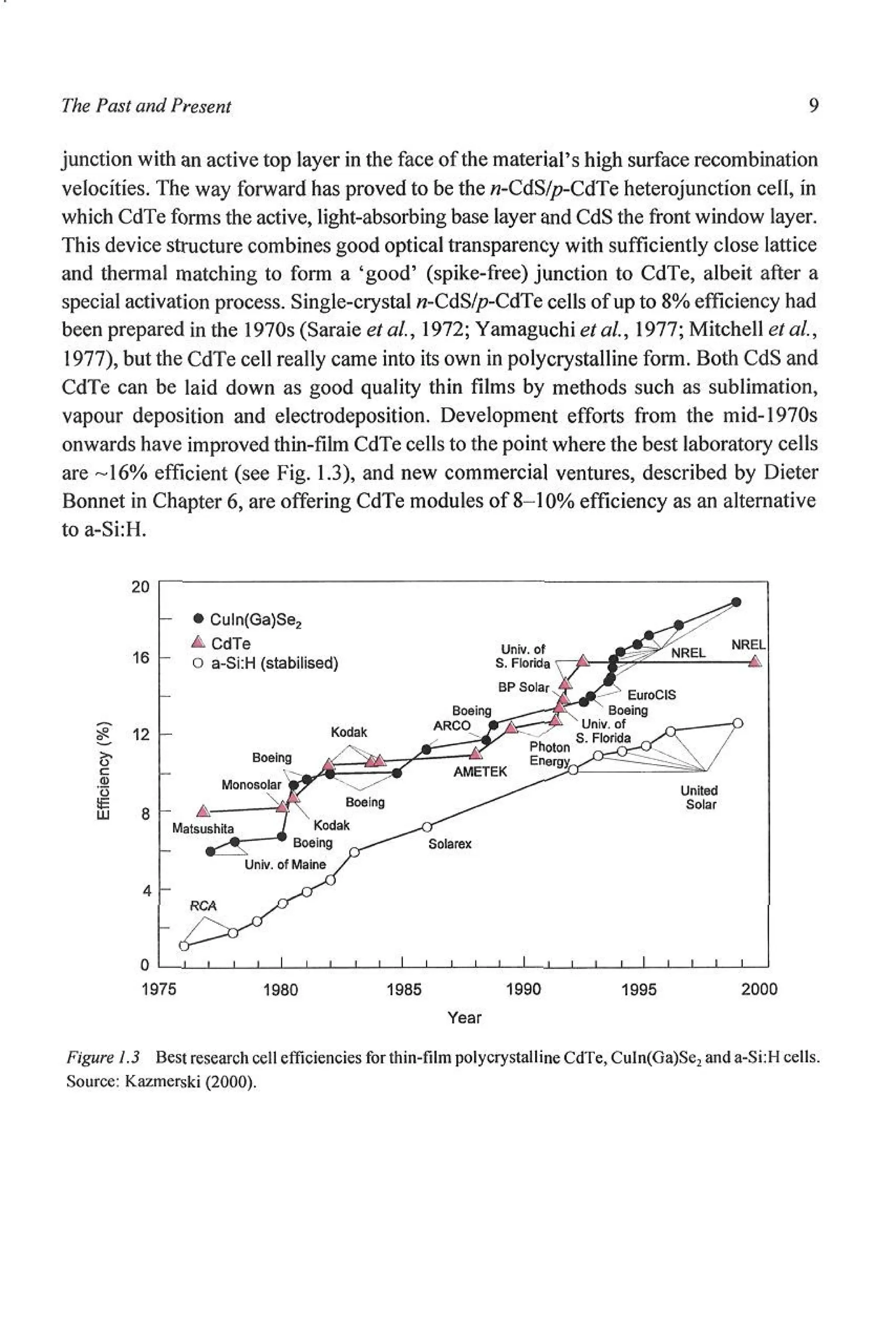
  • 26.
    About the Authorsxxi Masafumi Yamaguchi is a professor at the Toyota Technological Institute, Nagoya, Japan. He received his BS and PhD degrees from Hokkaido University in 1968 and 1978 respectively. In 1968, he joined the NTT Electrical Communications Laboratories in Tokyo, working on radiation damage in Si and III-V compounds, ZnSe blue-light- emitting diodes and III-V solar cells. In 1983, he discovered the superior radiation resistance of InP, and in 1987 his group developed high-efficiency InP, GaAs-on-Si and AlGaAs/GaAs tandem cells. As chairman of NEDO's Super High-Efficiency Solar Cell Committee, he has contributed to the attainment of very high efficiency InGaP/GaAs dual-junction cells. His research interests include high-efficiency multijunction, concentrator, polycrystalline and thin-film Si cells, radiation damage to solar cells and materials and new carbon-based materials for photovoltaics. He is the chairman of the Photovoltaic Power Generation Technologies Research Committee of the Institute of Electrical Engineers of Japan, and will serve as the Programme Chairman of the Third World Conference on Photovoltaic Energy Conversion, to be held in Osaka in 2003. He received the Vacuum Science Paper Award in 1981, and the Irving Weinberg Award for contributions to space photovoltaics in 1997. Beatriz Yordi has been responsible for the PV sector of the European Commission's Directorate-General for Energy and Transport since October 1994. She was born in La Coruna, Spain and took her Bachelor's Degree in physics at the University of Santiago de Compostela in 1987. Following a year of research in the Department of Optics and Materials Structure at the University of Santiago, she joined the Research Centre for Energy, Environment and Technology (Ciemat) in Madrid, working in the Institutes of Energy Studies and Renewable Energy. From 1991 to 1994, she served as Chief Engineer for the Toledo 1 MW photovoltaic plant, a project with several technical innovations (novel PV cells and a novel tracking system) that was co-funded by the European Commission, the Spanish and German governments and three European utilities.
  • 28.
    PREFACE And there theunregulated sun Slopes down to rest when day is done And wakes a vague, unpunctual star ... Rupert Brooke, The Old Vicarage, Grantchester, May 1912. Since the dawn of history, man has been fascinated by the Sun, the provider of the light and warmth that sustains life on Earth. In pre-industrial times, our major sources of energy—wood, wind and water power—derived from solar energy. The subsequent discovery and massive exploitation of fossil fuels laid down in the Earth's crust by early aeons of photosynthetic activity have conditioned the developed world to be dependent on convenient, readily available energy. But we are living on our energy capital. The Earth's reserves of coal, oil and gas are finite and likely to become resource-depleted in the course of this century. A sense of living on borrowed time was therefore appropriate even before concerns about global climate change, sustainability and energy security combined to raise interest in renewable energy to its current encouraging level. This book is the first in a series of four multi-authorial works on the photo- conversion of solar energy. It was created from my long-held conviction that, despite slow starts and setbacks, solar energy—broadly defined to encompass other renewable energy forms that derive from solar—will become the Earth's major energy source within this century. The Sun is a source of both radiant heat and light, and techniques for using solar energy correspondingly divide into thermal methods (solar power towers, water heaters and so on) and photoconversion (sometimes called direct) methods. Photoconversion is the subject of this book series. A photoconverter is a device that converts sunlight (or any other source of light) into a useful form of energy, usually electrical power or a chemical fuel, in a process that relies, not on a raised temperature, but on the selective excitation of molecules or electrons in a light-absorbing material and their subsequent de-excitation in a way that produces energy in a useful form. Volume I covers the most developed of the man photoconversion devices, photovoltaic (PV) cells, which are solid-state semiconductor devices that produce electrical power on illumination. Volume II will cover the natural photoconversion system of photosynthesis, the potential of biomass as an energy source and the global carbon budget. Volume III will explore the less developed but exciting possibilities of synthesising artificial 'molecule-based' photoelectrochemical or photochemical photoconverters. Finally, Volume IV will draw together the common themes of photoconversion and provide some background material. XXlll
  • 29.
    XXIV Preface The seriesis intended mainly for senior undergraduates, graduate students and scientists and technologists working on solar photoconversion. Chapters 1-12 of this book deal with PV cell design, device physics and the main cell types—crystalline and amorphous silicon, cadmium telluride and copper indium diselenide—as well as more advanced or less developed options such as quantum-well and thermophotovoltaic cells. These chapters are mainly technical, requiring sound knowledge of physics, chemistry or materials science for ready understanding. Chapters 13-18 deal with PV systems, manufacturers, markets and economics and are accessible without specialist knowledge. A multi-authorial work owes its very existence to its authors, and my wholehearted thanks must go to the twenty-five distinguished individuals, all recognised authorities in their own fields, who have contributed to this book and patiently answered my queries during the editing stage. I have also been helped by discussions about PV with many friends and colleagues, and visits to installations throughout the world: I have been up Swiss mountains, onto Japanese rooftops and into the Arizona desert, and thoroughly enjoyed every minute. I am most grateful to those who have read and commented on various parts of this book or provided specialist information in advance of publication: Dennis Anderson, Jeffrey and William Archer, Stephen Feldberg, Martin Green, Eric Lysen, Larry Kazmerski, Bernard McNelis and Nicola Pearsall. I also warmly thank Alexandra Anghel, Barrie Clark, Stuart Honan and my PA Jane Williams for editorial assistance, and Ellen Haigh and John Navas of IC Press and Alan Pui of World Scientific Press for guiding the book to publication. For me the sad part of writing this preface is that I must do so in the first person, for my co-editor Professor Robert Hill died suddenly on 26 November 1999. Bob was the most knowledgeable champion of photovoltaics in the UK, and his premature death has deprived the British PV community of its cornerstone. He had drafted his chapter with Nicky Pearsall some months before he died, and the flow of emails delivering his astute editorial comments on other chapters continued until the day before his death. Bob believed unshakeably in the future of PV. Although he knew that system costs will have to fall by another factor of 2-3 if PV is to become cost-competitive in major new grid-accessible markets, there are good grounds for believing this is possible. PV technology is still young, and significant further economies of scale from larger manufacturing facilities, as well as further advances in the fundamental science, can confidently be expected. The world's first-generation televisions and mobile telephones were at least as uncommon and expensive as PV is now. The Old Vicarage, Grantchester December 2000 Mary Archer
  • 30.
    CHAPTER 1 THE PASTAND PRESENT MARY D. ARCHER Centrefor Energy Policy and Technology, Imperial College of Science, Technology and Medicine, London SW7 2AZ, U.K. mdal2@cam. ac. uk Time present and time past Are both perhaps present in timefuture. T. S. Eliot Burnt Norton, Four Quartets, 1935-1942. Photovoltaic (PV) cells generate electric power when illuminated by sunlight or artificial light. They are by far the most highly developed of the man-made photoconversion devices. Born of the space age in the 1950s, their earliest terrestrial applications emerged in the 1970s and they are now poised for significant market expansion in the new millennium. PV technology is elegant and benign, with a number of striking advantages over conventional methods of electricity generation. First and foremost, solar energy is the world's major renewable energy resource. PV power can be generated from the Sun anywhere—in temperate or tropical locations, in urban or rural environments, in distributed or grid-feeding mode—where the insolation is adequate. As a fuel-free distributed resource, PV could in the long run make a major contribution to national energy security and carbon dioxide abatement. In the UK, for example, each kWp of PV installed avoids the emission of about 1 tonne C02 per year. PV is uniquely scalable, the only energy source that can supply power on a scale of milliwatts to megawatts from an easily replicated modular technology with excellent economies of scale in manufacture. A typical crystalline silicon PV cell generates about 1.5 peak watts1 (Wp) of DC power, a typical PV module about 50 Wp, and the world's largest multimodule arrays (for example, the 3.3 MWe plant at Serre, Italy) generate upward of a megawatt apiece. ' The power output of a PV cell or module is rated in peak watts (Wp), meaning the power output at 25 C under standard AMI.5 solar radiation of global irradiance 1 kW m"2 . To convert from peak watt output to 24-hour average power output in a sunny location, divide by ~5. 1
  • 31.
    2 M. D.Archer PV cells are made of thin semiconductor wafers or films. They contain small amounts only of (usually non-toxic) materials and, when manufactured in volume, have modest embedded energy. They possess no moving parts, generate no emissions, require no cooling water and are silent in operation. PV systems are reliable, easy to use and long- lived if properly maintained (most commercial modules have lifetime guarantees of 25 years, though some balance-of-system components, notably storage batteries, are less reliable and long-lived than this). Carefully designed, PV arrays are not visually intrusive, and can indeed add architectural merit to the aesthetic of a built structure. PV really has only three drawbacks. First is the intermittence and seasonality of sunlight. As President Gerald Ford is alleged to have remarked, "Solar energy isn't going to happen overnight." The lack of inexpensive and efficient methods of storing electrical energy, and the poor match between the solar and electrical demand peaks in many locations and applications, are stumbling blocks for PV. For small stand-alone applications, battery storage, unsatisfactory as it is, is the only practical storage option. This can be avoided in grid-connected applications where surplus power can be sold to the grid; where there are many distributed or embedded PV generators spread over a geographic region, this has the additional benefit of'integrating out' the fluctuations in local PV contributions. For PV to contribute to global electricity supply on a very large scale, cost-effective means of intercontinental transmission of electrical power (or perhaps of a chemical vector, such as hydrogen, derived from electrical power) would need to be developed. Another characteristic of solar energy that is sometimes perceived as a difficulty is its low power density. The solar power received at Earth's surface, averaged over day and night, winter and summer, varies from about 100 W m 2 in temperate locations to about 300 W m"2 in sunbelt regions. All solar technologies therefore require substantial areas to be covered by solar converters, or by optical concentrators coupled to solar converters, for substantial amounts of power to be generated.2 Taking the UK as an example, the south of England receives insolation of roughly 1 TWh per square kilometre per year, so an area of-2,500 km2 would need to be covered with 15% efficient PV modules to generate the UK's present electricity consumption of-350 TWh/y. The most elegant and cost-effective method of deploying such area-intensive technology is on the surfaces of built structures, rather than as free-standing arrays. This is the more attractive if the PV facade replaces, and avoids the cost of, conventional cladding. 2 Hydroelectric power is, however, considerably more area-intensive than solar power (Anderson and Ahmed, 1993).
  • 32.
    The Past andPresent 3 This brings us to the second difficulty with PV—its cost. Manufacture of most cell types is an intricate operation, requiring careful control of semiconductor growth and purity and many processing steps. PV systems are expensive, although module costs have fallen substantially—about five-fold in the last twenty years—as the market has grown. In 1999, the PV modules market was worth $665m, and the total value of the business—systems, installation and so forth—was about $2billion (SU, 2000). Current module manufacturing costs are 3-4/Wp, and balance-of-system (BOS) costs can raise the total system cost to 6$/Wp if no battery storage is needed, and 8-10$/Wp if storage is needed. A capital cost of 6$/Wp translates to a PV electricity cost of ~60e7kWh in low- insolation areas such as western Europe, and ~250/kWh in southern Europe, the USA and much of the developing world.3 These high costs for PV-generated electricity are often compared unfavourably with typical retail prices of -10-150/kWh for grid electricity, and do indeed make PV seem expensive in locations with immediate access to the grid, particularly where (as is often the case) distribution costs are subsidised. But reinforcing or extending the grid to supply increased or new demands is also expensive. The fairer question is under what circumstances the life-cycle costs of supplying a given load by reinforcing or extending the grid would exceed those of installing a stand-alone PV system to supply the same demand. In grid-connected locations, the cost of strengthening the grid to meet increased peak demands is usually concealed by cross subsidy, but can be 15-300/kWh or even more. Provision of peak electricity from a PV substation can therefore become cost-competitive where there is good coincidence between the demand peak and the solar peak. As for grid extension, it is generally cheaper to electrify an isolated village-sized community by PV than extend the grid by 5 km or more to reach it. Access to the grid is in any case not an option for 2 billion or so people (40% of world population) in the developing world. Their conventional small-power options—batteries and diesel generators—compare even less favourably with PV. The current life-cycle costs of PV systems (even with battery storage included) are only about one-tenth to one-half those of secondary batteries, and less than those of diesel generators for loads of under ~30 kWh/day. The third difficulty for PV is one faced by many emergent technologies—ignorance. It is often said that familiarity breeds contempt, but unfamiliarity breeds it too, together with scepticism over manufacturers' claims, veiled or unveiled hostility from established 3 The unit cost of PV electricity depends not only on the capital cost and lifetime of the system components, but also on the local insolation and the cost ofborrowing money to finance the system. Energy costs and prices vary widely within and between countries. The costs and assertions in this section are baldly stated, but derive from the detailed costings and assessments of Chapters 15 and 17.
  • 33.
    4 M. D.Archer suppliers and inappropriate regulatory and market structures. Even if consumers are aware of the potential benefits of PV, they can seldom buy 'plug and play' systems off the shelf, and are understandably reluctant to purchase non-standard components for one-off systems. Thus PV faces a dilemma. It is the second fastest growing energy technology in the world, but it is unfamiliar and—in the eyes of many—untested. In 1999 the global PV market grew by 31.5% {PVNews, February 2000), a growth rate exceeded only by wind power, which grew by 35% (IEA, 1999). Were a 30% growth rate to be maintained, PV would meet 1% of projected global electricity demand in 2018, and 10% in 2028. However, such a high growth rate is achievable only because and while PV is growing from a tiny base. In the USA, for example, PV currently provides less than 0.005% of total electricity consumption (KPMG, 1999). Worldwide, about 200 MWp of PV capacity was installed in 1999, and cumulative installed PV capacity is only just over 1 GWp. On average, this supplies -0.2 GWe of PV-generated power, which is only a tiny proportion of the world's current electrical consumption of ~3000 GWe. Although PV is in a virtuous cycle where costs decline as markets expand, its future growth will not be driven by market forces alone at anything like a 30% growth rate. Public policies have played an important role in the development of the industry to date. In Chapter 17, Dennis Anderson argues that further subsidy or tax incentives for PV will be economically efficient and politically justifiable so long as cost curves are declining, the level of prospective use is large and the environmental advantages are demonstrable. 1.1 Milestones in photovoltaic technology The discovery of photovoltaism is commonly, if inaccurately,4 ascribed to Becquerel (1839), who observed that photocurrents were produced on illuminating platinum electrodes coated with silver chloride or silver bromide and immersed in aqueous solution. The observation by Smith (1873) of photoconductivity in solid selenium led to the discovery of the photovoltaic effect in a purely solid-state device by Adams and Day (1877), who observed photovoltages in a selenium rod to which platinum contacts had been sealed, which they (incorrectly) ascribed to light-induced recrystallisation of the selenium. The first practical photovoltaic device—a light meter consisting of a thin layer 4 Becquerel's observation was strictly speaking a photoelectrochemical effect, but its basis—the rectifying junction formed between two dissimilar electric conductors—is the same as that ofthe photovoltaic effect in purely solid-state devices.
  • 34.
    The Past andPresent 5 of selenium sandwiched between an iron base plate and a semi-transparent gold top layer made by Fritts (1883)—was promoted by the German industrialist Werner von Siemens as demonstrating "for the first time, the direct conversion of the energy of light into electrical energy" (Siemens, 1885). Photometers based on selenium photocells were commercialised in Germany in the 1930s and are still in use. The selenium photocell is an example of a barrier layer cell, so called because it contains an electrical barrier that is highly resistive to current flow in one direction—a rectifying junction, in modern parlance. Two further barrier layer cells, the thallous sulphide cell (Case, 1920) and the copper oxide cell (Grondahl and Geiger,1927), were developed during the 1920s, but all had solar conversion efficiencies well below 1%. The book by Lange (1938) gives an account of these early devices. The electrical barrier of barrier layer cells was originally thought to lodge in an interfacial foreign layer of high resistivity such as an oxide, but Schottky (1938), and independently Davydov (1939) and Mott (1939), showed that a third phase was not necessarily involved. Rather, metal | semiconductor junctions could in themselves be rectifying by virtue of the space-charge layer created in the semiconductor by charge redistribution when contact was made with a metal of different work function. Metal | semiconductor devices make inefficient solar converters because their dark currents are relatively large and this diminishes the photovoltaic response. Semiconductor!semiconductor junctions a r e better in this regard. The father of the modern photovoltaic cell is Russell Ohl, a metallurgist at Bell Telephone Laboratories in New Jersey, who observed that crystallisation of a melt of commercial 'high purity' silicon produced a "well-defined barrier having a high degree of photovoltaic response" (Ohl, 1941). This barrier was in fact ap-n junction formed from the unequal distribution of impurities as the Si crystal grew from the melt. From this discovery, after a delay occasioned by World War II, grew the seminal work of Chapin et al. (1954) on the diffused p-n junction in single-crystal silicon and Bell Lab's successful drive to develop photovoltaic devices suitable for use in the infant space industry. The first p-n junctions to be reported, however, were the germanium homojunction of Lark-Horovitz's group at Purdue University (Benzer, 1946, 1947) and the quasi-homojunction formed by pressing together a wafer of lead-enriched lead sulphide with one of sulphur-enriched lead sulphide (Sosnowski et al., 1947). The modern era of silicon photovoltaics is described by Martin Green in Chapter 4, and Fig. 1.1 shows the evolution of silicon cell efficiency. Silicon (Si) is the material with which the electronics industry feels most at home, and Si single-crystal and
  • 35.
    6 M. D.Archer 32 28 24 20 E 16 - 12 " 8 NREL Multijunction concentrators T 3-junction (2-termina! monolithic) A 2-junction (2-terminal monolithic) Westinghouse Crystalline Si cells • Single-crystal • Multicrystalline • Thin Si ARCO Solarex AstroPower „ D" Q-- D Georgia UNSW Georgia shar P Tech 1975 1980 1985 1995 2000 Year Figure 1.1 Best research cell efficiencies for single-crystal, multicrystalline and thin c-Si cells, and for multijunction (III—V) concentrator cells. Source: Kazmerski (2000). multicrystalline homojunction cells dominate the PV market, between them holding -80% of 1999 sales. In the past, the silicon needed by the cell manufacturing industry all came from the 10 ohm cmp-type waste material discarded by the electronics industry, which can provide sufficient good-quality feedstock silicon to make up to about 200 MWp/y of Si solar cells. The PV market is now expanding past this level, so new entrants in the field must seek new sources of silicon feedstock. Despite their longevity, reliability and environmental compatibility, crystalline silicon cells remain relatively complex and heavy devices with significant materials and fabrication costs. One drawback of Si is its relatively poor light absorption, which means that unsophisticated cells must be at least 250 pm thick to absorb all the active wavelengths in sunlight with reasonable efficiency. Surface texturisation of cells to produce light-trapping geometries allows Si cells to be made much thinner (less than 80 //m) and still perform excellently, but it is impossible to use conventional cell fabrication technology to cut such thin wafers from crystal boules. There are various ways of growing thin crystalline Si films directly, but in the past these have led to cells of only modest performance. However, the advanced silicon ribbon and film deposition
  • 36.
    The Past andPresent 7 technologies, described in Chapter 4, now promise thin Si devices of useful efficiency. Fig. 1.1 shows recent advances in thin c-Si (crystalline silicon) cell efficiency). From the 1970s, when terrestrial applications of crystalline silicon technology began to emerge, there has been a parallel effort to develop semiconductors other than Si in order to make thin-film (polycrystalline) devices of lower cost and better light-absorbing properties. The original motive for investigating thin-film cells was not, however, lower cost but their better power-to-weight ratio for space applications. The first thin-film PV device was the cuprous sulphide/cadmium sulphide (p-Cu2S/«-CdS) heterojunction, made in single-crystal form by Reynoldsef al. (1954), and in thin-film form by Carlson (1956) at the Clevite Research Center, Cleveland, Ohio. The thin-film cell excited much interest because of the simplicity of its manufacture and low intrinsic costs. Clevite Corporation mounted a major development effort on thin-film CdS technology in 1964, and several others followed suit. However, in spite of some promising results, reviewed by Hill and Meakin (1985), these cells suffered from poor stability arising from the high diffusivity of copper, and there were also serious problems in making ohmic contacts to Cu2S. Cadmium sulphide lives on, however, as the window layer of the cadmium telluride and copper indium diselenide cells, despite problems with the use of the toxic metal cadmium in what is intended as an environmentally benign product.5 The Japanese had effectively already delivered the coup de grace to Cu2S/CdS technology by the early 1980s, by commercialising small amorphous hydrogenated silicon (a-Si:H) PV panels of modest but sufficient efficiency to power small consumer goods such as watches and calculators, thus providing PV with an assured market of ~1 MW/y and the cash flow to drive further R&D. Amorphous silicon of good quality (with sufficiently few mid-gap states to be dopable either n- orp-type) had been made by Spear and Le Comber (1975) in Dundee. Independently, David Carlson and Chris Wronski, then both at RCA, made several square centimetre n-i-p andp-i-n cells of-2% efficiency (Carlson and Wronski, 1976), and smaller area MIS cells of 5.5% efficiency. The n-i-p and p-i-n cells were to be the forerunner of modern a-Si:H photovoltaic technology. The Staebler-Wronski effect, which is the -10-20% diminution of efficiency that occurs on the first prolonged exposure of a cell to light, was discovered soon afterwards, in 1977. Puzzling and unwelcome as this was, ways to mitigate its impact by using thin cells (in which this volume recombination effect is diminished) in multijunction, light-trapping structures have been successfully developed, as Wronski and Carlson describe in Chapter 5. 5 CdS also lives on in the paintings of impressionists such as Monet, whose favourite yellow pigment it was.
  • 37.
    8 M. D.Archer While there is still a market for single-junction a-Si:H modules of modest (4-6%) stabilised efficiency in consumer applications where the cost per watt delivered is more important than the watts per unit area, they are being supplanted by dual- and triple- junction devices of much better performance. Figure 1.2 shows the evolution of a-Si:H module efficiency and Fig. 1.3 that of research-cell efficiency. The initial efficiency of the best laboratory triple-junction cells is now -15%, their stabilised efficiency is -12%, and the stabilised efficiency of commercial dual- and triple-junction modules is -10%. Amorphous Si technology has the potential for further cost reduction with the current scale-up of manufacturing facilities, and now seems poised to break into the power market. Efficiency/% 14 12 10 8 6 4 2 - i I stabilised efficiency _ _ a 4 A A . « V < a • •• . D i J i- * m tf ®® * • ®o °° D • i • D -1 cm2 • -100 cm2 A - • O r 1000 cm2 A DuaHunction I -1 1976 1978 1980 1982 1984 1986 1988 1990 1992 1994 1996 1998 Year Figure 1.2 Evolution of efficiency of amorphous silicon modules. Source: Kazmerski (2000). One of the problems with thin-film materials other than a-Si:H is that they are not used elsewhere in the electronics industry so there is little accumulated expertise about them. Nevertheless, two other thin-film materials, cadmium telluride (CdTe) and copper indium diselenide (CuInSe2, also referred to as CIS) are currently offering real competition to amorphous silicon in the PV field. CdTe was familiar to the semiconductor industry from its use, in very pure crystalline form, as a photoconductive y-ray detector. Although it can be doped both n- and p-type, it is hard to make an efficient p-n homojunction CdTe cell because of the difficulty of forming a shallow
  • 38.
    The Past andPresent 9 junction with an active top layer in the face of the material's high surface recombination velocities. The way forward has proved to be the «-CdS/p-CdTe heterojunction cell, in which CdTe forms the active, light-absorbing base layer and CdS the front window layer. This device structure combines good optical transparency with sufficiently close lattice and thermal matching to form a 'good' (spike-free) junction to CdTe, albeit after a special activation process. Single-crystal w-CdS//?-CdTe cells of up to 8% efficiency had been prepared in the 1970s (Saraie etal., 1972; Yamaguchi etal, 1977; Mitchell etal, 1977), but the CdTe cell really came into its own in polycrystalline form. Both CdS and CdTe can be laid down as good quality thin films by methods such as sublimation, vapour deposition and electrodeposition. Development efforts from the mid-1970s onwards have improved thin-film CdTe cells to the point where the best laboratory cells are -16% efficient (see Fig. 1.3), and new commercial ventures, described by Dieter Bonnet in Chapter 6, are offering CdTe modules of 8-10% efficiency as an alternative to a-Si:H. 20 16 ^ 12 I Culn(Ga)Se2 CdTe o a-Si:H (stabilised) Univ. of S. Florida ' Kodak 1975 1980 1985 1990 1995 2000 Year Figure 1.3 Best research cell efficiencies for thin-film polycrystalline CdTe, CuIn(Ga)Se2 and a-Si:H cells. Source: Kazmerski (2000).
  • 39.
    10 M. D.Archer Copper indium diselenide has a high optical absorptivity compared with most other semiconductors. Although, like CdTe, CIS can exhibit both n- and p-type conductivity arising from intrinsic defects, it is better used in the p-type form in a heterojunction device with an «-CdS window layer. 12% efficient single-crystal heterojunction n- CdS/p-CuInSe2 cells were made by Wagner et al. (1974) and Shay et al. (1975), and thin-film cells of 4-5% efficiency quickly followed (Kazmerski, 1976). By the end of 1980s, commercialisation efforts by Arco through its subsidiary Arco Solar had achieved thin-film CIS modules with areas of up to 1 x4 ft2 and -10% efficiency. Persistent problems with the process yield were later overcome by control of sodium impurities in the CIS film and improved junction fabrication processes. The pioneering work of the EuroCIS consortium in the early 1990s resulted in significant efficiency increases to -16%, and the US National Renewable Energy Laboratory (NREL) has recently reported an 18.8% efficient cell (see Fig. 1.3). Current commercialisation efforts with different techniques for the deposition of the CIS film are underway in the USA, Germany and Japan, as described by Uwe Rau and Hans Schock in Chapter 7, aiming at module efficiencies above 15%. The space hardness of CIS is superior to that of GaAs and InP, and space applications are also being pursued. Gallium arsenide (GaAs) is a younger and faster semiconductor than silicon, valued in the optoelectronics industry for the high hole mobility of the «-type material. A PV effect in GaAs p-n homojunction was first reported by Welker (1954), followed a year later by Gremmelmaier (1955), who obtained - 1 % efficiency in a polycrystallinep-w homojunction cell. The first efficient (>6%) p-n GaAs device was the monocrystalline cell of Jenny et al. (1956). The /?-AlGaAs/w-GaAs heterojunction cell was reported by Alferov et al. (1971), and the p- AlGaAs/p-GaAs/«-GaAs heteroface cell, which quickly achieved an AMI efficiency of 15.3%, by Woodall and Hovel (1972). From then on, the story of GaAs for space applications is taken up by Chris Hardingham in Chapter 13, and its use in conjunction with other III-V semiconductors in high-efficiency tandem cells is described by Masafumi Yamaguchi in Chapter 8 (Fig. 1.3 shows some recent efficiency records). Organic semiconductors have in the past been plagued by high resistivity and poor reproducibility, leading to very disappointing efficiencies of <0.1% in all-organic thin- film cells. There has been recent dramatic improvement, with the successful development of high-quality dopable polymers for LED displays and other optoelectronic applications. Jonathan Halls and Richard Friend describe the new generation of organic cells, based on co-blends of these polymers and now approaching 3% efficiency, in Chapter 9. Other advanced concepts that promise improved efficiencies are quantum-well cells, discussed by Jenny Nelson in Chapter 10, and thermophotovoltaics, covered by Tim Courts in
  • 40.
    The Past andPresent 11 Chapter 11. Concentrator cells and systems, described by Antonio Luque in Chapter 12, are at an early, pre-commercial stage of development but merit more attention in that they could undercut flat-module arrays on costs if a market (estimated by Luque at 10 MWp/y or more) for them existed. 1.2 Evolution of the PV market PV technology and markets have developed fitfully against a shifting background of energy policies and perceptions. The initial impetus that brought PV into being in the 1950s was the need for electrical power in space, where performance was crucial and cost irrelevant. By the early 1970s, PV was still too expensive to benefit from the flurry of anxiety (misplaced, as it turned out) about the imminent depletion of fossil fuel reserves inspired by the Club of Rome. Following the oil price hikes of 1973 and 1979, the main driver for PV became energy costs, with the inevitable result that investment slumped when the price of oil dropped in the mid-80s in response to the weakening of energy cartels, the discovery and exploitation of new oil and gas resources and the competitive pressures of utility deregulation and privatisation. Since then, the low price of oil, which currently accounts for about 40% of world commercial energy supplies, has held back the market growth of PV (and other renewables). In 1998, the price of oil collapsed further following increases in oil supply, and recession in South East Asia and the FSU; 1999 prices fell as low as $12 per barrel. In the course of year 2000, the price of oil has risen sharply to ~$35 per barrel, as OPEC (excluding Iraq) and key non-OPEC producers Mexico and Norway have implemented plans to cut oil production. It remains to be seen whether this price level will be sustained. Cost reduction remains key to the future—as to the past—growth of PV. In 1970, PV cells for use in space cost several hundred dollars per peak watt. By the mid-1970s, the efforts of Elliot Berman and his Solar Power Corporation (backed by Exxon) had reduced the cost of cells made specifically for terrestrial applications to $20/Wp. Since then, the cost of crystalline silicon modules has fallen to its current level of ~$4/Wp, and module lifetimes in excess of twenty years have been demonstrated. Successive markets have opened up for PV along the way, as discussed by Bernard McNelis in Chapter 16. In round terms, the RAPS (remote area power supplies) market opened up in the 1980s at module costs of $10/Wp. Solar lighting in grid-remote locations opened up in the early 1990s at $5/Wp. The BIPV (building-integrated photovoltaic) cladding market would open up at module costs of $3/Wp, and grid-connected applications at ~$1/Wp.
  • 41.
    12 M. D.Archer Several studies, discussed by Nicola Pearsall and Bob Hill in Chapter 15, have shown that mass production would bring module costs down to these levels, even with no further improvements in cell performance. Larger PV manufacturing facilities are being constructed today than hitherto, but even these have capacities of only -20 MWp/y. Much larger plants still would be needed to capture the remaining economies of scale—wafer silicon modules could be produced for $1/Wp in a plant of 500 MWp/y capacity, and thin-film modules for only $0.6/Wp in a plant of 100 MWp/y capacity (KPMG, 1999). But the global market for PV would have to grow by an order of magnitude from its current volume of about -200 MWp/y tojustify investment in plants of this scale. In Chapter 18, Erik Lysen and Beatriz Yordi consider how the PV market might evolve towards this size. The cost of PV system comprises the cost of the module itself plus the costs of BOS (balance-of-system) components such as power conditioners, wiring and inverters. Present BOS costs are around $3-4/Wp without battery storage, and market expansion and a continued R&D drive would be needed to bring them down to $1/Wp. The further development of inexpensive module inverters that can handle thin-film modules as well as crystalline silicon modules would be helpful in this context. The battery storage needed for stand-alone PV systems adds considerably to BOS costs. Battery costs obviously depend on the amount of storage required, with 3 — 4 days storage being typical of home systems and 10 days or more for communications and essential power supplies. To provide 3—4 days storage in sunny areas (which receive the equivalent of about 4-5 'peak hours' of sunlight per day), battery capacity of-15 kWh per kWp of PV capacity would be needed. Lead-acid batteries cost 150-200 $/kWh, so this would add $2/Wp to capital costs if the batteries were as long-lived as the PV modules. Unfortunately they are not, and allowing for this the effective addition would be about $3/Wp. In less sunny areas and where more storage capacity is required, battery costs rise proportionately, to perhaps $10/Wp for high-specification systems. These high battery costs, and the weight, chemical hazardous nature and maintenance requirements of lead-acid batteries are, it must be said, unattractive aspects of PV/battery systems. The development of inexpensive, long-lived, environmentally friendly batteries, or other means of storing electricity economically, would be helpful to PV. Ron Dell discusses the important topic of electricity storage in Chapter 14. The price of a PV system to the end user contains not only manufacturing costs, but also marketing costs, sales taxes and (sometimes) import duties, as well as distributors' costs and profits. While competition is the best way of avoiding excess cost-price differentials, the industry will not grow sustainably unless it is profitable. Against this background, the goals set in 1999 by the US PV Industry Roadmap (Roadmap, 1999),
  • 42.
    The Past andPresent 13 of end-user prices of $3 per watt AC in 2010, and approaching $1.50 per watt AC in 2020, must be regarded as quite challenging. In Chapter 17, Dennis Anderson discusses the most economically efficient ways of growing the market to achieve further economies of scale and bring PV to commercial viability in major new markets. One necessary ingredient will be continued public investment (that is, subsidy). Public expenditure on PV, although generally rising since the early 1970s, has been at the mercy of changing political priorities. President Carter arguably put too much money—$173 million—into PV in his final year in office, which was in part responsible for the 'Reagan effect' on subsequent renewables funding in the USA. Cumulatively, the USA and Japan have made the greatest public investment in PV, spending $1.5 bn and $1.25 bn (¥140.1 bn) respectively over the period 1975-1997 (Palmers et ai, 1998). Over almost the same period, 1975-1998, the European Union and its member states spent some $300-350 million (300-350 million ECU). National PV programmes vary widely. Japan, with no indigenous fuel sources, has the most vigorous government programme, spending $180 million (¥20 bn) in 1997 (PV-UK, 1999). Germany, where the Chernobyl accident of 1986 cast a particularly long shadow, has increased public support for PV sharply in recent years, spending $49 million (DM 97 million) in 1996. The Netherlands, Switzerland, India, Brazil and Mexico also have sizeable national programmes. The USA government spends roughly the same as Japan and Germany on R&D, but far less on commercialisation: $3 million in 1997 compared with $109 million by Japan and $45-50 million by Germany (SIJ, 1998). As for the UK, government support for PV is recent and modest, amounting to about $4.5 million (£3 million) in 1999. The scale of private investment in PV is hard to assess. Certainly it has lagged behind public programmes in the past, and the industry has not historically been profitable for its shareholders. Currently the most profitable PV companies are those offering 'vanilla- flavoured' technology to the consumer market. The PV divisions or subsidiaries that several oil multinationals, such as BP Amoco, Shell and Siemens, have nurtured over two decades or more, have considerable investment costs to recoup. The recent spate of consolidation and mergers led by these companies is encouraging, in that they could fund rapid expansion in PV manufacturing capacity if market demand grew. Meanwhile, regulatory and market trends that should make PV (and other renewables) more attractive are discernible. The Rio and Kyoto agreements aimed at the progressive reduction of carbon dioxide emissions by developed countries, while as much honoured in the breach as the observance, are nonetheless hardening support for the renewables. A large number of countries, including most countries in the OECD and several developing countries, have introduced tax or regulatory policies that favour the
  • 43.
    14 M. D.Archer renewables. In many countries with liberalised electricity supply industries, modest renewable set-asides (requirements on major utilities to source some power from renewables) are in place or under consideration, and the right to supply power to the grid is being extended to independent power producers (IPPs), sometimes with incentives to source electricity from renewable sources. IPPs can site their plant close to the consumer and avoid the costs of distribution, often as significant as the costs of generation. At the same time, PV is (slowly) being made more attractive to the end user by the introduction of net metering and green electricity tariffs and the removal of cross subsidy of the costs of peak-load generation and electricity supply to rural locations. New environmental and social drivers for PV are apparent in these trends. Developed nations with a high sensitivity to energy security and the environment can afford to be concerned about greenhouse gas emissions, global warming and urban air quality. The attractions of 'green' buildings and back-up uninterruptible power in grid-connected locations can be enhanced by financial sweeteners, and the capital costs of providing distributed power in grid-remote locations met. The developing world, with its rudimentary electrical service, debt burdens and low standard of living, could derive great benefits from clean distributed PV power. The international funding agencies that can help developing countries are well aware of the benefits of PV, and are developing innovative ways of providing the necessary capital. It is perhaps in the newly industrialising nations, where economic growth is the imperative and the (economically unjustified) subsidy of electricity generation from fossil fuels and/or nuclear to support that growth endemic, that the position of the renewables is rendered the weakest. A principal aim of the energy market liberalisation and regulatory reform now in train in many countries is to 'level the playing field' by removal of subsidies for nuclear power, fossil fuels and grid supplies. A second step, now being taken in several countries, is to support for the development and demonstration of renewable energy projects, this being justified in terms of their environmental advantage and long-term economic potential. 1.3 Overview of photovoltaic cell operation This book aims to present an in-the-round approach to PV, touching on all aspects from the choice of semiconductor materials through system design to public policy issues. But PV cells themselves and how they work form its main subject matter. By way of introduction to the detailed treatments of cell physics and design of Chapters 2 and 3, and the sequence of materials-based chapters beyond, we therefore conclude this chapter with an account of the main PV cell types and the basic principles of cell operation.
  • 44.
    The Past andPresent 15 1.3.1 Thep-n homojunction cell All PV cells work in essentially the same way. They contain a junction between two different materials across which there is a 'built-in' electric field. When the cell absorbs light, mobile electrons and holes are created. These flow in opposite directions across the junction. In this way the flow of absorbed photons is converted into a flow of DC power from the illuminated cell. front grid AR (anti- / ^ ^ M S . s e r i a l connections reflection) / / M m M M y % M M y * _> ^ tobackcon,aclof coating -^ //////////////^ * ^ n e x t c e " i n m o d u l e n-type top layer p-type base layer b a c k c o n t a c t p - n junction Figure 1.4 The essential features of ap-n homojunction Si solar cell. The crystalline silicon (c-Si) cell has a simplejunction structure, and provides a good model in which to explore the PV effect. Figure 1.4 shows the essential features of these cells, which are typically square or rectangular wafers of dimensions -10 cm x 10 cm x 0.3 mm. The top (emitter) region is a -0.5 /mi thick layer of «-type silicon, and the base region is a -300 ftm thick layer of p-type silicon.6 The work function of the p material is greater than that of the n material, so the two layers reach electronic equilibrium (in the cell at open circuit in the dark) by the transfer of some electrons from the n to the/? side. The structure as a whole remains electrically neutral, but the junction region contains an electric double layer, consisting of two space-charge regions or depletion regions (DRs), as shown in Fig. 1.5. The depletion regions are typically less than a micron thick, and the charges they contain are those of the ionised dopants (P+ and B~ in the case of c-Si). Beyond the base-layer DR in the c-Si cell (and some other cells) lies a quasineutral region (QNR)—a region that contains no space charge. 6 c-Si cells are always configured n-on-p because this best suits the properties of silicon, but some othep-/i cells are configuredp-on-n. These cells are also quite thick, because c-Si absorbs light relatively weakly. Most other cells are much thinner.
  • 45.
    16 M. D.Archer top layer junction -* base layer front grid AR coating « / •n-3 —n n n n n- back contact y + + + + + p-DR | space-charge region n-QNR n-DR Figure 1.5 Cross section through ap-n homojunction cell, showing the electrical double layer consisting of ionised dopant atoms (denoted + and -) in the junction region, the two depletions regions (DRs) that contain equal and opposite quantities ofjunction charge, and the base-layer quasineutral region (QNR). oThe Sun electrons n layer junction player 'free' electron hole-electron pair created by photon absorption holes Figure 1.6 Generation and movement of free carriers in ap-n junction solar cell. Figure 1.6 shows what happens in the illuminated c-Si cell. The absorption of photons of energy greater than the band-gap energy of silicon promotes electrons from the valence band to the conduction band, creating hole-electron pairs throughout the illuminated part of the cell, which in c-Si cells extends well into the base layer. In c-Si and most other semiconductors, these hole-electron pairs quickly dissociate into 'free' carriers—mobile holes and electrons that move independently of each other.7 Those free carriers that approach thejunction come under the influence of the built-in electric field, which sweeps electrons from the p to the n side, and holes from the n to the p side. ' In some semiconductors, particularly organic semiconductors, hole-electron pairs remain tight-bound, and are then referred to as excitons.
  • 46.
    The Past andPresent 17 1.3.2 Junction structure and dark current The electric double layer at the p-n junction has an important effect on the semiconductor energy levels, as shown in Fig. 1.7. The separate (uncharged) phases (Fig. 1.7a) have the same conduction and valence band-edge energies L/c and U„, separated by the forbidden gap U^, but different work functions &p and <P„, and therefore different Fermi levels //£ and £|!.8 In the equilibrated cell (Fig. 1.7b), the Fermi level /iF vacuum level electron energy hole energy p-QNR p-DR (a) metallurgical interface (b) Figure 1.7 Energy band structure of ap-n homojunctlon in the dark: (a) in uncharged blocks of p-type and n-typc semiconductors before contact, showing the conduction and valence band-edge energiest/c and (/,., the forbidden gap Ug and the Fermi levels /ip and p { ! (red dashed lines) in then andp phases; (b) across the p-n homojunction after contact and equilibration of the two phases, showing the electric double layer formed by transient charge transfer, the depletion regions (DRs) and quasineutral regions (QNRs) and the common Fermi level p F throughout the device. is the same throughout the device but the band-edge energies Uy and Uc (in common with all the energy levels of the semiconductor) bend across the junction in response to the local electric field. Inspection of Fig. 1.7 shows that the equilibrium band-bending energy is qVh" is related to the difference in the work functions of the (separate, uncharged) materials by iK = *„-*, (i.i) * The Fermi level is the energy for which the probability of a state being occupied by an electron is exactly one- half. In an intrinsic (undopcd) semiconductor, the Fermi level falls in the middle of the forbidden gap. In a lightly doped semiconductor, the Fermi level remains within the forbidden gap but is near the majority-carrier band edge. In a heavily doped semiconductor, the Fermi level lies within the majority-carrier band.
  • 47.
    18 M. D.Archer Since the Fermi level in a doped semiconductor normally lies within the forbidden gap but near the majority-carrier band edge, qVb° is normally slightly smaller than the band- gap energy Ug. . o W o.rtic 'h.gen . (.-i) /'"I7vj T_ Ih.gen • ' • - . . . > (b) (c) Figure 1.8 Darkp-n homojunction cell in the dark (a) at equilibrium; (b) under forward biasF,; (c) under reverse bias Vj, showing the generation and recombination currents as dotted lines and the Fermi levels as red dashed lines. Figure 1.8 shows how the band bending is affected and a current is caused to flow when a bias voltage Vj is applied across the cell in the dark. At equilibrium (Fig. 1.8a), no net current9 flows through any part of the cell. However, small, balanced tluxes of electrons in the conduction band and holes in the valence band pass each way across the junction. These are referred to as generation and recombination currents. The {thermal) generation currents ih and ie shown in Fig. 1.8a come from the minority carriers (electrons in the p side and holes in the n side) generated throughout the device, albeit at a minuscule rate, by thermal excitation. Those minority carriers that reach thejunction without recombining are swept across it in opposite directions by the strong electric field. The recombination currents i£nc and i°rec also shown in Fig. 1.8a come from majority carriers (holes in the/? side and electrons in the n side) that flow 'up' the band- bending barrier (this is energetically unfavourable, but entropically favourable because the carriers move from a region of high to low concentration). At equilibrium, the generation and recombination currents in each band exactly balance each other. The sum of the hole and electron thermal generation currents is called the saturation current density /'„ of the junction. o h.Ren e.gen h.rec e.rev (1.2) 'All the currents given the symbol i in Figs. 1.8-1.10 are strictly speaking current densities.
  • 48.
    The Past andPresent 19 When a forward10 bias voltage Vj is applied across the junction of the dark cell, the barrier height is reduced to q Vb = q( Vb°- Vj), as shown in Fig. 1.8b. This does not affect the generation currents, but it strongly increases the recombination currents. The net current across the junction, which is the difference between the recombination current and the generation current, is called the dark current orjunction current zj. >j(V j) = i h,rec(V j) + i e,rec(V j)-kgen-i e,gen = W P + K.JVj) ~ ' rec ~ ' °e,rec 0 -3 ) When a reverse bias (Vj < 0) is applied, the barrier height is increased to qVb = <7( K°+ I V}• I ) . a s shown in Fig. 1.8c. The generation currents are still unaffected, but the recombination currents are now suppressed. Thus only the very small, bias-independent saturation current passes. / ( F < 0 ) = - / o (1.4) The dependence of the recombination currents ihrec{V) and ierec(V) on Vj is determined by the dominant recombination mechanism of the carriers injected into the junction. In most cells, the dark current-voltage characteristic conforms well to the empirical diode equation ijiVj) = /0 [exp(^K/^7)-l] (1.5) where fi is called the diode idealityfactor. For an ideal junction, in which no injected carriers recombine in the junction, fi = 1. For a non-ideal junction, in which some carriers do recombine in the junction, 1 < fi < 2. For some cells, particularly thin-film ones, eq. 1.5 is better written as the double diode equation ij(Yj) = ^[expiqV/kT)- 1] + /o 2 [exp(^F/2^)- 1] (1.6) where the first term corresponds to carriers that move across the junction without recombining, and the second to the carriers that recombine in mid-gap. Regardless of the exact form of the diode equation, all PV cells behave as rectifiers in the dark, showing highly non-linear current-voltage characteristics similar to that labelled 'dark' in Fig. 1.10. Junctions must show rectifying properties in the dark if they are to show photovoltaic properties in the light. 10 Forward biasing ajunction means applying a voltage across the device that lowers the band-bending barrier. Reverse biasing means applying a voltage in the opposite direction.
  • 49.
    ?.() M. D.Archer 1.3.3 The illuminated cell (a) (b) Figure 1.9 Illuminated p-n homojunclion cell (a) at open circuit; (b) at short circuit, showing the photogeneration of hole-electron pairs and photocurrents in red, and the Fermi levels as black dashed lines. When a PV cell is illuminated, a photocurrent and photovoltage are generated. Figure 1.9 shows how this happens, again using the example of ap-n homojunction cell. Absorption of photons of energy greater than the band-gap energy of the semiconductor creates excess minority carriers throughout the illuminated region of the cell (the light intensity in the cell interior falls off exponentially with distance into the cell, but often it penetrates into the base layer). The photogenerated minority carriers in the illuminated cell behave like the much smaller population of thermally generated minority carriers in the dark cell. That is, they diffuse from the QNRs towards thejunction, where they are swept across it by the strong junction field. These fluxes of photogenerated minority carriers give rise to the photogeneration currents ie h and /'/; . shown in Fig. 1.9a, consisting respectively of photogenerated electrons drifting from the p to the n side of the junction and photogenerated holes drifting the other way. The sum of the two is the overall photocurrent /^. The photocurrent is directly proportional to the absorbed photon flux but independent of bias (provided that the junction field is always high enough to sweep carriers across the junction). At open circuit (Fig. 1.9a), no current is drawn from the cell and the photocurrent must be balanced by the recombination current. Thejunction self-biases in the forward direction by the open-circuit voltage V^, at which point the recombination (junction) current exactly opposes the photocurrent, i.e.
  • 50.
    The Past andPresent 21 As shown in Fig. 1.9a, qVx is the difference between the Fermi levels on the two sides of the junction. Since metal contacts always equilibrate with the local majority carrier Fermi level, Vx is an observable output voltage. Figure 1.9b shows what happens when the illuminated cell is short-circuited. The cell delivers maximum current but at zero output voltage. Provided internal resistance effects are negligible, the junction bias Vj is also zero, so the band bending is the same as in the dark junction at equilibrium." The short-circuit current is given by '« = I'nfcl " «„ (1.9) Under closed-circuit conditions, the band bending and junction current are intermediate between the open-circuit and short-circuit cases, and the cell delivers current / at output voltage V~Vj, where / is given by / = iph-w (1.10) Provided the photocurrent ;^, is bias-independent, the current-voltage characteristics of the dark and illuminated cells will therefore show superposition. That is, they will map onto each other, but the latter will be shifted down with respect to the former by the constant amount i/lA, as shown in Fig. 1.10. maximum power point Figure 1.10 Current-voltage curves in the dark and the light for a cell that shows superposition (i.e. one in which the photogenerated current is bias-independent), showing the short-circuit and maximum-power currents ix and /mp, the open-circuit and maximum-power voltages V^ and V and the maximum power point (•). "If the cell has significant internal resistance, the output voltage Kdrops below the junction voltage V;, and a small forward bias remains across the junction when the cell is short-circuited.
  • 51.
    22 M. D.Archer Superposition is an idealisation that is seldom accurately obeyed. Clearly it is not to be expected where the photocurrent is bias-dependent, which can happen for a number of reasons. In the amorphous silicon cell, for example, the field in thejunction region is weak and the extent of recombination in it bias-dependent. Cells operating in the high- injection mode, where the concentration of photogenerated minority carriers becomes comparable with that of the majority carriers, do not show superposition because the majority-carrier concentrations and fluxes are not then the same in the light and the dark. Cells with significant internal series resistance or shunt conductance also depart from superposition. 1.3.4 Cell current-voltage characteristics The current-voltage characteristic of the illuminated cell is found by substituting eq. 1.5 into eq. 1.10. Assuming superposition and negligible internal resistance effects, the current-voltage characteristic is given by i = k-i0[exp(<jrK/P*7)-l] (1.11) The output power is the product iV, is the area of a rectangle of sides / and Vinscribed in the i—Vcurve. The power is zero for both the open-circuit and short-circuit conditions. The maximum-power condition is reached where the area/mpFmp (shaded in Fig. 1.10) is a maximum. The fillfactor rjm is a measure of the squareness of the i-V curve and is defined as na] - ^ s (i.i2) sc oc In efficient cells, the fill factor is around 0.7-0.8. In poor cells, it can be 0.5 or lower. By setting / = 0, V= V^ in eq. 1.11 and rearranging, the open-circuit voltage of the illuminated cell is found as V = ^ l n OC q pkT In >ph (1.13)
  • 52.
    The Past andPresent 23 For good performance, iph and V^ must be as large as possible. The maximum value of iph would be obtained if all photogenerated electron-hole pairs were collected as photocurrent, and iph can achieve 80-90% of this limit if light absorption and minority carrier collection are both highly efficient. The limiting value of Vx is the built-in voltage K6°, corresponding to complete flattening of the bands across the junction. This could only happen under extremely intense illumination, and 1 Sun Vx values are usually no more than -0.7 V^. For a high open-circuit voltage, FA° should be as large as possible given the band gap of the semiconductor, so the work function difference between the two sides of the junction should be as large as possible. Inspection of eq. 1.13 shows that V^. increases as the saturation current /0 decreases. Interestingly, i0 has no absolute minimum value. In thin cells with well-passivated surfaces, z0 can be driven down toward zero, and V^ towards its upper limit of v£. In thicker cells in which volume recombination occurs, the lower limit on i0 is determined by the rate of radiative recombination of minority carriers. Usually nonradiative recombination also occurs and this raises i0 by several orders of magnitude, and lowers VK accordingly. 1.3.5 Cell efficiency The maximum-power solar conversion efficiency ^mp of a solar cell (often called simply the cell efficiency) is defined as i V i V where £„s (watts per unit area) is the incident solar irradiance. Since iph normally increases in direct proportion to £0 S , while Vx increases as In iph (eq. 1.13), it follows that rjmp should increase logarithmically with irradiance, other factors being equal. This is observed for solar concentrations of up to several hundred Suns for some cell types, though ultimately the series resistance of the cell and the increased operating temperature will limit the efficiency increase obtainable by using concentrated sunlight. Most commercial PV cells have (1 Sun) efficiencies in the range -8-18%. The best laboratory cells have higher efficiencies, now up to -24% for a single-junction device. Establishing the theoretical limits of cell efficiency is of considerable practical importance. Since PV cells are direct conversion devices, they are not subject to the
  • 53.
    24 M. D.Archer Carnot limits that control the efficiency of heat engines. Nevertheless, there are constraints on PV cell efficiency. The major constraint comes from the poor match between the broadband spectral distribution of sunlight and the single band gap Ug of a given semiconductor. Solar photons of energy U < UB are not absorbed in the semi- conductor (or if they are, they do not create hole-electron pairs). Photons of energy U z Ug can be absorbed and create hole-electron pairs, but their initial 'excess' energy (U-UB) is very quickly lost by thermalisation, that is, dissipation as heat via carrier-phonon collisions. The band gap of the photoactive semiconductor determines the upper bound on both the open-circuit voltage Vx and the short-circuit current ix. A large-bandgap cell has a larger VK than a small-bandgap one, but it absorbs fewer solar photons so it has a smaller ix. The 'detailed-balance' limiting efficiency of an 'ideal' isotropic single-junction cell12 of optimal band gap U%~ 1.4 eV is -32%. In real cells, 'non-ideal' loss mechanisms—for example, nonradiative recombination of carriers in the cell interior or at junction defects or cell surfaces—lower the efficiencies below the detailed-balance limit. The route to high efficiency in a single-junction cell lies in eliminating these non-ideal losses as far as possible. This is in large measure achieved in high-efficiency c-Si and GaAs cells. An alternative route is to stack two or three single-junction devices on top of each other so that each absorbs the portion of the solar spectrum best suited to its band gap, and the loss of energy from carrier thermalisation is diminished. This is the approach taken in multijunction a-Si:H and III-V cells. More ambitiously, if thermalisation losses could be avoided altogether, very high efficiencies of over 80% could be achieved. Green (2000) has proposed a number of 'third generation' device designs, such as hot-carrier and thermophotonic cells, that in principle do avoid thermalisation, and has instigated a programme to bring these to 'proof-of-concept' level. 1.4 Other junction types The p-n homojunction examined in the preceding section is not only the simplest type of photovoltaic junction, but also the most common, being that found in crystalline silicon cells, junction type, but there are others. Figure 1.11 shows how the conduction and valence band-edge energies Uc and U„ and the Fermi level //F, vary across the main junction types encountered in solar cells. 12 An ideal isotropic cell is one in which electrons and holes are thermalised to the band edge, the only decay channel for excited states is radiative recombination, and light can enter the cell at all forward angles.
  • 54.
    The Past andPresent 7.5 M I S (e) (f) (9) Figure 1.11 Common PV junction types. (a)p-n homojunction, formed within a single semiconductor of band gap Ug; (b) p-i-n junction, formed within a single semiconductor of band gap Ug; (c) anisotype P-n hctcrojunction formed between semiconductors of band gaps Ugl and Us2, showing a valence-band spike hUv and aconduction-band notch AUC; (d) P'-p-n heterofacejunction; (e) MSjunction between a metal M and an n-type semiconductor S; (f) MIS junction with a thin layer of an insulator I interposed between M and S; (g) organic cell containing an organic co-polymer blend between a top transparent conducting oxide (TCO) electrode and a metal electrode M. All thesejunctions arc shown at equilibrium in the dark, so the Fermi levels, shown by the red dashed lines, are the same throughout each junction.
  • 55.
    Other documents randomlyhave different content
  • 56.
    July 4.—We've wonGettysburg; but now the fight's over, the fields yonder are just seeded down with bodies, blue and gray together. The Union's safe, and all the town boys, big and little, are firing cannons and muskets, there not being a store that's charging for powder! There's been hallelujahs in the meeting-house, bell-ringings and speeches on the green. I've run up both the flags, one atop of t'other, and yet now it's night and I've come in out of the crowd, it seems like I must put a bit of black out somewhere for those others! The picture of them in the glass looks darkly, but byme-by, when Poppea comes to read this, mebbe it'll shine up clear and be seen face to face. Joy and sorrow, there's always the two around; the matter is which of us gets which. July 5.—It's just come in by 'Lisha Potts that plucky Grant, who's been meandering down-stream and in the marshes this long time, got safe down the river past the fort and in back of Pemberton's men, and through battering and starving, Vicksburg has given in! Hallelujah for victory! say I with the rest, yet I can't get the thought out of my head of those famished women and children living in ground-holes and caves to keep out of shot range. Maybe when Poppea is grown, there'll be some way of keeping peace and right without this murder. Perhaps it might come about even through women themselves! Who knows? July 7.—Joy and sorrow! Both amongst us in this village. John Angus's wife has borne him his long-wished-for son, but she is dead! Oh, God! what has he done to be so dealt with? He bent his will considerable through love of her, or maybe it was pride. Must it be altogether broke? Or is it because he withered little Roseleaf? I hauled my victory flags down just so soon as Dr. Morewood told me. Then I run the little one back, halfway up. I wouldn't want Angus to think that I bear malice or was aught but sorry; though if I told him so, he'd likely read it as a taunt. Mrs. Angus was pleasant spoken to the child and me; mebbe some day Poppea can pass those kind words back to the little boy.
  • 57.
    July 10.—To-day theyburied her up in God's-acre on the hill. The flowers and singing were beautiful,—'specially the little boys from Mr. Latimer's church that he teaches music. Hughey Oldys sang one piece all alone about flying away on the wings of a dove to find rest. It took me straight up after it and set me down far away, wondering where little Roseleaf lies and if any bedded her with flowers and singing. The women folks brought home satisfaction from the funeral anyhow, for there on a graven silver plate was the age out plain—"In her thirty-seventh year." 1864, July 13.—Early tried to get into Washington yesterday, but he didn't. What a terrible year it's been so far, and only half over. Blood it seems everywhere, in earth and sky and sea. Our boys dropping down at more'n a thousand a day, week in and week out. Can we hold out? Yes, to the end, with patience; for Lincoln says, "Victory will come, but it comes slowly." There's nobody else left to go soldiering from this town. 'Lisha Potts was the last likely one and went yesterday. His mother has come down to widow Baker's and they've sold most of their stock,—fodder and labor both being so high. Three dollars a day for a man at haying. Tough bull beef at thirty cents the pound; sack flour taken over from the Mills is at the rate of seventeen dollars a barrel, and taxes up to eight mills from five, they say, to help pay the war debt; things look pretty blue in my purse. Did I do wrong in keeping the child from those who could do better by her? Sister Satira is all shook up by 'Lisha's going. I never suspicioned before that they were courting. But she claims ever since he hired her farm it sort of seems as if she belonged with it, and he claims ever since she left and shut the door more'n half the place is missing. Satira isn't in any hurry, even if 'Lisha hadn't enlisted, for
  • 58.
    she says shehad less than a month's courting before and poor quality at that, so now she means to make it last. I pray she does. What would become of us? Nov. 12.—The Union is safe for Lincoln is reëlected! 1865, Feb. 10.—Lincoln wanted to pay the owners something for the slaves set free, but the cabinet would not let him! Others wanted to hang the chief Rebel leaders, but he would not let them. So it goes. I want the child by and by to think of this every time she sees those letters that he wrote her Daddy, so's she'll remember what times and doings she came into to make her loyal to the land and the folks that stand next her. This month the thirteenth amendment to the Constitution was passed that cuts out slavery from every State and Territory. So help us, God! that every soul of us on this soil may be free forever more, black or white, man, woman, or child. Keep us from bondage to ourselves, for slavery isn't only the body being bought and sold. March 5.—Yesterday, Lincoln took oath again. March 12.—'Lisha Potts came home to-day, honorably discharged and wounded some, but not past mending. He's been in three battles, and looks old enough to count out those four years that he's younger than Satira. Dave Morse came with him, but little Davy lies at Gettysburg. It seems as if we ones behind can't keep our hands from touching and feeling of the flesh of them that was there, or our eyes from searching the eyes of them that have seen! April 5.—Yesterday, Lee surrendered and Richmond fell. This ends the war. Yet woe is still upon the land. What martyrs' blood must be shed to cleanse it? April 15.—He is dead! Assassinated! None else would suffice!
  • 59.
    April 24.—To-morrow weare going to see them take him home, the child and I. The Fennimans have made me free of their front porch; they have a house on Union Square, New York. He will pass that way. The neighbors think I'm crazy to take a child of four or five. She may not understand, but she will see, and byme-by, some day, it will come back to her, and she'll be glad that Daddy took her with him. April 25.—We left at daybreak. As it was raw and threatening, the child wore a little blue cloak and cap like a soldier's that Satira made to please her last winter. It being eight years since I've seen the city, I was forced to ask my way, but Mr. Esterbrook being at the station to meet some friends, he counselled me. Carrying Poppea, for the streets were thronged, I went out to Madison Square and so down to Fifth Avenue. Black on every side, hanging from roof to street, black-banded flags, black bands on people's arms, the great clock shrouded in black. There were no public stages on the streets that I could see, so I walked down Fifth Avenue to Seventeenth Street, then eastward to Union Square, and so down to Fourteenth Street. One large building in particular was covered with black from the dormers down to the street, with all the windows hid by black- trimmed flags. I asked a passer-by whose house it was, and he told me that it was the home of a society called the Union League, formed by the best men of this city for the upholding of the Union. We got to the house at half after one o'clock. I don't know how long we waited, bells tolling. A groan ran up and down the street, and then a great silence. From where I stood out by the fence, the porch and verandy being crowded, I could see the black-covered horses swinging round the corner from Broadway, and after them the car. Down the street it came, from the corner seemed an hour. I lifted Poppea to the iron fence post by the walk. The groan rose once more, and then silence, with all hats off. When the car passed, it seemed as though the world was dead, and that after the minute guns would follow the last trump!
  • 60.
    Gazing before herat the car, the child pulled her little soldier cap off, then whispered to me, drawing my head down, "I don't see him, Daddy. Is he going to heaven in that bed asleep?" "Yes, yes," I said. "'N' when he wakes up, will he see muvver and Ma'gold and tell 'em we was here?" A band struck up a dirge, so I didn't have to answer. I can't but think perhaps he'll find her mother, and tell her that there's an old fellow who couldn't fight, that just lives to right her wrongs. After the car a stream of faces followed, men and more men of high- up societies and committees. I was looking at them without seeing, until one man passed and looked back as he went, at us I thought. It was John Angus! My suz, but he's aged or something. His face was drawn as if by pain or anger, I can't judge which. Poppea saw him too, and as he passed she waved her hand, she's such an eye for faces. Then she turned her mind to some cakes the ladies gave her, with pink tops. It's wonderful how nature eases things for children. May 10.—The Anguses are back, and folks say that Philip is not well, does not keep his footing as a boy should who is turning three. Satira saw him yesterday, sitting in his little coach behind the parapet, and she says he looks old and tired across the eyes. Some doctors are coming from New York to-night to see him. Morewood only shakes his head when asked, as much as saying, I know, but he will not believe me. May 12.—Mrs. Shandy came down to Satira last evening crying, and blurted out that Philip has a twist or something in his backbone,— Pott's disease they call it. He will be a hunchback. "An' when he looks at me so lovin' with those big gray eyes of his, it seems that I can't bear it," she sobbed right on Satira's shoulder. "What did his father say?" asked she.
  • 61.
    "Mr. Angus? Wellhe was hard struck and stayed above stairs all yesterday. But this morning he came down and says to us help standing by, 'Do all the doctors say, but never mention to my son or to me that he is different from other boys. Who breaks my order— goes.' Ah! Mrs. Pegrim, but he's got an awful pride and will; I have my doubts if God himself could break it." 1867, May. Poppea is past six now and the Misses Felton think she should have lessons. She knows her letters from her blocks, and Hughey Oldys reads fairy books to her, but it's the hill-country speech that worries me, and also the Felton ladies. When I talk, I talk like those I live among, but when I put pen to paper, I do better, and write more like those I've met in reading. Miss Emmy wants to learn her every day so when she's eight she can go to the Academy, and being a lady baby as she was, not shame her breeding. For manners, she's catching them already, and Stephen Latimer says she has a great ear for music, and can sing anything she hears Hugh sing in Sunday-school; not out loud, of course, but soft and strange, like a young bird that's trying.
  • 62.
    CHAPTER VII INTO THEDARK During the week of the greenest Christmas that had been known at Harley's Mills for years, sudden and bitter cold turned a heavy rain to an ice-storm that locked village and country-side, laying low great trees by the clinging weight of icicles, freezing outright more than one veteran crow in the roost on Cedar Hill, and making prisoners of the ruffed grouse and bob-whites in their shelter of hemlock and juniper in the river woods. In two nights Moosatuck became a vast mirror, in which the figures of the skaters by daylight and torchlight were reflected, framed by wonderful prismatic colors. Below the falls, however, the water, tempered by the breath of the sea, bedded the wild fowl, repulsed by the ice-pointed reed bayonets from their usual shelter. From all the bordering towns the people gathered along the banks this particular Wednesday afternoon in a spirit of holiday festivity, whether they took the part of actors or spectators. Contrary to the custom of years, the Feltons and Mr. Esterbrook had returned to Quality Hill for the week, though quite against the wishes of Miss Elizabeth, who insisted that for Miss Emmy, with her sensitive lungs, the tropic atmosphere of a steam-heated New York house, with double windows to prevent even a breath of fresh air from entering unduly, was the only place. Miss Emmy, however, had rebelled, and seemed bent upon following the advice of a young practitioner, who had for two years been propounding the radical doctrine that fresh, cool air was the natural cure. The absurdity of his theory was on every tongue, even though he was backed by a few women of the progressive sort, who are always said by others to fly in the face of Providence.
  • 63.
    Be this asit may, a quaint old push-sled that had belonged to Madam Harley, and been many years in the loft at the Mills, presently appeared on the ice, propelled by Patrick, somewhat indignant at his descent from the thronelike box of the carriage. When above a mass of fur robes Miss Emmy's eager face appeared, framed in a chinchilla hood tied with wide rose-colored ribbons, she was quickly surrounded, even before she had time to shrug her shoulders free and draw one hand from the depths of her great muff, extending it toward a young girl who had come toward her with the grace of a swallow skimming the air, bending to kiss her almost before she had paused, saying in the same breath: "Oh, Miss Emmy, I'm so glad that you've come out; I was afraid that we had missed you, and I must be going soon, for I promised Daddy that I would be home by four. No, it's not cold if you keep moving, but it will never do for you to sit stock-still. Please let Hugh push and I will skate beside you, and Patrick can wait in that old shed yonder, back of the bonfire the boys have made. "We've been pushing Philip Angus all the afternoon. His tutor is ill, and the man that brought him out only stood about stamping his feet and beating his hands. It must be hard enough not to be able to skate, for there's nothing like flying down with the wind and fighting your way back in spite of it, without having to be stuck in one spot like a snow man. So we simply made Philip fly along, until he said that he really, truly felt as if the runners were on his feet instead of on the sleigh, and his cheeks grew red and his big gray eyes shone so. He is such a dear little fellow, Miss Emmy, and so clever at making pictures and images of anything he sees. Last summer he made Mack's head out of pond clay and baked it in the sun, and it was ever so much like Mack when he holds one ear up to listen, you know. Then he tried to do a head of Aunt Satira, but it wasn't so good; the nose and bob of hair behind looked too much alike. But then he coaxed Mack up through one of the parapet holes into his garden, but he had to look over at aunty where she sits to sew or shell peas under the first apple tree. You see, Philip and I can't visit to and fro like other people, because his father is angry with Daddy
  • 64.
    about something thatisn't Daddy's fault, but we love each other over the parapet just the same, so now I have two make-believe brothers, little Philip and big Hugh." Poppea had chattered on without a break in obedience to a signal from Miss Emmy, who, putting her muff to her face, indicated that the young girl must carry on the conversation, as she did not think it wise to talk in the face of the wind. Then looking about for Hugh Oldys, Poppea saw that he was evidently searching for her in the zigzag line of skaters near the opposite bank, and as a wave of her scarlet muffler did not attract his attention, she started in pursuit, still with the grace of birdlike flight that makes of motion an embodied thought rather than a muscular action. As she glanced after the girl, Miss Emmy seemed to see as a panorama all the years between the time that she had first found the lady baby in the post-office house, with Hughey Oldys giving her his beloved tin soldier and the present, nearly thirteen years. Poppea, now at the crisis of her girlhood, Hugh in his first college year. Did she realize the lapse of time? In some ways not at all. Mr. Esterbrook was as courteous and precise as ever; if his morning walk was a little shorter and his before-dinner nap a little longer, the change was imperceptible to any outsider. But it was through her interest in Poppea that Miss Emmy knew that time was passing, and yet the same interest kept middle age from laying hold upon her, either physically or mentally; Poppea, whom Miss Felton had from the beginning called Julia as a matter of principle, the second name having too theatrical a flavor to suit her. At first it had been the little child of five, coming to take her lesson in needlework on squares of dainty patchwork, one white, the alternate sprigged with blue forget-me-nots. The tiny silver thimble and work-box as a reward when the doll's bed-quilt was completed. With this came almost unconscious teaching of pretty manners, rising when some one enters the room, standing until all are seated.
  • 65.
    Next came thediscovery that Poppea was all music and rhythmic motion to her toe tips. At one of the summer afternoon concerts for which Felton Manor was famous, Louis Moreau Gottschalk had been the soloist, playing some of his Cuban dances, when to the surprise of all, the child of seven, who had been sitting on the porch steps listening intently, got up and, creeping inside the window of the music room, began to dance, suiting her steps to the music, now slow, now rapid, perfectly unconscious that any one was present, until the great emotional pianist, glancing up, finished abruptly, pausing to applaud, and Poppea, brought suddenly to herself and covered with confusion, fled out into the shrubbery, where, her face hidden in Mack's soft neck, she cried out her excitement. Then followed the music lessons, Poppea's legs dangling from the high piano-stool as Miss Emmy leaned over her, repeating the ceaseless, "one-two-three (thumb under) four-five-six-seven-eight" of the scale of C for the right hand. Now, born of the last Christmas, a small upright piano stood in the foreroom of the post-office house, the room being further transformed by frilled draperies, flowery paper, and a few good prints, while in another year, Poppea would, if Oliver Gilbert could bring his mind to allow it, go away to school to have the necessary companionship of girls of her own age; not that she had the slightest feeling of aloofness or did not mingle with the village young people in the simplest way. It was the village people themselves, not Poppea, who seemed to hold aloof, as if they did not know how to place the girl, who, though belonging at the post-office, had the freedom of the Felton home, calling the ladies "aunt." Gilbert could not realize this, and a possible parting put him in a state of panic, not only for himself, but for her. What questions might be asked her? What doubts raised? The Misses Felton and Mr. Esterbrook, on this topic being united, said, "Farmington, of course!" Yet they had to confess that there were certain difficulties in the way, and were oftentimes inclined to agree with Hugh Oldys's mother, who said in her gentle way, "You
  • 66.
    may be right,cousins Felton, but my feeling would be to keep the dear child here close amongst us, Stephen Latimer helping, so that when the time comes when she must realize her natural loneliness, she need never otherwise feel alone." Miss Emmy's momentary fit of retrospection was broken by the return of Poppea and Hugh, skating "cross-hands," and in a moment Miss Emmy was whirling over the ice until she began to feel, like Philip Angus, that the runners were on her own feet. After a mile of this exhilaration, Hugh pushed the sled into a little cove, to the shelter of the high bank and a hemlock tree combined, that he might ease his numb hands and give Poppea a chance to collect her straggling hair. "How do you like that, cousin Emmy?" he cried. "If it wasn't that gripping that confounded handle bar paralyzes my hands, I could push you clear up to Kirby; the mischief of it would be coming down again. Face the wind, Poppy, then your hair will blow back so you can grab it." Hugh, of man's strength and stature, was still a boy in the joy of life that was stamped in every line of his frank, well-featured, dark face. His hair, tousled by a fur cap, had a wave above the forehead; his almost black eyes looked straight at you without boldness. The corners of both nostrils and mouth had a firmness of curve that might either develop to a keen expression of humor or the power of holding his emotions in check. As he looked at Poppea who, having taken off her red woollen hood, was struggling to rebraid her long hair that had escaped from its ribbon, his expression was of the affectionate regard of a boy for his sister, who is also his chum, and so much a part of his normal life that it never occurs to him to analyze their relations. "Here's your ribbon," he said, tossing it to her at the moment she reached the end of the strand. "It blew into my hands a quarter of a mile back. You tie and I'll hold; I never could manage a bow."
  • 67.
    "Put on yourhood quick or you'll lose that too," laughed Miss Emmy, revelling in the youth and freshness of the pair before her. So Poppea tied tight the ample head-gear crocheted by Satira Pegrim's generous, if not artistic hands, and in so doing, hid her thick, long mane of golden brown, with the tints of copper and ash that painters love. Beautiful as her hair was, the great charm of her face lay in her eyes. These, a casual observer might say, were hazel, but at times they held slanting glints of gold and green, like the poppy's heart, shaded by dark lashes, and all the opal colors: yes, even the fire opal. Sometimes as they looked out from under the straight, dark brows, their expression would have been wistful, almost sad, had it not been for the upward curve of the lips and tip tilt of the straight nose that separated them, the sort of a nose that in a child is termed kissable. "Once more up to the turn," said Hugh, "and then home. I'm afraid it will snow to-night and spoil the skating." "No, home now; that is, for me," answered Poppea, looking for a hump where she could take off her skates. "Daddy hasn't been feeling quite well for a few days and he likes me to look over the mail after he has tied up the packages. You see, he mismarked one, day before yesterday. Quarter of four already? Then I shall be late." "Not if we take a short cut across the fields and go down the hill through the cemetery. There's no snow to speak of, and it will be easier walking that way than over the icy main roads. Yes, I'm going back with you; I've got to, anyway, for father told me to go to the express office and also buy a lot of stamps, and I forgot both this noon. "Bah! How cold my hands are! I wonder if, by any chance, Mrs. Pegrim would give a couple of tramps a cup of tea and a doughnut." "Not tea, Hugh, chocolate with whipped cream on top, and I'll make it. I've learned up at the Feltons'; the aunties have it every
  • 68.
    afternoon, and it'sdelicious." In this mood, the girl and man tramped over the brown-and-white meadows with their tumbledown stone fences, until in the high pickets of the graveyard fence they met the first real obstruction, which they avoided by going around to the north gate that opened above Oliver Gilbert's plot. "I hope the ice hasn't broken the young dogwoods," said Poppea; "they were growing so nicely. No, but they are bending. Stop one minute, Hugh, and help me break off the biggest icicles that are weighing down these branches until they will snap. "Oh, look! the ice and wind have torn all the vines from Mother's stone and Daddy will feel dreadfully; he's trained it so as to make a frame and he would never let me touch even a leaf. I wonder if we can put it back? No," and she stooped to lift the vine; "the ice is too heavy." As Poppea bent over she suddenly slipped to her knees before the stone, her eyes fixed upon it with an intensity amounting to terror. Hugh, close behind her, followed her glance. For a second, neither moved or spoke, then turning toward him, her hands outstretched and pleading, she cried:— "Look, Hugh! look quick, and tell me if the snow has blinded me, or are those numbers 1851?" He stooped and looked intently before he answered what he already knew, had known, these half dozen years; then said, "It is 1851, Poppea." "But it must be a mistake then of the stone-cutters, that we've never noticed before because of the vines; it should be 1861, the year that I was born and Mother died, so that I never saw her. "Don't you think that is the way of it, Hugh? Why don't you speak? What ails you?"
  • 69.
    Again she turnedfrom the stone to look him in the face. Something she saw there struck a chill into her more penetrating than the icy ground on which she continued to kneel. Poor Hugh Oldys! What avail was his athletic strength or moral courage? If his playmate had been drowning, burning, or in any other form of physical peril, he could have dashed through anything, or even killed men to rescue her from harm, but now—He stood facing the intangible, with bent head, helplessly groping for some way of escape, not so much for himself as for Poppea. The truth lay bare before them, and he knew that it could no longer be veiled. The protective instinct of manhood told him to get her home quickly and under cover, that the blow need not seem so brutal as in the open cold. While he was trying to collect himself and form a plan, Poppea's intuition, keyed almost to second sight, was reading his mind through his eyes. "You do not think the date is a mistake, but you don't know what to say!" The words came out so slowly that her lips hardly seemed to form them; then Poppea faced the stone once more, her hands pressed to the sides of her face. "If 1851 is right, then 'Mary, beloved wife of Oliver G. Gilbert' can't be my mother. Do you understand, Hugh? Not my mother. Why don't you speak? Oh, do say something, Hugh; that is, if you understand!" Stumbling to her feet, Poppea went to the little stone and, pulling away the vine, exposed the other date, 1852! "Then Marygold isn't my sister either! Who was my mother, Hugh? And Daddy—isn't Daddy my father? Tell me, you must!" Grasping Hugh by the shoulders, half to steady herself, half in frenzy, she shook him as she swayed to and fro. "Come home, Poppea, and ask Daddy himself; he is the one to tell you all about it," the lump in Hugh's throat almost stopping his
  • 70.
    voice, as hetook her arm and tried, without force, to turn her homeward. But Poppea was at bay. Still holding fast and looking in his face, she gasped:— "What were my mother's and father's names? Tell me that now! Where did Daddy get me? Tell me that!" Unconsciously Hugh shook his head, at the same time his lips said, "This also you must ask Daddy." "That means that no one knows; that I'm not anybody, not anybody," she repeated with a moan. "Did Miss Emmy and Mr. Esterbrook and 'Lisha and Aunt Satira and everybody know but me? Does little Philip know? Take your hand off my arm, Hugh. I'm not going home any more; how can I, when I haven't a home or even a dead mother or a Daddy, and every one has deceived me?" The poor young fellow, meanwhile, was trying to lead her toward the highway gate in the hope that a team might pass so that they could beg a ride, for heavy snow clouds were hastening the dark, and even he began to feel the chill of it through his pea-jacket, while Poppea was colorless and rigid as one of the icicles that hung from the trees. Could this be the same being who, less than an hour before, joyous and radiant, was skating up the river holding Miss Emmy by the hand? If she had cried, ever so passionately, it would have reassured him. "If you don't want to go back, you must go over to my mother or Miss Emmy," he said, as she again halted outside the gate in sight of the cross-roads. "Listen, I hear a wagon in the turnpike; wait a moment while I stop it and beg a ride down; you are trembling all over, and if you stay here any longer, you'll be very ill maybe." Hugh ran down the side road to the turnpike in time to stop the team, a wave of relief sweeping over him when he saw that it was 'Lisha Potts taking his evening milk down to the centre. ('Lisha, who was still courting Satira Pegrim.)
  • 71.
    To 'Lisha noexplanation was needed save the fact of the discovery of the date and the need of getting Poppea home. "Great snakes!" he ejaculated, closing his jaw with the snap of a steel trap. "So it's come at last! At the very first I rather sided with Gilbert's keeping the thing dark from her, but Satiry had the common sense,—'It's got to come,' says she, 'so why not let her grow up with an aunty and uncle and fetch up to it drop by drop instead of gettin' the whole thing some day like a pail of cold water on the head that may jar the brain.' Now it seems the cold water's come. Go back and fetch her, Hughey man, I'll wait; but I can't turn this long wagon on a hill noway, nohow." Hugh hurried back, calling Poppea's name as he went, but when he reached the gate, she was gone. Rushing frantically to and fro, he looked back into the graveyard and behind the long line of stone fence opposite that the night was fast blending with its other shadows, but Poppea was nowhere to be seen. "She would ha' passed this way if she'd gone down home," said 'Lisha, now thoroughly startled at Hugh's drawn face and hurried words of what had happened. "I can see almost all the way down the other road, and she ain't on that. 'Tain't like she'd take to the hill-country this time o' night. Anyway, it isn't no use trying to track her; the ground's froze so hard it doesn't take a hoof print. Well, come to think of it, if that isn't darned queer! It was froze jest like this the night she was left at Gilbert's! Best come down to the centre and I'll drop this milk and borrer a buggy and you and me'll do some tall searchin'. It does look some as if the Lord had meant I was to be sort of trackin' of the little gall from the beginnin'. But mebbe it's jest because I'm a good deal round about and keep my eyes open. "You'll best tell Gilbert, but make him stay to hum, and we'll do the searchin'. It's no fit night for his lame leg; jest say 'Lisha Potts's going on the trail and he'll trust me, and mention to Satiry that the
  • 72.
    coffee-pot on theback of the stove'll make a nice picture for us when we get back." Meanwhile, the long-legged horses were making good time toward the village, and presently, as Hugh entered the post-office, he could see Oliver Gilbert's face looking anxiously up the road through the window by the beehive, for the Binks boy had already come for the mail-bag. "Where's Poppy? Has anything happened? Don't say she's fell through the ice and drowned!" Gilbert said almost in a whisper. "No, no, she's safe enough," and Hugh paused, realizing that even these words might not be true. "Sit down, Daddy" (Hugh had fallen into using Poppea's epithets). "I must tell you something." Hugh told all as it had happened, repeating Poppea's broken sentences word for word with unconscious emphasis and pathos. Then, after giving 'Lisha's message, he stopped short and, still standing, looked at the old man, who was sitting motionless. Gilbert arose with difficulty, steadying himself by the table corner. "Go, Hugh, and do you and 'Lisha do the best you can. She—she came to me in the night, and in the darkness she has gone from me," and hiding his face in his arm he left the office and, stumbling across the passage to the house, passed through the kitchen and entered his bedroom, where he closed and locked the door. Hugh followed to say a few words to Satira, and remind her of the deserted post-office. She, overcoming her desire to set forth the fulfilment of her prediction in all its details, sat down suddenly in the rocker, head between her hands, until the honest tears spattered both on the floor and on the coat of old Mack, who, gray and rheumatic, still kept the place, half under the stove, that he had first chosen almost thirteen years before.
  • 73.
    Oliver Gilbert meanwhilepaced up and down the inner room, the irregular tapping of his heels telling its own story to Satira Pegrim, though she could not see the pitiful working of his face or the nervous clenching of his long, thin hands. Presently he paused by the hooded cradle that stood as of old between the bed and wall. Lighting a candle, he set it upon the chest of drawers, where its rays fell upon the cradle. Upon the white counterpane was a little bouquet of Prince's pine, wintergreen berries, and holly ferns that Poppea had placed there on Christmas eve. Stiffly Gilbert dropped to his knees, his arms clasped about the cradle as on that first night.—"God keep her and lead her in somewhere out of the cold and harm. Oh, Lord! I've been short- sighted and selfish. I wanted her for my very own so bad that I've lived out a lie rather than have the truth come between ever so little. Now she is suffering for it when it should only be me. I was puffed up and said to myself in my pride,—'A wrong has been laid at my door because the Lord knew that I would right it,'—but instead I have added to it. Oh, Lord! have pity; keep her away from the river and the railroad and Brook's pea-brush swamp until she gets time to think."
  • 74.
    CHAPTER VIII SANCTUARY When HughOldys left Poppea by the graveyard gate, her first blind impulse was to hide somewhere, anywhere from familiar faces, this being an instinct common to all healthy young animals when either physically hurt or in trouble. Knowing as she did all the by-ways, lanes, and pent roads of the entire township, the very last thing she thought of was to follow the highway or any of its cross-roads. So when Hugh was peering among the shadows of the walls and bushes that hedged them on either side, Poppea was crossing the graveyard toward the Northeast gate by which they had entered, flitting swiftly behind the larger stones for concealment. She had no voice to answer Hugh's call even if she had wished to; her throat was contracted and dry, and to her ears, still ringing with the rush of blood brought by the first shock, his voice sounded miles away. When finally she heard the rattle of the milk wagon going unmistakably downhill, she stopped her efforts at concealment, and walking directly to the round hill above the graveyard took such a view of the surroundings as the dusk would allow. The bitter north wind sweeping down from the hill-country turned her about when she faced in that direction, putting an end to a wild idea she had of spending the night in a rough camp the young people had made the previous summer in the hemlock woods. The Moosatuck was already being outlined by many bonfires and all the lanterns that the young folks could collect, for they meant to make the most of what might prove the only snowless skating of the winter. The village lights began to twinkle below, and an up train, stopping at Harley's Mills Station, drew out again, taking long breaths, and, creeping through the fields like a great glow-worm, made its way
  • 75.
    toward Bridgeton. Therewould be a down train in a quarter of an hour; could she reach the station in time, she might gain the last car from the brook side of the track without being seen. Then she realized that she had no money, and the Felton ladies, her only friends in what was to her the fathomless mystery of New York, were at Quality Hill. Could she have gone to Mrs. Oldys, sure of finding her alone, and begged to be hidden for a few days, that would have suited her mood and necessities the best. As she closed her eyes for a moment, she saw the peaceful picture of Mr. Oldys sitting with his evening paper by the fire in the library of endless books in their white, varnished cases, discussing the doings of the day with Hugh. Through the doorway into the dining room was a glimpse of white-clothed table, a jar of flowers, and the delicate outlines of Mrs. Oldys' sensitive face, as she bent over the great silver tray, tea-caddy in hand, watching for the first puff of steam from the kettle in order to complete the brewing of her perfect tea, and summon the father and son to table. To go there would be once more to give herself up to all the dearest things of home that she had experienced through the kindness of friends, but thought that she must forever more lack; but above all, she was held back by a bitter feeling of resentment toward those who had been kind to her, for had they not all banded to deceive her? she, who was nobody, saved from charity possibly,—so quickly did her mind travel ahead of what she knew,—from being a town charge! At this bitter moment, the conventional expression came back to her as applied to a child who was being brought up by the widow Baker, much being expected of her and little done for the girl. Poppea did not analyze her feelings, she was too young and too miserable for any logical reasoning; it was only that impressions crowded her brain with the rapid confusion of a nightmare, and at this moment the germs of two distinct natures began to develop rapidly: one sensitive and emotional; the other stern, proud, and unflinching to the verge of stubbornness.
  • 76.
    For a fewmoments she stood thus, overlooking the village, the upland, and marsh meadows that stretched to salt water, until it seemed that the winking eyes of the lights, one red and one yellow, that guarded the entrance of the shallow bay, were beckoning her to come to them. As she waited, a curtain dropped about her from the clouds, and fine, crisp snowflakes melted upon her upturned face. Then she began to walk rapidly through the pasture, but whichever way she turned thickets of bay or huckleberry bushes caused her to go back, until, tired with groping, her feet found a worn track, one of the many cow-paths that wound about the lot. Keeping to it, no longer trying to think but walking blindly, she slipped and lost the narrow hollow worn smooth in the thick old turf; then picking it up again, stumbled on. After she had gone many miles, as she thought, the path came to some bars; two of these were down, left so probably since the cows had made their last homeward trip in November. On the other side of the bars, the path that had previously zigzagged down a steep hillside continued on a level, and the whistle of a locomotive sounded very near. In a few minutes more a great hayrick stopped her short, and feeling a way around it, she could see two cows, who were pulling their supper from one side of the stack that had been hollowed into a sort of shelter by many such meals. Then a lantern shone a few steps ahead, and a voice, that she recognized as belonging to an old neighbor of their own, called the cows into the shelter of the barnyard. Poppea, finding that she had travelled only a mile and was within a few feet of the village street, and thinking that the farmer had awakened and come to protect his cattle from the storm, was tempted to crawl into the hay for warmth and rest; her feet were almost without feeling, her hood and muffler were frayed in many places; she shivered so that she had bitten her tongue until it bled, and faintness was creeping over her.
  • 77.
    As she gropedto find a place where the hay was loose enough to make a place for her body, the clock in the tower of St. Luke's struck melodiously, not counting out ten or eleven strokes as Poppea expected, but stopping short at six. It was the joy of Stephen Latimer that both clock and bells sent forth a cheerful message of love and hope for what good time might bring forth rather than a warning of passing hours. 'Lisha Potts had once voiced this interpretation with his characteristic direct emphasis, saying one day to Miss Emmy, who had given the bells and was asking his opinion of them:— "Yes, marm, they're real coaxin', persuasive, and comfortable; the First Church bell allers calls jerky like, 'Re-pent, re-pent, re-pent,' and the Hill Meeting House's says, 'H E L L! Hell! Hell!' plain as words, so's I don't feel called to go, though they do say bein' set against a rock has a powerful lot to do with the expression." Be this as it may, the chimes had hardly ceased when Poppea left the haystack and found her way to the main road through another pair of bars, familiar to all the village children as the daily short cut to the Academy. Perhaps the church door might be unlocked, it often was; surely no one would look for her there. The snow flurry was one of a series of squalls, that stopped long enough for her to see her way across the road, also that a dim light came through the chancel window. Then the snow began to fall again in large, loose flakes that quickly filled her footprints. Her scarf caught upon one of the shrubs that lined the bit of flagged path from road to door, and when she had pulled herself free, she noticed that the outer porch door stood open; then the notes of the organ reached her. What day was it? It took her a full minute to remember that it was Wednesday, the afternoon upon which Stephen Latimer played the organ, only it was much later than he usually stayed. Expecting that the people might come out at any moment, Poppea tried to turn
  • 78.
    away, but shewas nearly spent. Pulling herself into the vestibule with great effort, she looked through the diamond panes of the inner door into the church; it was quite empty save for the figure of Latimer himself at the organ, a single lamp above his head breaking the darkness. The truth being that the skating carnival had drawn all the people toward the Moosatuck, and finding himself alone, Latimer had this day let loose his very soul, dreaming and playing on, oblivious of time or falling night. Cautiously Poppea pushed open the felt-edged door and crept into the church, watching intently for any move on the part of the player. Once within she slipped into the first of the pair of pews, that were in the deep shadow of the loft that once held the organ before the new instrument had been placed beside the chancel. The backs and door ends were high to keep out draughts; likewise these pews were seldom used except for the infant class. Sinking upon the tufted seat, after trying in vain to sit up, she gradually took a half- crouching position, her head and shoulders supported by one of the little carpet footstools. Oh! the unspeakable relief of it, after the hour out in the storm, this being surrounded once more by friendly walls, the sudden cessation of cold, the light, the subtle fragrance of the fir trees and pine of the Christmas greens, and the sight of a human being who was, at the same time, unconscious alike of her presence as of her misery. Stephen Latimer, sitting upon the organ bench with the soft light of the oil lamp outlining his face, looked little, if any, older than on the day when he had baptized Poppea. It was his double vocation that kept him young, for in reality he led two separate lives: in one he was the tireless and sympathetic priest; in the other, romanticist, musician, and dreamer. To-night he was leading this second life to the full. Once he set the stops in order as though he had finished, then releasing a few of the more delicate, he began to improvise, weaving together the themes of the Christmas carols in which he had been drilling his little choir throughout the Advent season. The very joy of the strains seemed to mock the young girl listening back
  • 79.
    among the shadows,and she sat upright with a gesture almost of impatience, so far away seemed the singing and lighted tree of Christmas Eve. Presently his mood dropped from exalted joy down into the depths of stern reality, and the little church began to tremble with the opening chords of the Stabat Mater of Rossini. Poppea knew nothing of the meaning of the music or the idea that it interpreted, yet the emotion of it seized upon her, and she felt that something inexplicable had found her in the dark hiding-place, and was struggling with her body and soul. Her breath came quick and fast when Latimer began the massive splendor of Cujus Animam, and when he let the stop Vox Humana sing the unpronounced words of Sancta Mater, it seemed as though she must cry out, while the Amen exalted her, but painfully, and without final relief. Evidently, it had somewhat the same effect upon the organist, for he stopped abruptly, wiped his forehead, that was beaded by the masterly exertion, and, passing his hand wearily across his eyes, shut off the stops still quivering with passion, leaving only Vox Humana, and then, after a moment's pause, played the hymn of childhood, as though convinced that in its simplicity alone lay peace.
  • 80.
    "Gentle Jesus, meekand mild, Look upon a little child." Poppea rose to her feet, grasping the back of the seat in front of her: the hymn was the first that Gilbert had taught her while she still slept in the hooded cradle. At last God was merciful: the tension broke; tears rained from her strained eyes and began to quench the fire in her brain. Burying her face in her hood to stifle the blessed sobs, she again crouched in the pew corner. At the same time, the door opened and Mrs. Latimer came into the church; feeling her way, she steadied herself by the door of the pew where Poppea lay until her eyes focussed to the surroundings. As Latimer reluctantly closed the keyboard with the lingering of one parting from a friend, she called, walking toward him as she spoke: "Stevie dear, what have you been about? It is half-past seven and the popovers that I made for tea have grown quite discouraged. I was expecting you hours ago, but Hugh Oldys came rushing in looking so ghastly that he put everything else out of my head. He was coming home with Poppy Gilbert from skating, they took the short cut across the graveyard—" then, as Mrs. Latimer reached her husband, she leaned over his shoulder and finished the sentence, but the crouching girl knew its import perfectly. In a moment, husband and wife were hurrying from the church. As Stephen Latimer stooped to bolt the swinging inner door, Poppea heard Mrs. Latimer say, "Elisha Potts and Hugh are hunting everywhere, but if they do not find her by nine o'clock, don't you think we would better ring the church bells to collect the skaters and have a general search?" "Yes, if it must be; but I wish we could find some less public way of reaching her, she is such a sensitive child, yet very proud beneath the surface. Do you know, Jeanne, she very often reminds me of you
  • 81.
    Welcome to ourwebsite – the perfect destination for book lovers and knowledge seekers. We believe that every book holds a new world, offering opportunities for learning, discovery, and personal growth. That’s why we are dedicated to bringing you a diverse collection of books, ranging from classic literature and specialized publications to self-development guides and children's books. More than just a book-buying platform, we strive to be a bridge connecting you with timeless cultural and intellectual values. With an elegant, user-friendly interface and a smart search system, you can quickly find the books that best suit your interests. Additionally, our special promotions and home delivery services help you save time and fully enjoy the joy of reading. Join us on a journey of knowledge exploration, passion nurturing, and personal growth every day! ebookbell.com