The teacher will roll
the magic dice
The number that appears in
the box is the number of
the student who will
answet the questions in the
next slides
For the second roll, the
number that will appear will
be added and counted to
the person who answered
the first question
And then the sum of their
numbers will be the one to
answer the next questions.
Good luck and answer it
correctly!
These are illnesses caused by viruses or
bacteria that people spread to one another
through contact with contaminated
surfaces, bodily fluids, blood products,
insect bites, or through the air.
EMUNCBOMIALC EASDIES
These are illnesses caused by viruses or
bacteria that people spread to one another
through contact with contaminated
surfaces, bodily fluids, blood products,
insect bites, or through the air.
COMMUNICABLE DISEASE
These are catastrophic events that result
from any of the Earth's natural
phenomena. These can range from floods
and hurricanes to tsunamis and
earthquakes.
UTALARN SRETASSDI
These are catastrophic events that result
from any of the Earth's natural
phenomena. These can range from floods
and hurricanes to tsunamis and
earthquakes.
NATURAL DISASTERS
This is a situation in which there is resort
to armed force between States or
protracted resort to armed force between
governmental authorities and organized
armed groups.
DMERA CLIFSONTC
This is a situation in which there is resort
to armed force between States or
protracted resort to armed force between
governmental authorities and organized
armed groups.
ARMED CONFLICTS
Garbage
Cans
Boxers
Bedding
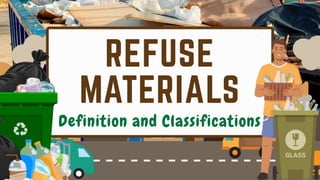
Refuse
Wood
Glass
Ashes
ESUFER AMETIRLAS
Definition and Classifications
It refers to any disposable materials,
which includes both recyclable and
non-recyclable materials. Basically,
these are the dump, food wastes or
discarded materials.
This term is often interchangeably with
waste, but refuse is a broad,
overarching term that applies to
anything that is leftover after it is used,
while waste only refers to leftovers that
cannot be recycled.
There are different kinds of refuse
materials such as garbage, rubbish,
ashes, street refuse, dead animals
abandoned vehicles, industrial,
demolition, construction and special
wastes, as well as sewage residue.
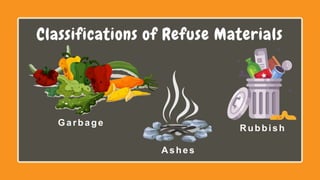
Classifications of Refuse Materials
Garbage
Ashes
Rubbish
Garbage
Waste from preparation,
cooking and serving of food,
market wastes, wastes from
handling, storage and sale of
produce
Households, restaurants,
institutions
Rubbish Combustible: paper, cartons,
boxes, barrels, wood, excelsior,
tree branches, yard trimmings,
wood furniture, bedding, dunnage
Non-combustible: metals, tin cans,
metal furniture, dirt, glass,
crockery, minerals
Same as garbage
Ashes
Residue from fires used for
cooking and heating and from
on-site incineration
Same as garbage
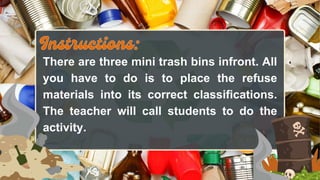
There are three mini trash bins infront. All
you have to do is to place the refuse
materials into its correct classifications.
The teacher will call students to do the
activity.
Garbage Rubbish Ashes
Rotten Mustasa Leaf
Yard Trimmings
Burned paper
Wood Furniture
Residue from
burned Cotton
Fish gills and
intestines
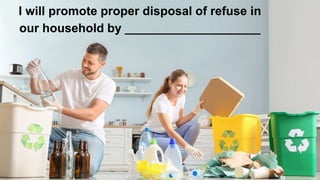
I will promote proper disposal of refuse in
our household by ____________________
I will promote proper disposal of refuse in our
school by ____________________
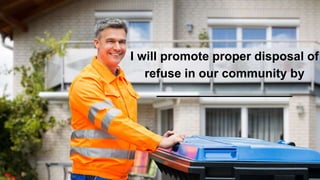
I will promote proper disposal of
refuse in our community by
____________________
In your statement, how can you
say that a healthy environment
positively impact the health of
people and communities?
Now that you know what is all about
Refuse Materials - its definition and three
classifications, work independently and
make your own ways on how you help the
environment. Please be guided with the
rubrics and mechanics in the presentation.
You'll be given 10 minutes to finish your
activity.
Create a tag line, phrase or motto in your
A4 size bond paper which promotes
proper disposal of refuse materials
Rubrics:
Content : 40%
Organization and Creativity: 30%
Visual Presentation: 30%
Make a poster in A4 size bond paper
which promotes proper disposal of
refuse materials
Rubrics:
Content : 40%
Organization and Creativity: 30%
Visual Presentation: 30%
Compose an essay A4 size bond paper
which promotes proper disposal of
refuse materials. Minimum of 10
sentences and 2 paragraphs
Explanation of Ideas : 40%
Coherence: 30%
Grammar Usage : 30%
For this activity, we will
estabtish tules and agree on
consequences when the time
is over. Also, a reward will be
given to the first person who
will finish first or ahead of time
Answer the following questions in
the next slide of the presentation.
It refers to any disposable materials, which
includes both recyclable and non-
recyclable materials. Basically, there are
the dump, food wastes or discarded
materials.
QUESTION NUMBER 1
There are different classifications of refuse
maerials. What kind of policies, guidelines
and refuse has a composition of waste
from preparation, cooking and serving of
food, market wastes, wastes from handling
storage and sale of produce?
QUESTION NUMBER 2
Enumerate the two kinds of rubbish as a
kind of refuse material
QUESTION NUMBER 3 and 4
These are residue from fires used for
cooking and heating and from on-site
incineration. What classification of refuse
materials is this one?
QUESTION NUMBER 5
Read and research about street refuse,
dead animals and abandoned vehicles.
Answer and copy the table on the next
slide.
TYPE COMPOSITION SOURCES
STREET REFUSE
DEAD ANIMALS
ABANDONED VEHICLES
Submit your assignment tomorrow as we
continue discussing the classifications of
refuse materials
Classroom Observation - Refuse Materials.pptx

Classroom Observation - Refuse Materials.pptx

  • 3.
    The teacher willroll the magic dice
  • 4.
    The number thatappears in the box is the number of the student who will answet the questions in the next slides
  • 5.
    For the secondroll, the number that will appear will be added and counted to the person who answered the first question
  • 6.
    And then thesum of their numbers will be the one to answer the next questions. Good luck and answer it correctly!
  • 7.
    These are illnessescaused by viruses or bacteria that people spread to one another through contact with contaminated surfaces, bodily fluids, blood products, insect bites, or through the air. EMUNCBOMIALC EASDIES
  • 8.
    These are illnessescaused by viruses or bacteria that people spread to one another through contact with contaminated surfaces, bodily fluids, blood products, insect bites, or through the air. COMMUNICABLE DISEASE
  • 9.
    These are catastrophicevents that result from any of the Earth's natural phenomena. These can range from floods and hurricanes to tsunamis and earthquakes. UTALARN SRETASSDI
  • 10.
    These are catastrophicevents that result from any of the Earth's natural phenomena. These can range from floods and hurricanes to tsunamis and earthquakes. NATURAL DISASTERS
  • 11.
    This is asituation in which there is resort to armed force between States or protracted resort to armed force between governmental authorities and organized armed groups. DMERA CLIFSONTC
  • 12.
    This is asituation in which there is resort to armed force between States or protracted resort to armed force between governmental authorities and organized armed groups. ARMED CONFLICTS
  • 14.
  • 15.
  • 16.
  • 17.
    It refers toany disposable materials, which includes both recyclable and non-recyclable materials. Basically, these are the dump, food wastes or discarded materials.
  • 18.
    This term isoften interchangeably with waste, but refuse is a broad, overarching term that applies to anything that is leftover after it is used, while waste only refers to leftovers that cannot be recycled.
  • 19.
    There are differentkinds of refuse materials such as garbage, rubbish, ashes, street refuse, dead animals abandoned vehicles, industrial, demolition, construction and special wastes, as well as sewage residue.
  • 20.
    Classifications of RefuseMaterials Garbage Ashes Rubbish
  • 21.
    Garbage Waste from preparation, cookingand serving of food, market wastes, wastes from handling, storage and sale of produce Households, restaurants, institutions
  • 24.
    Rubbish Combustible: paper,cartons, boxes, barrels, wood, excelsior, tree branches, yard trimmings, wood furniture, bedding, dunnage Non-combustible: metals, tin cans, metal furniture, dirt, glass, crockery, minerals Same as garbage
  • 27.
    Ashes Residue from firesused for cooking and heating and from on-site incineration Same as garbage
  • 31.
    There are threemini trash bins infront. All you have to do is to place the refuse materials into its correct classifications. The teacher will call students to do the activity.
  • 32.
  • 33.
  • 34.
  • 35.
  • 36.
  • 37.
  • 38.
  • 40.
    I will promoteproper disposal of refuse in our household by ____________________
  • 41.
    I will promoteproper disposal of refuse in our school by ____________________
  • 42.
    I will promoteproper disposal of refuse in our community by ____________________
  • 43.
    In your statement,how can you say that a healthy environment positively impact the health of people and communities?
  • 45.
    Now that youknow what is all about Refuse Materials - its definition and three classifications, work independently and make your own ways on how you help the environment. Please be guided with the rubrics and mechanics in the presentation. You'll be given 10 minutes to finish your activity.
  • 47.
    Create a tagline, phrase or motto in your A4 size bond paper which promotes proper disposal of refuse materials Rubrics: Content : 40% Organization and Creativity: 30% Visual Presentation: 30%
  • 50.
    Make a posterin A4 size bond paper which promotes proper disposal of refuse materials Rubrics: Content : 40% Organization and Creativity: 30% Visual Presentation: 30%
  • 53.
    Compose an essayA4 size bond paper which promotes proper disposal of refuse materials. Minimum of 10 sentences and 2 paragraphs Explanation of Ideas : 40% Coherence: 30% Grammar Usage : 30%
  • 54.
    For this activity,we will estabtish tules and agree on consequences when the time is over. Also, a reward will be given to the first person who will finish first or ahead of time
  • 56.
    Answer the followingquestions in the next slide of the presentation.
  • 57.
    It refers toany disposable materials, which includes both recyclable and non- recyclable materials. Basically, there are the dump, food wastes or discarded materials. QUESTION NUMBER 1
  • 58.
    There are differentclassifications of refuse maerials. What kind of policies, guidelines and refuse has a composition of waste from preparation, cooking and serving of food, market wastes, wastes from handling storage and sale of produce? QUESTION NUMBER 2
  • 59.
    Enumerate the twokinds of rubbish as a kind of refuse material QUESTION NUMBER 3 and 4
  • 60.
    These are residuefrom fires used for cooking and heating and from on-site incineration. What classification of refuse materials is this one? QUESTION NUMBER 5
  • 62.
    Read and researchabout street refuse, dead animals and abandoned vehicles. Answer and copy the table on the next slide.
  • 63.
    TYPE COMPOSITION SOURCES STREETREFUSE DEAD ANIMALS ABANDONED VEHICLES
  • 64.
    Submit your assignmenttomorrow as we continue discussing the classifications of refuse materials