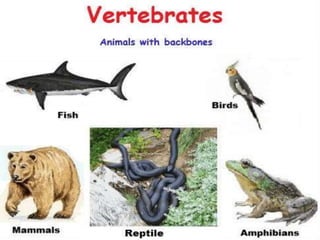
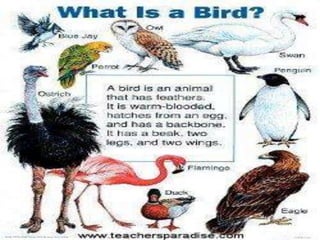
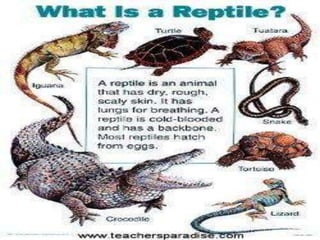
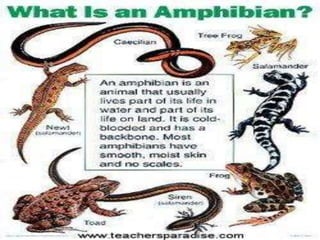
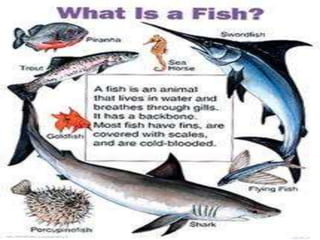
an animal of a large group
distinguished by the
possession of a backbone
or spinal column, including
mammals, birds, reptiles,
amphibians, and fishes.
an animal lacking a backbone,
such as an arthropod, mollusk,
annelid, coelenterate, etc. The
invertebrates constitute an
artificial division of the animal
kingdom, comprising 95 percent
of animal species and about 30
different phyla.
Name the five groups of
vertebrates and five
examples for each group.
What are the common
characteristics of each
group of vertebrates?
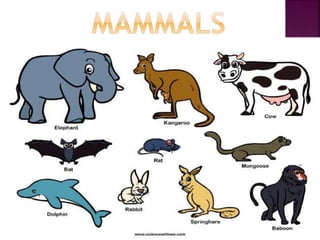
What are different kinds
of mammals?
Name the six groups of
invertebrates and give
examples for each
group.
What are the common
characteristics of each
group of invertebrates?
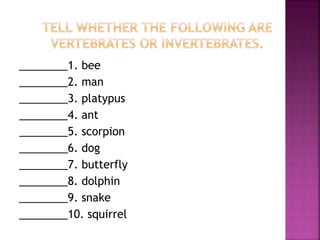
________1. bee
________2. man
________3. platypus
________4. ant
________5. scorpion
________6. dog
________7. butterfly
________8. dolphin
________9. snake
________10. squirrel
Make a research
about the
characteristics of
each group of
vertebrates.

Classify animals into vertebrates and invertebrates

  • 2.
    an animal ofa large group distinguished by the possession of a backbone or spinal column, including mammals, birds, reptiles, amphibians, and fishes.
  • 10.
    an animal lackinga backbone, such as an arthropod, mollusk, annelid, coelenterate, etc. The invertebrates constitute an artificial division of the animal kingdom, comprising 95 percent of animal species and about 30 different phyla.
  • 15.
    Name the fivegroups of vertebrates and five examples for each group. What are the common characteristics of each group of vertebrates? What are different kinds of mammals?
  • 16.
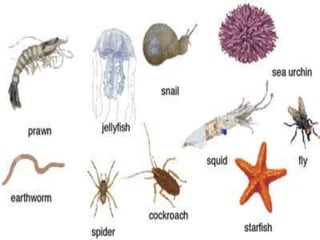
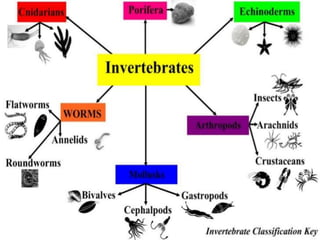
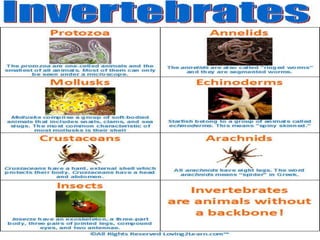
    Name the sixgroups of invertebrates and give examples for each group. What are the common characteristics of each group of invertebrates?
  • 17.
    ________1. bee ________2. man ________3.platypus ________4. ant ________5. scorpion ________6. dog ________7. butterfly ________8. dolphin ________9. snake ________10. squirrel
  • 18.
    Make a research aboutthe characteristics of each group of vertebrates.