CLASSIFICATION OF COMPUTER
BY DATA PROCESSED
NAME:
CF ASSIGNMENT 2
FYBCA SEM 1
OVERVIEW AND HISTORY
1. Computer systems may be classified according to the data they
are designed to process or they may be classified according to
their size and capabilities.
2. The data required for processing may be obtained either as a
result of counting or through some measuring device.
3. Data obtained through counting is known as discrete data, while
that obtained through measuring instruments is known as
continuous data.
4. An example of discrete data is the number of marks obtained by a
student in an examination, while the constant monitoring of the
Electro-Cardiogram of a patient is an example of continuous data.
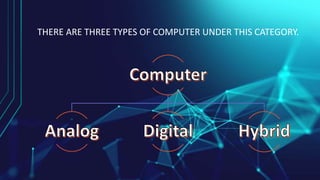
THERE ARE THREE TYPES OF COMPUTER UNDER THIS CATEGORY.
ANALOG COMPUTER
1. Computers that measure the continuous physical magnitude or
electrical states.
2. For example pressure, temperature, voltage, volume, etc.
3. A speedometer in a vehicle is another example of analog
computer.
4. Analog computers are used for scientific, engineering & process
control purposes.
5. Since they deal with quantities that are continuously varying in
nature, they give only approximate result i.e. Not accurate results
as in digital computer.
ANALOG COMPUTER
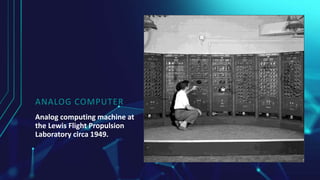
Analog computing machine at
the Lewis Flight Propulsion
Laboratory circa 1949.
DIGITAL COMPUTER
1. computer designed to processed data in discrete numerical
form which are represented by discrete signal using binary code,
numbers, letters, and symbols are represented by codes based on
the binary number system consisting of two digits
2. .i.e. 1,0 the digital computer must convert all data to binary form.
Generally, results from digital computer are more than the results
from analog computers.
3. They are used for counting and calculating numbers. Examples
are calculator, adding machine, counting machine, etc.
DIGITAL COMPUTER
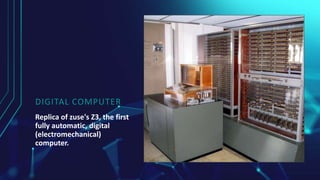
Replica of zuse's Z3, the first
fully automatic, digital
(electromechanical)
computer.
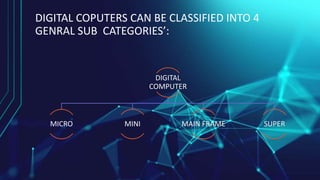
DIGITAL COPUTERS CAN BE CLASSIFIED INTO 4
GENRAL SUB CATEGORIES’:
DIGITAL
COMPUTER
MICRO MINI MAIN FRAME SUPER
HYBRID COMPUTER
1. A hybrid computing system is one in which desirable
characteristics of both the analog and digital computers are
integrated.
2. n an intensive care unit, analog computers may measure the
patient’s heart rate, temperature, etc.
3. The measurements may then be converted into numbers and
supplied to the digital part of the system which will thereafter
regulate the flow of certain medications.
4. They can be used for both counting and measuring. In fact, they
are very useful in the control of manufacturing and processing.
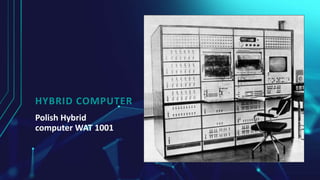
HYBRID COMPUTER
Polish Hybrid
computer WAT 1001
Classification of computer by data processed

Classification of computer by data processed

  • 1.
    CLASSIFICATION OF COMPUTER BYDATA PROCESSED NAME: CF ASSIGNMENT 2 FYBCA SEM 1
  • 2.
    OVERVIEW AND HISTORY 1.Computer systems may be classified according to the data they are designed to process or they may be classified according to their size and capabilities. 2. The data required for processing may be obtained either as a result of counting or through some measuring device. 3. Data obtained through counting is known as discrete data, while that obtained through measuring instruments is known as continuous data. 4. An example of discrete data is the number of marks obtained by a student in an examination, while the constant monitoring of the Electro-Cardiogram of a patient is an example of continuous data.
  • 3.
    THERE ARE THREETYPES OF COMPUTER UNDER THIS CATEGORY.
  • 4.
    ANALOG COMPUTER 1. Computersthat measure the continuous physical magnitude or electrical states. 2. For example pressure, temperature, voltage, volume, etc. 3. A speedometer in a vehicle is another example of analog computer. 4. Analog computers are used for scientific, engineering & process control purposes. 5. Since they deal with quantities that are continuously varying in nature, they give only approximate result i.e. Not accurate results as in digital computer.
  • 5.
    ANALOG COMPUTER Analog computingmachine at the Lewis Flight Propulsion Laboratory circa 1949.
  • 6.
    DIGITAL COMPUTER 1. computerdesigned to processed data in discrete numerical form which are represented by discrete signal using binary code, numbers, letters, and symbols are represented by codes based on the binary number system consisting of two digits 2. .i.e. 1,0 the digital computer must convert all data to binary form. Generally, results from digital computer are more than the results from analog computers. 3. They are used for counting and calculating numbers. Examples are calculator, adding machine, counting machine, etc.
  • 7.
    DIGITAL COMPUTER Replica ofzuse's Z3, the first fully automatic, digital (electromechanical) computer.
  • 8.
    DIGITAL COPUTERS CANBE CLASSIFIED INTO 4 GENRAL SUB CATEGORIES’: DIGITAL COMPUTER MICRO MINI MAIN FRAME SUPER
  • 9.
    HYBRID COMPUTER 1. Ahybrid computing system is one in which desirable characteristics of both the analog and digital computers are integrated. 2. n an intensive care unit, analog computers may measure the patient’s heart rate, temperature, etc. 3. The measurements may then be converted into numbers and supplied to the digital part of the system which will thereafter regulate the flow of certain medications. 4. They can be used for both counting and measuring. In fact, they are very useful in the control of manufacturing and processing.
  • 10.