Classification
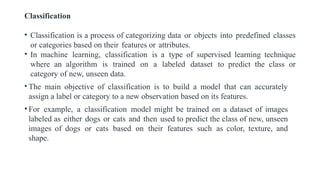
• Classification is a process of categorizing data or objects into predefined classes
or categories based on their features or attributes.
• In machine learning, classification is a type of supervised learning technique
where an algorithm is trained on a labeled dataset to predict the class or
category of new, unseen data.
• The main objective of classification is to build a model that can accurately
assign a label or category to a new observation based on its features.
• For example, a classification model might be trained on a dataset of images
labeled as either dogs or cats and then used to predict the class of new, unseen
images of dogs or cats based on their features such as color, texture, and
shape.
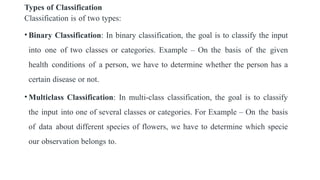
Types of Classification
Classification is of two types:
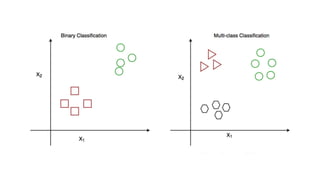
• Binary Classification: In binary classification, the goal is to classify the input
into one of two classes or categories. Example – On the basis of the given
health conditions of a person, we have to determine whether the person has a
certain disease or not.
• Multiclass Classification: In multi-class classification, the goal is to classify
the input into one of several classes or categories. For Example – On the basis
of data about different species of flowers, we have to determine which specie
our observation belongs to.
Types of classification algorithms
There are various types of classifiers. Some of them are :
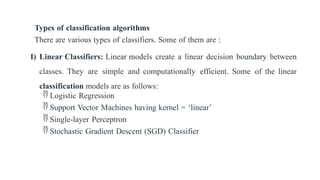
I) Linear Classifiers: Linear models create a linear decision boundary between
classes. They are simple and computationally efficient. Some of the linear
classification models are as follows:
 Logistic Regression
 Support Vector Machines having kernel = ‘linear’
 Single-layer Perceptron
 Stochastic Gradient Descent (SGD) Classifier
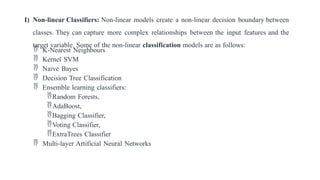
I) Non-linear Classifiers: Non-linear models create a non-linear decision boundary between
classes. They can capture more complex relationships between the input features and the
target variable. Some of the non-linear classification models are as follows:
 K-Nearest Neighbours
 Kernel SVM
 Naive Bayes
 Decision Tree Classification
 Ensemble learning classifiers:
Random Forests,
AdaBoost,
Bagging Classifier,
Voting Classifier,
ExtraTrees Classifier
 Multi-layer Artificial Neural Networks
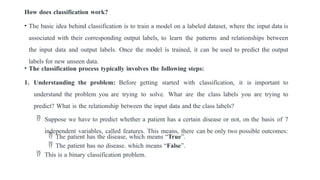
How does classification work?
• The basic idea behind classification is to train a model on a labeled dataset, where the input data is
associated with their corresponding output labels, to learn the patterns and relationships between
the input data and output labels. Once the model is trained, it can be used to predict the output
labels for new unseen data.
• The classification process typically involves the following steps:
1. Understanding the problem: Before getting started with classification, it is important to
understand the problem you are trying to solve. What are the class labels you are trying to
predict? What is the relationship between the input data and the class labels?
 Suppose we have to predict whether a patient has a certain disease or not, on the basis of 7
independent variables, called features. This means, there can be only two possible outcomes:
 The patient has the disease, which means “True”.
 The patient has no disease. which means “False”.
 This is a binary classification problem.

classification in Data Analysis Data Analysis.pptx

  • 2.
    Classification • Classification isa process of categorizing data or objects into predefined classes or categories based on their features or attributes. • In machine learning, classification is a type of supervised learning technique where an algorithm is trained on a labeled dataset to predict the class or category of new, unseen data. • The main objective of classification is to build a model that can accurately assign a label or category to a new observation based on its features. • For example, a classification model might be trained on a dataset of images labeled as either dogs or cats and then used to predict the class of new, unseen images of dogs or cats based on their features such as color, texture, and shape.
  • 3.
    Types of Classification Classificationis of two types: • Binary Classification: In binary classification, the goal is to classify the input into one of two classes or categories. Example – On the basis of the given health conditions of a person, we have to determine whether the person has a certain disease or not. • Multiclass Classification: In multi-class classification, the goal is to classify the input into one of several classes or categories. For Example – On the basis of data about different species of flowers, we have to determine which specie our observation belongs to.
  • 5.
    Types of classificationalgorithms There are various types of classifiers. Some of them are : I) Linear Classifiers: Linear models create a linear decision boundary between classes. They are simple and computationally efficient. Some of the linear classification models are as follows:  Logistic Regression  Support Vector Machines having kernel = ‘linear’  Single-layer Perceptron  Stochastic Gradient Descent (SGD) Classifier
  • 6.
    I) Non-linear Classifiers:Non-linear models create a non-linear decision boundary between classes. They can capture more complex relationships between the input features and the target variable. Some of the non-linear classification models are as follows:  K-Nearest Neighbours  Kernel SVM  Naive Bayes  Decision Tree Classification  Ensemble learning classifiers: Random Forests, AdaBoost, Bagging Classifier, Voting Classifier, ExtraTrees Classifier  Multi-layer Artificial Neural Networks
  • 7.
    How does classificationwork? • The basic idea behind classification is to train a model on a labeled dataset, where the input data is associated with their corresponding output labels, to learn the patterns and relationships between the input data and output labels. Once the model is trained, it can be used to predict the output labels for new unseen data. • The classification process typically involves the following steps: 1. Understanding the problem: Before getting started with classification, it is important to understand the problem you are trying to solve. What are the class labels you are trying to predict? What is the relationship between the input data and the class labels?  Suppose we have to predict whether a patient has a certain disease or not, on the basis of 7 independent variables, called features. This means, there can be only two possible outcomes:  The patient has the disease, which means “True”.  The patient has no disease. which means “False”.  This is a binary classification problem.