The document discusses the Classification and Regression Trees (CART) methodology introduced in 1984, which predicts target variable values based on input variables. It explains the distinction between classification trees, used for categorical targets, and regression trees for continuous targets. The document highlights the simplicity and nonparametric nature of CART, along with its advantages and limitations in machine learning.
Introduction to Classification and Regression Trees (CART) methodology, created to model and predict target variable values based on independent variables.
Classification trees are algorithms focusing on categorical target variables, used to categorize or identify classes.
Regression trees are algorithms focusing on continuous target variables to predict their values, like housing prices.
Comparison of classification and regression trees, detailing when to use each based on response variable type.
CART advantages include simplicity, nonparametric nature, nonlinear structure, and implicit feature selection.
CART limitations address issues such as overfitting, high variance, and low bias.
CART is a foundational predictive algorithm in machine learning, influencing advanced algorithms like random forests.
Brief mention of upcoming topics related to statistical methods including Discriminant Analysis and Linear Regression.
Decision Trees arecommonly used in data mining with
the objective of creating a model that predicts the
value of a target (or dependent variable) based on the
values of several input (or independent variables). In
today's post, we discuss the CART decision tree
methodology. The CART or Classification & Regression
Trees methodology was introduced in 1984 by Leo
Breiman, Jerome Friedman, Richard Olshen and Charles
Stone as an umbrella term to refer to the following
types of decision trees.
CART decision tree methodology
3.
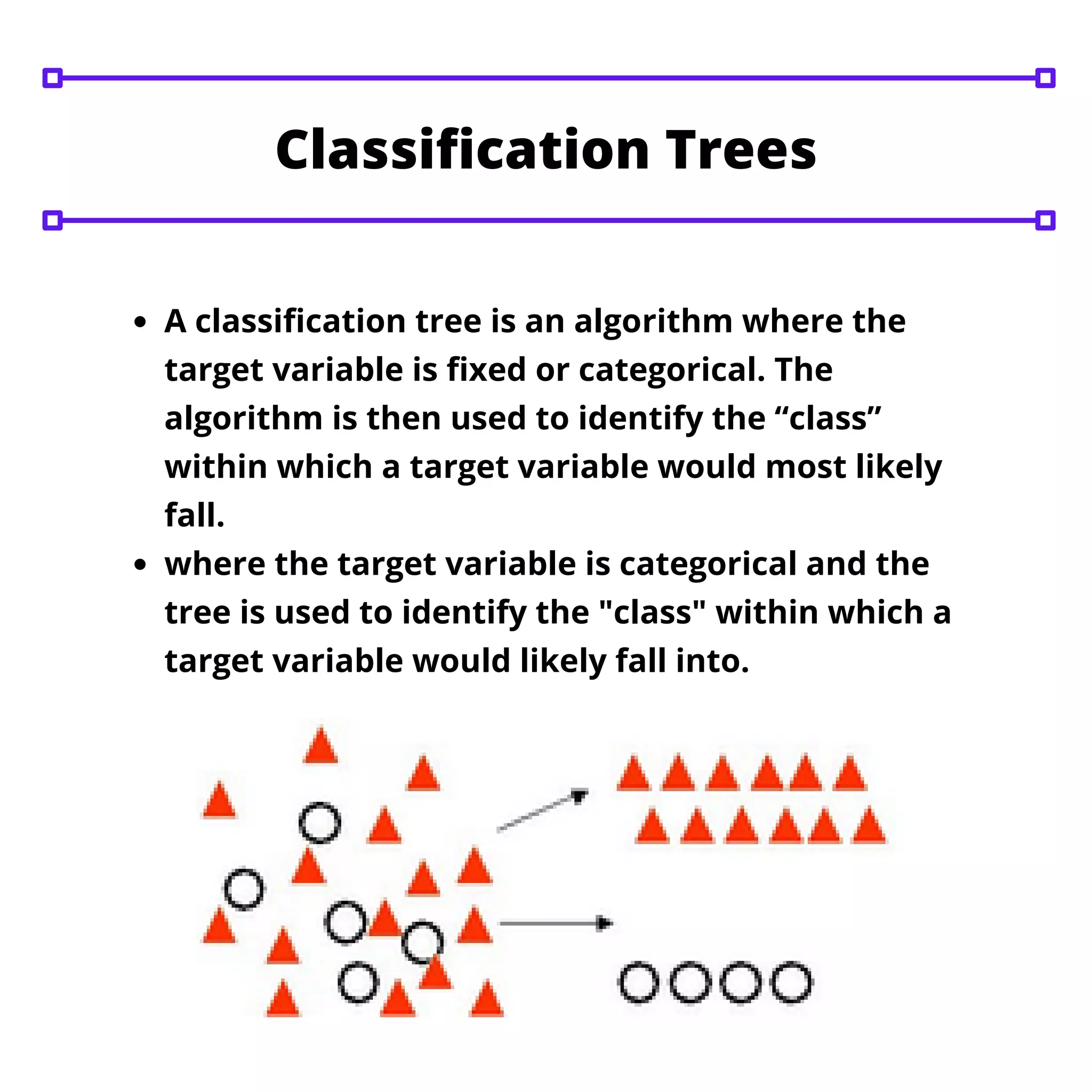
A classification treeis an algorithm where the
target variable is fixed or categorical. The
algorithm is then used to identify the “class”
within which a target variable would most likely
fall.
where the target variable is categorical and the
tree is used to identify the "class" within which a
target variable would likely fall into.
Classification Trees
4.
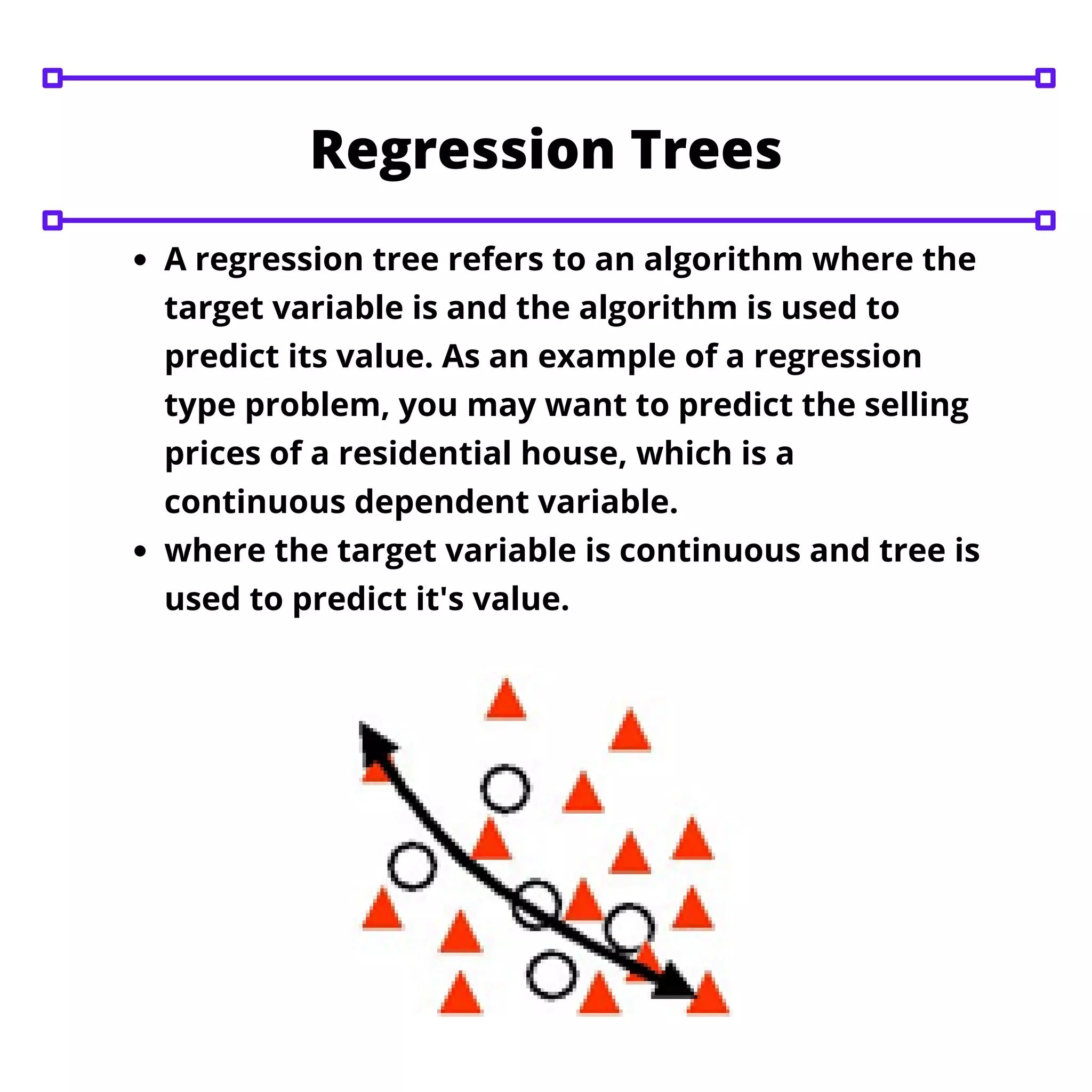
A regression treerefers to an algorithm where the
target variable is and the algorithm is used to
predict its value. As an example of a regression
type problem, you may want to predict the selling
prices of a residential house, which is a
continuous dependent variable.
where the target variable is continuous and tree is
used to predict it's value.
Regression Trees
5.
Decision trees areeasily understood and there are
several classification and regression trees ppts to
make things even simpler. However, it’s important to
understand that there are some fundamental
differences between classification and regression
trees.
Differences CART
6.
Classification trees areused when the dataset
needs to be split into classes that belong to the
response variable. In many cases, the classes Yes
or No.
In other words, they are just two and mutually
exclusive. In some cases, there may be more than
two classes in which case a variant of the
classification tree algorithm is used.
When to use CART?
7.
Regression trees, onthe other hand, are used
when the response variable is continuous. For
instance, if the response variable is something like
the price of a property or the temperature of the
day, a regression tree is used.
In other words, regression trees are used for
prediction-type problems while classification trees
are used for classification-type problems.
8.
The Results areSimplistic
Classification and Regression Trees are
Nonparametric & Nonlinear
Classification and Regression Trees Implicitly
Perform Feature Selection
Advantages of CART
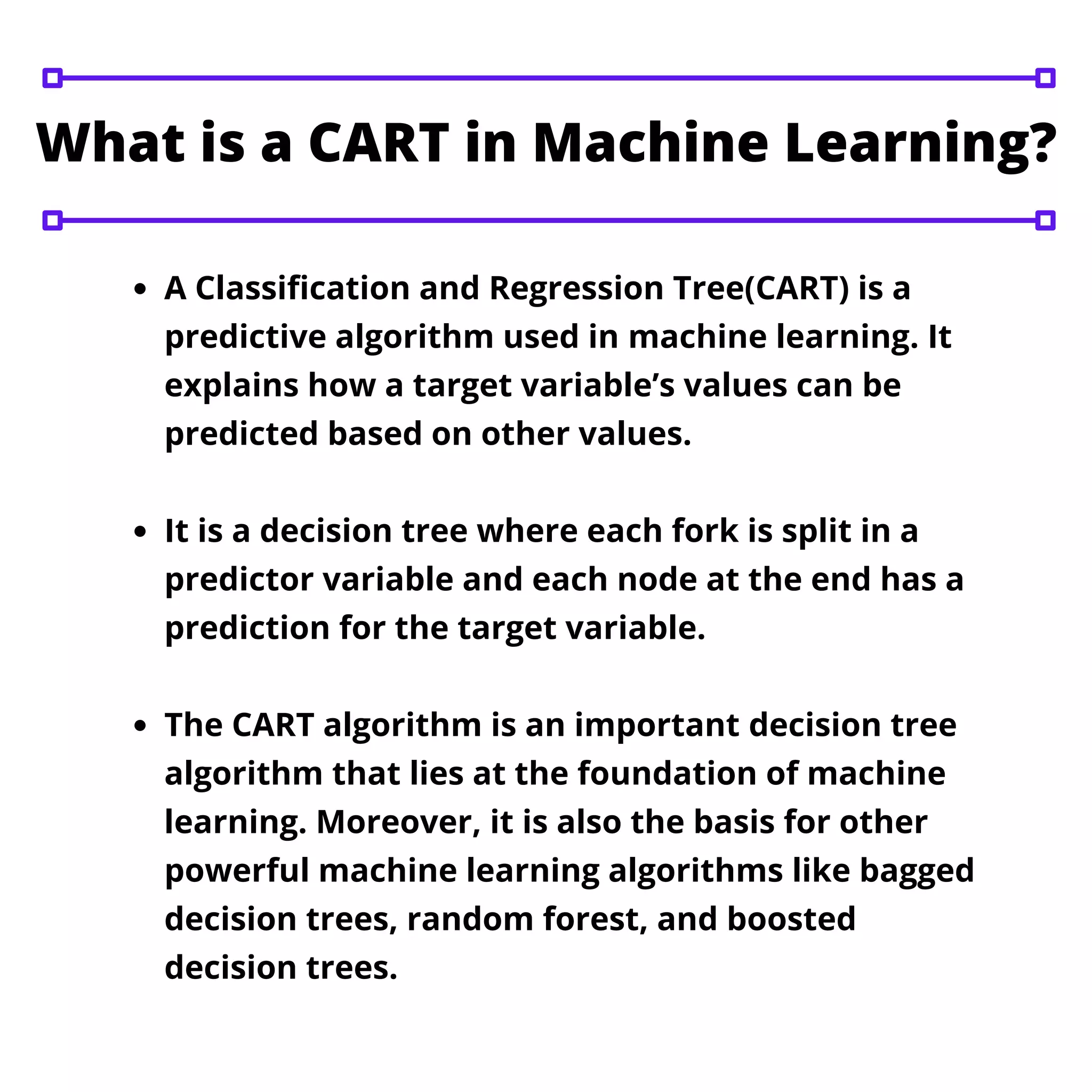
What is aCART in Machine Learning?
A Classification and Regression Tree(CART) is a
predictive algorithm used in machine learning. It
explains how a target variable’s values can be
predicted based on other values.
It is a decision tree where each fork is split in a
predictor variable and each node at the end has a
prediction for the target variable.
The CART algorithm is an important decision tree
algorithm that lies at the foundation of machine
learning. Moreover, it is also the basis for other
powerful machine learning algorithms like bagged
decision trees, random forest, and boosted
decision trees.