Swipe
AI - Popular Search Algorithms
AI
Searching is the universal technique of problem
solving in AI.
There are some single-player games such as tile
games, Sudoku, crossword, etc.
The search algorithms help you to search for a
particular position in such games.
AI - Popular Search Algorithms
The games such as 3X3 eight-tile, 4X4 fifteen-tile,
and 5X5 twenty four tile puzzles are single-agent-
path-finding challenges.
They consist of a matrix of tiles with a blank tile.
The player is required to arrange the tiles by
sliding a tile either vertically or horizontally into a
blank space with the aim of accomplishing some
objective.
The other examples of single agent pathfinding
problems are Travelling Salesman Problem,
Rubik’s Cube, and Theorem Proving.
Single Agent Pathfinding Problems
Problem Space − It is the environment in which
the search takes place. (A set of states and set of
operators to change those states)
Problem Instance − It is Initial state + Goal state.
Problem Space Graph − It represents problem
state. States are shown by nodes and operators
are shown by edges.
Depth of a problem − Length of a shortest path or
shortest sequence of operators from Initial State
to goal state.
Search Terminology
Space Complexity − The maximum number of
nodes that are stored in memory.
Time Complexity − The maximum number of
nodes that are created.
Admissibility − A property of an algorithm to
always find an optimal solution.
Branching Factor − The average number of child
nodes in the problem space graph.
Depth − Length of the shortest path from initial
state to goal state.
They are most simple, as they do not need any
domain-specific knowledge. They work fine with
small number of possible states.
Requirements:-
State description
A set of valid operators
Initial state
Goal state description
Brute-Force Search Strategies
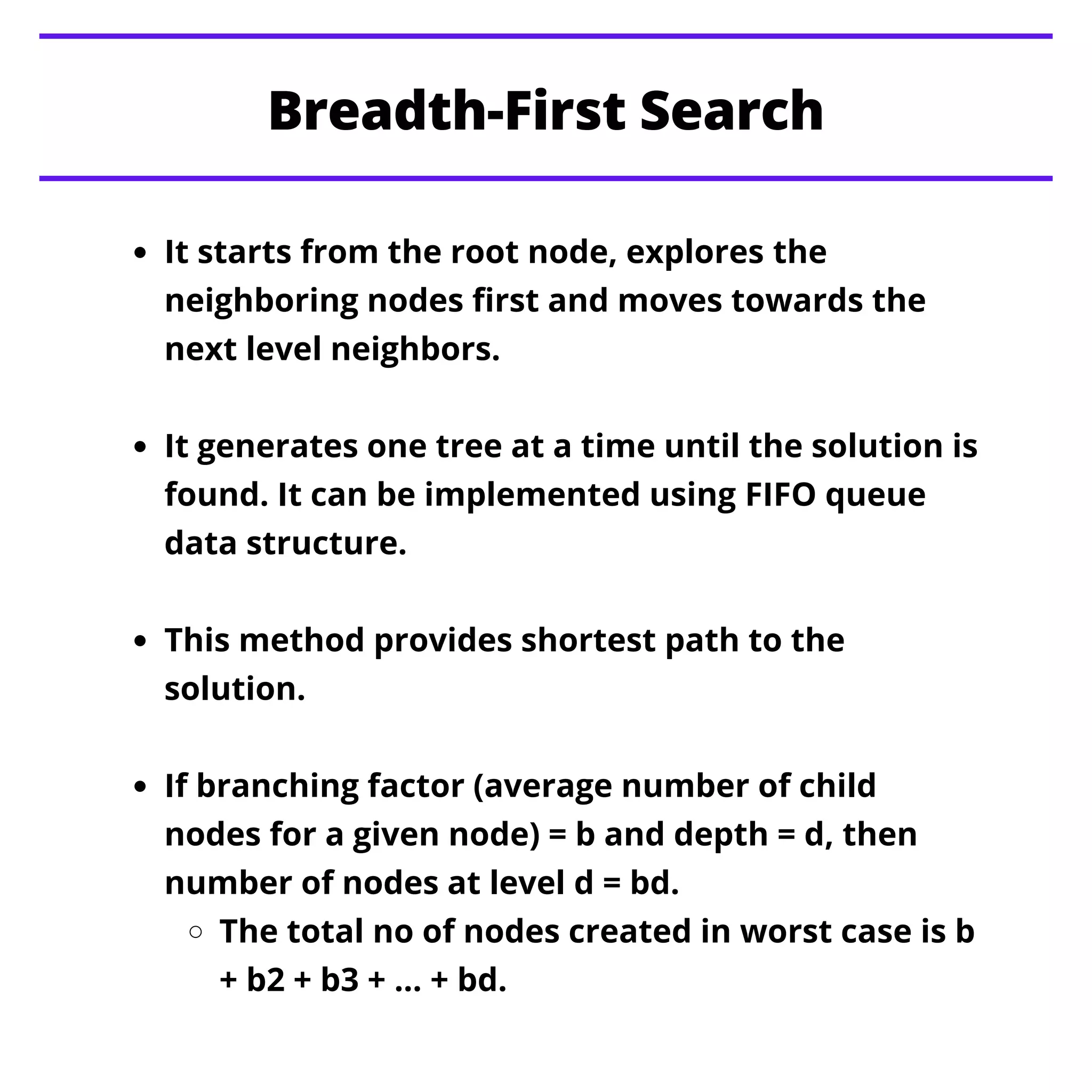
It starts from the root node, explores the
neighboring nodes first and moves towards the
next level neighbors.
It generates one tree at a time until the solution is
found. It can be implemented using FIFO queue
data structure.
This method provides shortest path to the
solution.
If branching factor (average number of child
nodes for a given node) = b and depth = d, then
number of nodes at level d = bd.
The total no of nodes created in worst case is b
+ b2 + b3 + … + bd.
Breadth-First Search
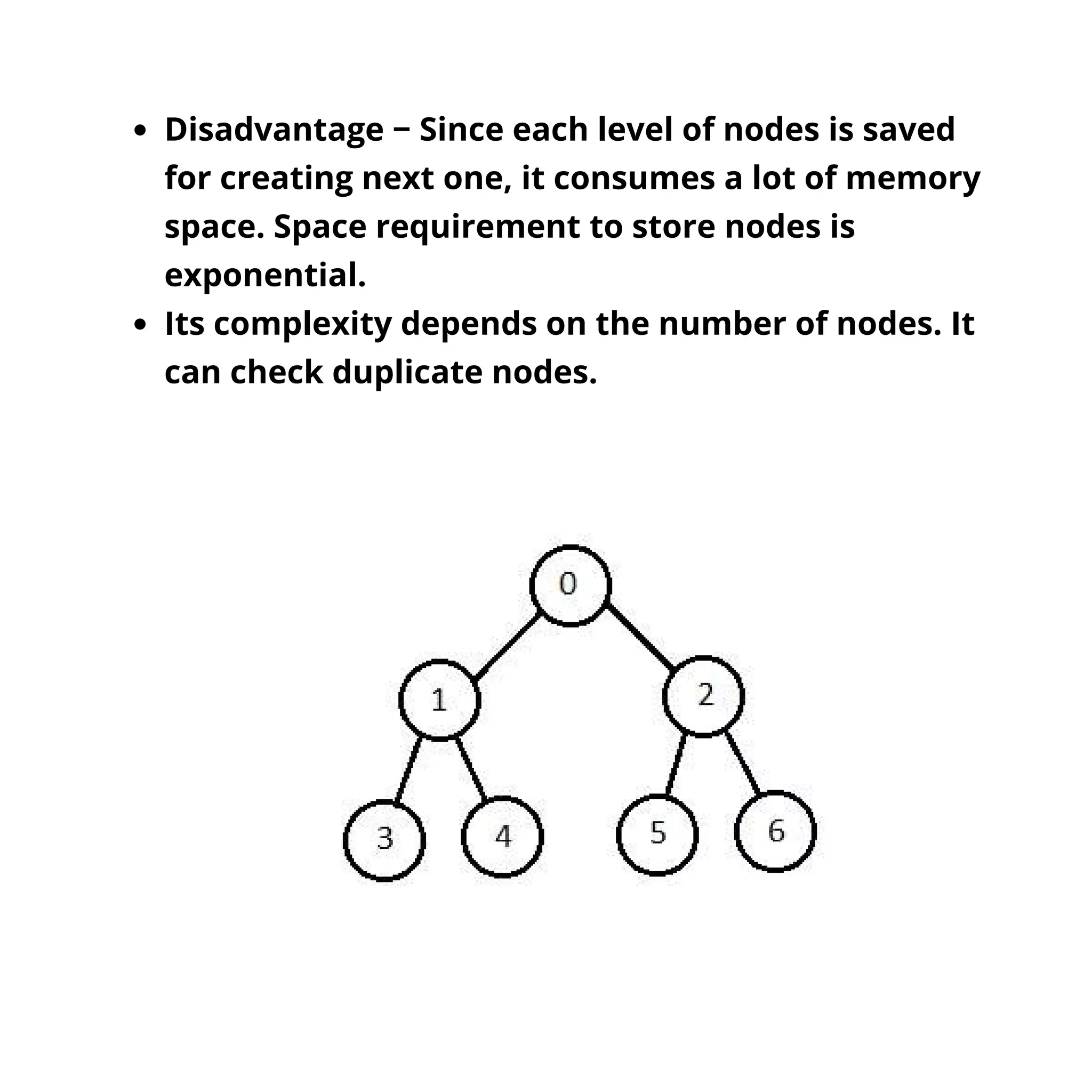
Disadvantage − Since each level of nodes is saved
for creating next one, it consumes a lot of memory
space. Space requirement to store nodes is
exponential.
Its complexity depends on the number of nodes. It
can check duplicate nodes.
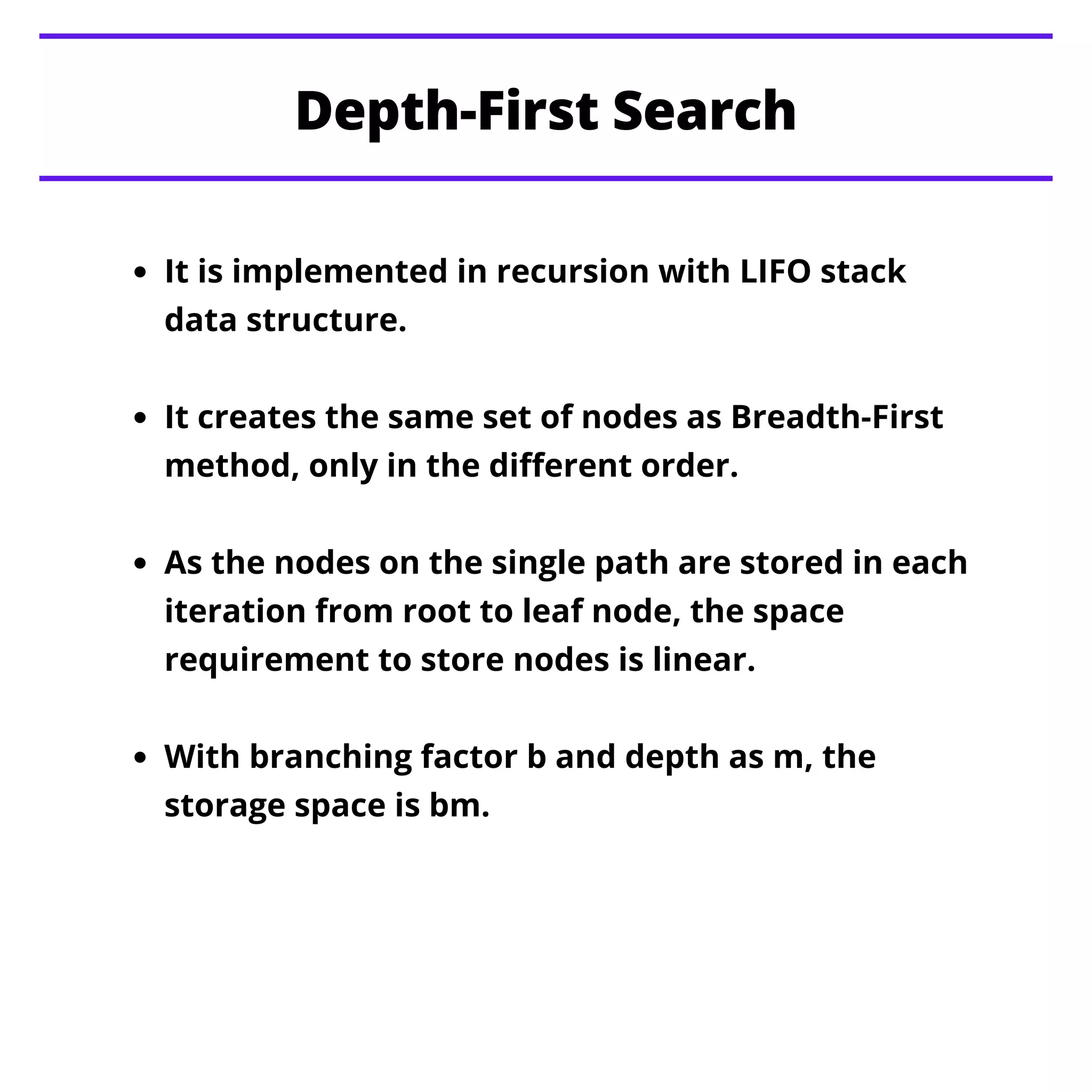
Depth-First Search
It is implemented in recursion with LIFO stack
data structure.
It creates the same set of nodes as Breadth-First
method, only in the different order.
As the nodes on the single path are stored in each
iteration from root to leaf node, the space
requirement to store nodes is linear.
With branching factor b and depth as m, the
storage space is bm.
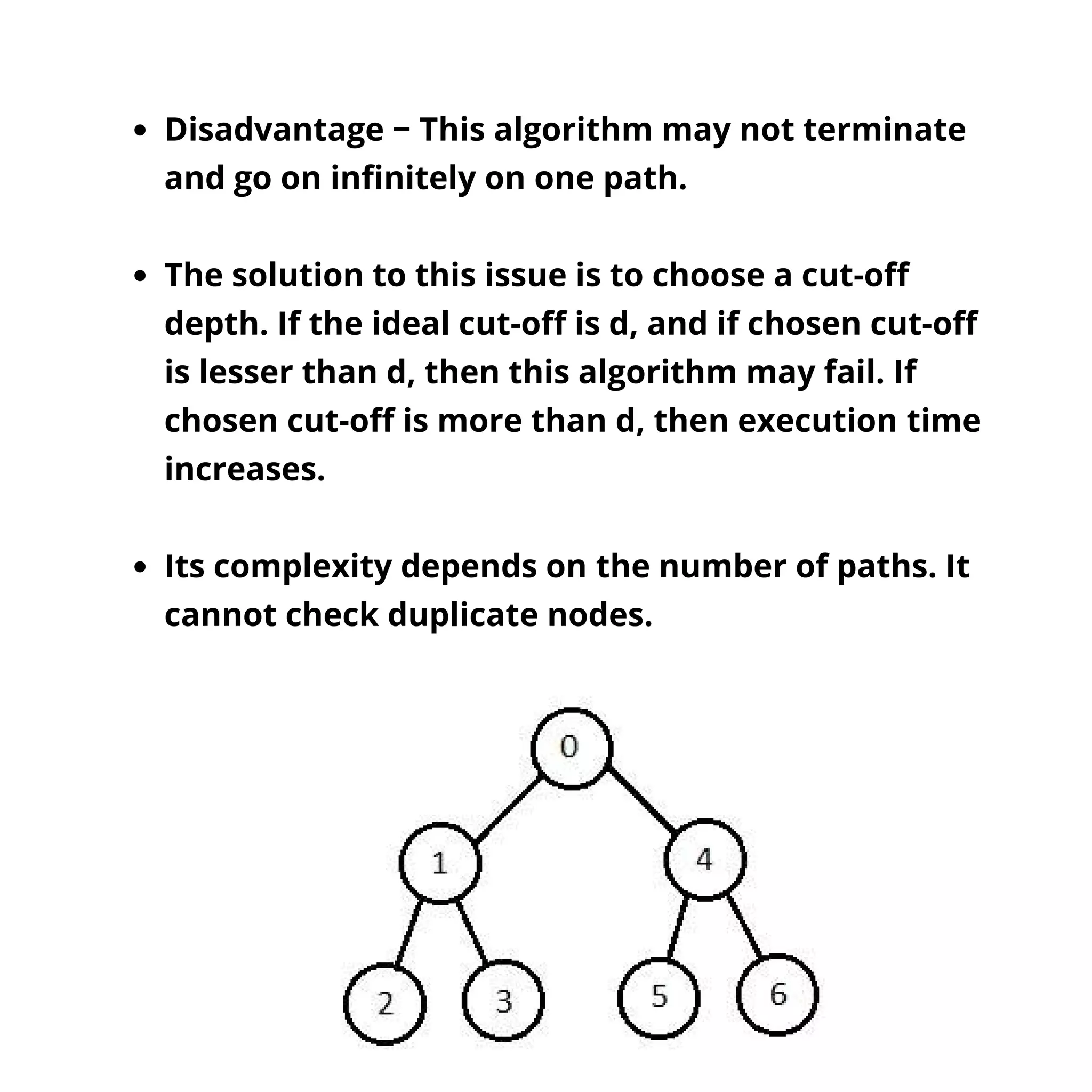
Disadvantage − This algorithm may not terminate
and go on infinitely on one path.
The solution to this issue is to choose a cut-off
depth. If the ideal cut-off is d, and if chosen cut-off
is lesser than d, then this algorithm may fail. If
chosen cut-off is more than d, then execution time
increases.
Its complexity depends on the number of paths. It
cannot check duplicate nodes.
Depth-First Search
It is implemented in recursion with LIFO stack
data structure.
It creates the same set of nodes as Breadth-First
method, only in the different order.
As the nodes on the single path are stored in each
iteration from root to leaf node, the space
requirement to store nodes is linear.
With branching factor b and depth as m, the
storage space is bm.
AI - Natural Language Processing
Artificial Intelligence - Expert
Systems
Artificial Intelligence - Robotics
Topics for next Post
Stay Tuned with

Ai popular search algorithms

  • 1.
    Swipe AI - PopularSearch Algorithms AI
  • 2.
    Searching is theuniversal technique of problem solving in AI. There are some single-player games such as tile games, Sudoku, crossword, etc. The search algorithms help you to search for a particular position in such games. AI - Popular Search Algorithms
  • 3.
    The games suchas 3X3 eight-tile, 4X4 fifteen-tile, and 5X5 twenty four tile puzzles are single-agent- path-finding challenges. They consist of a matrix of tiles with a blank tile. The player is required to arrange the tiles by sliding a tile either vertically or horizontally into a blank space with the aim of accomplishing some objective. The other examples of single agent pathfinding problems are Travelling Salesman Problem, Rubik’s Cube, and Theorem Proving. Single Agent Pathfinding Problems
  • 4.
    Problem Space −It is the environment in which the search takes place. (A set of states and set of operators to change those states) Problem Instance − It is Initial state + Goal state. Problem Space Graph − It represents problem state. States are shown by nodes and operators are shown by edges. Depth of a problem − Length of a shortest path or shortest sequence of operators from Initial State to goal state. Search Terminology
  • 5.
    Space Complexity −The maximum number of nodes that are stored in memory. Time Complexity − The maximum number of nodes that are created. Admissibility − A property of an algorithm to always find an optimal solution. Branching Factor − The average number of child nodes in the problem space graph. Depth − Length of the shortest path from initial state to goal state.
  • 6.
    They are mostsimple, as they do not need any domain-specific knowledge. They work fine with small number of possible states. Requirements:- State description A set of valid operators Initial state Goal state description Brute-Force Search Strategies
  • 7.
    It starts fromthe root node, explores the neighboring nodes first and moves towards the next level neighbors. It generates one tree at a time until the solution is found. It can be implemented using FIFO queue data structure. This method provides shortest path to the solution. If branching factor (average number of child nodes for a given node) = b and depth = d, then number of nodes at level d = bd. The total no of nodes created in worst case is b + b2 + b3 + … + bd. Breadth-First Search
  • 8.
    Disadvantage − Sinceeach level of nodes is saved for creating next one, it consumes a lot of memory space. Space requirement to store nodes is exponential. Its complexity depends on the number of nodes. It can check duplicate nodes.
  • 9.
    Depth-First Search It isimplemented in recursion with LIFO stack data structure. It creates the same set of nodes as Breadth-First method, only in the different order. As the nodes on the single path are stored in each iteration from root to leaf node, the space requirement to store nodes is linear. With branching factor b and depth as m, the storage space is bm.
  • 10.
    Disadvantage − Thisalgorithm may not terminate and go on infinitely on one path. The solution to this issue is to choose a cut-off depth. If the ideal cut-off is d, and if chosen cut-off is lesser than d, then this algorithm may fail. If chosen cut-off is more than d, then execution time increases. Its complexity depends on the number of paths. It cannot check duplicate nodes.
  • 11.
    Depth-First Search It isimplemented in recursion with LIFO stack data structure. It creates the same set of nodes as Breadth-First method, only in the different order. As the nodes on the single path are stored in each iteration from root to leaf node, the space requirement to store nodes is linear. With branching factor b and depth as m, the storage space is bm.
  • 12.
    AI - NaturalLanguage Processing Artificial Intelligence - Expert Systems Artificial Intelligence - Robotics Topics for next Post Stay Tuned with