Swipe
Artificial Intelligence Composed
AI
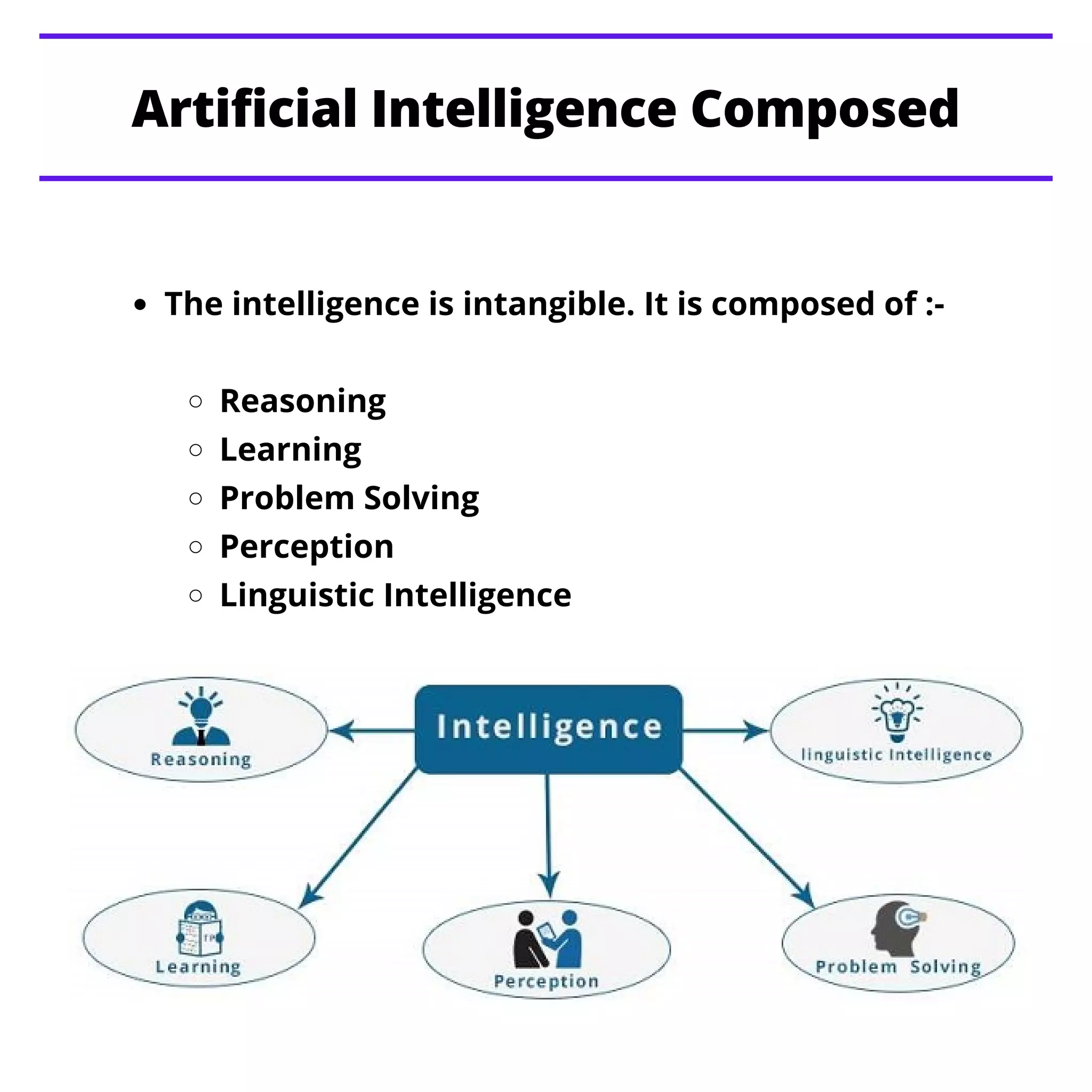
The intelligence is intangible. It is composed of :-
Reasoning
Learning
Problem Solving
Perception
Linguistic Intelligence
Artificial Intelligence Composed
It is the set of processes that enables us to provide
basis for judgement, making decisions, and
prediction.
There are broadly two types
Reasoning
It conducts specific observations to makes broad
general statements.
Even if all of the premises are true in a statement,
inductive reasoning allows for the conclusion to
be false.
Example − "Nita is a teacher. Nita is studious.
Therefore, All teachers are studious."
Inductive Reasoning
It starts with a general statement and examines
the possibilities to reach a specific, logical
conclusion.
If something is true of a class of things in general,
it is also true for all members of that class.
Example − "All women of age above 60 years are
grandmothers. Shalini is 65 years. Therefore,
Shalini is a grandmother."
Deductive Reasoning
It is the activity of gaining knowledge or skill by
studying, practising, being taught, or experiencing
something. Learning enhances the awareness of
the subjects of the study.
The ability of learning is possessed by humans,
some animals, and AI-enabled systems. Learning is
categorized as
Auditory Learning
Episodic Learning
Motor Learning
Observational Learning
Perceptual Learning
Relational Learning
Spatial Learning
Stimulus-Response Learning
Learning
It is the process in which one perceives and tries
to arrive at a desired solution from a present
situation by taking some path, which is blocked by
known or unknown hurdles.
Problem solving also includes decision making,
which is the process of selecting the best suitable
alternative out of multiple alternatives to reach
the desired goal are available.
Problem Solving
It is the process of acquiring, interpreting,
selecting, and organizing sensory information.
Perception presumes sensing. In humans,
perception is aided by sensory organs. In the
domain of AI, perception mechanism puts the
data acquired by the sensors together in a
meaningful manner.
Perception
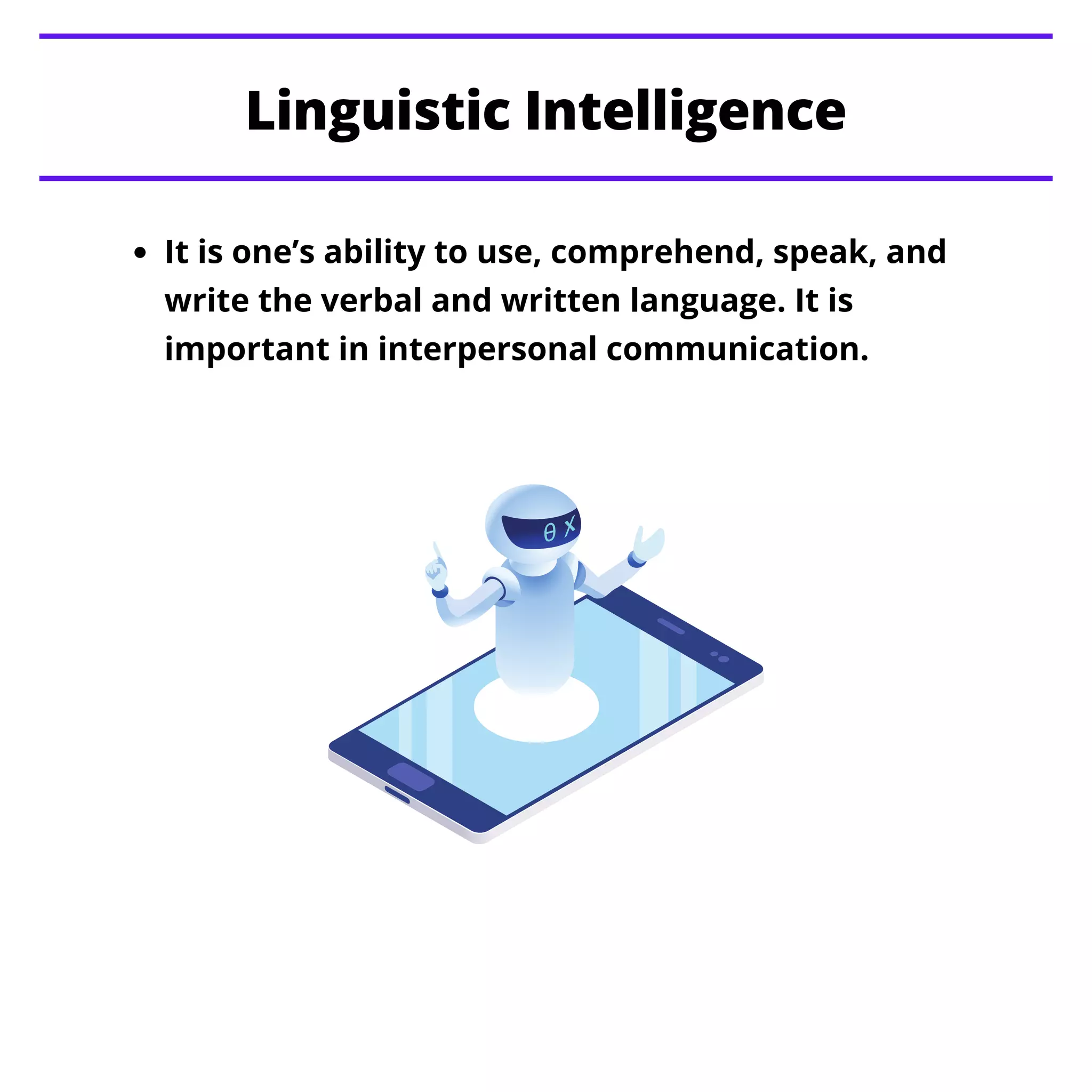
It is one’s ability to use, comprehend, speak, and
write the verbal and written language. It is
important in interpersonal communication.
Linguistic Intelligence
Humans perceive by patterns whereas the
machines perceive by set of rules and data.
Humans store and recall information by patterns,
machines do it by searching algorithms. For
example, the number 40404040 is easy to
remember, store, and recall as its pattern is
simple.
Humans can figure out the complete object even if
some part of it is missing or distorted; whereas
the machines cannot do it correctly.
Difference between Human and Machine
Intelligence
Artificial Intelligence - Research
Areas
AI - Agents & Environments
AI - Popular Search Algorithms
Topics for next Post
Stay Tuned with

Artificial intelligence composed

  • 1.
  • 2.
    The intelligence isintangible. It is composed of :- Reasoning Learning Problem Solving Perception Linguistic Intelligence Artificial Intelligence Composed
  • 3.
    It is theset of processes that enables us to provide basis for judgement, making decisions, and prediction. There are broadly two types Reasoning
  • 4.
    It conducts specificobservations to makes broad general statements. Even if all of the premises are true in a statement, inductive reasoning allows for the conclusion to be false. Example − "Nita is a teacher. Nita is studious. Therefore, All teachers are studious." Inductive Reasoning
  • 5.
    It starts witha general statement and examines the possibilities to reach a specific, logical conclusion. If something is true of a class of things in general, it is also true for all members of that class. Example − "All women of age above 60 years are grandmothers. Shalini is 65 years. Therefore, Shalini is a grandmother." Deductive Reasoning
  • 6.
    It is theactivity of gaining knowledge or skill by studying, practising, being taught, or experiencing something. Learning enhances the awareness of the subjects of the study. The ability of learning is possessed by humans, some animals, and AI-enabled systems. Learning is categorized as Auditory Learning Episodic Learning Motor Learning Observational Learning Perceptual Learning Relational Learning Spatial Learning Stimulus-Response Learning Learning
  • 7.
    It is theprocess in which one perceives and tries to arrive at a desired solution from a present situation by taking some path, which is blocked by known or unknown hurdles. Problem solving also includes decision making, which is the process of selecting the best suitable alternative out of multiple alternatives to reach the desired goal are available. Problem Solving
  • 8.
    It is theprocess of acquiring, interpreting, selecting, and organizing sensory information. Perception presumes sensing. In humans, perception is aided by sensory organs. In the domain of AI, perception mechanism puts the data acquired by the sensors together in a meaningful manner. Perception
  • 9.
    It is one’sability to use, comprehend, speak, and write the verbal and written language. It is important in interpersonal communication. Linguistic Intelligence
  • 10.
    Humans perceive bypatterns whereas the machines perceive by set of rules and data. Humans store and recall information by patterns, machines do it by searching algorithms. For example, the number 40404040 is easy to remember, store, and recall as its pattern is simple. Humans can figure out the complete object even if some part of it is missing or distorted; whereas the machines cannot do it correctly. Difference between Human and Machine Intelligence
  • 11.
    Artificial Intelligence -Research Areas AI - Agents & Environments AI - Popular Search Algorithms Topics for next Post Stay Tuned with