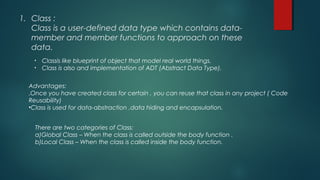
Classes define new user-defined data types that contain data members and member functions. Classes act as blueprints for objects which represent real-world entities. There are two types of classes: global classes which can be called outside functions, and local classes which are called within functions. Objects are variables of a class data type that represent runtime instances of that class. An object's state is represented by its data members, and its behavior is represented by member functions. Classes allow for code reusability and data abstraction.


![Example (Global Class):
#include <iostream>
using namespace std;
//create a class book
class books{
int b_id;//book id
char pub[100];//publication name
public:
//getting input from the user
void getdata()
{
cin>>b_id;
cin>>pub;
}
//display the result
void display()
{
cout<<"Book ID = "<< b_id <<" "<<"Publication = "<<pub;
}
};
int main()
{
books b1;//create an object of a class where b1 is instance variables
b1.getdata();
b1.display();//message or behavior
}](https://image.slidesharecdn.com/classesandobjects-180118150911/85/Classes-and-objects-3-320.jpg)
![Example (Local Class):
using namespace std;
void testfun()
{
class books
{
int b_id;
char pub[100];
public:
void getdata()
{
cout<<"Insert Book ID";
cin>>b_id;
cout<<"Insert Publication name";
cin>>pub;
}
void display()
{
cout<<"Book ID = "<<b_id;
cout<<"Publication = "<<pub;
}
};
books b1;
b1.getdata();
b1.display();
}
int main()
{
testfun();
return 0;
}](https://image.slidesharecdn.com/classesandobjects-180118150911/85/Classes-and-objects-4-320.jpg)
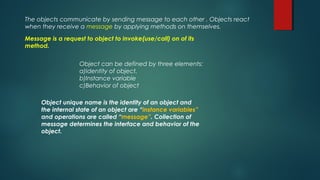
![Objects:
Real world entity that has its state and certain behavior is called Object.
Objects is a variable of class data-type which is a run-time instance of a
class.
• State of an object represent all the information held inside (within).
• Characteristics of object is determined by the data members of class.
• Behavior is represented by member functions.
Example
using namespace std;
void testfun()
{
class books
{
int b_id;//member function of a class books
char pub[100];
public:
void getdata()
{
cout<<"Insert Book ID";
cin>>b_id;
cout<<"Insert Publication name";
cin>>pub;
}
void display()
{
cout<<"Book ID = "<<b_id;
cout<<"Publication = "<<pub;
}
};
books b1; // Object of a class books.
b1.getdata();//instance variable of class
b1.display();//displays the result
}
int main()
{
testfun();//function call
return 0;
}
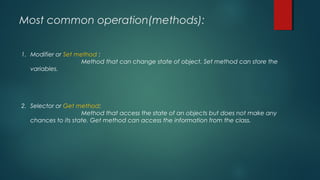
Access mode](https://image.slidesharecdn.com/classesandobjects-180118150911/85/Classes-and-objects-5-320.jpg)
![[OOP - Lec 13,14,15] Constructors / Destructor and its Types](https://cdn.slidesharecdn.com/ss_thumbnails/lecture-131415constructorsitstypes-160705094532-thumbnail.jpg?width=640&height=640&fit=bounds)
![[OOP - Lec 20,21] Inheritance](https://cdn.slidesharecdn.com/ss_thumbnails/lecture-2021inheritance-160705095417-thumbnail.jpg?width=640&height=640&fit=bounds)
![[OOP - Lec 09,10,11] Class Members & their Accessing](https://cdn.slidesharecdn.com/ss_thumbnails/lecture-091011classmemberstheiraccessing-160604060651-thumbnail.jpg?width=640&height=640&fit=bounds)


![[OOP - Lec 19] Static Member Functions](https://cdn.slidesharecdn.com/ss_thumbnails/lecture-19staticmemberfunctions-160705095235-thumbnail.jpg?width=640&height=640&fit=bounds)


