Economics for Journalists
    Week 9: The Banking System

    Jeffrey Timmermans


Monday, 26 March, 12
Review: Monetary Policy


Monday, 26 March, 12
Monetary policy


    ✤   Now, typically the domain of central banks

         ✤    In most developed countries, central banks control interest rates
              and money supply independently

    ✤   Both interest rates and money supply are closely linked


Monday, 26 March, 12
Central banks & money supply

    ✤   Central banks have three main ways to influence the supply of money
        in an economy

         ✤    Directly increasing/decreasing money supply by selling/buying
              government bonds (U.S., Europe, Japan)

         ✤    Raising/lowering deposit & lending rates (China)

         ✤    Changing commercial banks’ reserve ratio (China)


Monday, 26 March, 12
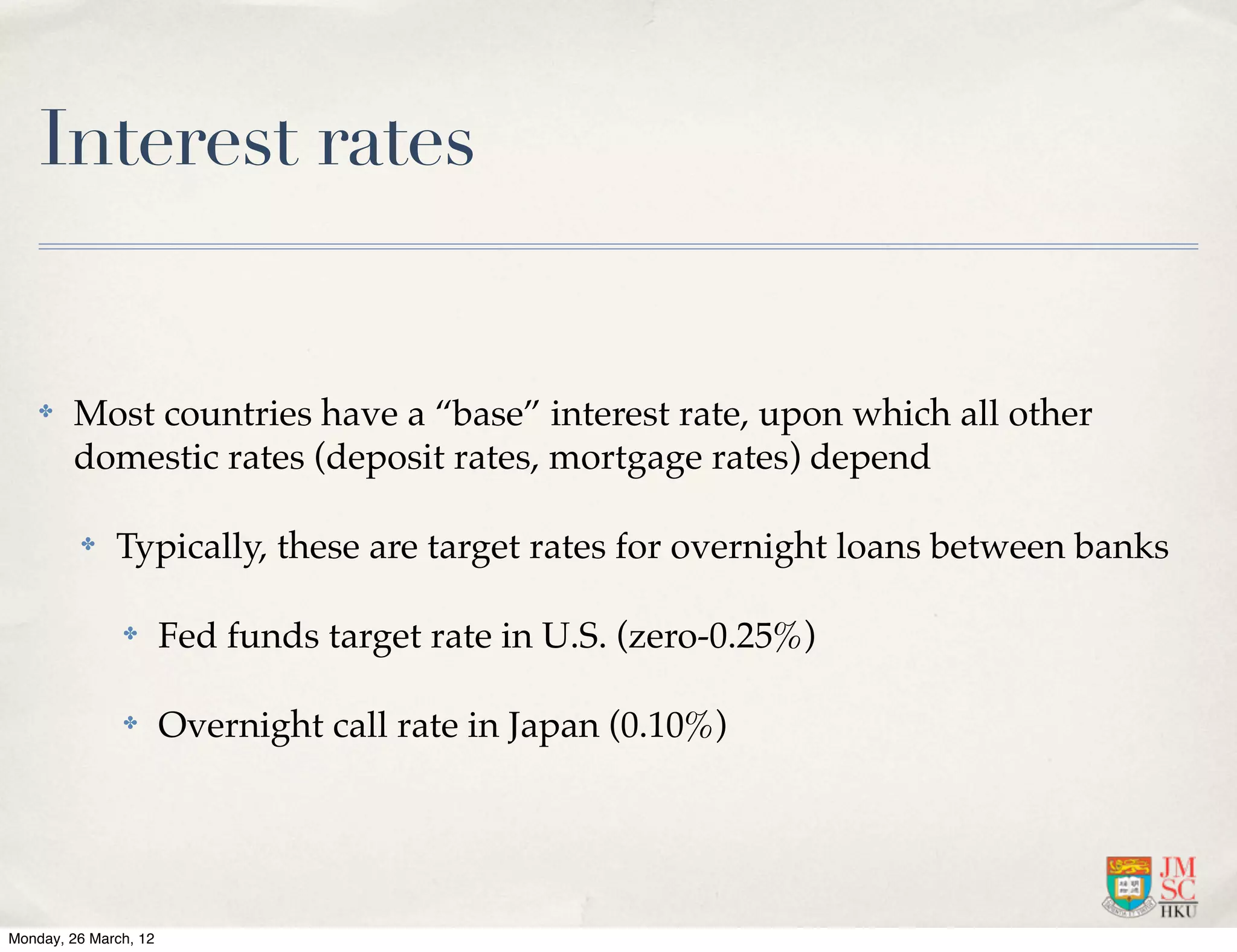
Interest rates


    ✤   Most countries have a “base” interest rate, upon which all other
        domestic rates (deposit rates, mortgage rates) depend

         ✤    Typically, these are target rates for overnight loans between banks

               ✤       Fed funds target rate in U.S. (zero-0.25%)

               ✤       Overnight call rate in Japan (0.10%)


Monday, 26 March, 12
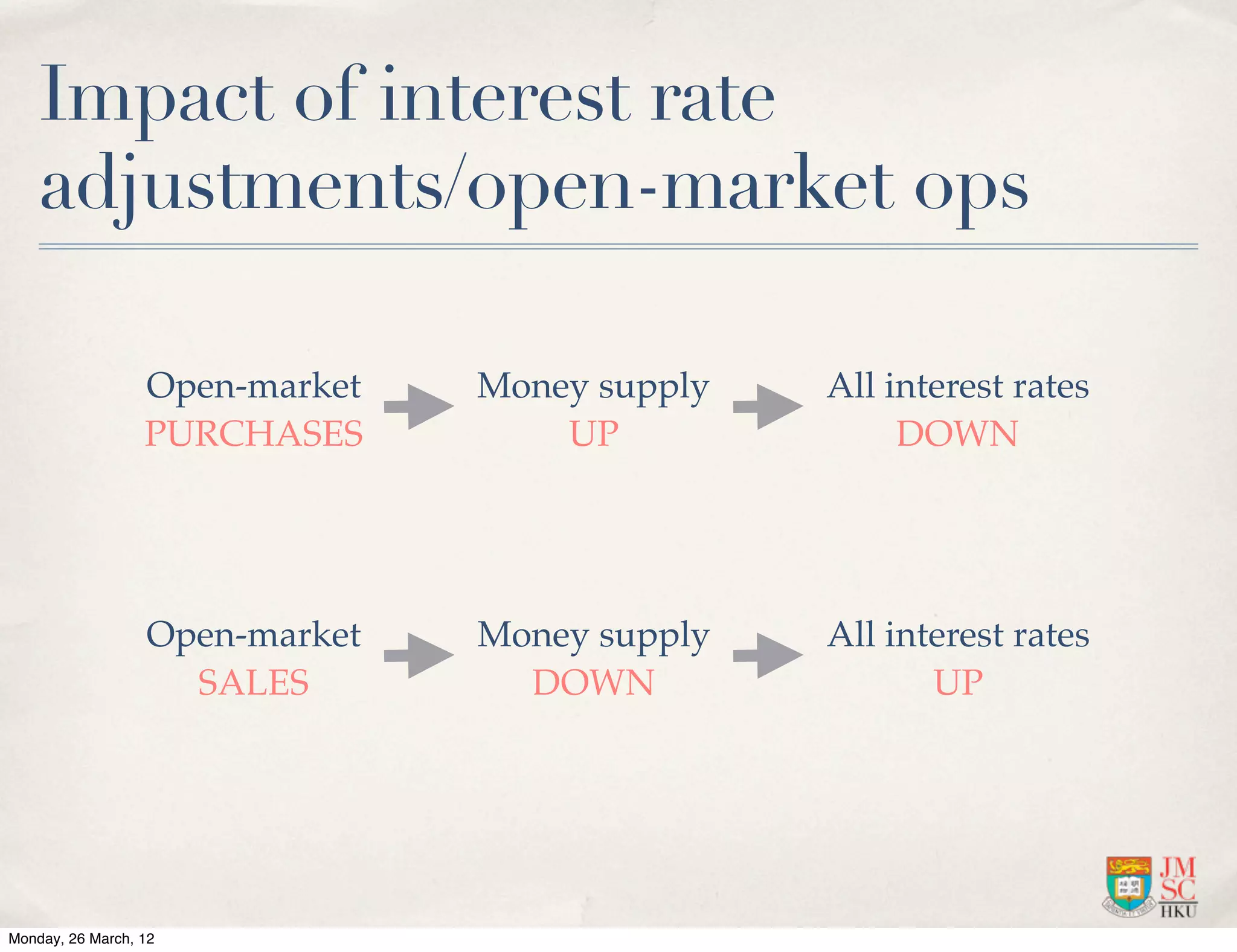
Impact of interest rate
    adjustments/open-market ops

                  Open-market   Money supply   All interest rates
                  PURCHASES         UP              DOWN


                  Open-market   Money supply   All interest rates
                    SALES         DOWN                UP


Monday, 26 March, 12
Money Supply


Monday, 26 March, 12
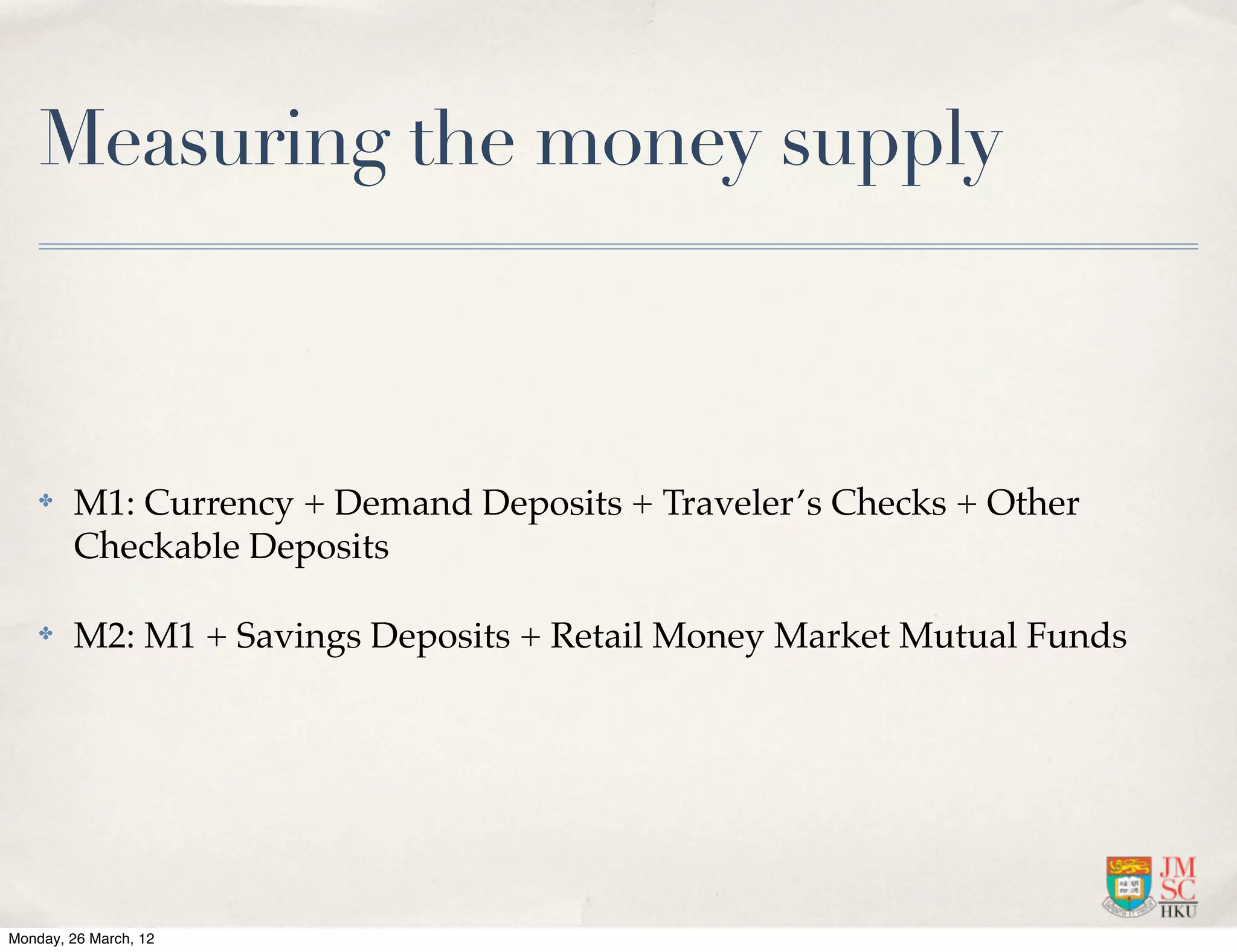
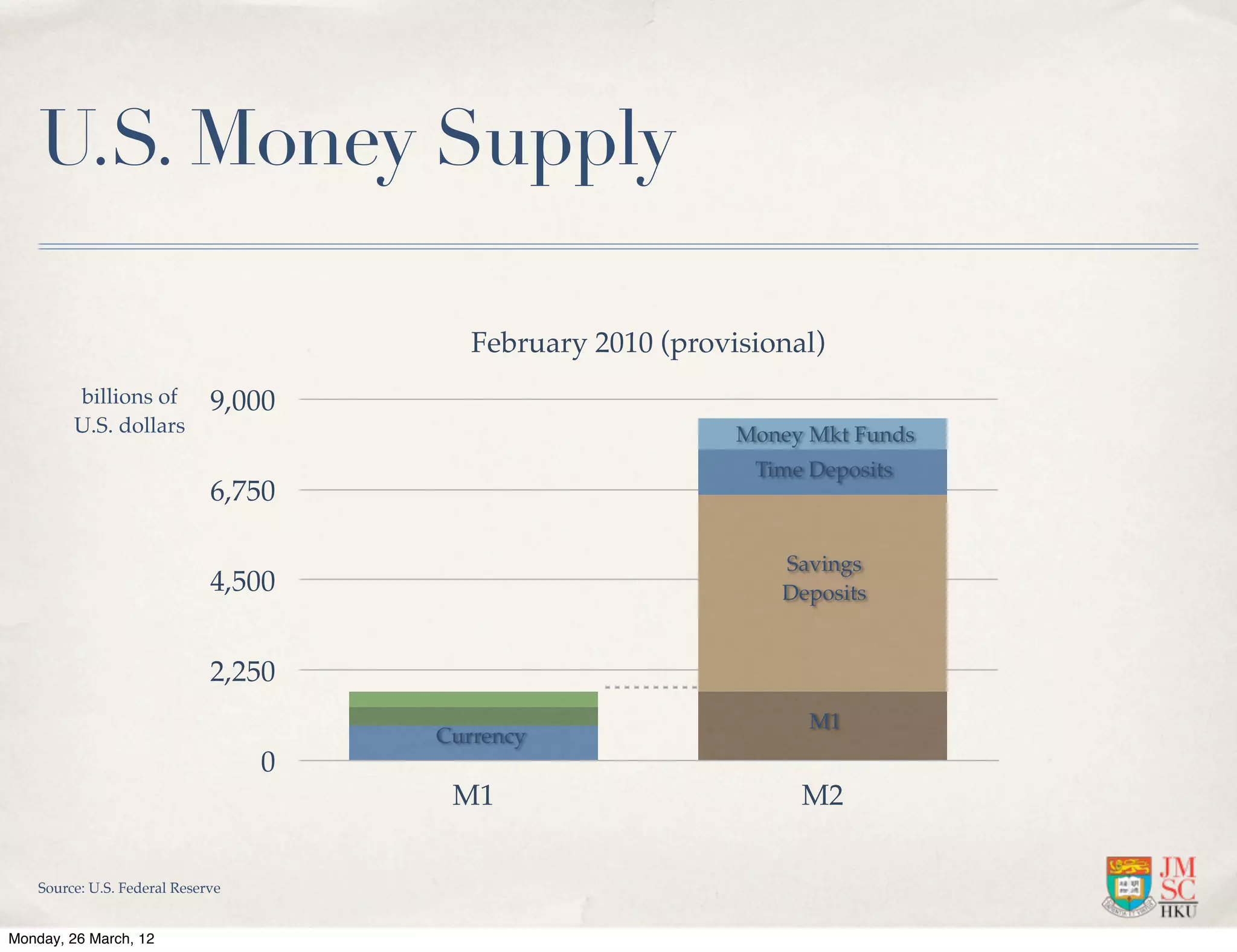
Measuring the money supply


    ✤   M1: Currency + Demand Deposits + Traveler’s Checks + Other
        Checkable Deposits

    ✤   M2: M1 + Savings Deposits + Retail Money Market Mutual Funds


Monday, 26 March, 12
U.S. Money Supply

                                          February 2010 (provisional)
         billions of          9,000
         U.S. dollars                                         Money Mkt Funds
                                                               Time Deposits
                              6,750

                                                                 Savings
                              4,500                              Deposits


                              2,250
                                                                    M1
                                       Currency
                                   0
                                        M1                         M2


    Source: U.S. Federal Reserve


Monday, 26 March, 12
The Banking System


Monday, 26 March, 12
Role of the banking system


    ✤   To channel individuals’ savings to others who want to borrow money

    ✤   To serve as a financial intermediary


Monday, 26 March, 12
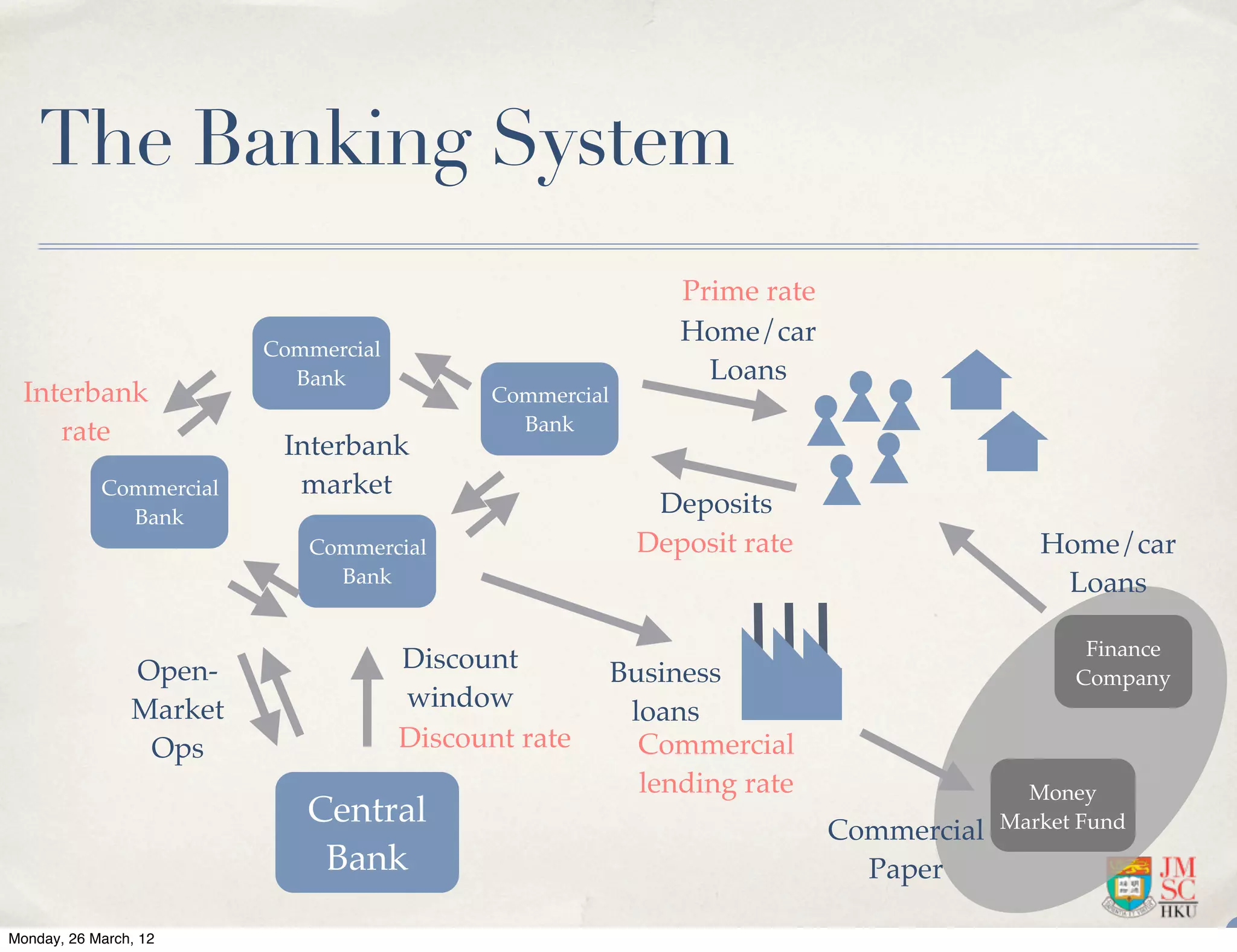
The Banking System
                                                               Prime rate
                                                               Home/car
                         Commercial
                           Bank                                  Loans
  Interbank                                  Commercial
     rate                                      Bank
                          Interbank
            Commercial     market
              Bank
                                                             Deposits
                            Commercial                      Deposit rate                    Home/car
                              Bank                                                           Loans

                                                                                                Finance
                Open-                 Discount            Business                             Company
                Market                window               loans
                 Ops                  Discount rate         Commercial
                                                            lending rate                   Money
                            Central                                                      Market Fund
                                                                            Commercial
                             Bank                                             Paper

Monday, 26 March, 12
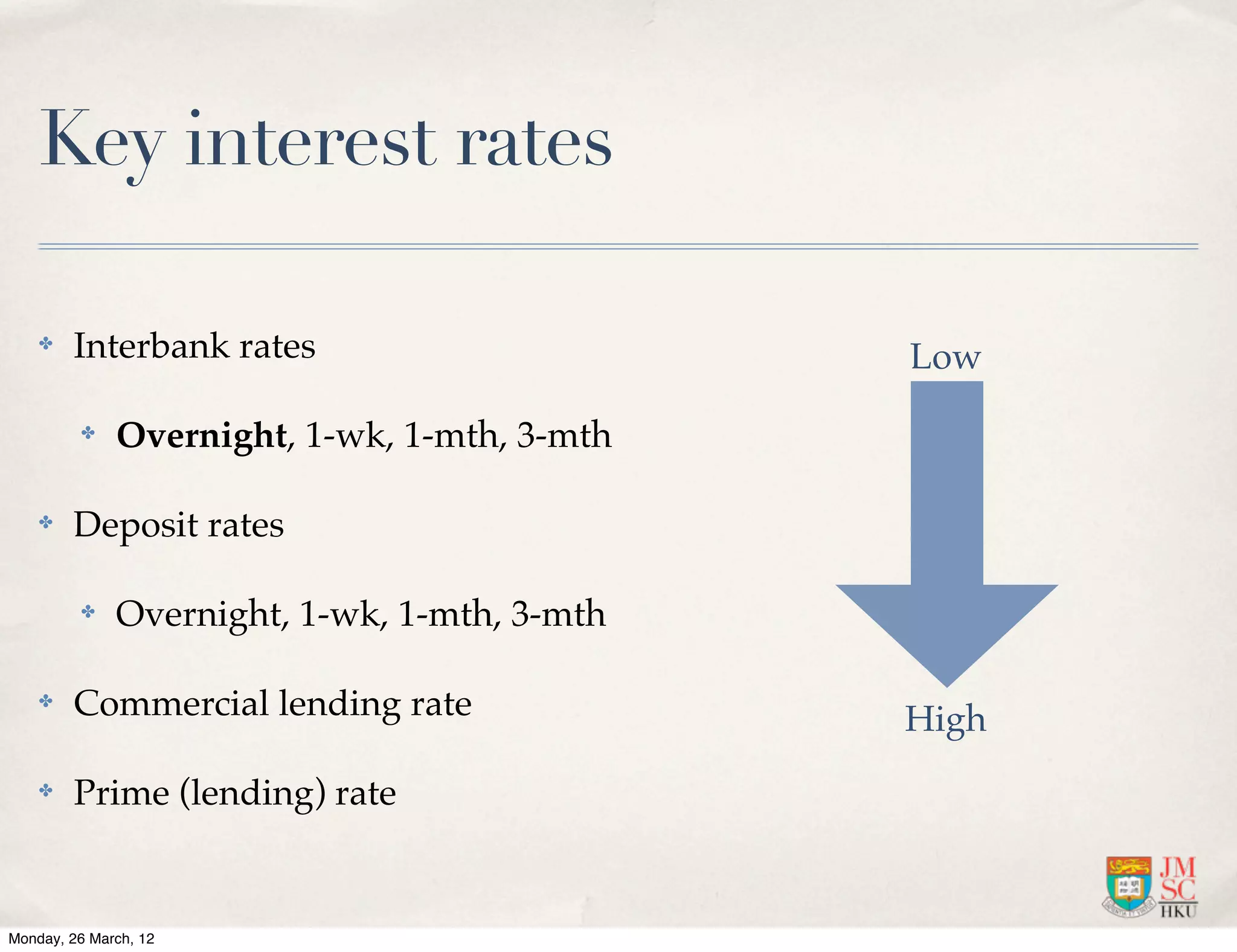
Key interest rates

    ✤   Interbank rates                       Low
         ✤    Overnight, 1-wk, 1-mth, 3-mth

    ✤   Deposit rates

         ✤    Overnight, 1-wk, 1-mth, 3-mth

    ✤   Commercial lending rate               High
    ✤   Prime (lending) rate


Monday, 26 March, 12
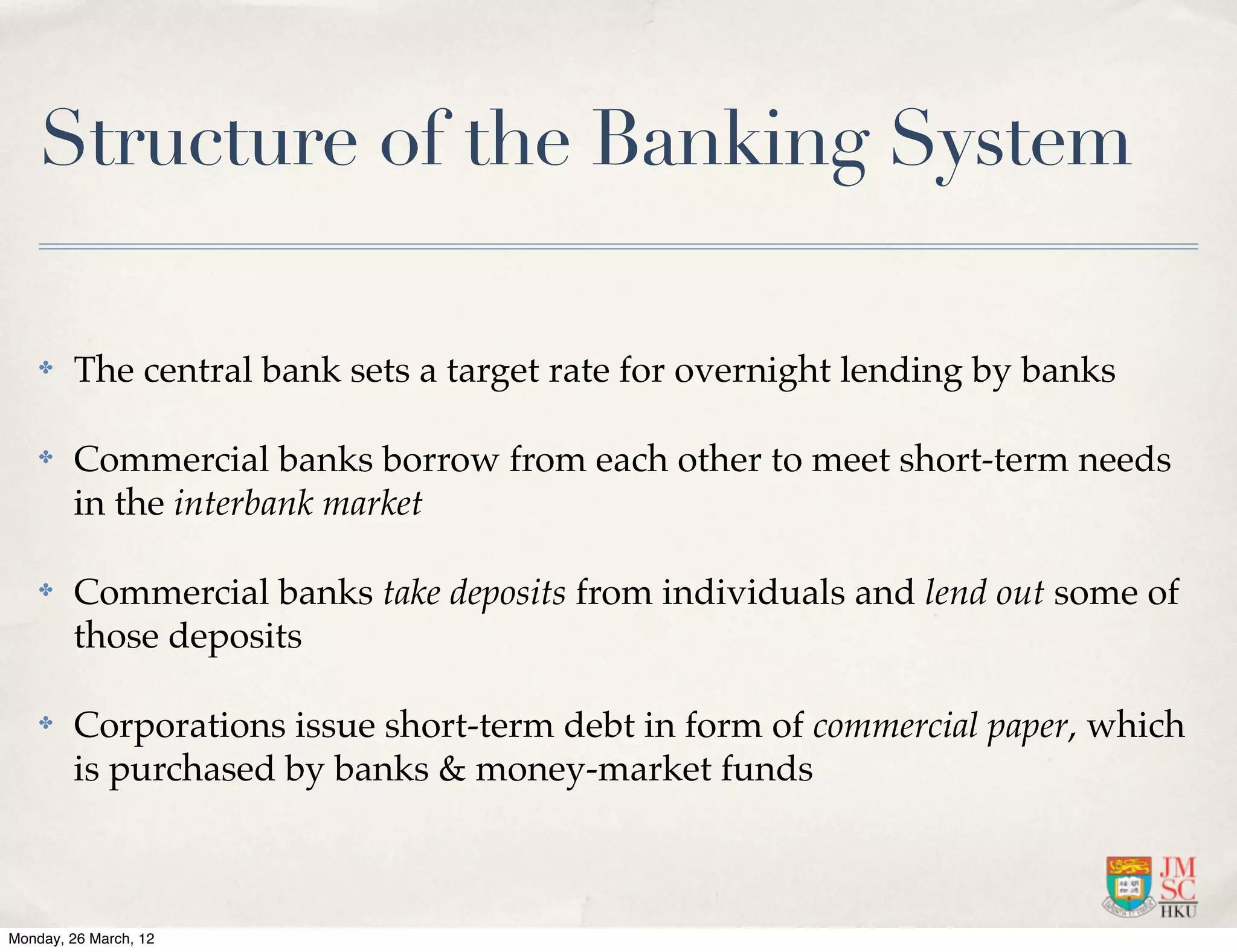
Structure of the Banking System

    ✤   The central bank sets a target rate for overnight lending by banks

    ✤   Commercial banks borrow from each other to meet short-term needs
        in the interbank market

    ✤   Commercial banks take deposits from individuals and lend out some of
        those deposits

    ✤   Corporations issue short-term debt in form of commercial paper, which
        is purchased by banks & money-market funds


Monday, 26 March, 12
The “Shadow Banking System”


    ✤   Any non-bank financial institution that is subject to less oversight
        than traditional lenders like commercial banks

         ✤    Finance companies

         ✤    Money-market funds

         ✤    Hedge funds


Monday, 26 March, 12
Interbank rates


    ✤   H.K.: Hong Kong Interbank Offer Rate (Hibor)

    ✤   U.K.: London Interbank Offer Rate (Libor)

    ✤   Fed sets Fed Funds target rate; supply/demand determine Hibor &
        Libor

    ✤   Banks’ other lending rates often based on local interbank rate


Monday, 26 March, 12
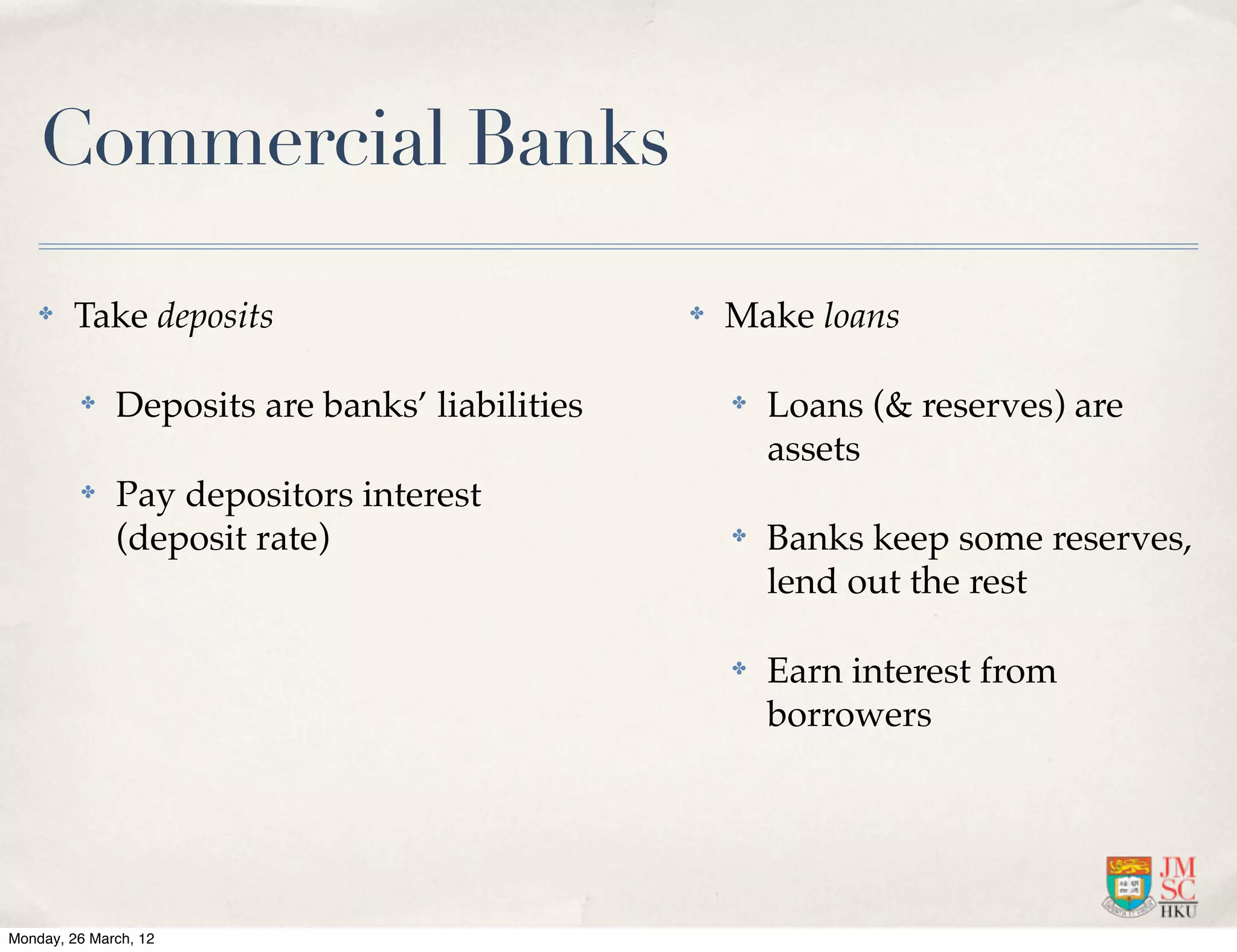
Commercial Banks

    ✤   Take deposits                           ✤   Make loans

         ✤    Deposits are banks’ liabilities       ✤   Loans (& reserves) are
                                                        assets
         ✤    Pay depositors interest
              (deposit rate)                        ✤   Banks keep some reserves,
                                                        lend out the rest

                                                    ✤   Earn interest from
                                                        borrowers


Monday, 26 March, 12
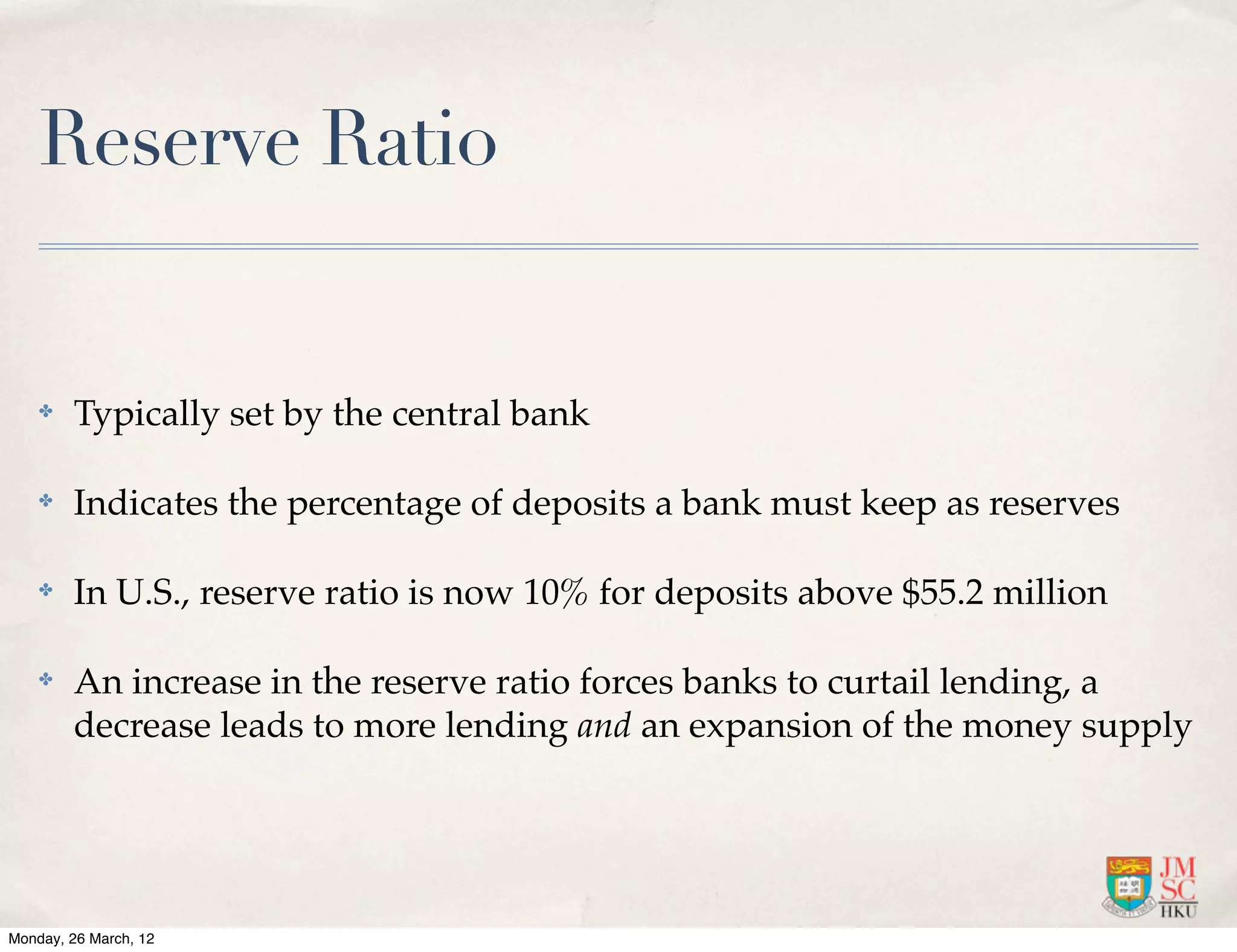
Reserve Ratio


    ✤   Typically set by the central bank

    ✤   Indicates the percentage of deposits a bank must keep as reserves

    ✤   In U.S., reserve ratio is now 10% for deposits above $55.2 million

    ✤   An increase in the reserve ratio forces banks to curtail lending, a
        decrease leads to more lending and an expansion of the money supply


Monday, 26 March, 12
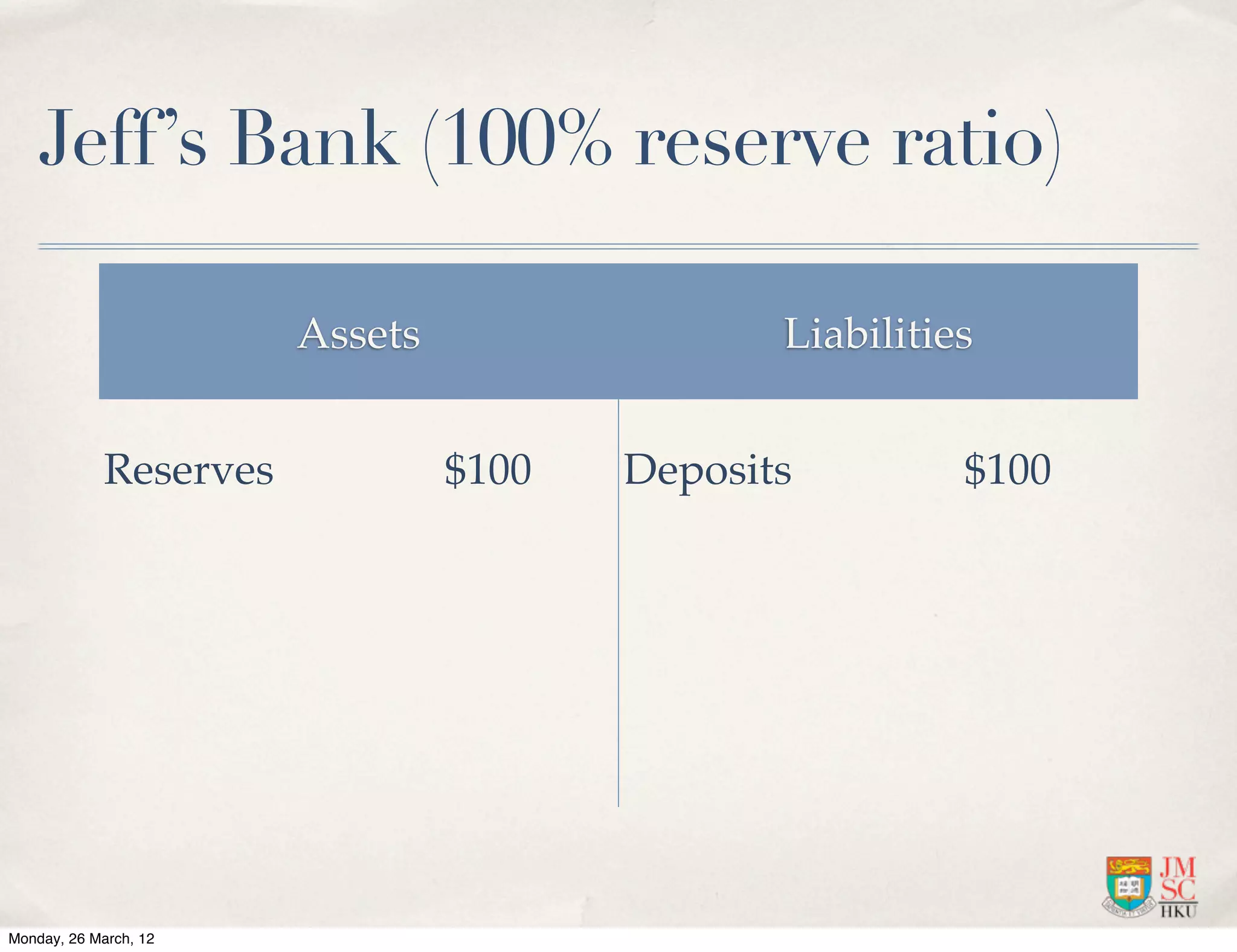
Jeff’s Bank (100% reserve ratio)

                        Assets                 Liabilities


             Reserves            $100   Deposits         $100


Monday, 26 March, 12
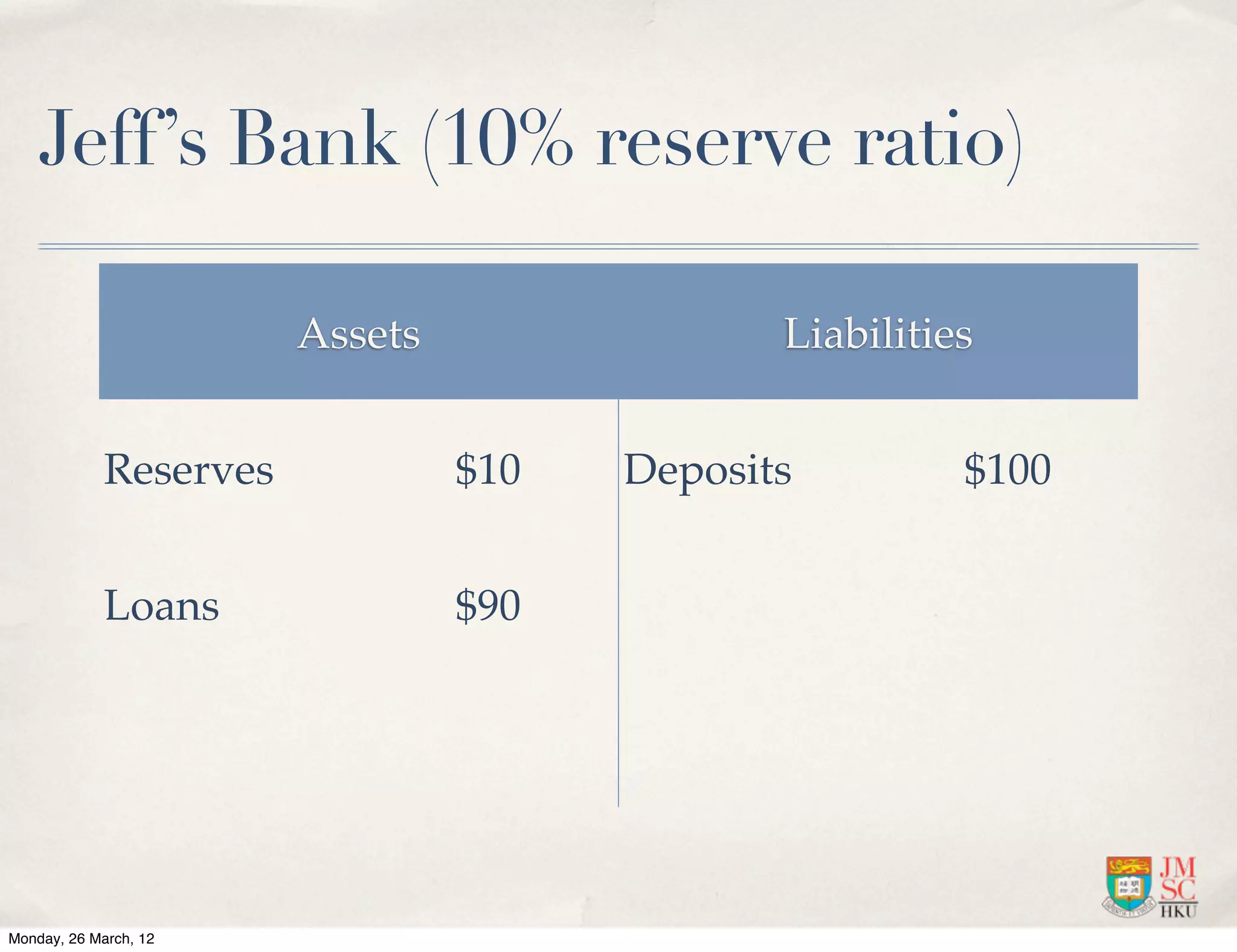
Jeff’s Bank (10% reserve ratio)

                        Assets                Liabilities


             Reserves            $10   Deposits         $100


             Loans               $90


Monday, 26 March, 12
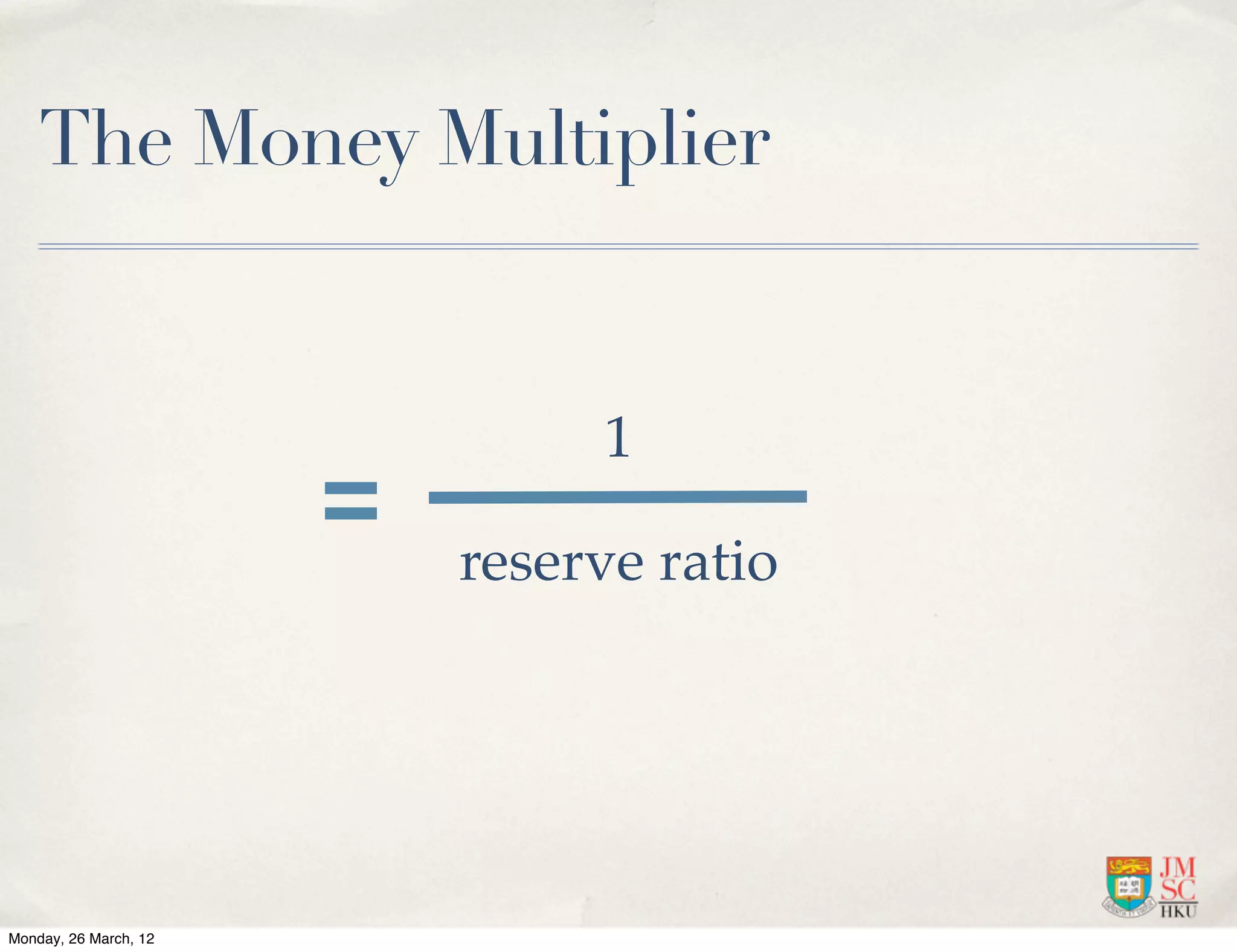
The Money Multiplier


                            1

                       reserve ratio


Monday, 26 March, 12
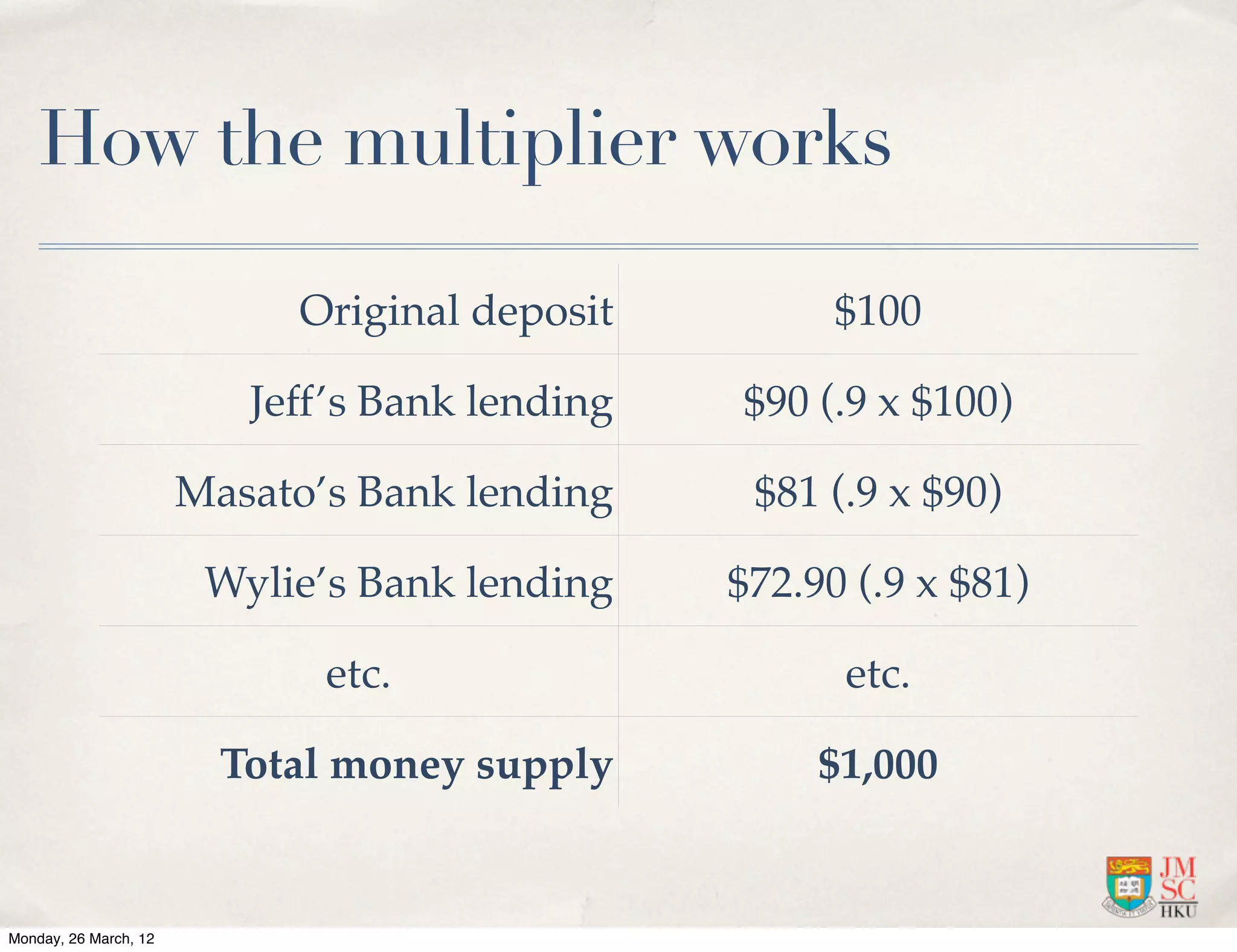
How the multiplier works

                            Original deposit          $100

                          Jeff’s Bank lending   $90 (.9 x $100)

                       Masato’s Bank lending     $81 (.9 x $90)

                        Wylie’s Bank lending    $72.90 (.9 x $81)

                              etc.                    etc.

                         Total money supply          $1,000


Monday, 26 March, 12

Class9

  • 1.
    Economics for Journalists Week 9: The Banking System Jeffrey Timmermans Monday, 26 March, 12
  • 2.
  • 3.
    Monetary policy ✤ Now, typically the domain of central banks ✤ In most developed countries, central banks control interest rates and money supply independently ✤ Both interest rates and money supply are closely linked Monday, 26 March, 12
  • 4.
    Central banks &money supply ✤ Central banks have three main ways to influence the supply of money in an economy ✤ Directly increasing/decreasing money supply by selling/buying government bonds (U.S., Europe, Japan) ✤ Raising/lowering deposit & lending rates (China) ✤ Changing commercial banks’ reserve ratio (China) Monday, 26 March, 12
  • 5.
    Interest rates ✤ Most countries have a “base” interest rate, upon which all other domestic rates (deposit rates, mortgage rates) depend ✤ Typically, these are target rates for overnight loans between banks ✤ Fed funds target rate in U.S. (zero-0.25%) ✤ Overnight call rate in Japan (0.10%) Monday, 26 March, 12
  • 6.
    Impact of interestrate adjustments/open-market ops Open-market Money supply All interest rates PURCHASES UP DOWN Open-market Money supply All interest rates SALES DOWN UP Monday, 26 March, 12
  • 7.
  • 8.
    Measuring the moneysupply ✤ M1: Currency + Demand Deposits + Traveler’s Checks + Other Checkable Deposits ✤ M2: M1 + Savings Deposits + Retail Money Market Mutual Funds Monday, 26 March, 12
  • 9.
    U.S. Money Supply February 2010 (provisional) billions of 9,000 U.S. dollars Money Mkt Funds Time Deposits 6,750 Savings 4,500 Deposits 2,250 M1 Currency 0 M1 M2 Source: U.S. Federal Reserve Monday, 26 March, 12
  • 10.
  • 11.
    Role of thebanking system ✤ To channel individuals’ savings to others who want to borrow money ✤ To serve as a financial intermediary Monday, 26 March, 12
  • 12.
    The Banking System Prime rate Home/car Commercial Bank Loans Interbank Commercial rate Bank Interbank Commercial market Bank Deposits Commercial Deposit rate Home/car Bank Loans Finance Open- Discount Business Company Market window loans Ops Discount rate Commercial lending rate Money Central Market Fund Commercial Bank Paper Monday, 26 March, 12
  • 13.
    Key interest rates ✤ Interbank rates Low ✤ Overnight, 1-wk, 1-mth, 3-mth ✤ Deposit rates ✤ Overnight, 1-wk, 1-mth, 3-mth ✤ Commercial lending rate High ✤ Prime (lending) rate Monday, 26 March, 12
  • 14.
    Structure of theBanking System ✤ The central bank sets a target rate for overnight lending by banks ✤ Commercial banks borrow from each other to meet short-term needs in the interbank market ✤ Commercial banks take deposits from individuals and lend out some of those deposits ✤ Corporations issue short-term debt in form of commercial paper, which is purchased by banks & money-market funds Monday, 26 March, 12
  • 15.
    The “Shadow BankingSystem” ✤ Any non-bank financial institution that is subject to less oversight than traditional lenders like commercial banks ✤ Finance companies ✤ Money-market funds ✤ Hedge funds Monday, 26 March, 12
  • 16.
    Interbank rates ✤ H.K.: Hong Kong Interbank Offer Rate (Hibor) ✤ U.K.: London Interbank Offer Rate (Libor) ✤ Fed sets Fed Funds target rate; supply/demand determine Hibor & Libor ✤ Banks’ other lending rates often based on local interbank rate Monday, 26 March, 12
  • 17.
    Commercial Banks ✤ Take deposits ✤ Make loans ✤ Deposits are banks’ liabilities ✤ Loans (& reserves) are assets ✤ Pay depositors interest (deposit rate) ✤ Banks keep some reserves, lend out the rest ✤ Earn interest from borrowers Monday, 26 March, 12
  • 18.
    Reserve Ratio ✤ Typically set by the central bank ✤ Indicates the percentage of deposits a bank must keep as reserves ✤ In U.S., reserve ratio is now 10% for deposits above $55.2 million ✤ An increase in the reserve ratio forces banks to curtail lending, a decrease leads to more lending and an expansion of the money supply Monday, 26 March, 12
  • 19.
    Jeff’s Bank (100%reserve ratio) Assets Liabilities Reserves $100 Deposits $100 Monday, 26 March, 12
  • 20.
    Jeff’s Bank (10%reserve ratio) Assets Liabilities Reserves $10 Deposits $100 Loans $90 Monday, 26 March, 12
  • 21.
    The Money Multiplier 1 reserve ratio Monday, 26 March, 12
  • 22.
    How the multiplierworks Original deposit $100 Jeff’s Bank lending $90 (.9 x $100) Masato’s Bank lending $81 (.9 x $90) Wylie’s Bank lending $72.90 (.9 x $81) etc. etc. Total money supply $1,000 Monday, 26 March, 12