Analyzing system data:  Class diagram Asper School of Business  University of Manitoba Systems Analysis & Design Instructor: Bob Travica Updated: October 2009
Outline Problem domain classes Identifying things to be represented in system Associations among things Multiplicity Attributes Generalization/Specialization association Part-Whole association Associations between class objects 3510 Systems Analysis & Design * Bob Travica  of 16
Problem domain classes  Problem domain Area of business a system supports  Classes & objects are the way to represent  things that make business (products, orders, invoices, customers, employees…) Identifying and analyzing things in problem domain = essential to defining systems requirements 3510 Systems Analysis & Design * Bob Travica  of 16
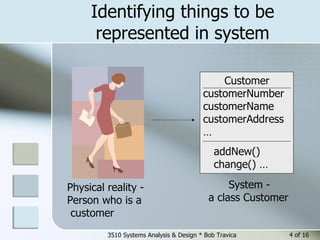
Identifying things to be represented in system 3510 Systems Analysis & Design * Bob Travica  of 16 Physical reality - Person who is a  customer customerNumber customerName customerAddress … Customer addNew() change() … System - a class Customer
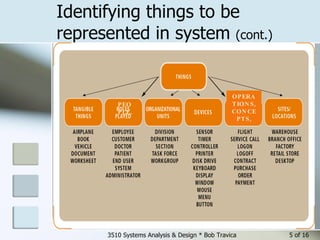
Identifying things to be represented in system  (cont.) 3510 Systems Analysis & Design * Bob Travica  of 16 PEOPLE, OPERATIONS, CONCEPTS,
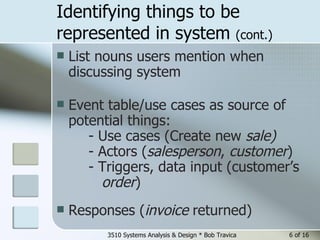
Identifying things to be represented in system  (cont.) List nouns   users mention when discussing system Event table/use cases as source of potential things: - Use cases (Create new  sale)   - Actors ( salesperson ,  customer )  - Triggers, data input (customer’s    order )  Responses ( invoice  returned) 3510 Systems Analysis & Design * Bob Travica  of 16
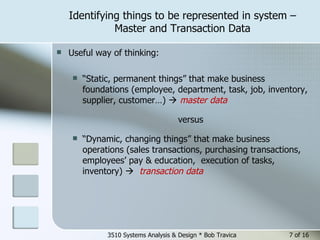
Identifying things to be represented in system – Master and Transaction Data Useful way of thinking: “ Static, permanent things” that make business foundations (employee, department, task, job, inventory, supplier, customer…)     master data versus “ Dynamic, changing things” that make business operations (sales transactions, purchasing transactions, employees’ pay & education,  execution of tasks, inventory)     transaction data  3510 Systems Analysis & Design * Bob Travica  of 16
Associations among things Association = relationship between things Example: Customer  places  Order  Associations apply in both directions Order  is placed by Customer  3510 Systems Analysis & Design * Bob Travica  of 16
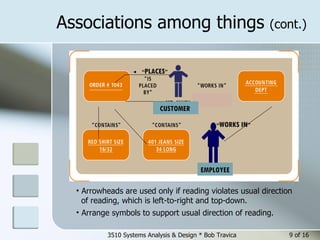
Associations among things  (cont.) 3510 Systems Analysis & Design * Bob Travica  of 16 Arrowheads are used only if reading violates usual direction  of reading, which is left-to-right and top-down.  Arrange symbols to support usual direction of reading. “ PLACES ” “ WORKS IN ” CUSTOMER  EMPLOYEE
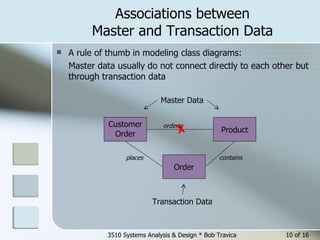
Associations between Master and Transaction Data A rule of thumb in modeling class diagrams:  Master data usually do not connect directly to each other but through transaction data 3510 Systems Analysis & Design * Bob Travica  of 16 3510 Systems Analysis & Design * Bob Travica  of 16 Customer Order Order Product X Master Data Transaction Data orders places contains
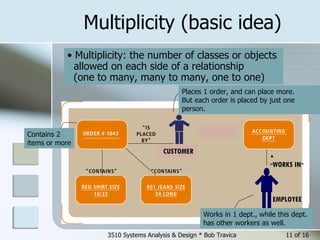
Multiplicity (basic idea) 3510 Systems Analysis & Design * Bob Travica  of 16 Multiplicity: the number of classes or objects  allowed on each side of a relationship  (one to many, many to many, one to one) Places 1 order, and can place more.  But each order is placed by just one person. Works in 1 dept., while this dept.  has other workers as well. CUSTOMER EMPLOYEE “ WORKS IN ” Contains 2 items or more
Understanding things -attributes  Think of a database record Specific details of things (pieces of data) are called attributes Understanding attributes is part of system analysis Key attribute: uniquely identifies a thing: Social insurance  number , product  ID , vehicle identification  number   3510 Systems Analysis & Design * Bob Travica  of 16
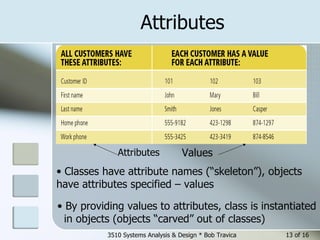
Attributes 3510 Systems Analysis & Design * Bob Travica  of 16 Attributes By providing values to attributes, class is instantiated  in objects (objects “carved” out of classes) Classes have attribute names (“skeleton”), objects  have attributes specified – values  Values
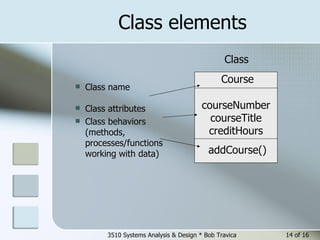
Class elements Class name  Class attributes Class behaviors (methods, processes/functions working with data) 3510 Systems Analysis & Design * Bob Travica  of 16 Class courseNumber courseTitle creditHours Course addCourse()
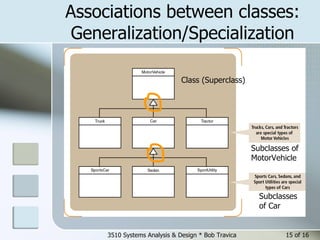
Associations between classes: Generalization/Specialization 3510 Systems Analysis & Design * Bob Travica  of 16 Class (Superclass) Subclasses of  MotorVehicle  Subclasses  of Car
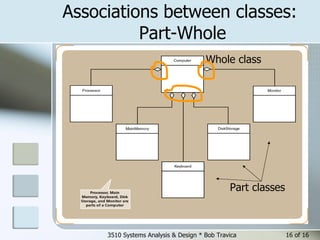
Associations between classes:  Part-Whole 3510 Systems Analysis & Design * Bob Travica  of 16 Part classes Whole class
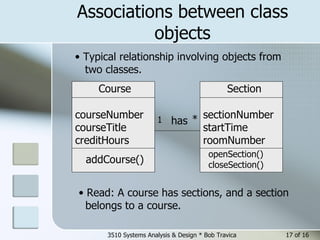
Associations between class objects 3510 Systems Analysis & Design * Bob Travica  of 16 1 * has Typical relationship involving objects from  two classes. Read: A course has sections, and a section belongs to a course.  courseNumber courseTitle creditHours Course addCourse() sectionNumber startTime roomNumber Section openSection() closeSection()

Class10

  • 1.
    Analyzing system data: Class diagram Asper School of Business University of Manitoba Systems Analysis & Design Instructor: Bob Travica Updated: October 2009
  • 2.
    Outline Problem domainclasses Identifying things to be represented in system Associations among things Multiplicity Attributes Generalization/Specialization association Part-Whole association Associations between class objects 3510 Systems Analysis & Design * Bob Travica of 16
  • 3.
    Problem domain classes Problem domain Area of business a system supports Classes & objects are the way to represent things that make business (products, orders, invoices, customers, employees…) Identifying and analyzing things in problem domain = essential to defining systems requirements 3510 Systems Analysis & Design * Bob Travica of 16
  • 4.
    Identifying things tobe represented in system 3510 Systems Analysis & Design * Bob Travica of 16 Physical reality - Person who is a customer customerNumber customerName customerAddress … Customer addNew() change() … System - a class Customer
  • 5.
    Identifying things tobe represented in system (cont.) 3510 Systems Analysis & Design * Bob Travica of 16 PEOPLE, OPERATIONS, CONCEPTS,
  • 6.
    Identifying things tobe represented in system (cont.) List nouns users mention when discussing system Event table/use cases as source of potential things: - Use cases (Create new sale) - Actors ( salesperson , customer ) - Triggers, data input (customer’s order ) Responses ( invoice returned) 3510 Systems Analysis & Design * Bob Travica of 16
  • 7.
    Identifying things tobe represented in system – Master and Transaction Data Useful way of thinking: “ Static, permanent things” that make business foundations (employee, department, task, job, inventory, supplier, customer…)  master data versus “ Dynamic, changing things” that make business operations (sales transactions, purchasing transactions, employees’ pay & education, execution of tasks, inventory)  transaction data 3510 Systems Analysis & Design * Bob Travica of 16
  • 8.
    Associations among thingsAssociation = relationship between things Example: Customer places Order Associations apply in both directions Order is placed by Customer 3510 Systems Analysis & Design * Bob Travica of 16
  • 9.
    Associations among things (cont.) 3510 Systems Analysis & Design * Bob Travica of 16 Arrowheads are used only if reading violates usual direction of reading, which is left-to-right and top-down. Arrange symbols to support usual direction of reading. “ PLACES ” “ WORKS IN ” CUSTOMER EMPLOYEE
  • 10.
    Associations between Masterand Transaction Data A rule of thumb in modeling class diagrams: Master data usually do not connect directly to each other but through transaction data 3510 Systems Analysis & Design * Bob Travica of 16 3510 Systems Analysis & Design * Bob Travica of 16 Customer Order Order Product X Master Data Transaction Data orders places contains
  • 11.
    Multiplicity (basic idea)3510 Systems Analysis & Design * Bob Travica of 16 Multiplicity: the number of classes or objects allowed on each side of a relationship (one to many, many to many, one to one) Places 1 order, and can place more. But each order is placed by just one person. Works in 1 dept., while this dept. has other workers as well. CUSTOMER EMPLOYEE “ WORKS IN ” Contains 2 items or more
  • 12.
    Understanding things -attributes Think of a database record Specific details of things (pieces of data) are called attributes Understanding attributes is part of system analysis Key attribute: uniquely identifies a thing: Social insurance number , product ID , vehicle identification number 3510 Systems Analysis & Design * Bob Travica of 16
  • 13.
    Attributes 3510 SystemsAnalysis & Design * Bob Travica of 16 Attributes By providing values to attributes, class is instantiated in objects (objects “carved” out of classes) Classes have attribute names (“skeleton”), objects have attributes specified – values Values
  • 14.
    Class elements Classname Class attributes Class behaviors (methods, processes/functions working with data) 3510 Systems Analysis & Design * Bob Travica of 16 Class courseNumber courseTitle creditHours Course addCourse()
  • 15.
    Associations between classes:Generalization/Specialization 3510 Systems Analysis & Design * Bob Travica of 16 Class (Superclass) Subclasses of MotorVehicle Subclasses of Car
  • 16.
    Associations between classes: Part-Whole 3510 Systems Analysis & Design * Bob Travica of 16 Part classes Whole class
  • 17.
    Associations between classobjects 3510 Systems Analysis & Design * Bob Travica of 16 1 * has Typical relationship involving objects from two classes. Read: A course has sections, and a section belongs to a course. courseNumber courseTitle creditHours Course addCourse() sectionNumber startTime roomNumber Section openSection() closeSection()