SMALL-GROUP DISCUSSION GRADING RUBRIC
Student Name: _______________________________________
Outcomes Demonstrated: Speaking and Listening
    • Students will be expected to speak and listen to explore, extend, clarify, and reflect on their thoughts, ideas, feelings, and experiences; communicate information and ideas effectively and clearly, and to
       respond personally and critically; and interact with sensitivity and respect, considering the situation, audience, and purpose
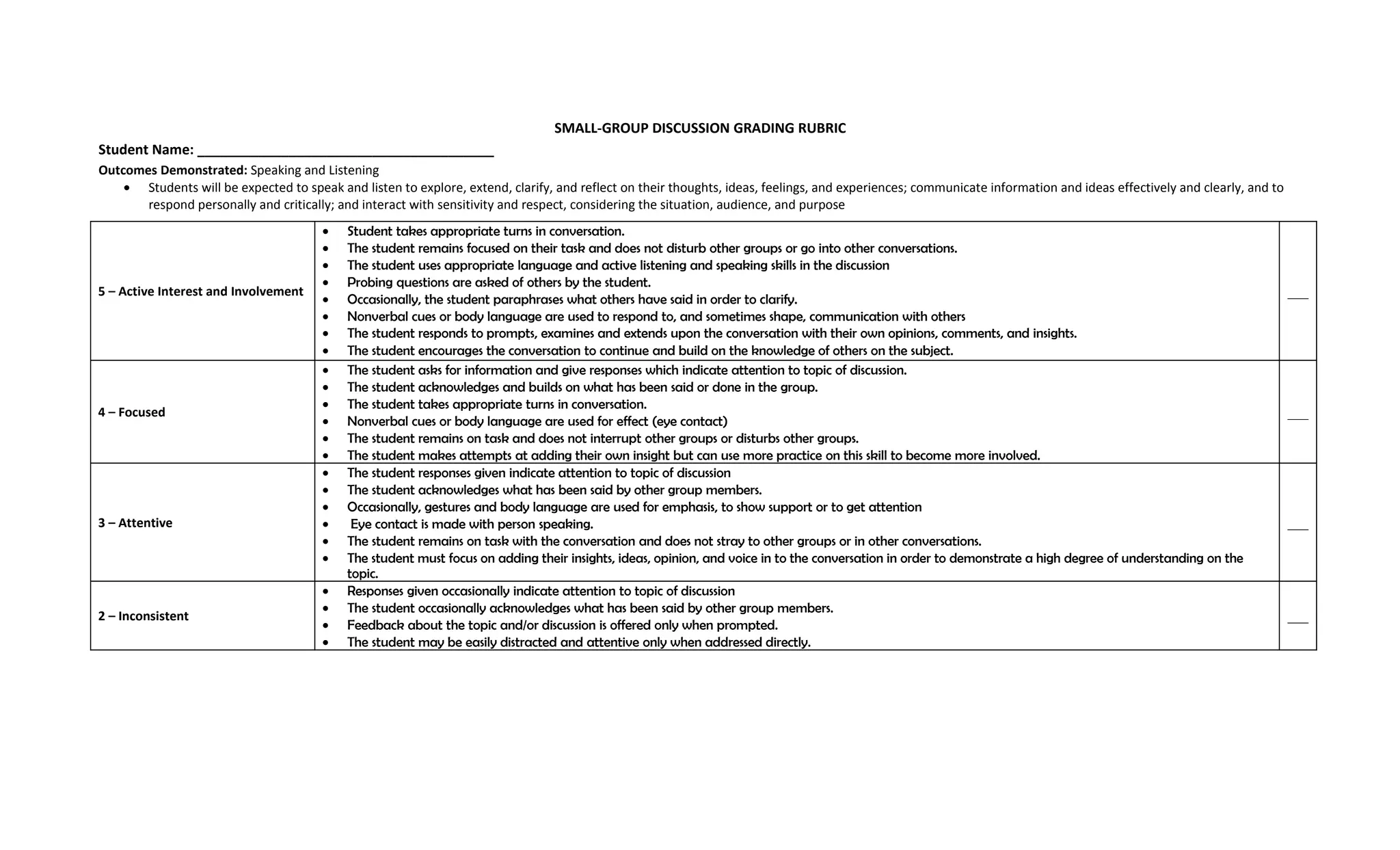
                                       •    Student takes appropriate turns in conversation.
                                       •    The student remains focused on their task and does not disturb other groups or go into other conversations.
                                       •    The student uses appropriate language and active listening and speaking skills in the discussion
                                       •    Probing questions are asked of others by the student.
5 – Active Interest and Involvement                                                                                                                                                                                   ___
                                       •    Occasionally, the student paraphrases what others have said in order to clarify.
                                       •    Nonverbal cues or body language are used to respond to, and sometimes shape, communication with others
                                       •    The student responds to prompts, examines and extends upon the conversation with their own opinions, comments, and insights.
                                       •    The student encourages the conversation to continue and build on the knowledge of others on the subject.
                                       •    The student asks for information and give responses which indicate attention to topic of discussion.
                                       •    The student acknowledges and builds on what has been said or done in the group.
                                       •    The student takes appropriate turns in conversation.
4 – Focused                                                                                                                                                                                                           ___
                                       •    Nonverbal cues or body language are used for effect (eye contact)
                                       •    The student remains on task and does not interrupt other groups or disturbs other groups.
                                       •    The student makes attempts at adding their own insight but can use more practice on this skill to become more involved.
                                       •    The student responses given indicate attention to topic of discussion
                                       •    The student acknowledges what has been said by other group members.
                                       •    Occasionally, gestures and body language are used for emphasis, to show support or to get attention
3 – Attentive                          •     Eye contact is made with person speaking.                                                                                                                                ___
                                       •    The student remains on task with the conversation and does not stray to other groups or in other conversations.
                                       •    The student must focus on adding their insights, ideas, opinion, and voice in to the conversation in order to demonstrate a high degree of understanding on the
                                            topic.
                                       •    Responses given occasionally indicate attention to topic of discussion
                                       •    The student occasionally acknowledges what has been said by other group members.
2 – Inconsistent                                                                                                                                                                                                      ___
                                       •    Feedback about the topic and/or discussion is offered only when prompted.
                                       •    The student may be easily distracted and attentive only when addressed directly.
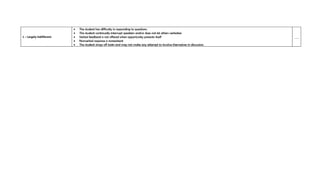
•   The student has difficulty in responding to questions.
                          •   The student continually interrupt speakers and/or does not let others verbalize
1 – Largely Indifferent   •   Verbal feedback is not offered when opportunity presents itself                                  ___
                          •   Nonverbal response is nonexistent
                          •   The student strays off tasks and may not make any attempt to involve themselves in discussion.

Class discussion grading rubric

  • 1.
    SMALL-GROUP DISCUSSION GRADINGRUBRIC Student Name: _______________________________________ Outcomes Demonstrated: Speaking and Listening • Students will be expected to speak and listen to explore, extend, clarify, and reflect on their thoughts, ideas, feelings, and experiences; communicate information and ideas effectively and clearly, and to respond personally and critically; and interact with sensitivity and respect, considering the situation, audience, and purpose • Student takes appropriate turns in conversation. • The student remains focused on their task and does not disturb other groups or go into other conversations. • The student uses appropriate language and active listening and speaking skills in the discussion • Probing questions are asked of others by the student. 5 – Active Interest and Involvement ___ • Occasionally, the student paraphrases what others have said in order to clarify. • Nonverbal cues or body language are used to respond to, and sometimes shape, communication with others • The student responds to prompts, examines and extends upon the conversation with their own opinions, comments, and insights. • The student encourages the conversation to continue and build on the knowledge of others on the subject. • The student asks for information and give responses which indicate attention to topic of discussion. • The student acknowledges and builds on what has been said or done in the group. • The student takes appropriate turns in conversation. 4 – Focused ___ • Nonverbal cues or body language are used for effect (eye contact) • The student remains on task and does not interrupt other groups or disturbs other groups. • The student makes attempts at adding their own insight but can use more practice on this skill to become more involved. • The student responses given indicate attention to topic of discussion • The student acknowledges what has been said by other group members. • Occasionally, gestures and body language are used for emphasis, to show support or to get attention 3 – Attentive • Eye contact is made with person speaking. ___ • The student remains on task with the conversation and does not stray to other groups or in other conversations. • The student must focus on adding their insights, ideas, opinion, and voice in to the conversation in order to demonstrate a high degree of understanding on the topic. • Responses given occasionally indicate attention to topic of discussion • The student occasionally acknowledges what has been said by other group members. 2 – Inconsistent ___ • Feedback about the topic and/or discussion is offered only when prompted. • The student may be easily distracted and attentive only when addressed directly.
  • 2.
    The student has difficulty in responding to questions. • The student continually interrupt speakers and/or does not let others verbalize 1 – Largely Indifferent • Verbal feedback is not offered when opportunity presents itself ___ • Nonverbal response is nonexistent • The student strays off tasks and may not make any attempt to involve themselves in discussion.