SE 412
Acceptance and System Testing
Fall 2023
Software Engineering
1
Outline
● Introducing the importance of acceptance testing especially before
development.
● Introducing FIT/FITness.
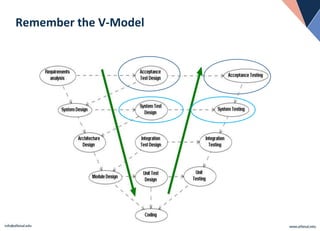
Remember the V-Model
Acceptance Testing
Why Acceptance Testing?
Before development:
• Any concept is best understood with examples.
• To develop a common understanding of the system’s
black-box behavior.
Why Acceptance Testing?
Before development:
• Any concept is best understood with examples.
• To develop a common understanding of the system’s black-box
behavior.
• Information provided by the customer contains domain
assumptions due to his expertise of the domain.
• Uncover usage scenarios that the customer has not thought of.
• Sometimes customers just do not exactly know what they
want.
Before development:
• A basis to write down further lower-level tests.
• A basis to guide the development process.
• A basis to write down the contract.
We try to make sure that we will be building the
right system Validation
Why Acceptance Testing?
System Testing
Why System Testing?
Before development:
• To cover more usage scenarios, especially unsuccessful
ones.
• To test against tacit requirements, especially non-functional
ones (such as data safety and security concerns).
• To cross-check against use cases (or user-stories) to make
sure all functionalities are covered.
• As a basis to develop further lower-level tests.
• As a basis to guide the development process.
• As means to track the progress of the project.
9
We try to make sure that we will be building the right system
→ Validation
Why Acceptance Testing?
10
After development:
• Does the system actually behave the way the customer
expected (in case there was ambiguity)?
• Is the system’s functionality correct?
• Is the system’s performance acceptable?
• Is the system’s usability by its end-users acceptable?
• Is all the functionality requested there?
• To run the system at the customer site.
• To sign-off on the contract and end it.
We try to make sure that the system we built was built the
right way → Verification
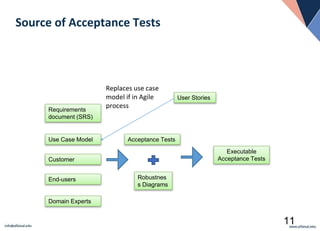
11
Requirements
document (SRS)
Use Case Model
Customer
End-users
Domain Experts
Acceptance Tests
Robustnes
s Diagrams
User Stories
Executable
Acceptance Tests
Replaces use case
model if in Agile
process
Source of Acceptance Tests
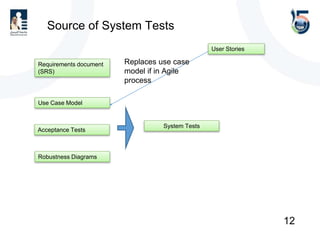
Source of System Tests
12
Acceptance Tests
Requirements document
(SRS)
Use Case Model
Robustness Diagrams
User Stories
System Tests
Replaces use case
model if in Agile
process
How does it start?
• A brain storming session that includes the customers, domain
experts and the product manager.
FIT (Framework for Integrated Tests)
• A framework that allows non-technical stakeholders to specify
system requirements through concrete examples.
• A tool that can execute acceptance and system tests.
• Using a tabular form – FIT tables
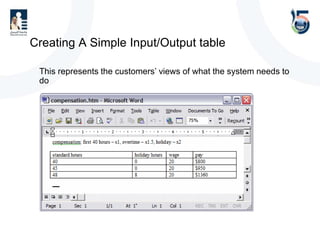
Creating A Simple Input/Output table
• This represents the customers’ views of what the system needs to
do
Fixtures
• FIT tables are more commonly referred to as fixtures.
• Fixtures uses fragments of the actual code that is being tested
when the coding is completed.
• Before coding is completed, fixtures simply use English words.
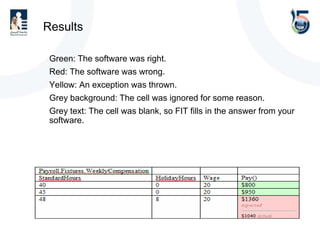
Results
• Green: The software was right.
• Red: The software was wrong.
• Yellow: An exception was thrown.
• Grey background: The cell was ignored for some reason.
• Grey text: The cell was blank, so FIT fills in the answer from your
software.
Table Types
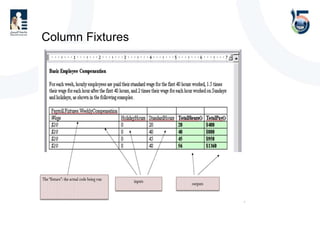
• ColumnFixture - best for checking rules and calculations
• ActionFixture - best for step-by-step processing
• RowFixture - best for checking sets of data
Column Fixtures
ActionFixtures
• Checking that a sequence of actions produced the right results
• Special keywords
• start aClass or a program -- Subsequent commands are directed to an
instance of aClass. This is similar to navigating to a particular GUI screen.
• enter aValue into a aField. This is similar to entering values into GUI
fields.
• press aMethod -- Invoke aMethod with no arguments. This is similar to
pressing a GUI button.
• check aValue -- Compare the returned value with aValue. This is similar to
reading values from a GUI screen.
ActionFixtures - Example
fit.ActionFixture
start BuyActions
check total 00.00
enter price 12.00
press buy
check total 12.00
enter price 100.00
press buy
check total 112.00
•What if the row “enter price 100.00” was removed?
•Then the “buy” action will be performed on the previous “price” and the total would be 24.00.
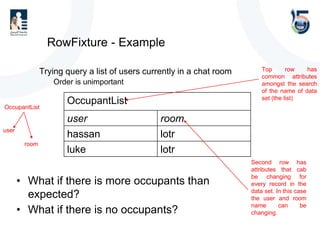
RowFixture
• RowFixture tables are designed for testing that the results of a
search or a query of the system under test are as expected.
• Testing lists
RowFixture - Example
• Trying query a list of users currently in a chat room
• Order is unimportant
OccupantList
user room
hassan lotr
luke lotr
• What if there is more occupants than
expected?
• What if there is no occupants?
Second row has
attributes that cab
be changing for
every record in the
data set. In this case
the user and room
name can be
changing.
Top row has
common attributes
amongst the search
of the name of data
set (the list)
OccupantList
user
room
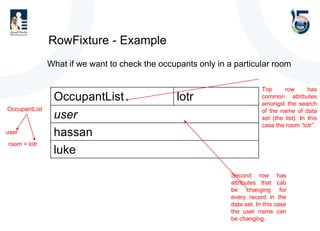
RowFixture - Example
• What if we want to check the occupants only in a particular room
OccupantList lotr
user
hassan
luke
OccupantList
user
room = lotr
Top row has
common attributes
amongst the search
of the name of data
set (the list). In this
case the room “lotr”.
Second row has
attributes that cab
be changing for
every record in the
data set. In this case
the user name can
be changing.
Chapter 4
SE 412 Folder
bit.ly/se412fall2023

class Acceptance and System Testing.pptx

  • 1.
    SE 412 Acceptance andSystem Testing Fall 2023 Software Engineering 1
  • 2.
    Outline ● Introducing theimportance of acceptance testing especially before development. ● Introducing FIT/FITness.
  • 3.
  • 4.
  • 5.
    Why Acceptance Testing? Beforedevelopment: • Any concept is best understood with examples. • To develop a common understanding of the system’s black-box behavior.
  • 6.
    Why Acceptance Testing? Beforedevelopment: • Any concept is best understood with examples. • To develop a common understanding of the system’s black-box behavior. • Information provided by the customer contains domain assumptions due to his expertise of the domain. • Uncover usage scenarios that the customer has not thought of. • Sometimes customers just do not exactly know what they want.
  • 7.
    Before development: • Abasis to write down further lower-level tests. • A basis to guide the development process. • A basis to write down the contract. We try to make sure that we will be building the right system Validation Why Acceptance Testing?
  • 8.
  • 9.
    Why System Testing? Beforedevelopment: • To cover more usage scenarios, especially unsuccessful ones. • To test against tacit requirements, especially non-functional ones (such as data safety and security concerns). • To cross-check against use cases (or user-stories) to make sure all functionalities are covered. • As a basis to develop further lower-level tests. • As a basis to guide the development process. • As means to track the progress of the project. 9 We try to make sure that we will be building the right system → Validation
  • 10.
    Why Acceptance Testing? 10 Afterdevelopment: • Does the system actually behave the way the customer expected (in case there was ambiguity)? • Is the system’s functionality correct? • Is the system’s performance acceptable? • Is the system’s usability by its end-users acceptable? • Is all the functionality requested there? • To run the system at the customer site. • To sign-off on the contract and end it. We try to make sure that the system we built was built the right way → Verification
  • 11.
    11 Requirements document (SRS) Use CaseModel Customer End-users Domain Experts Acceptance Tests Robustnes s Diagrams User Stories Executable Acceptance Tests Replaces use case model if in Agile process Source of Acceptance Tests
  • 12.
    Source of SystemTests 12 Acceptance Tests Requirements document (SRS) Use Case Model Robustness Diagrams User Stories System Tests Replaces use case model if in Agile process
  • 13.
    How does itstart? • A brain storming session that includes the customers, domain experts and the product manager.
  • 14.
    FIT (Framework forIntegrated Tests) • A framework that allows non-technical stakeholders to specify system requirements through concrete examples. • A tool that can execute acceptance and system tests. • Using a tabular form – FIT tables
  • 15.
    Creating A SimpleInput/Output table • This represents the customers’ views of what the system needs to do
  • 16.
    Fixtures • FIT tablesare more commonly referred to as fixtures. • Fixtures uses fragments of the actual code that is being tested when the coding is completed. • Before coding is completed, fixtures simply use English words.
  • 17.
    Results • Green: Thesoftware was right. • Red: The software was wrong. • Yellow: An exception was thrown. • Grey background: The cell was ignored for some reason. • Grey text: The cell was blank, so FIT fills in the answer from your software.
  • 18.
    Table Types • ColumnFixture- best for checking rules and calculations • ActionFixture - best for step-by-step processing • RowFixture - best for checking sets of data
  • 19.
  • 20.
    ActionFixtures • Checking thata sequence of actions produced the right results • Special keywords • start aClass or a program -- Subsequent commands are directed to an instance of aClass. This is similar to navigating to a particular GUI screen. • enter aValue into a aField. This is similar to entering values into GUI fields. • press aMethod -- Invoke aMethod with no arguments. This is similar to pressing a GUI button. • check aValue -- Compare the returned value with aValue. This is similar to reading values from a GUI screen.
  • 21.
    ActionFixtures - Example fit.ActionFixture startBuyActions check total 00.00 enter price 12.00 press buy check total 12.00 enter price 100.00 press buy check total 112.00 •What if the row “enter price 100.00” was removed? •Then the “buy” action will be performed on the previous “price” and the total would be 24.00.
  • 22.
    RowFixture • RowFixture tablesare designed for testing that the results of a search or a query of the system under test are as expected. • Testing lists
  • 23.
    RowFixture - Example •Trying query a list of users currently in a chat room • Order is unimportant OccupantList user room hassan lotr luke lotr • What if there is more occupants than expected? • What if there is no occupants? Second row has attributes that cab be changing for every record in the data set. In this case the user and room name can be changing. Top row has common attributes amongst the search of the name of data set (the list) OccupantList user room
  • 24.
    RowFixture - Example •What if we want to check the occupants only in a particular room OccupantList lotr user hassan luke OccupantList user room = lotr Top row has common attributes amongst the search of the name of data set (the list). In this case the room “lotr”. Second row has attributes that cab be changing for every record in the data set. In this case the user name can be changing.
  • 25.
    Chapter 4 SE 412Folder bit.ly/se412fall2023