Citing Sources in
 Presentations
        Janice R. Walker
   Georgia Southern University
Citing Graphics

   Include a “source” line on each
    slide with borrowed graphics.
   If the source is online, you can
    include a link.
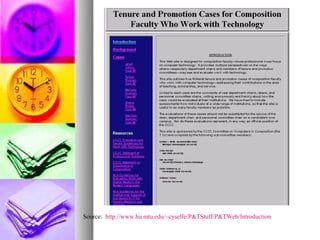
Source: http://www.hu.mtu.edu/~cyselfe/P&TStuff/P&TWeb/Introduction
If all graphics are from a
single source, you may
include this information on
your title slide instead.
How to Cite Graphics
                 By Janice R. Walker

 All graphics for this presentation courtesy of Barry Thomson,
                               Ltd.
Citing quotations

   Cite direct quotations,
    information, ideas, or statistics
    from other sources.
   Include the author’s last name
    or the title in parentheses after
    the quotation, just as you would
    in a paper, or
   Include a “Source” line.
Cite source of information in the
text if it’s an important source or
key information.

 James Berlin delineates three major paradigms of
 the “poetic-rhetoric binary” in English studies:
 “literacy for the scientific meritocracy,” marked by
 current-traditional rhetoric and literary criticism as
 philology; the “liberal-cultural paradigm,” wherein
 rhetoric becomes a branch of poetry, a “product of
 genius,” with oral reading at the center of teaching
 literature since “to those of taste the text spoke for
 itself”; and the “social-democratic” that argues that
 “Rhetoric in college should focus on training citizens
 for participation in a democracy” (34).
Cite the source in a
parenthetic note if it is not
central to your argument, if
the source is not critical, or
if the source has previously
been identified.
The “dot-com bubble” was
 characterized by investment in
 online companies whose value
 was highly speculative and,
 usually, “grossly overvalued”
 (“Dot-com Bubble”).
   You may include a “source line”
    if all of the information on a slide
    is from a single source.
   If the source is online, you may
    include a link.
CCCC’s Position Statement:

  Promotion & Tenure Guidelines for Work with Technology


It is important that candidates find ways to explain
their work in terms of the traditional areas of
teaching, research, and service, and also to explain
carefully the ways in which their work overlaps or
redefines those categories. The burden of
understanding the technology, the candidate's
specific uses of it, and the importance of such
work rests jointly on the committee and the
candidate -- it is not carried by either party
alone (emphasis added).

Source: http://www.ncte.org/about/over/positions/category/inst/107658.htm
Don’t forget your list of Works
Cited!
   List references following required
    style guidelines (e.g., MLA/COS,
    APA/COS, Chicago/COS, etc.).
   Use bulleted list feature instead of
    hanging-indent.
   Do not double space inside entries.
   Do not include graphics in works
    cited or references list.
   You may have a separate list of
    graphics if you choose.
Works Cited
   Berlin, James. Rhetorics, Poetics, and
    Culture: Refiguring College English Studies.
    Urbana, IL: NCTE, 1996.
   “Dot-com Bubble.” Wikipedia. 19 Oct. 2006.
    http://en.wikipedia.org/wiki/Dot_com_bubble
    (21 Oct. 2006).
   Walker, Janice R. "Resisting Resistance:
    Power and Control in the Technologized
    Classroom." In Insurrection: Approaches to
    Resistance in Composition Studies. Ed.
    Andrea Greenbaum. Albany: SUNY, 2001.
    119-32.
List of Graphics and Figures

   Slide 3. “Tenure and Promotion
    Cases for Composition Faculty
    Who Work with Technology.”
    http://www.hu.mtu.edu/~cyselfe/P&
    (used without permission).
   Slide 5. “Kiwi.gif.” Courtesy of
    Barry Thomson, Ltd.

Citing sources in_presentations

  • 1.
    Citing Sources in Presentations Janice R. Walker Georgia Southern University
  • 2.
    Citing Graphics  Include a “source” line on each slide with borrowed graphics.  If the source is online, you can include a link.
  • 3.
  • 4.
    If all graphicsare from a single source, you may include this information on your title slide instead.
  • 5.
    How to CiteGraphics By Janice R. Walker All graphics for this presentation courtesy of Barry Thomson, Ltd.
  • 6.
    Citing quotations  Cite direct quotations, information, ideas, or statistics from other sources.  Include the author’s last name or the title in parentheses after the quotation, just as you would in a paper, or  Include a “Source” line.
  • 7.
    Cite source ofinformation in the text if it’s an important source or key information. James Berlin delineates three major paradigms of the “poetic-rhetoric binary” in English studies: “literacy for the scientific meritocracy,” marked by current-traditional rhetoric and literary criticism as philology; the “liberal-cultural paradigm,” wherein rhetoric becomes a branch of poetry, a “product of genius,” with oral reading at the center of teaching literature since “to those of taste the text spoke for itself”; and the “social-democratic” that argues that “Rhetoric in college should focus on training citizens for participation in a democracy” (34).
  • 8.
    Cite the sourcein a parenthetic note if it is not central to your argument, if the source is not critical, or if the source has previously been identified.
  • 9.
    The “dot-com bubble”was characterized by investment in online companies whose value was highly speculative and, usually, “grossly overvalued” (“Dot-com Bubble”).
  • 10.
    You may include a “source line” if all of the information on a slide is from a single source.  If the source is online, you may include a link.
  • 11.
    CCCC’s Position Statement: Promotion & Tenure Guidelines for Work with Technology It is important that candidates find ways to explain their work in terms of the traditional areas of teaching, research, and service, and also to explain carefully the ways in which their work overlaps or redefines those categories. The burden of understanding the technology, the candidate's specific uses of it, and the importance of such work rests jointly on the committee and the candidate -- it is not carried by either party alone (emphasis added). Source: http://www.ncte.org/about/over/positions/category/inst/107658.htm
  • 12.
    Don’t forget yourlist of Works Cited!  List references following required style guidelines (e.g., MLA/COS, APA/COS, Chicago/COS, etc.).  Use bulleted list feature instead of hanging-indent.  Do not double space inside entries.  Do not include graphics in works cited or references list.  You may have a separate list of graphics if you choose.
  • 13.
    Works Cited  Berlin, James. Rhetorics, Poetics, and Culture: Refiguring College English Studies. Urbana, IL: NCTE, 1996.  “Dot-com Bubble.” Wikipedia. 19 Oct. 2006. http://en.wikipedia.org/wiki/Dot_com_bubble (21 Oct. 2006).  Walker, Janice R. "Resisting Resistance: Power and Control in the Technologized Classroom." In Insurrection: Approaches to Resistance in Composition Studies. Ed. Andrea Greenbaum. Albany: SUNY, 2001. 119-32.
  • 14.
    List of Graphicsand Figures  Slide 3. “Tenure and Promotion Cases for Composition Faculty Who Work with Technology.” http://www.hu.mtu.edu/~cyselfe/P& (used without permission).  Slide 5. “Kiwi.gif.” Courtesy of Barry Thomson, Ltd.