Anatomopathology
TOPIC: Cirrhosis Liver
Professor: Sann Chamroeun, MD,DHPE
Students : Soth Liheang
Sarith Arun
Kun Salim
Contents
I. Introduction
 Definition
 Cause
 Clinical
II. Histology (Normal Cell)
III. Structure (Histology Abnormal Cell)
I. Introduction
 Definition
 Cirrhosis is a late stage of scarring (fibrosis) of the liver caused by
many forms of liver diseases and conditions, such as hepatitis and
chronic alcoholism.
 Each time your liver is injured — whether by disease, excessive alcohol
consumption or another cause — it tries to repair itself
 Advanced cirrhosis is life-threatening.
 Cause
 The most common causes of cirrhosis are:
 Alcohol-related liver disease
 Hepatitis (B,C)
 Clinical features
 Cirrhosis often has no signs or symptoms
until liver damage is extensive.
 When signs and symptoms do occur, they
may include:
II. Histology
 Normal Histology of the liver
Normal Histology of the liver
III. Structure Microscopic Cell
 Alcohol and hepatitis B and C are the most common causes of Chirrhosis.
 Viral Hepatitis Cirrhosis
 Macro-nodular cirrhosis
 Nodular larger than 3mm
 Chronic Alcoholism Cirrhosis
 Micro-nodular cirrhosis
 Develop over many years
 Nodular are quite small averaging less than 3mm
 Microscopic Cirrhosis
 Nodules of hepatocytes are surrounded by
fibrous connective tissues
 Proliferation of Bile duct( Neocanal Bile Duct )
 Portal tracts: with this collagenous tissue are
scattered
 Cirrhosis
• Moderate fatty Change
( Macro-vesicular steatosis )
• Regenerative nodules surrounded by Fibrous
connective tissue extending between portal
regions
 Cirrhosis
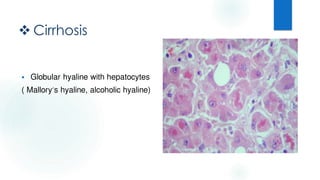
 Globular hyaline with hepatocytes
( Mallory’s hyaline, alcoholic hyaline)
Referent
*Mayoclinic
https://www.mayoclinic.org/diseases-conditions/cirrhosis/symptoms-
causes/syc-20351487
*liverfoundation
https://liverfoundation.org/for-patients/about-the-liver/diseases-of-the-
liver/cirrhosis/

Cirrhosis Liver