Frankfurt (Germany), 6-9 June 2011


        Mission-Critical Communications
       essential enabler of the Smart Grid


   Wim D’Hondt


   Senior Manager
   EALA Smart Grid Communications Technology Lead
   Accenture
   wim.dhondt@accenture.com
Wim D’Hondt – Accenture– RT 3c.
Frankfurt (Germany), 6-9 June 2011


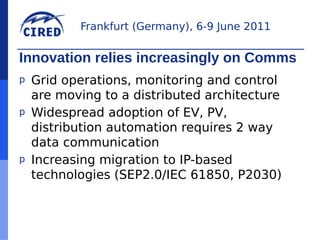
Innovation relies increasingly on Comms
p   Grid operations, monitoring and control
    are moving to a distributed architecture
p   Widespread adoption of EV, PV,
    distribution automation requires 2 way
    data communication
p   Increasing migration to IP-based
    technologies (SEP2.0/IEC 61850, P2030)
Frankfurt (Germany), 6-9 June 2011


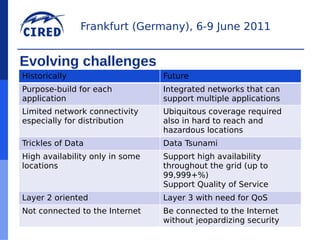
Evolving challenges
Historically                     Future
Purpose-build for each           Integrated networks that can
application                      support multiple applications
Limited network connectivity     Ubiquitous coverage required
especially for distribution      also in hard to reach and
                                 hazardous locations
Trickles of Data                 Data Tsunami
High availability only in some   Support high availability
locations                        throughout the grid (up to
                                 99,999+%)
                                 Support Quality of Service
Layer 2 oriented                 Layer 3 with need for QoS
Not connected to the Internet    Be connected to the Internet
                                 without jeopardizing security
Frankfurt (Germany), 6-9 June 2011


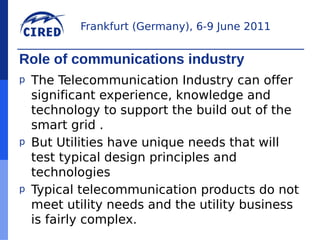
Role of communications industry
p   The Telecommunication Industry can offer
    significant experience, knowledge and
    technology to support the build out of the
    smart grid .
p   But Utilities have unique needs that will
    test typical design principles and
    technologies
p   Typical telecommunication products do not
    meet utility needs and the utility business
    is fairly complex.
Frankfurt (Germany), 6-9 June 2011


Concrete Challenges
p   Do we really understand Smart grid network
    requirements?
p   Should we build or own the communications
    network?
p   Is Smart Metering an asset or hindrance for
    smart grid
p   How can I keep the network secure?
6
C
o
p
y
                    Frankfurt (Germany), 6-9 June 2011
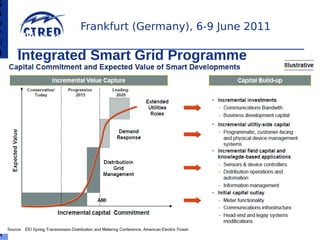
     AMI is a key building block to Smart Grid
ri
g
h
      Integrated Smart Grid Programme
©

2
0
1
0
A
c
c
e
n

u
r
e

A
Frankfurt (Germany), 6-9 June 2011

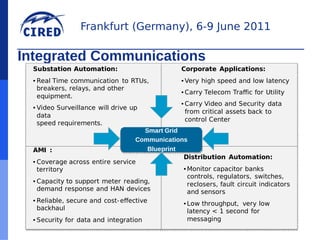
Integrated Communications
  Substation Automation:                           Corporate Applications:
  • Real Time communication to RTUs,               • Very high speed and low latency
    breakers, relays, and other
                                                   • Carry Telecom Traffic for Utility
    equipment.
                                                   • Carry Video and Security data
  • Video Surveillance will drive up
                                                     from critical assets back to
    data
                                                     control Center
    speed requirements.
                                       Smart Grid
                                    Communications
  AMI :                                  Blueprint
                                                   Distribution Automation:
  • Coverage across entire service
    territory                                      • Monitor capacitor banks
                                                     controls, regulators, switches,
  • Capacity to support meter reading,               reclosers, fault circuit indicators
    demand response and HAN devices                  and sensors
  • Reliable, secure and cost- effective           • Low throughput, very low
   7backhaul                                         latency < 1 second for
  • Security for data and integration                messaging
Frankfurt (Germany), 6-9 June 2011


Utilities will need to:
p   Skill up and learn
p   Collaborate with industry and regulators
p   Educate suppliers on specific needs
p   Lead the way in standardization

CIRED 2011 Presentation Smart Grid communications

  • 1.
    Frankfurt (Germany), 6-9June 2011 Mission-Critical Communications essential enabler of the Smart Grid Wim D’Hondt Senior Manager EALA Smart Grid Communications Technology Lead Accenture wim.dhondt@accenture.com Wim D’Hondt – Accenture– RT 3c.
  • 2.
    Frankfurt (Germany), 6-9June 2011 Innovation relies increasingly on Comms p Grid operations, monitoring and control are moving to a distributed architecture p Widespread adoption of EV, PV, distribution automation requires 2 way data communication p Increasing migration to IP-based technologies (SEP2.0/IEC 61850, P2030)
  • 3.
    Frankfurt (Germany), 6-9June 2011 Evolving challenges Historically Future Purpose-build for each Integrated networks that can application support multiple applications Limited network connectivity Ubiquitous coverage required especially for distribution also in hard to reach and hazardous locations Trickles of Data Data Tsunami High availability only in some Support high availability locations throughout the grid (up to 99,999+%) Support Quality of Service Layer 2 oriented Layer 3 with need for QoS Not connected to the Internet Be connected to the Internet without jeopardizing security
  • 4.
    Frankfurt (Germany), 6-9June 2011 Role of communications industry p The Telecommunication Industry can offer significant experience, knowledge and technology to support the build out of the smart grid . p But Utilities have unique needs that will test typical design principles and technologies p Typical telecommunication products do not meet utility needs and the utility business is fairly complex.
  • 5.
    Frankfurt (Germany), 6-9June 2011 Concrete Challenges p Do we really understand Smart grid network requirements? p Should we build or own the communications network? p Is Smart Metering an asset or hindrance for smart grid p How can I keep the network secure?
  • 6.
    6 C o p y Frankfurt (Germany), 6-9 June 2011 AMI is a key building block to Smart Grid ri g h Integrated Smart Grid Programme © 2 0 1 0 A c c e n u r e A
  • 7.
    Frankfurt (Germany), 6-9June 2011 Integrated Communications Substation Automation: Corporate Applications: • Real Time communication to RTUs, • Very high speed and low latency breakers, relays, and other • Carry Telecom Traffic for Utility equipment. • Carry Video and Security data • Video Surveillance will drive up from critical assets back to data control Center speed requirements. Smart Grid Communications AMI : Blueprint Distribution Automation: • Coverage across entire service territory • Monitor capacitor banks controls, regulators, switches, • Capacity to support meter reading, reclosers, fault circuit indicators demand response and HAN devices and sensors • Reliable, secure and cost- effective • Low throughput, very low 7backhaul latency < 1 second for • Security for data and integration messaging
  • 8.
    Frankfurt (Germany), 6-9June 2011 Utilities will need to: p Skill up and learn p Collaborate with industry and regulators p Educate suppliers on specific needs p Lead the way in standardization