What is the
cardiovascular
system?
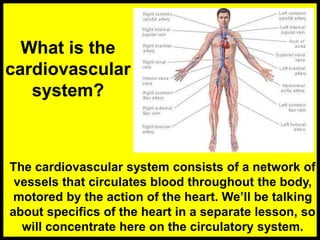
The cardiovascular system consists of a network of
vessels that circulates blood throughout the body,
motored by the action of the heart. We’ll be talking
about specifics of the heart in a separate lesson, so
will concentrate here on the circulatory system.
Tracing the flow of
blood…pulmonary circulation
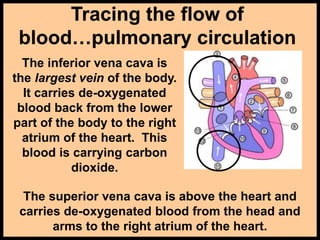
The inferior vena cava is
the largest vein of the body.
It carries de-oxygenated
blood back from the lower
part of the body to the right
atrium of the heart. This
blood is carrying carbon
dioxide.
The superior vena cava is above the heart and
carries de-oxygenated blood from the head and
arms to the right atrium of the heart.
Tracing the flow of
blood…pulmonary circulation
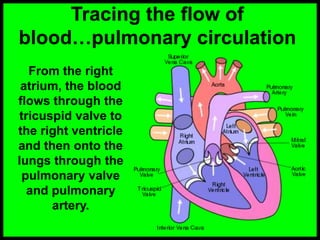
From the right
atrium, the blood
flows through the
tricuspid valve to
the right ventricle
and then onto the
lungs through the
pulmonary valve
and pulmonary
artery.
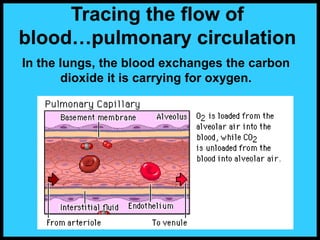
In the lungs, the blood exchanges the carbon
dioxide it is carrying for oxygen.
Tracing the flow of
blood…pulmonary circulation
Tracing the flow of
blood…pulmonary circulation
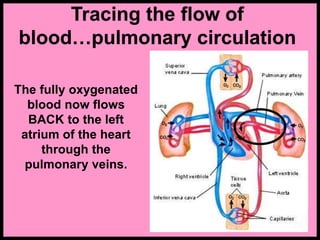
The fully oxygenated
blood now flows
BACK to the left
atrium of the heart
through the
pulmonary veins.
Tracing the flow of
blood…systemic circulation
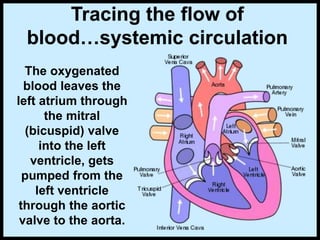
The oxygenated
blood leaves the
left atrium through
the mitral
(bicuspid) valve
into the left
ventricle, gets
pumped from the
left ventricle
through the aortic
valve to the aorta.
Tracing the flow of
blood…systemic circulation
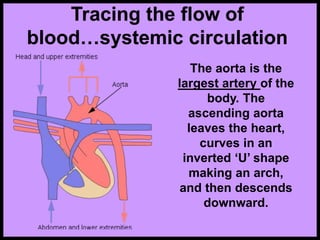
The aorta is the
largest artery of the
body. The
ascending aorta
leaves the heart,
curves in an
inverted ‘U’ shape
making an arch,
and then descends
downward.
Tracing the flow of
blood…systemic circulation
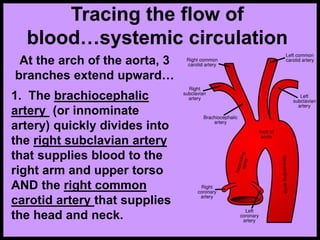
At the arch of the aorta, 3
branches extend upward…
1. The brachiocephalic
artery (or innominate
artery) quickly divides into
the right subclavian artery
that supplies blood to the
right arm and upper torso
AND the right common
carotid artery that supplies
the head and neck.
Tracing the flow of
blood…systemic circulation
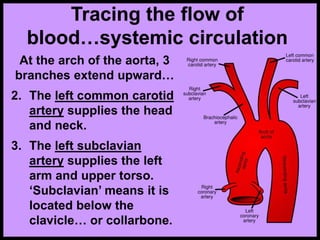
At the arch of the aorta, 3
branches extend upward…
2. The left common carotid
artery supplies the head
and neck.
3. The left subclavian
artery supplies the left
arm and upper torso.
‘Subclavian’ means it is
located below the
clavicle… or collarbone.
Tracing the flow of
blood… the arteries
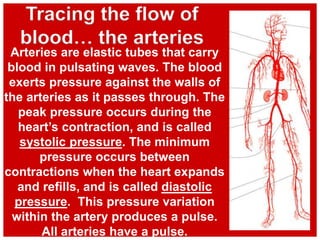
Arteries are elastic tubes that carry
blood in pulsating waves. The blood
exerts pressure against the walls of
the arteries as it passes through. The
peak pressure occurs during the
heart’s contraction, and is called
systolic pressure. The minimum
pressure occurs between
contractions when the heart expands
and refills, and is called diastolic
pressure. This pressure variation
within the artery produces a pulse.
All arteries have a pulse.
Tracing the flow of blood… the
arteries
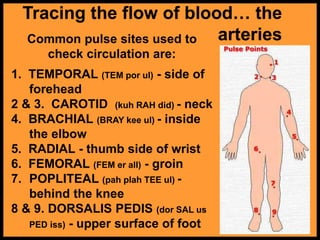
Common pulse sites used to
check circulation are:
1. TEMPORAL (TEM por ul) - side of
forehead
2 & 3. CAROTID (kuh RAH did) - neck
4. BRACHIAL (BRAY kee ul) - inside
the elbow
5. RADIAL - thumb side of wrist
6. FEMORAL (FEM er all) - groin
7. POPLITEAL (pah plah TEE ul) -
behind the knee
8 & 9. DORSALIS PEDIS (dor SAL us
PED iss) - upper surface of foot
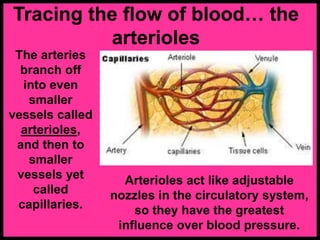
Arterioles act like adjustable
nozzles in the circulatory system,
so they have the greatest
influence over blood pressure.
Tracing the flow of blood… the
arterioles
The arteries
branch off
into even
smaller
vessels called
arterioles,
and then to
smaller
vessels yet
called
capillaries.
Tracing the flow of blood… the
capillaries
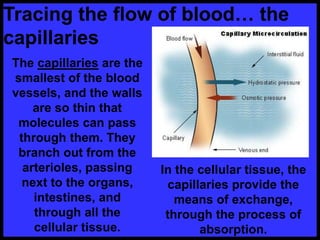
The capillaries are the
smallest of the blood
vessels, and the walls
are so thin that
molecules can pass
through them. They
branch out from the
arterioles, passing
next to the organs,
intestines, and
through all the
cellular tissue.
In the cellular tissue, the
capillaries provide the
means of exchange,
through the process of
absorption.
Tracing the flow of blood… the
capillaries
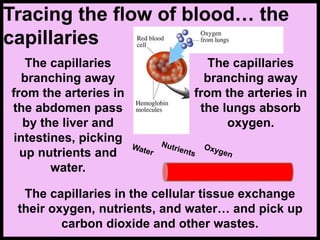
The capillaries
branching away
from the arteries in
the abdomen pass
by the liver and
intestines, picking
up nutrients and
water.
The capillaries in the cellular tissue exchange
their oxygen, nutrients, and water… and pick up
carbon dioxide and other wastes.
The capillaries
branching away
from the arteries in
the lungs absorb
oxygen.
Tracing the flow of blood… the
venules
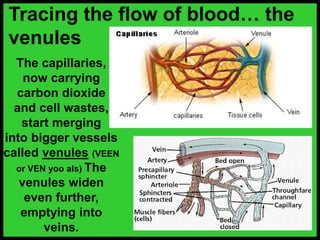
The capillaries,
now carrying
carbon dioxide
and cell wastes,
start merging
into bigger vessels
called venules (VEEN
or VEN yoo als) The
venules widen
even further,
emptying into
veins.
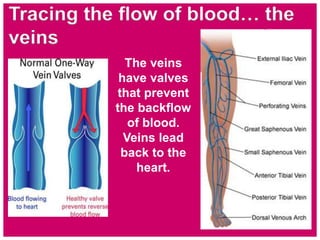
The veins
have valves
that prevent
the backflow
of blood.
Veins lead
back to the
heart.
Tracing the flow of blood… the
veins
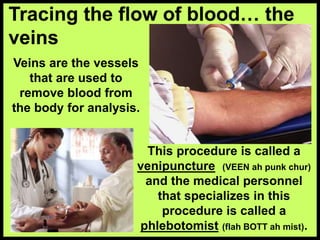
Veins are the vessels
that are used to
remove blood from
the body for analysis.
Tracing the flow of blood… the
veins
This procedure is called a
venipuncture (VEEN ah punk chur)
and the medical personnel
that specializes in this
procedure is called a
phlebotomist (flah BOTT ah mist).
Circulatory-System-STEM.ppt

Circulatory-System-STEM.ppt

  • 2.
    What is the cardiovascular system? Thecardiovascular system consists of a network of vessels that circulates blood throughout the body, motored by the action of the heart. We’ll be talking about specifics of the heart in a separate lesson, so will concentrate here on the circulatory system.
  • 3.
    Tracing the flowof blood…pulmonary circulation The inferior vena cava is the largest vein of the body. It carries de-oxygenated blood back from the lower part of the body to the right atrium of the heart. This blood is carrying carbon dioxide. The superior vena cava is above the heart and carries de-oxygenated blood from the head and arms to the right atrium of the heart.
  • 4.
    Tracing the flowof blood…pulmonary circulation From the right atrium, the blood flows through the tricuspid valve to the right ventricle and then onto the lungs through the pulmonary valve and pulmonary artery.
  • 5.
    In the lungs,the blood exchanges the carbon dioxide it is carrying for oxygen. Tracing the flow of blood…pulmonary circulation
  • 6.
    Tracing the flowof blood…pulmonary circulation The fully oxygenated blood now flows BACK to the left atrium of the heart through the pulmonary veins.
  • 7.
    Tracing the flowof blood…systemic circulation The oxygenated blood leaves the left atrium through the mitral (bicuspid) valve into the left ventricle, gets pumped from the left ventricle through the aortic valve to the aorta.
  • 8.
    Tracing the flowof blood…systemic circulation The aorta is the largest artery of the body. The ascending aorta leaves the heart, curves in an inverted ‘U’ shape making an arch, and then descends downward.
  • 9.
    Tracing the flowof blood…systemic circulation At the arch of the aorta, 3 branches extend upward… 1. The brachiocephalic artery (or innominate artery) quickly divides into the right subclavian artery that supplies blood to the right arm and upper torso AND the right common carotid artery that supplies the head and neck.
  • 10.
    Tracing the flowof blood…systemic circulation At the arch of the aorta, 3 branches extend upward… 2. The left common carotid artery supplies the head and neck. 3. The left subclavian artery supplies the left arm and upper torso. ‘Subclavian’ means it is located below the clavicle… or collarbone.
  • 11.
    Tracing the flowof blood… the arteries Arteries are elastic tubes that carry blood in pulsating waves. The blood exerts pressure against the walls of the arteries as it passes through. The peak pressure occurs during the heart’s contraction, and is called systolic pressure. The minimum pressure occurs between contractions when the heart expands and refills, and is called diastolic pressure. This pressure variation within the artery produces a pulse. All arteries have a pulse.
  • 12.
    Tracing the flowof blood… the arteries Common pulse sites used to check circulation are: 1. TEMPORAL (TEM por ul) - side of forehead 2 & 3. CAROTID (kuh RAH did) - neck 4. BRACHIAL (BRAY kee ul) - inside the elbow 5. RADIAL - thumb side of wrist 6. FEMORAL (FEM er all) - groin 7. POPLITEAL (pah plah TEE ul) - behind the knee 8 & 9. DORSALIS PEDIS (dor SAL us PED iss) - upper surface of foot
  • 13.
    Arterioles act likeadjustable nozzles in the circulatory system, so they have the greatest influence over blood pressure. Tracing the flow of blood… the arterioles The arteries branch off into even smaller vessels called arterioles, and then to smaller vessels yet called capillaries.
  • 14.
    Tracing the flowof blood… the capillaries The capillaries are the smallest of the blood vessels, and the walls are so thin that molecules can pass through them. They branch out from the arterioles, passing next to the organs, intestines, and through all the cellular tissue. In the cellular tissue, the capillaries provide the means of exchange, through the process of absorption.
  • 15.
    Tracing the flowof blood… the capillaries The capillaries branching away from the arteries in the abdomen pass by the liver and intestines, picking up nutrients and water. The capillaries in the cellular tissue exchange their oxygen, nutrients, and water… and pick up carbon dioxide and other wastes. The capillaries branching away from the arteries in the lungs absorb oxygen.
  • 16.
    Tracing the flowof blood… the venules The capillaries, now carrying carbon dioxide and cell wastes, start merging into bigger vessels called venules (VEEN or VEN yoo als) The venules widen even further, emptying into veins.
  • 17.
    The veins have valves thatprevent the backflow of blood. Veins lead back to the heart. Tracing the flow of blood… the veins
  • 18.
    Veins are thevessels that are used to remove blood from the body for analysis. Tracing the flow of blood… the veins This procedure is called a venipuncture (VEEN ah punk chur) and the medical personnel that specializes in this procedure is called a phlebotomist (flah BOTT ah mist).