A platform to 
re-think the future 
THE CIRCULAR ECONOMY 100
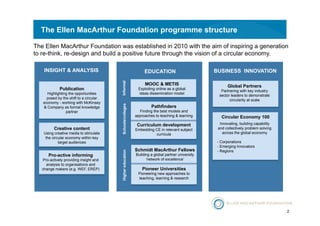
The Ellen MacArthur Foundation was established in 2010 with the aim of inspiring a generation 
to re-think, re-design and build a positive future through the vision of a circular economy. 
2 
The Ellen MacArthur Foundation programme structure 
EDUCATION 
Pathfinders 
Finding the best models and 
approaches to teaching & learning 
Curriculum development 
Embedding CE in relevant subject 
curricula 
Schmidt MacArthur Fellows 
Building a global partner university 
‘network of excellence’ 
Pioneer Universities 
Pioneering new approaches to 
teaching, learning & research 
CE100 
INSIGHT & ANALYSIS 
Publication 
Highlighting the opportunities 
posed by the shift to a circular 
economy - working with McKinsey 
& Company as formal knowledge 
partner 
BUSINESS INNOVATION 
Global Partners 
Partnering with key industry 
sector leaders to demonstrate 
circularity at scale 
Circular Economy 100 
Schools/colleges 
Creative content 
Using creative media to stimulate 
the circular economy within key 
target audiences 
Pro-active informing 
Pro-actively providing insight and 
analysis to organisations and 
change makers (e.g. WEF, EREP) 
Higher education 
Innovating, building capability 
and collectively problem solving 
across the global economy 
- Corporations 
- Emerging Innovators 
- Regions 
MOOC & METIS 
Exploiting online as a global 
ideas dissemination model 
Informal
3 
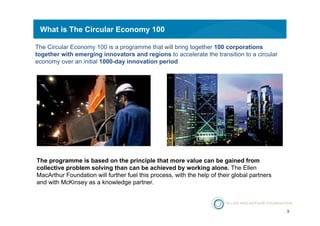
What is The Circular Economy 100 
The Circular Economy 100 is a programme that will bring together 100 corporations 
together with emerging innovators and regions to accelerate the transition to a circular 
economy over an initial 1000-day innovation period 
The programme is based on the principle that more value can be gained from 
collective problem solving than can be achieved by working alone. The Ellen 
MacArthur Foundation will further fuel this process, with the help of their global partners 
and with McKinsey as a knowledge partner.
4 
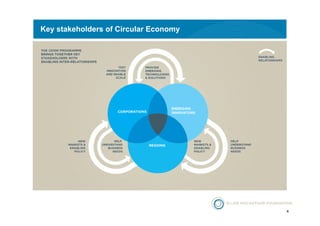
Key stakeholders of Circular Economy
5 
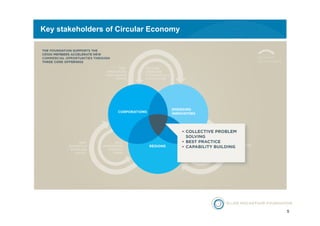
Key stakeholders of Circular Economy
6 
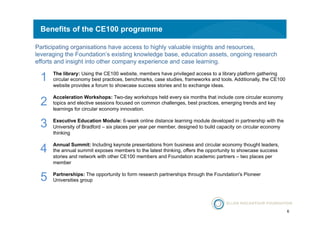
Benefits of the CE100 programme 
Participating organisations have access to highly valuable insights and resources, 
leveraging the Foundation’s existing knowledge base, education assets, ongoing research 
efforts and insight into other company experience and case learning. 
The library: Using the CE100 website, members have privileged access to a library platform gathering 
circular economy best practices, benchmarks, case studies, frameworks and tools. Additionally, the CE100 
website provides a forum to showcase success stories and to exchange ideas. 
Acceleration Workshops: Two-day workshops held every six months that include core circular economy 
topics and elective sessions focused on common challenges, best practices, emerging trends and key 
learnings for circular economy innovation. 
Executive Education Module: 6-week online distance learning module developed in partnership with the 
University of Bradford – six places per year per member, designed to build capacity on circular economy 
thinking 
Annual Summit: Including keynote presentations from business and circular economy thought leaders, 
the annual summit exposes members to the latest thinking, offers the opportunity to showcase success 
stories and network with other CE100 members and Foundation academic partners – two places per 
member 
Partnerships: The opportunity to form research partnerships through the Foundation's Pioneer 
Universities group 
1 
2 
3 
4 
5
7 
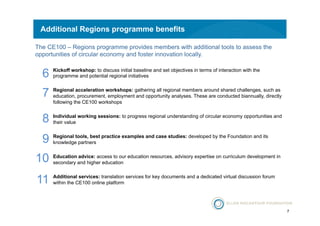
Additional Regions programme benefits 
The CE100 – Regions programme provides members with additional tools to assess the 
opportunities of circular economy and foster innovation locally. 
6 
7 
8 
9 
10 
11 
Kickoff workshop: to discuss initial baseline and set objectives in terms of interaction with the 
programme and potential regional initiatives 
Regional acceleration workshops: gathering all regional members around shared challenges, such as 
education, procurement, employment and opportunity analyses. These are conducted biannually, directly 
following the CE100 workshops 
Individual working sessions: to progress regional understanding of circular economy opportunities and 
their value 
Regional tools, best practice examples and case studies: developed by the Foundation and its 
knowledge partners 
Education advice: access to our education resources, advisory expertise on curriculum development in 
secondary and higher education 
Additional services: translation services for key documents and a dedicated virtual discussion forum 
within the CE100 online platform
8 
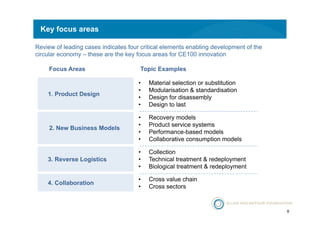
Key focus areas 
Review of leading cases indicates four critical elements enabling development of the 
circular economy – these are the key focus areas for CE100 innovation 
Focus Areas Topic Examples 
1. Product Design 
2. New Business Models 
3. Reverse Logistics 
4. Collaboration 
• Material selection or substitution 
• Modularisation & standardisation 
• Design for disassembly 
• Design to last 
• Recovery models 
• Product service systems 
• Performance-based models 
• Collaborative consumption models 
• Collection 
• Technical treatment & redeployment 
• Biological treatment & redeployment 
• Cross value chain 
• Cross sectors
9 
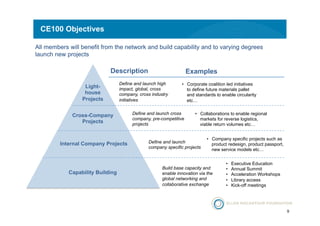
CE100 Objectives 
All members will benefit from the network and build capability and to varying degrees 
launch new projects 
Define and launch high 
impact, global, cross 
company, cross industry 
initiatives 
• Corporate coalition led initiatives 
to define future materials pallet 
and standards to enable circularity 
etc… 
Define and launch cross 
company, pre-competitive 
projects 
• Collaborations to enable regional 
markets for reverse logistics, 
viable return volumes etc… 
• Company specific projects such as 
product redesign, product passport, 
new service models etc… 
Build base capacity and 
enable innovation via the 
global networking and 
collaborative exchange 
Light-house 
Projects 
Cross-Company 
Projects 
Internal Company Projects 
Capability Building 
Define and launch 
company specific projects 
• Executive Education 
• Annual Summit 
• Acceleration Workshops 
• Library access 
• Kick-off meetings 
Description Examples
10 
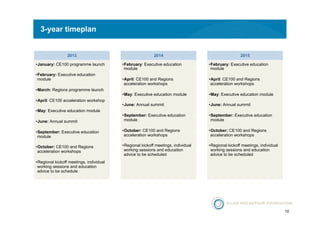
3-year timeplan 
2013 
• January: CE100 programme launch 
• February: Executive education 
module 
• March: Regions programme launch 
• April: CE100 acceleration workshop 
• May: Executive education module 
• June: Annual summit 
• September: Executive education 
module 
• October: CE100 and Regions 
acceleration workshops 
• Regional kickoff meetings, individual 
working sessions and education 
advice to be schedule 
2014 
• February: Executive education 
module 
• April: CE100 and Regions 
acceleration workshops 
• May: Executive education module 
• June: Annual summit 
• September: Executive education 
module 
• October: CE100 and Regions 
acceleration workshops 
• Regional kickoff meetings, individual 
working sessions and education 
advice to be scheduled 
2015 
• February: Executive education 
module 
• April: CE100 and Regions 
acceleration workshops 
• May: Executive education module 
• June: Annual summit 
• September: Executive education 
module 
• October: CE100 and Regions 
acceleration workshops 
• Regional kickoff meetings, individual 
working sessions and education 
advice to be scheduled
THE CIRCULAR ECONOMY 100 
Appendix
12 
CE100 Acceleration Workshops 
The biannual 2-day CE100 Acceleration Workshops are action-oriented problem solving 
sessions bringing together members, external thought leaders and experts to share best 
practices and collectively address the key issues for enabling and accelerating CE 
transition initiatives. 
The April 22/23rd Acceleration Workshop addressed: 
• Key findings from recent join Ellen MacArthur Foundation/McKinsey & Company 
research 
• Panel discussions on leading company lessons learned and key opportunities and 
challenges for scaling CE solutions 
• Plenary and industry group working sessions on critical barriers, gaps and 
opportunities for collaboration, including 
• Rethinking Design - The critical role of product design for increasing circularity 
of materials, reducing new material demands, enabling access over ownership 
models and effective end-of- use asset capture 
• Optimising reverse logistics – Challenges and solutions for new business 
models and processes design, creating local networks and hubs, consumer 
incentives and effective feedback loops 
The next Acceleration Workshop on 23/24th October in Amsterdam, and will be followed 
by the CE100 Regions meeting on October 25th.
13 
CE100 Annual Summit 
The CE100 Annual Summit brings together the leading global thought leaders, academics, 
companies and practitioners to provide a global wrap-up of the most current thinking on key 
circular economy topics 
The June 19th 2013 Summit addressed : 
• Latest global perspectives on the economic opportunities, challenges and key gaps in 
the market critical for adoption at scale 
• The latest thinking and examples of product and process redesign to enable circularity 
• Review of emerging access-over-ownership models and trends – leading cases, 
adoption rates and trends, local and emerging scale models 
• Enabling technologies – new and emerging technologies that will enable adoption, 
opportunities and challenges for adoption at scale 
• Leading company, industry, country, and regional cases 
The Annual Summit takes stock of the current landscape, leading practices and innovations and 
re-sets the key opportunities and challenge for the coming year.

Circular Economy 100 summary

  • 1.
    A platform to re-think the future THE CIRCULAR ECONOMY 100
  • 2.
    The Ellen MacArthurFoundation was established in 2010 with the aim of inspiring a generation to re-think, re-design and build a positive future through the vision of a circular economy. 2 The Ellen MacArthur Foundation programme structure EDUCATION Pathfinders Finding the best models and approaches to teaching & learning Curriculum development Embedding CE in relevant subject curricula Schmidt MacArthur Fellows Building a global partner university ‘network of excellence’ Pioneer Universities Pioneering new approaches to teaching, learning & research CE100 INSIGHT & ANALYSIS Publication Highlighting the opportunities posed by the shift to a circular economy - working with McKinsey & Company as formal knowledge partner BUSINESS INNOVATION Global Partners Partnering with key industry sector leaders to demonstrate circularity at scale Circular Economy 100 Schools/colleges Creative content Using creative media to stimulate the circular economy within key target audiences Pro-active informing Pro-actively providing insight and analysis to organisations and change makers (e.g. WEF, EREP) Higher education Innovating, building capability and collectively problem solving across the global economy - Corporations - Emerging Innovators - Regions MOOC & METIS Exploiting online as a global ideas dissemination model Informal
  • 3.
    3 What isThe Circular Economy 100 The Circular Economy 100 is a programme that will bring together 100 corporations together with emerging innovators and regions to accelerate the transition to a circular economy over an initial 1000-day innovation period The programme is based on the principle that more value can be gained from collective problem solving than can be achieved by working alone. The Ellen MacArthur Foundation will further fuel this process, with the help of their global partners and with McKinsey as a knowledge partner.
  • 4.
    4 Key stakeholdersof Circular Economy
  • 5.
    5 Key stakeholdersof Circular Economy
  • 6.
    6 Benefits ofthe CE100 programme Participating organisations have access to highly valuable insights and resources, leveraging the Foundation’s existing knowledge base, education assets, ongoing research efforts and insight into other company experience and case learning. The library: Using the CE100 website, members have privileged access to a library platform gathering circular economy best practices, benchmarks, case studies, frameworks and tools. Additionally, the CE100 website provides a forum to showcase success stories and to exchange ideas. Acceleration Workshops: Two-day workshops held every six months that include core circular economy topics and elective sessions focused on common challenges, best practices, emerging trends and key learnings for circular economy innovation. Executive Education Module: 6-week online distance learning module developed in partnership with the University of Bradford – six places per year per member, designed to build capacity on circular economy thinking Annual Summit: Including keynote presentations from business and circular economy thought leaders, the annual summit exposes members to the latest thinking, offers the opportunity to showcase success stories and network with other CE100 members and Foundation academic partners – two places per member Partnerships: The opportunity to form research partnerships through the Foundation's Pioneer Universities group 1 2 3 4 5
  • 7.
    7 Additional Regionsprogramme benefits The CE100 – Regions programme provides members with additional tools to assess the opportunities of circular economy and foster innovation locally. 6 7 8 9 10 11 Kickoff workshop: to discuss initial baseline and set objectives in terms of interaction with the programme and potential regional initiatives Regional acceleration workshops: gathering all regional members around shared challenges, such as education, procurement, employment and opportunity analyses. These are conducted biannually, directly following the CE100 workshops Individual working sessions: to progress regional understanding of circular economy opportunities and their value Regional tools, best practice examples and case studies: developed by the Foundation and its knowledge partners Education advice: access to our education resources, advisory expertise on curriculum development in secondary and higher education Additional services: translation services for key documents and a dedicated virtual discussion forum within the CE100 online platform
  • 8.
    8 Key focusareas Review of leading cases indicates four critical elements enabling development of the circular economy – these are the key focus areas for CE100 innovation Focus Areas Topic Examples 1. Product Design 2. New Business Models 3. Reverse Logistics 4. Collaboration • Material selection or substitution • Modularisation & standardisation • Design for disassembly • Design to last • Recovery models • Product service systems • Performance-based models • Collaborative consumption models • Collection • Technical treatment & redeployment • Biological treatment & redeployment • Cross value chain • Cross sectors
  • 9.
    9 CE100 Objectives All members will benefit from the network and build capability and to varying degrees launch new projects Define and launch high impact, global, cross company, cross industry initiatives • Corporate coalition led initiatives to define future materials pallet and standards to enable circularity etc… Define and launch cross company, pre-competitive projects • Collaborations to enable regional markets for reverse logistics, viable return volumes etc… • Company specific projects such as product redesign, product passport, new service models etc… Build base capacity and enable innovation via the global networking and collaborative exchange Light-house Projects Cross-Company Projects Internal Company Projects Capability Building Define and launch company specific projects • Executive Education • Annual Summit • Acceleration Workshops • Library access • Kick-off meetings Description Examples
  • 10.
    10 3-year timeplan 2013 • January: CE100 programme launch • February: Executive education module • March: Regions programme launch • April: CE100 acceleration workshop • May: Executive education module • June: Annual summit • September: Executive education module • October: CE100 and Regions acceleration workshops • Regional kickoff meetings, individual working sessions and education advice to be schedule 2014 • February: Executive education module • April: CE100 and Regions acceleration workshops • May: Executive education module • June: Annual summit • September: Executive education module • October: CE100 and Regions acceleration workshops • Regional kickoff meetings, individual working sessions and education advice to be scheduled 2015 • February: Executive education module • April: CE100 and Regions acceleration workshops • May: Executive education module • June: Annual summit • September: Executive education module • October: CE100 and Regions acceleration workshops • Regional kickoff meetings, individual working sessions and education advice to be scheduled
  • 11.
  • 12.
    12 CE100 AccelerationWorkshops The biannual 2-day CE100 Acceleration Workshops are action-oriented problem solving sessions bringing together members, external thought leaders and experts to share best practices and collectively address the key issues for enabling and accelerating CE transition initiatives. The April 22/23rd Acceleration Workshop addressed: • Key findings from recent join Ellen MacArthur Foundation/McKinsey & Company research • Panel discussions on leading company lessons learned and key opportunities and challenges for scaling CE solutions • Plenary and industry group working sessions on critical barriers, gaps and opportunities for collaboration, including • Rethinking Design - The critical role of product design for increasing circularity of materials, reducing new material demands, enabling access over ownership models and effective end-of- use asset capture • Optimising reverse logistics – Challenges and solutions for new business models and processes design, creating local networks and hubs, consumer incentives and effective feedback loops The next Acceleration Workshop on 23/24th October in Amsterdam, and will be followed by the CE100 Regions meeting on October 25th.
  • 13.
    13 CE100 AnnualSummit The CE100 Annual Summit brings together the leading global thought leaders, academics, companies and practitioners to provide a global wrap-up of the most current thinking on key circular economy topics The June 19th 2013 Summit addressed : • Latest global perspectives on the economic opportunities, challenges and key gaps in the market critical for adoption at scale • The latest thinking and examples of product and process redesign to enable circularity • Review of emerging access-over-ownership models and trends – leading cases, adoption rates and trends, local and emerging scale models • Enabling technologies – new and emerging technologies that will enable adoption, opportunities and challenges for adoption at scale • Leading company, industry, country, and regional cases The Annual Summit takes stock of the current landscape, leading practices and innovations and re-sets the key opportunities and challenge for the coming year.