CIRCUITS
DIRECT-CURRENT PRINCIPLES
 A current is maintained in a closed circuit by a source of emf
 Source of emf
Any device that increase the potential energy of the circulating
charges
Can be thought of as a charge pump that forces electrons to move in
a direction opposite of the electrostatic field inside the source
Emf of a source
Work done per unit charge
 Consider the circuit consisting of
a battery connected to a resistor
Assume that the connection wires
have no resistance
Dropping the internal resistance of
the battery, the potential drop
across the battery equals the emf of
the battery
Because a real battery always has
some internal resistance r, the
terminal voltage is not equal to the
emf
 The battery, represented by the dashed
rectangle, consists of a source of emfε in
series with an internal resistance r
 Imagine a positive charge moving through
the battery from a to b in the figure
 As the charge passes from negative to the
positive terminal of the battery, the potential of
the charge increases by ε
 As the charge moves through the resistance r,
however, its potential decreases by the amount
Ir, where I is the current in the circuit
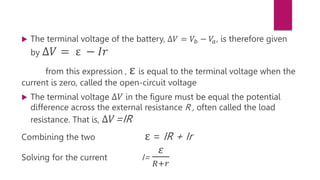
 The terminal voltage of the battery, ∆𝑉 = 𝑉𝑏 − 𝑉
𝑎, is therefore given
by ∆𝑉 = ε − 𝐼𝑟
from this expression , ε is equal to the terminal voltage when the
current is zero, called the open-circuit voltage
 The terminal voltage ∆𝑉 in the figure must be equal the potential
difference across the external resistance R , often called the load
resistance. That is, ∆𝑉=IR
Combining the two ε = IR + Ir
Solving for the current I=
𝜀
𝑅+𝑟
 The equation shows that the current in the simple circuit
depends on both the resistance external to the battery and the
internal resistance of the battery. Multiplying the previous
equation by I, we have
𝐼ε = 𝐼2
𝑅 + 𝐼2
𝑟
Which tells us that the total power output 𝐼ε of the source of emf
is converted at the rate of 𝐼2
𝑅 at which energy is delivered to the
load resistance, plus the rate 𝐼2
𝑟 at which energy is delivered to
the internal resistance if 𝑟 << 𝑅, most of the powered delivered
by the battery is transferred to the load resistance
RESISTORS IN SERIES
 The figure above shows how two or more resistors are connected in
series
 Here the current is the same in the two resistors, because any
change that flows through 𝑅1must also flow through 𝑅2
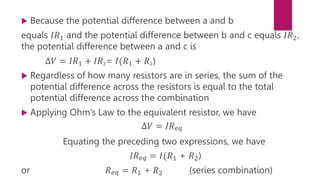
 Because the potential difference between a and b
equals 𝐼𝑅1 and the potential difference between b and c equals 𝐼𝑅2,
the potential difference between a and c is
∆𝑉 = 𝐼𝑅1 + 𝐼𝑅2= 𝐼(𝑅1 + 𝑅2)
 Regardless of how many resistors are in series, the sum of the
potential difference across the resistors is equal to the total
potential difference across the combination
 Applying Ohm’s Law to the equivalent resistor, we have
∆𝑉 = 𝐼𝑅𝑒𝑞
Equating the preceding two expressions, we have
𝐼𝑅𝑒𝑞 = 𝐼(𝑅1 + 𝑅2)
or 𝑅𝑒𝑞 = 𝑅1 + 𝑅2 (series combination)
 Analysis shows that the equivalent resistance of three or
more resistors connected in series is
𝑅𝑒𝑞 = 𝑅1 + 𝑅2 + 𝑅3 + …
Thus, the equivalent resistance of a series combination of resistors
is the algebraic sum of individual resistances and is always greater
than any individual resistance.
CIRCUITS-direct current principles .pptx

CIRCUITS-direct current principles .pptx

  • 1.
  • 2.
    DIRECT-CURRENT PRINCIPLES  Acurrent is maintained in a closed circuit by a source of emf  Source of emf Any device that increase the potential energy of the circulating charges Can be thought of as a charge pump that forces electrons to move in a direction opposite of the electrostatic field inside the source Emf of a source Work done per unit charge
  • 3.
     Consider thecircuit consisting of a battery connected to a resistor Assume that the connection wires have no resistance Dropping the internal resistance of the battery, the potential drop across the battery equals the emf of the battery Because a real battery always has some internal resistance r, the terminal voltage is not equal to the emf
  • 4.
     The battery,represented by the dashed rectangle, consists of a source of emfε in series with an internal resistance r  Imagine a positive charge moving through the battery from a to b in the figure  As the charge passes from negative to the positive terminal of the battery, the potential of the charge increases by ε  As the charge moves through the resistance r, however, its potential decreases by the amount Ir, where I is the current in the circuit
  • 5.
     The terminalvoltage of the battery, ∆𝑉 = 𝑉𝑏 − 𝑉 𝑎, is therefore given by ∆𝑉 = ε − 𝐼𝑟 from this expression , ε is equal to the terminal voltage when the current is zero, called the open-circuit voltage  The terminal voltage ∆𝑉 in the figure must be equal the potential difference across the external resistance R , often called the load resistance. That is, ∆𝑉=IR Combining the two ε = IR + Ir Solving for the current I= 𝜀 𝑅+𝑟
  • 6.
     The equationshows that the current in the simple circuit depends on both the resistance external to the battery and the internal resistance of the battery. Multiplying the previous equation by I, we have 𝐼ε = 𝐼2 𝑅 + 𝐼2 𝑟 Which tells us that the total power output 𝐼ε of the source of emf is converted at the rate of 𝐼2 𝑅 at which energy is delivered to the load resistance, plus the rate 𝐼2 𝑟 at which energy is delivered to the internal resistance if 𝑟 << 𝑅, most of the powered delivered by the battery is transferred to the load resistance
  • 7.
    RESISTORS IN SERIES The figure above shows how two or more resistors are connected in series  Here the current is the same in the two resistors, because any change that flows through 𝑅1must also flow through 𝑅2
  • 8.
     Because thepotential difference between a and b equals 𝐼𝑅1 and the potential difference between b and c equals 𝐼𝑅2, the potential difference between a and c is ∆𝑉 = 𝐼𝑅1 + 𝐼𝑅2= 𝐼(𝑅1 + 𝑅2)  Regardless of how many resistors are in series, the sum of the potential difference across the resistors is equal to the total potential difference across the combination  Applying Ohm’s Law to the equivalent resistor, we have ∆𝑉 = 𝐼𝑅𝑒𝑞 Equating the preceding two expressions, we have 𝐼𝑅𝑒𝑞 = 𝐼(𝑅1 + 𝑅2) or 𝑅𝑒𝑞 = 𝑅1 + 𝑅2 (series combination)

  • 9.
     Analysis showsthat the equivalent resistance of three or more resistors connected in series is 𝑅𝑒𝑞 = 𝑅1 + 𝑅2 + 𝑅3 + … Thus, the equivalent resistance of a series combination of resistors is the algebraic sum of individual resistances and is always greater than any individual resistance.