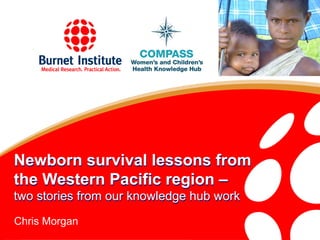
Newborn survival lessons from
the Western Pacific region –
two stories from our knowledge hub work
Chris Morgan
The problem in certain settings in our region
•  Places with the highest
   maternal and newborn
   mortality generally have the
   worst access to services, and
   higher rates of home-birth.
•  Most deaths of mothers and
   many deaths of babies occur
   on or near the day of birth,
•  WHO and national strategies
   recommend childbirth care in                Like Nepal
   a health facility, but this takes
   time to scale up
    –  PNG Maternal Task Force         or PNG,
       plans 60% of all pregnant       or Lao PDR
       women having skilled            or….
       attendant at delivery by
       2015 and 80% by 2020
Provoked one stream of knowledge collation

•    There are forms of community-based        Established packages for
     care at childbirth, that could be         newborn care (warmth,
     delivered by trained lay health workers
                                               hygiene, EBF), clean delivery
     or community-based staff
                                               kits;
•    Some are interim measures to meet the
     immediate crisis in maternal deaths.      Community mobilisation,
•    Could maybe reduce maternal and
                                               facilitated referral;
     newborn deaths by 30% or more.
                                               Oxytocics from trained
•    However, they must be introduced in a     workers or self-administered;
     carefully measured fashion, using a
     systems approach, to monitor for impact
                                               Antibiotics from trained
     and unforeseen consequences.
                                               workers (lay or paid); and

                                               ? pre-filled injection devices
          Recognising the many other           for vaccination or oxytocics.
             determinants, such as
        family planning, girls’ education
                and nutrition etc
Site analyses
Collaboration with World Vision for an
“evidence-based policy-advocacy’ study
 •  … on the potential of “Family and Community
    Care” that is: care by family and community
    members, rather than by health professionals”
     –  Eg by “trained lay health workers” – aka VHVs

 •  We did a
    –  Comprehensive literature review of
       international publications to find interventions
       or packages delivered by FCC
    –  Determined a simple cost-effectiveness rating
       and excluded any that were not good value for
       money
    –  Researched their current or past application on
       PNG through publication and contacting
       experts
An interventions and service delivery analysis of
Family and Community Care for maternal and
child survival in PNG -
What we concluded
•  In places where the maternal and
   newborn mortality rates are still
   relatively high…

•  FCC interventions could avert
   deaths:
    –  Up to one third of maternal
       deaths
    –  Up to two thirds of newborn
       deaths
    –  Up to half of child deaths

•  PNG already has a variety of
   experiences with nearly all
   interventions researched
Two ways to view family
and community care,
provided by VHVs, in
PNG

•  A complement to the current investment in re-building the
   health infrastructure, training more health workers (including
   midwives) and strengthening systems
    –  FCC can help engage communities in a stronger HSS
       process
•  A stop-gap for get some high impact interventions to
   mothers and children, while the health system is being rebuilt
    –  Might require innovative approaches and some risk-benefit
       analysis
What came next
Another story – unique to East Asia and
the Western Pacific
•  Most of the operational research demonstrating
   the efficacy of community-based newborn care
   has come from South Asia
•  Meanwhile, in East Asia and the Pacific, it has
   been immunization programs that focused on
   the first 24 hours after birth
  –  The critical period during which vaccination against
     hepatitis B can interrupt perinatal transmission of
     hepatitis B (the form most likely to lead to chronic
     liver disease and death)
•  Scale-up of this has been a major push for the
   WHO WPRO
Rationale for early post-natal care and
vaccination visits in homes
- in Angoram District, East Sepik Province (our study site)

•  Coverage of HepB birth dose is low:
   –  National: 16% 2005 survey), 25% (2008 NHIS)
   –  East Sepik: 27% Prov, 18% Angoram (2008 NHIS)
•  Proportions of childbirth occurring in health facilities had
   not increased for 10 years - between 30 and 40%
   –  But our partner, Save International PNG, has a good
      network of village health volunteers
•  Maternal and newborn mortality is high and postnatal
   care underutilised
•  Indonesia has supported hepatitis B vaccine in Uniject,
    –  makes injection by LHWs feasible
THE STUDY: A small feasibility trial
of expanded health services, in a
difficult but characteristic location
 •  To answer the questions:
    –  Can postnatal care be expanded for home births?
    –  Can birth-dose vaccination reach home births?
    –  Can combining the two result in synergy rather
       than fragmentation or competition?
 •  Providing
    –  birth-dose vaccination for hepatitis B
       vaccination (HBV) using UnijectTM in a real-world
       setting, including out-of-cold chain usage
    –  Integrated with early post-natal visits for
       home births in a remote district
 •  Provision by
    –  Trained lay Village Health Volunteers (VHV),
    –  Nursing Officers (NOs) and Community
       Health Workers (CHWs)
MINIMAL POSTNATAL PACKAGE
for community or aid-post level
•  Hepatitis B vaccine
   –  within 24 hours of birth, w UnijectTM
•  Essential information:
   –  breast-feeding and nutrition for the
      mother and baby
   –  warmth and hygiene (inc. cord care)
   –  signs of infection in mother/baby,
      how to prevent and respond
•  Additional information and care
   –  weighing the baby and information
      on care of low-birth weight babies,
      especially for temperature control
   –  routine postnatal care for mother
      and baby, including further routine
      immunisations
   –  family planning
•  Vitamin A for the mother
Trainers
                    Manual


                  IEC brochure
                      draft


Both translated
 into Tok Pisin
IMPLEMENTATION
•  Training of staff and VHVs:
   –  13 rural health staff (NOs & CHWs)
   –  212 VHVs (175 female)
•  Provision of services in four health centre catchments:
   –  UnijectTM HBV procurement and distribution via govt systems
   –  Services to more than 364 mothers
•  Monitoring and supervision by a locally based project officer
    –  birth and postnatal visit record form, designed for use by VHVs
    –  calendar to ensure vaccine out of the cold chain < 30 days
•  Evaluation
    –  using project databases - 2 for triangulation
    –  two visits with structured questionnaires for qualitative data
       gathering - involved National Dept of Health and WHO
Extract from
the VHV
birth and
postnatal
care record
form
EVALUATION -
 POSITIVE OUTCOMES
•  Coverage with birth-dose increased
   –  83% overall (cf district average 24%)
   –  74% (homebirths), 93% (health centre)
•  Use of VHVs extended coverage:
   –  ~ 10 VHVs for every paid staff member
•  VHVs vaccinated safely, using Uniject
•  Out-of-cold chain management of HBV
   feasible and appropriate, vaccine vial
   monitors used appropriately
•  Active VHVs credited the level of
   support provided by Save and Burnet        VHV Unitha Longhi providing
                                              birth-dose vaccination w UnijectTM
•  Most of postnatal package provided
   most of the time (but Vit A only 62%)
•  Having a vaccine role motivated greater
   attendance at birth for VHVs
•  Good community acceptance
EVALUATION -
SURPRISES

•  Births in health centres increased
   –  often a VHV accompanied and
      attended the birth in the health
      facility, with staff on stand-by
•  UnijectTM use in health centres
   –  contributed to increased coverage there as well as
      at community level
   –  staff found it far easier the multi-dose vial
•  Considerable new information regarding birth
   outcomes and care-seeking behaviour
   –  very high rates of obstetric complications and
      death persist
   –  our program could only really influence newborn
      outcomes and possibly puerperal sepsis
Global extensions
•  2009 WHO Position Paper adopted the policy led by
   WPRO
   –  “In all regions of the world, all infants should receive the
      first dose of hepatitis B vaccine as soon as possible (<24
      hours) after birth. This should be followed by two or three
      doses to complete the series.”
   –  Adopted as part of the World Health Assembly’s resolution
      on the control of viral hepatitis in 2010
   –  New global hepatitis program established at WHO in 2011


•  Implications for other regions
   –  African and South Asian settings with high home birth rates
      that have not yet introduced birth dose vaccination
   –  Can vaccination leverage better maternal/newborn care or
      will it be a burden on over-stretched systems?
WCH Knowledge Hub
supported WHO
expansion efforts
•  WHO global consultation
   on birth-dose held in
   Melbourne, Dec 2010
•  Systematic review of
   global practices to provide
   birth-dose vaccination
   –  A chance to ensure that
      integration with postnatal
      care for newborn and
      maternal survival was
      highlighted
Issues for newborns:                    To finish:
-  timing of home visit
-  preventive care only, or             Some critical
   therapeutic as well                  service delivery
-  integration with maternal and
   immunisation programs
                                        questions for us

 Issues for mothers:
 -  risk encouraging home births
    or distracting from facility care
 -  misoprostol - treatment or
    prevention; vs oxytocin, timing
 -  unknowns around puerperal
    sepsis in the community

Issues for both:
-  introduce in concert with
   health system strengthening
-  comprehensive PHC still offers
   best health system environment
The value of
kangaroo care

Morgan and Rongong.
Use of Kangaroo
Nursing Method in
Western Nepal;
J Nepal Med Assoc, Jul-
Sep 1997 (36): 320 -
323
A short history of baby care

•  BC 2000
    –  “Just carry it next to your skin. Breastfeed it
       whenever it is hungry.”
•  AD1660
    –  “Breastfeeding is undignified. Hand it over to a wet-
       nurse.”
•  AD 1850
    –  “Wet-nurses are low class and have an undesirable
                                                               Thank
       influence on the child. Get a good experienced          you
       nanny to bottle feed it cow’s milk, and wean it on
       to a cup as soon as possible.”
•  AD 1930
    –  "Cow’s milk is unsuitable for babies. It must be
       bottle fed on a special infant formula.”
•  AD 1950
    –  “Bottle feeding at all hours is bad for the baby.
       Follow a strict routine, let it sleep in its own room
       and ignore it when it cries at other times.”
•  AD 2000
    –  “Bottle feeding is unsuitable, a strict time-table is
       nonsense, babies don’t like being alone, and crying
       is stressful. Just carry it next to your skin.
       Breastfeed it whenever it is hungry.”

                (Joan Norton, 2001)

Chris Morgan, Burnet Institute

  • 1.
    Newborn survival lessonsfrom the Western Pacific region – two stories from our knowledge hub work Chris Morgan
  • 2.
    The problem incertain settings in our region •  Places with the highest maternal and newborn mortality generally have the worst access to services, and higher rates of home-birth. •  Most deaths of mothers and many deaths of babies occur on or near the day of birth, •  WHO and national strategies recommend childbirth care in Like Nepal a health facility, but this takes time to scale up –  PNG Maternal Task Force or PNG, plans 60% of all pregnant or Lao PDR women having skilled or…. attendant at delivery by 2015 and 80% by 2020
  • 3.
    Provoked one streamof knowledge collation •  There are forms of community-based Established packages for care at childbirth, that could be newborn care (warmth, delivered by trained lay health workers hygiene, EBF), clean delivery or community-based staff kits; •  Some are interim measures to meet the immediate crisis in maternal deaths. Community mobilisation, •  Could maybe reduce maternal and facilitated referral; newborn deaths by 30% or more. Oxytocics from trained •  However, they must be introduced in a workers or self-administered; carefully measured fashion, using a systems approach, to monitor for impact Antibiotics from trained and unforeseen consequences. workers (lay or paid); and ? pre-filled injection devices Recognising the many other for vaccination or oxytocics. determinants, such as family planning, girls’ education and nutrition etc
  • 4.
  • 5.
    Collaboration with WorldVision for an “evidence-based policy-advocacy’ study •  … on the potential of “Family and Community Care” that is: care by family and community members, rather than by health professionals” –  Eg by “trained lay health workers” – aka VHVs •  We did a –  Comprehensive literature review of international publications to find interventions or packages delivered by FCC –  Determined a simple cost-effectiveness rating and excluded any that were not good value for money –  Researched their current or past application on PNG through publication and contacting experts
  • 6.
    An interventions andservice delivery analysis of Family and Community Care for maternal and child survival in PNG -
  • 7.
    What we concluded • In places where the maternal and newborn mortality rates are still relatively high… •  FCC interventions could avert deaths: –  Up to one third of maternal deaths –  Up to two thirds of newborn deaths –  Up to half of child deaths •  PNG already has a variety of experiences with nearly all interventions researched
  • 8.
    Two ways toview family and community care, provided by VHVs, in PNG •  A complement to the current investment in re-building the health infrastructure, training more health workers (including midwives) and strengthening systems –  FCC can help engage communities in a stronger HSS process •  A stop-gap for get some high impact interventions to mothers and children, while the health system is being rebuilt –  Might require innovative approaches and some risk-benefit analysis
  • 9.
  • 10.
    Another story –unique to East Asia and the Western Pacific •  Most of the operational research demonstrating the efficacy of community-based newborn care has come from South Asia •  Meanwhile, in East Asia and the Pacific, it has been immunization programs that focused on the first 24 hours after birth –  The critical period during which vaccination against hepatitis B can interrupt perinatal transmission of hepatitis B (the form most likely to lead to chronic liver disease and death) •  Scale-up of this has been a major push for the WHO WPRO
  • 11.
    Rationale for earlypost-natal care and vaccination visits in homes - in Angoram District, East Sepik Province (our study site) •  Coverage of HepB birth dose is low: –  National: 16% 2005 survey), 25% (2008 NHIS) –  East Sepik: 27% Prov, 18% Angoram (2008 NHIS) •  Proportions of childbirth occurring in health facilities had not increased for 10 years - between 30 and 40% –  But our partner, Save International PNG, has a good network of village health volunteers •  Maternal and newborn mortality is high and postnatal care underutilised •  Indonesia has supported hepatitis B vaccine in Uniject, –  makes injection by LHWs feasible
  • 12.
    THE STUDY: Asmall feasibility trial of expanded health services, in a difficult but characteristic location •  To answer the questions: –  Can postnatal care be expanded for home births? –  Can birth-dose vaccination reach home births? –  Can combining the two result in synergy rather than fragmentation or competition? •  Providing –  birth-dose vaccination for hepatitis B vaccination (HBV) using UnijectTM in a real-world setting, including out-of-cold chain usage –  Integrated with early post-natal visits for home births in a remote district •  Provision by –  Trained lay Village Health Volunteers (VHV), –  Nursing Officers (NOs) and Community Health Workers (CHWs)
  • 13.
    MINIMAL POSTNATAL PACKAGE forcommunity or aid-post level •  Hepatitis B vaccine –  within 24 hours of birth, w UnijectTM •  Essential information: –  breast-feeding and nutrition for the mother and baby –  warmth and hygiene (inc. cord care) –  signs of infection in mother/baby, how to prevent and respond •  Additional information and care –  weighing the baby and information on care of low-birth weight babies, especially for temperature control –  routine postnatal care for mother and baby, including further routine immunisations –  family planning •  Vitamin A for the mother
  • 14.
    Trainers Manual IEC brochure draft Both translated into Tok Pisin
  • 15.
    IMPLEMENTATION •  Training ofstaff and VHVs: –  13 rural health staff (NOs & CHWs) –  212 VHVs (175 female) •  Provision of services in four health centre catchments: –  UnijectTM HBV procurement and distribution via govt systems –  Services to more than 364 mothers •  Monitoring and supervision by a locally based project officer –  birth and postnatal visit record form, designed for use by VHVs –  calendar to ensure vaccine out of the cold chain < 30 days •  Evaluation –  using project databases - 2 for triangulation –  two visits with structured questionnaires for qualitative data gathering - involved National Dept of Health and WHO
  • 16.
    Extract from the VHV birthand postnatal care record form
  • 17.
    EVALUATION - POSITIVEOUTCOMES •  Coverage with birth-dose increased –  83% overall (cf district average 24%) –  74% (homebirths), 93% (health centre) •  Use of VHVs extended coverage: –  ~ 10 VHVs for every paid staff member •  VHVs vaccinated safely, using Uniject •  Out-of-cold chain management of HBV feasible and appropriate, vaccine vial monitors used appropriately •  Active VHVs credited the level of support provided by Save and Burnet VHV Unitha Longhi providing birth-dose vaccination w UnijectTM •  Most of postnatal package provided most of the time (but Vit A only 62%) •  Having a vaccine role motivated greater attendance at birth for VHVs •  Good community acceptance
  • 18.
    EVALUATION - SURPRISES •  Birthsin health centres increased –  often a VHV accompanied and attended the birth in the health facility, with staff on stand-by •  UnijectTM use in health centres –  contributed to increased coverage there as well as at community level –  staff found it far easier the multi-dose vial •  Considerable new information regarding birth outcomes and care-seeking behaviour –  very high rates of obstetric complications and death persist –  our program could only really influence newborn outcomes and possibly puerperal sepsis
  • 19.
    Global extensions •  2009WHO Position Paper adopted the policy led by WPRO –  “In all regions of the world, all infants should receive the first dose of hepatitis B vaccine as soon as possible (<24 hours) after birth. This should be followed by two or three doses to complete the series.” –  Adopted as part of the World Health Assembly’s resolution on the control of viral hepatitis in 2010 –  New global hepatitis program established at WHO in 2011 •  Implications for other regions –  African and South Asian settings with high home birth rates that have not yet introduced birth dose vaccination –  Can vaccination leverage better maternal/newborn care or will it be a burden on over-stretched systems?
  • 20.
    WCH Knowledge Hub supportedWHO expansion efforts •  WHO global consultation on birth-dose held in Melbourne, Dec 2010 •  Systematic review of global practices to provide birth-dose vaccination –  A chance to ensure that integration with postnatal care for newborn and maternal survival was highlighted
  • 21.
    Issues for newborns: To finish: -  timing of home visit -  preventive care only, or Some critical therapeutic as well service delivery -  integration with maternal and immunisation programs questions for us Issues for mothers: -  risk encouraging home births or distracting from facility care -  misoprostol - treatment or prevention; vs oxytocin, timing -  unknowns around puerperal sepsis in the community Issues for both: -  introduce in concert with health system strengthening -  comprehensive PHC still offers best health system environment
  • 22.
    The value of kangaroocare Morgan and Rongong. Use of Kangaroo Nursing Method in Western Nepal; J Nepal Med Assoc, Jul- Sep 1997 (36): 320 - 323
  • 23.
    A short historyof baby care •  BC 2000 –  “Just carry it next to your skin. Breastfeed it whenever it is hungry.” •  AD1660 –  “Breastfeeding is undignified. Hand it over to a wet- nurse.” •  AD 1850 –  “Wet-nurses are low class and have an undesirable Thank influence on the child. Get a good experienced you nanny to bottle feed it cow’s milk, and wean it on to a cup as soon as possible.” •  AD 1930 –  "Cow’s milk is unsuitable for babies. It must be bottle fed on a special infant formula.” •  AD 1950 –  “Bottle feeding at all hours is bad for the baby. Follow a strict routine, let it sleep in its own room and ignore it when it cries at other times.” •  AD 2000 –  “Bottle feeding is unsuitable, a strict time-table is nonsense, babies don’t like being alone, and crying is stressful. Just carry it next to your skin. Breastfeed it whenever it is hungry.” (Joan Norton, 2001)