Upscaling Zinc Sulphate in Solomon Islands
Nunan, M1,2., Pirpinias, M1., Zinihite, J1
1. Solomon Islands Ministry of Health & Medical Services
2. Centre for International Child Health, University of Melbourne


    Background                                                                                                                   Results
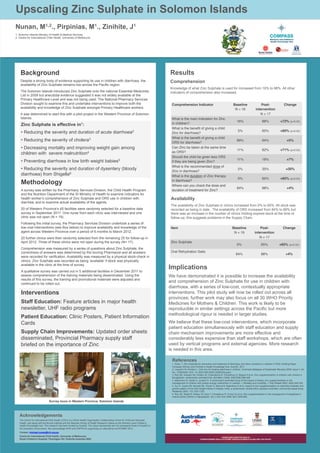
    Despite a strong body of evidence supporting its use in children with diarrhoea, the                                         Comprehension
    availability of Zinc Sulphate remains low across the Pacific region.
                                                                                                                                 Knowledge of what Zinc Sulphate is used for increased from 16% to 88%. All other
    The Solomon Islands introduced Zinc Sulphate onto the national Essential Medicines                                           indicators of comprehension also increased.
    List in 2009 but anecdotal evidence suggested it was not widely available at the
    Primary Healthcare Level and was not being used. The National Pharmacy Services
    Division sought to examine this and undertake interventions to improve both the                                               Comprehension Indicator!                                                  Baseline!                                        Post-          Change!
    availability and knowledge of Zinc Sulphate amongst Primary Healthcare workers.                                                                                                                          N = 19!                                     intervention!
    It was determined to start this with a pilot project in the Western Province of Solomon                                                                                                                                                                 N = 17!
    Islands.                                                                                                                      What is the main indication for Zinc
                                                                                                                                                                                                                        16%!                                 88%!        +72% (p<0.05)!
    Zinc Sulphate is effective                          in1:                                                                      in children? !
                                                                                                                                  What is the benefit of giving a child
    •  Reducing the severity and duration of acute diarrhoea2                                                                                                                                                              5%!                               65%!        +60% (p<0.05)!
                                                                                                                                  Zinc for diarrhoea? !
                                                                                                                                  What is the benefit of giving a child
    •  Reducing the severity of cholera3                                                                                          ORS for diarrhoea?!
                                                                                                                                                                                                                        89%!                                 94%!             +5%!

    •  Decreasing mortality and improving weight gain among                                                                       Can Zinc be taken at the same time
                                                                                                                                                                                                                         11%!                                82%!        +71% (p<0.05)!
    children with severe malnutrition4                                                                                            as ORS?!
                                                                                                                                  Should the child be given less ORS
                                                                                                                                                                                                                         11%!                                18%!             +7%!
    •  Preventing diarrhoea in low birth weight babies5                                                                           if they are being given Zinc?!
                                                                                                                                  What is the recommended dose of
    •  Reducing the severity and duration of dysentery (bloody                                                                    Zinc in diarrhoea?!
                                                                                                                                                                                                                           5%!                               35%!            +30%!
    diarrhoea) from Shigella6                                                                                                     What is the duration of Zinc therapy
                                                                                                                                                                                                                           0%!                               65%!        +65% (p<0.05)!
    Methodology                                                                                                                   in diarrhoea?!
                                                                                                                                  Where can you check the dose and
                                                                                                                                                                                                                        84%!                                 88%!             +4%!
    A survey was written by the Pharmacy Services Division, the Child Health Program                                              duration of treatment for Zinc? !
    and the Nutrition Department of the SI Ministry of Health to examine indicators for
    health worker’s comprehension of Zinc Sulphate and ORS use in children with                                                   Availability
    diarrhea; and to examine actual availability of the agents.
                                                                                                                                  The availability of Zinc Sulphate in clinics increased from 0% to 65%. All stock was
    20 of Western Province’s 45 facilities were randomly selected for a baseline data                                             recorded as being in date. The availability of ORS increased from 84% to 88% but
    survey in September 2011. One nurse from each clinic was interviewed and one                                                  there was an increase in the number of clinics holding expired stock at the time of
    clinic was not open (N = 19)                                                                                                  follow-up; this suggests problems in the Supply Chain.
    Following the initial survey, the Pharmacy Services Division undertook a series of
    low-cost interventions (see Box below) to improve availability and knowledge of the                                           Item!                                                                  Baseline!                                           Post-         Change!
    agent across Western Province over a period of 6 months to March 2012.                                                                                                                                N = 19!                                        intervention!
    20 further clinics were then randomly selected from the remaining 25 for follow-up in                                                                                                                                                                   N = 17!
    April 2012. Three of these clinics were not open during the survey (N= 17).                                                   Zinc Sulphate!
                                                                                                                                                                                                                        0%!                                  65%!        +65% (p<0.05)!
    Comprehension was measured by a series of questions about Zinc Sulphate; the
    correctness of answers was determined by the touring Pharmacist and all answers                                               Oral Rehydration Salts!
                                                                                                                                                                                                                     84%!                                    88%!            +4%!
    were recorded for verification. Availability was measured by a physical stock-check in
    clinics. Zinc Sulphate was recorded as being ‘available’ if stock was physically
    available in the clinic at the time of survey.
    A qualitative survey was carried out in 5 additional facilities in December 2011 to
                                                                                                                                 Implications
    assess comprehension of the training materials being disseminated. Using the                                                 We have demonstrated it is possible to increase the availability
    results of this survey, the training and promotional materials were adjusted and
    continued to be rolled out.
                                                                                                                                 and comprehension of Zinc Sulphate for use in children with
                                                                                                                                 diarrhoea, with a series of low-cost, contextually appropriate
    Interventions                                                                                                                interventions. This pilot study will now be rolled out across all
                                                                                                                                 provinces; further work may also focus on all 30 WHO Priority
    Staff Education: Feature articles in major health                                                                            Medicines for Mothers & Children. This work is likely to be
    newsletter, UHF radio programs                                                                                               reproducible in similar settings across the Pacific but more
                                                                                                                                 methodological rigour is needed in larger studies.
    Patient Education: Clinic Posters, Patient Information
    Cards                                                                                                                        We believe that these low-cost interventions, which incorporate
                                                                                                                                 patient education simultaneously with staff education and supply
    Supply Chain Improvements: Updated order sheets                                                                              chain mechanism improvements are more effective and
    disseminated, Provincial Pharmacy supply staff                                                                               considerably less expensive than staff workshops, which are often
    briefed on the importance of Zinc                                                                                            used by vertical programs and external agencies. More research
                                                                                                                                 is needed in this area.

                                                                                                                                  References
                                                                                                                                  1. Duke, T. Zinc Sulphate for prevention and treatment of diarrhoea, and other conditions in children in PNG, Briefing Paper,
                                                                                                                                  Compass Women and Children’s Health Knowledge Hub, AusAID, 2011
                                                                                                                                  2. Lazzerini M, Ronfani L. Oral zinc for treating diarrhoea in children. Cochrane Database of Systematic Reviews 2008; Issue 3. Art.
                                                                                                                                  No.: CD005436. DOI: 10.1002/14651858.CD005436.pub2.
                                                                                                                                  3. Roy SK, Hossain MJ, Khatun W, Chakraborty B, Chowdhury S, Begum A et al. Zinc supplementation in children with cholera in
                                                                                                                                  Bangladesh: randomised controlled trial. Brit Med J 2008; 336(7638):266-268.
                                                                                                                                  4. Makonnen B, Venter A, Joubert G. A randomized controlled study of the impact of dietary zinc supplementation in the
                                                                                                                                  management of children with protein-energy malnutrition in Lesotho. I: Mortality and morbidity. J Trop Pediatr 2003; 49(6):340-352.
                                                                                                                                  5. Sur D, Gupta DN, Mondal SK, Ghosh S, Manna B, Rajendran K et al. Impact of zinc supplementation on diarrheal morbidity and
                                                                                                                                  growth pattern of low birth weight infants in kolkata, India: a randomized, double-blind, placebo-controlled, community-based study.
                                                                                                                                  Pediatrics 2003; 112:1327-1332.
                                                                                                                                  6. Roy SK, Raqib R, Khatun W, Azim T, Chowdhury R, Fuchs GJ et al. Zinc supplementation in the management of shigellosis in
                                                                                                                                  malnourished children in Bangladesh. Eur J Clin Nutr 2008; 62(7):849-855.

                              Survey tours in Western Province, Solomon Islands


   Acknowledgements
   The Centre for International Child Health (CICH) is a World Health Organization Collaborating Centre for Child and Neonatal
   Health, and along with the Burnet Institute and the Menzies School of Health Research makes up the Women’s and Children’s                                                                                   Burnet Institute


   Health Knowledge Hub. This research has been funded by AusAID. The views represented are not necessarily those of AusAID or
                                                                                                                                                                                        Centre for International Child Health, University of Melbourne
                                                                                                                                                                                                      Menzies School of Health Research


   the Australian Government. We acknowledge WHO and UNFPA for supporting our attendance at APCNMP 2012.
   Contact: michael.nunan@rch.org.au
   Centre for International Child Health, University of Melbourne,                                                                                                               KNOWLEDGE HUBS FOR HEALTH
   Royal Children’s Hospital, Flemington Rd, Parkville Australia 3052.                                                                                        STRENGTHENING HEALTH SYSTEMS THROUGH EVIDENCE IN ASIA AND THE PACIFIC

Upscaling zinc in the Solomon Islands

  • 1.
    Upscaling Zinc Sulphatein Solomon Islands Nunan, M1,2., Pirpinias, M1., Zinihite, J1 1. Solomon Islands Ministry of Health & Medical Services 2. Centre for International Child Health, University of Melbourne Background Results Despite a strong body of evidence supporting its use in children with diarrhoea, the Comprehension availability of Zinc Sulphate remains low across the Pacific region. Knowledge of what Zinc Sulphate is used for increased from 16% to 88%. All other The Solomon Islands introduced Zinc Sulphate onto the national Essential Medicines indicators of comprehension also increased. List in 2009 but anecdotal evidence suggested it was not widely available at the Primary Healthcare Level and was not being used. The National Pharmacy Services Division sought to examine this and undertake interventions to improve both the Comprehension Indicator! Baseline! Post- Change! availability and knowledge of Zinc Sulphate amongst Primary Healthcare workers. N = 19! intervention! It was determined to start this with a pilot project in the Western Province of Solomon N = 17! Islands. What is the main indication for Zinc 16%! 88%! +72% (p<0.05)! Zinc Sulphate is effective in1: in children? ! What is the benefit of giving a child •  Reducing the severity and duration of acute diarrhoea2 5%! 65%! +60% (p<0.05)! Zinc for diarrhoea? ! What is the benefit of giving a child •  Reducing the severity of cholera3 ORS for diarrhoea?! 89%! 94%! +5%! •  Decreasing mortality and improving weight gain among Can Zinc be taken at the same time 11%! 82%! +71% (p<0.05)! children with severe malnutrition4 as ORS?! Should the child be given less ORS 11%! 18%! +7%! •  Preventing diarrhoea in low birth weight babies5 if they are being given Zinc?! What is the recommended dose of •  Reducing the severity and duration of dysentery (bloody Zinc in diarrhoea?! 5%! 35%! +30%! diarrhoea) from Shigella6 What is the duration of Zinc therapy 0%! 65%! +65% (p<0.05)! Methodology in diarrhoea?! Where can you check the dose and 84%! 88%! +4%! A survey was written by the Pharmacy Services Division, the Child Health Program duration of treatment for Zinc? ! and the Nutrition Department of the SI Ministry of Health to examine indicators for health worker’s comprehension of Zinc Sulphate and ORS use in children with Availability diarrhea; and to examine actual availability of the agents. The availability of Zinc Sulphate in clinics increased from 0% to 65%. All stock was 20 of Western Province’s 45 facilities were randomly selected for a baseline data recorded as being in date. The availability of ORS increased from 84% to 88% but survey in September 2011. One nurse from each clinic was interviewed and one there was an increase in the number of clinics holding expired stock at the time of clinic was not open (N = 19) follow-up; this suggests problems in the Supply Chain. Following the initial survey, the Pharmacy Services Division undertook a series of low-cost interventions (see Box below) to improve availability and knowledge of the Item! Baseline! Post- Change! agent across Western Province over a period of 6 months to March 2012. N = 19! intervention! 20 further clinics were then randomly selected from the remaining 25 for follow-up in N = 17! April 2012. Three of these clinics were not open during the survey (N= 17). Zinc Sulphate! 0%! 65%! +65% (p<0.05)! Comprehension was measured by a series of questions about Zinc Sulphate; the correctness of answers was determined by the touring Pharmacist and all answers Oral Rehydration Salts! 84%! 88%! +4%! were recorded for verification. Availability was measured by a physical stock-check in clinics. Zinc Sulphate was recorded as being ‘available’ if stock was physically available in the clinic at the time of survey. A qualitative survey was carried out in 5 additional facilities in December 2011 to Implications assess comprehension of the training materials being disseminated. Using the We have demonstrated it is possible to increase the availability results of this survey, the training and promotional materials were adjusted and continued to be rolled out. and comprehension of Zinc Sulphate for use in children with diarrhoea, with a series of low-cost, contextually appropriate Interventions interventions. This pilot study will now be rolled out across all provinces; further work may also focus on all 30 WHO Priority Staff Education: Feature articles in major health Medicines for Mothers & Children. This work is likely to be newsletter, UHF radio programs reproducible in similar settings across the Pacific but more methodological rigour is needed in larger studies. Patient Education: Clinic Posters, Patient Information Cards We believe that these low-cost interventions, which incorporate patient education simultaneously with staff education and supply Supply Chain Improvements: Updated order sheets chain mechanism improvements are more effective and disseminated, Provincial Pharmacy supply staff considerably less expensive than staff workshops, which are often briefed on the importance of Zinc used by vertical programs and external agencies. More research is needed in this area. References 1. Duke, T. Zinc Sulphate for prevention and treatment of diarrhoea, and other conditions in children in PNG, Briefing Paper, Compass Women and Children’s Health Knowledge Hub, AusAID, 2011 2. Lazzerini M, Ronfani L. Oral zinc for treating diarrhoea in children. Cochrane Database of Systematic Reviews 2008; Issue 3. Art. No.: CD005436. DOI: 10.1002/14651858.CD005436.pub2. 3. Roy SK, Hossain MJ, Khatun W, Chakraborty B, Chowdhury S, Begum A et al. Zinc supplementation in children with cholera in Bangladesh: randomised controlled trial. Brit Med J 2008; 336(7638):266-268. 4. Makonnen B, Venter A, Joubert G. A randomized controlled study of the impact of dietary zinc supplementation in the management of children with protein-energy malnutrition in Lesotho. I: Mortality and morbidity. J Trop Pediatr 2003; 49(6):340-352. 5. Sur D, Gupta DN, Mondal SK, Ghosh S, Manna B, Rajendran K et al. Impact of zinc supplementation on diarrheal morbidity and growth pattern of low birth weight infants in kolkata, India: a randomized, double-blind, placebo-controlled, community-based study. Pediatrics 2003; 112:1327-1332. 6. Roy SK, Raqib R, Khatun W, Azim T, Chowdhury R, Fuchs GJ et al. Zinc supplementation in the management of shigellosis in malnourished children in Bangladesh. Eur J Clin Nutr 2008; 62(7):849-855. Survey tours in Western Province, Solomon Islands Acknowledgements The Centre for International Child Health (CICH) is a World Health Organization Collaborating Centre for Child and Neonatal Health, and along with the Burnet Institute and the Menzies School of Health Research makes up the Women’s and Children’s Burnet Institute Health Knowledge Hub. This research has been funded by AusAID. The views represented are not necessarily those of AusAID or Centre for International Child Health, University of Melbourne Menzies School of Health Research the Australian Government. We acknowledge WHO and UNFPA for supporting our attendance at APCNMP 2012. Contact: michael.nunan@rch.org.au Centre for International Child Health, University of Melbourne, KNOWLEDGE HUBS FOR HEALTH Royal Children’s Hospital, Flemington Rd, Parkville Australia 3052. STRENGTHENING HEALTH SYSTEMS THROUGH EVIDENCE IN ASIA AND THE PACIFIC