
CHOPSTICKS
DR. DINESWAR
SECONDYEAR RADIOLOGY RESIDENT
2017 BATCH
Y2017N05014
Today’s sub-topics
■ Introduction
■ Chopsticks History
■ Types of chopstick
■ Chopstick stand
■ How to use chopsticks
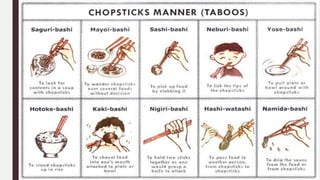
■ Chopstick manner
■ Bad manners
■ Chopsticks Dance
INTRODUCTION
 A pair of small even-length tapered sticks, are the
traditional eating utensils of East Asia (China, Japan,
Korea, and Vietnam, the four "chopstick countries")
 Chopsticks are commonly made of wood, bamboo, metal,
bone, ivory, in modern times, plastic as well.
 Chopsticks play an important role in Chinese food culture.
Chopsticks are called "Kuaizi“( 筷子) in Chinese and were
called "Zhu“(箸) in ancient times.
 Chinese people have been using kuaizi as one of the main
tableware for more than 3,000 years.
■ In Japanese, chopsticks are called hashi.
■ In Korean, chopsticks are called jeo.
■ InVietnamese, chopsticks are called "đũa“.
■ Japanese chopsticks are shorter and sharper than
chinese chopsticks.
Chopsticks History
■ In ancient times, Chinese liked to steam or boil food. It was difficult for them to
use spoons to scoop vegetables out of soups, thus they decided to invent new
utensils: chopsticks
■ It was mentioned in Shiji (the Chinese history book) that Zhou, the last king of
the Shang Dynasty (1600 BC - 1100 BC), used ivory chopsticks.
■ Experts believe the history of wood or bamboo chopsticks can be dated to about
1,000 years earlier than ivory chopsticks.
■ Bronze chopsticks were invented in the Zhou Dynasty (1100 BC - 771 BC).
■ Lacquer chopsticks from the Han(206 BC-24 AD) were discovered in Mawangdui,
China
■ Gold and silver chopsticks became popular in theTang Dynasty(618 - 907). It was
believed that silver chopsticks could detect poisons in food.
■ If poison was present, the chopsticks would become blackened owing to
displacement reactions on the silver
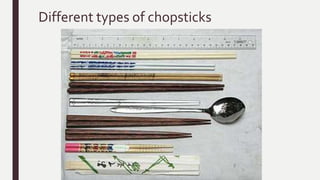
Different types of chopsticks
6 main types of chopsticks
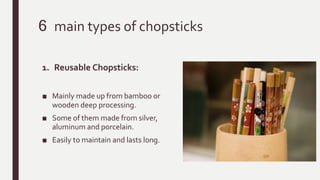
1. Reusable Chopsticks:
■ Mainly made up from bamboo or
wooden deep processing.
■ Some of them made from silver,
aluminum and porcelain.
■ Easily to maintain and lasts long.
2. Bamboo Chopsticks:
■ The most affordable and appropriate
materials for Chopsticks.
■ Eco-friendly chopsticks and are free
from any toxicity or pesticides, etc.
■ Ecologically green alternative to wood,
strong, dense and versatile.
■ Usually bamboo chopsticks is
disposables.
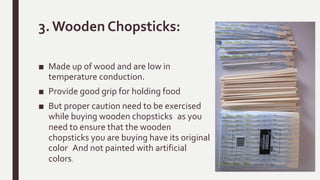
3. Wooden Chopsticks:
■ Made up of wood and are low in
temperature conduction.
■ Provide good grip for holding food
■ But proper caution need to be exercised
while buying wooden chopsticks as you
need to ensure that the wooden
chopsticks you are buying have its original
color And not painted with artificial
colors.
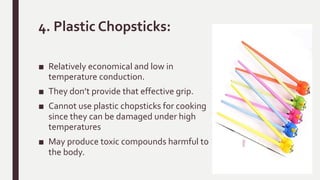
4. Plastic Chopsticks:
■ Relatively economical and low in
temperature conduction.
■ They don’t provide that effective grip.
■ Cannot use plastic chopsticks for cooking
since they can be damaged under high
temperatures
■ May produce toxic compounds harmful to
the body.
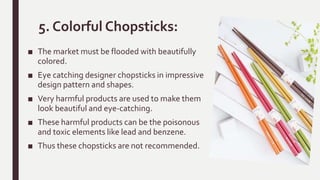
5. Colorful Chopsticks:
■ The market must be flooded with beautifully
colored.
■ Eye catching designer chopsticks in impressive
design pattern and shapes.
■ Very harmful products are used to make them
look beautiful and eye-catching.
■ These harmful products can be the poisonous
and toxic elements like lead and benzene.
■ Thus these chopsticks are not recommended.
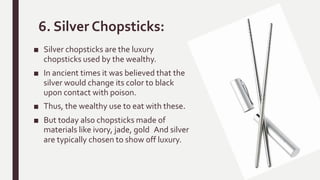
6. Silver Chopsticks:
■ Silver chopsticks are the luxury
chopsticks used by the wealthy.
■ In ancient times it was believed that the
silver would change its color to black
upon contact with poison.
■ Thus, the wealthy use to eat with these.
■ But today also chopsticks made of
materials like ivory, jade, gold And silver
are typically chosen to show off luxury.
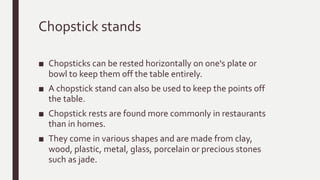
Chopstick stands
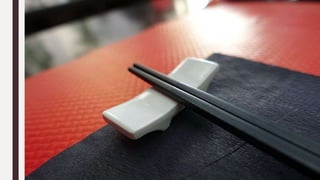
■ Chopsticks can be rested horizontally on one's plate or
bowl to keep them off the table entirely.
■ A chopstick stand can also be used to keep the points off
the table.
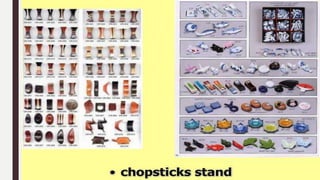
■ Chopstick rests are found more commonly in restaurants
than in homes.
■ They come in various shapes and are made from clay,
wood, plastic, metal, glass, porcelain or precious stones
such as jade.
How to use chopsticks
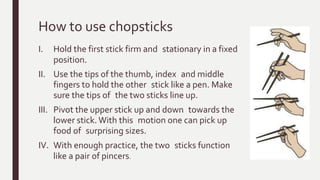
I. Hold the first stick firm and stationary in a fixed
position.
II. Use the tips of the thumb, index and middle
fingers to hold the other stick like a pen. Make
sure the tips of the two sticks line up.
III. Pivot the upper stick up and down towards the
lower stick. With this motion one can pick up
food of surprising sizes.
IV. With enough practice, the two sticks function
like a pair of pincers.
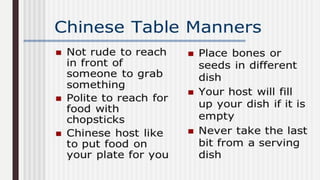
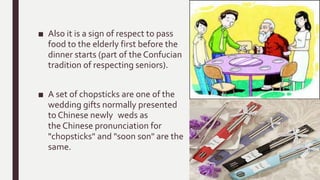
■ Also it is a sign of respect to pass
food to the elderly first before the
dinner starts (part of the Confucian
tradition of respecting seniors).
■ A set of chopsticks are one of the
wedding gifts normally presented
to Chinese newly weds as
the Chinese pronunciation for
"chopsticks" and "soon son" are the
same.
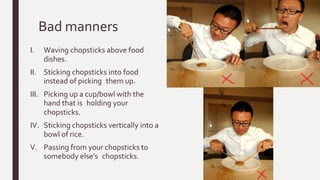
Bad manners
I. Waving chopsticks above food
dishes.
II. Sticking chopsticks into food
instead of picking them up.
III. Picking up a cup/bowl with the
hand that is holding your
chopsticks.
IV. Sticking chopsticks vertically into a
bowl of rice.
V. Passing from your chopsticks to
somebody else’s chopsticks.
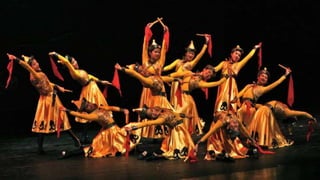
Chopsticks Dance
■ Chopsticks Dance was originally a single mans dance at
marriage or festival ceremonies, under the accompaniment of a
stringed instrument.
■ The dancer holds a bunch of chopsticks in his hands and beats
the shoulder, waist and legs.
■ Today, people tie the chopsticks together with a small rope,
decorate it with red silk, and the female dancer partner wears
the colorful traditional customs and hand-made ornaments
on her head, thus making it an exquisite stage.
Chopsticks
Chopsticks

Chopsticks

  • 1.
    CHOPSTICKS DR. DINESWAR SECONDYEAR RADIOLOGYRESIDENT 2017 BATCH Y2017N05014
  • 3.
    Today’s sub-topics ■ Introduction ■Chopsticks History ■ Types of chopstick ■ Chopstick stand ■ How to use chopsticks ■ Chopstick manner ■ Bad manners ■ Chopsticks Dance
  • 4.
    INTRODUCTION  A pairof small even-length tapered sticks, are the traditional eating utensils of East Asia (China, Japan, Korea, and Vietnam, the four "chopstick countries")  Chopsticks are commonly made of wood, bamboo, metal, bone, ivory, in modern times, plastic as well.  Chopsticks play an important role in Chinese food culture. Chopsticks are called "Kuaizi“( 筷子) in Chinese and were called "Zhu“(箸) in ancient times.  Chinese people have been using kuaizi as one of the main tableware for more than 3,000 years.
  • 5.
    ■ In Japanese,chopsticks are called hashi. ■ In Korean, chopsticks are called jeo. ■ InVietnamese, chopsticks are called "đũa“. ■ Japanese chopsticks are shorter and sharper than chinese chopsticks.
  • 6.
    Chopsticks History ■ Inancient times, Chinese liked to steam or boil food. It was difficult for them to use spoons to scoop vegetables out of soups, thus they decided to invent new utensils: chopsticks ■ It was mentioned in Shiji (the Chinese history book) that Zhou, the last king of the Shang Dynasty (1600 BC - 1100 BC), used ivory chopsticks. ■ Experts believe the history of wood or bamboo chopsticks can be dated to about 1,000 years earlier than ivory chopsticks. ■ Bronze chopsticks were invented in the Zhou Dynasty (1100 BC - 771 BC). ■ Lacquer chopsticks from the Han(206 BC-24 AD) were discovered in Mawangdui, China ■ Gold and silver chopsticks became popular in theTang Dynasty(618 - 907). It was believed that silver chopsticks could detect poisons in food. ■ If poison was present, the chopsticks would become blackened owing to displacement reactions on the silver
  • 7.
  • 8.
    6 main typesof chopsticks 1. Reusable Chopsticks: ■ Mainly made up from bamboo or wooden deep processing. ■ Some of them made from silver, aluminum and porcelain. ■ Easily to maintain and lasts long.
  • 9.
    2. Bamboo Chopsticks: ■The most affordable and appropriate materials for Chopsticks. ■ Eco-friendly chopsticks and are free from any toxicity or pesticides, etc. ■ Ecologically green alternative to wood, strong, dense and versatile. ■ Usually bamboo chopsticks is disposables.
  • 10.
    3. Wooden Chopsticks: ■Made up of wood and are low in temperature conduction. ■ Provide good grip for holding food ■ But proper caution need to be exercised while buying wooden chopsticks as you need to ensure that the wooden chopsticks you are buying have its original color And not painted with artificial colors.
  • 11.
    4. Plastic Chopsticks: ■Relatively economical and low in temperature conduction. ■ They don’t provide that effective grip. ■ Cannot use plastic chopsticks for cooking since they can be damaged under high temperatures ■ May produce toxic compounds harmful to the body.
  • 12.
    5. Colorful Chopsticks: ■The market must be flooded with beautifully colored. ■ Eye catching designer chopsticks in impressive design pattern and shapes. ■ Very harmful products are used to make them look beautiful and eye-catching. ■ These harmful products can be the poisonous and toxic elements like lead and benzene. ■ Thus these chopsticks are not recommended.
  • 13.
    6. Silver Chopsticks: ■Silver chopsticks are the luxury chopsticks used by the wealthy. ■ In ancient times it was believed that the silver would change its color to black upon contact with poison. ■ Thus, the wealthy use to eat with these. ■ But today also chopsticks made of materials like ivory, jade, gold And silver are typically chosen to show off luxury.
  • 14.
    Chopstick stands ■ Chopstickscan be rested horizontally on one's plate or bowl to keep them off the table entirely. ■ A chopstick stand can also be used to keep the points off the table. ■ Chopstick rests are found more commonly in restaurants than in homes. ■ They come in various shapes and are made from clay, wood, plastic, metal, glass, porcelain or precious stones such as jade.
  • 17.
    How to usechopsticks I. Hold the first stick firm and stationary in a fixed position. II. Use the tips of the thumb, index and middle fingers to hold the other stick like a pen. Make sure the tips of the two sticks line up. III. Pivot the upper stick up and down towards the lower stick. With this motion one can pick up food of surprising sizes. IV. With enough practice, the two sticks function like a pair of pincers.
  • 22.
    ■ Also itis a sign of respect to pass food to the elderly first before the dinner starts (part of the Confucian tradition of respecting seniors). ■ A set of chopsticks are one of the wedding gifts normally presented to Chinese newly weds as the Chinese pronunciation for "chopsticks" and "soon son" are the same.
  • 23.
    Bad manners I. Wavingchopsticks above food dishes. II. Sticking chopsticks into food instead of picking them up. III. Picking up a cup/bowl with the hand that is holding your chopsticks. IV. Sticking chopsticks vertically into a bowl of rice. V. Passing from your chopsticks to somebody else’s chopsticks.
  • 24.
    Chopsticks Dance ■ ChopsticksDance was originally a single mans dance at marriage or festival ceremonies, under the accompaniment of a stringed instrument. ■ The dancer holds a bunch of chopsticks in his hands and beats the shoulder, waist and legs. ■ Today, people tie the chopsticks together with a small rope, decorate it with red silk, and the female dancer partner wears the colorful traditional customs and hand-made ornaments on her head, thus making it an exquisite stage.