Coordination and control
Cholinergic Synapses
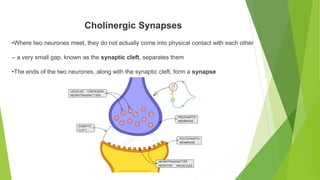
•Where two neurones meet, they do not actually come into physical contact with each other
– a very small gap, known as the synaptic cleft, separates them
•The ends of the two neurones, along with the synaptic cleft, form a synapse
Synaptic transmission – basic mechanism
•Electrical impulses cannot ‘jump’ across synapses
•When an electrical impulse arrives at the end of the axon on the presynaptic
neurone, chemical messengers called neurotransmitters are released
from vesicles at the presynaptic membrane
•The neurotransmitters diffuse across the synaptic cleft and temporarily bind with
receptor molecules on the postsynaptic membrane
•This stimulates the postsynaptic neurone to generate an electrical impulse that then
travels down the axon of the postsynaptic neurone
•The neurotransmitters are then destroyed or recycled to prevent continued
stimulation of the second neurone, which could cause repeated impulses to be sent
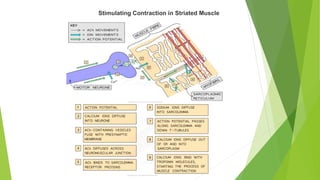
Stimulating Contraction in Striated Muscle
Cholinergic Synapses- cordination and control.pptx

Cholinergic Synapses- cordination and control.pptx

  • 1.
  • 2.
    Cholinergic Synapses •Where twoneurones meet, they do not actually come into physical contact with each other – a very small gap, known as the synaptic cleft, separates them •The ends of the two neurones, along with the synaptic cleft, form a synapse
  • 4.
    Synaptic transmission –basic mechanism •Electrical impulses cannot ‘jump’ across synapses •When an electrical impulse arrives at the end of the axon on the presynaptic neurone, chemical messengers called neurotransmitters are released from vesicles at the presynaptic membrane •The neurotransmitters diffuse across the synaptic cleft and temporarily bind with receptor molecules on the postsynaptic membrane •This stimulates the postsynaptic neurone to generate an electrical impulse that then travels down the axon of the postsynaptic neurone •The neurotransmitters are then destroyed or recycled to prevent continued stimulation of the second neurone, which could cause repeated impulses to be sent
  • 5.