History of Chinese
Cinema
A brief introduction and overview:
History of Chinese Cinema (Cont.)
• Historically there have been 3 distinct threads of Chinese cinema:
Chinese cinema, Cinema of Hong Kong, and Cinema of Taiwan.
• Cinema was introduced to China in 1896. The first film with sound
was created in 1931. The first film to use color was developed in
1948.
• The 1930’s was considered the first ‘golden age’ of Chinese
cinema. The second golden age took place after World War II.
Many films created during this time are, to this day, well received
by audiences and critics alike.
Popular forms of Chinese film
• Mainland China- Historical dramas
• Hong Kong- Westernized mainstream (comedies/action movies)
• Taiwan- TV dramas
• All three movie businesses are intertwined. For example, a
Taiwanese-financed movie could be filmed in Mainland China with
Hong Kong actors. (Crouching Tiger Hidden Dragon)
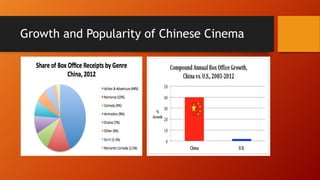
Chinese Film Popularity
• China is the fastest growing movie market in the world
• Box Office sale have risen 64% in 2010 and 29% in 2011(over 2
billion dollars)
• Third largest film producer in the world (After India and US)
• Makes over 500 films a year
Growth and Popularity of Chinese Cinema
Chinese Romance Films
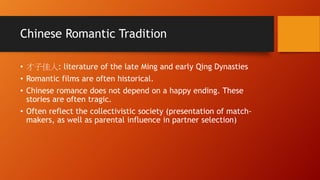
Chinese Romantic Tradition
• 才子佳人: literature of the late Ming and early Qing Dynasties
• Romantic films are often historical.
• Chinese romance does not depend on a happy ending. These
stories are often tragic.
• Often reflect the collectivistic society (presentation of match-
makers, as well as parental influence in partner selection)
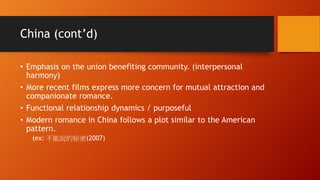
China (cont’d)
• Emphasis on the union benefiting community. (interpersonal
harmony)
• More recent films express more concern for mutual attraction and
companionate romance.
• Functional relationship dynamics / purposeful
• Modern romance in China follows a plot similar to the American
pattern.
(ex: 不能說的秘密(2007)
American Romance
• Heavily influenced by French romantic tradition of courtly love.
• Cinema is sometimes historical or refigured from literary works.
• Romance in America is usually light-hearted and endearingly
funny. (Rom-Com)
• Focuses on the physical attraction and compatibility of the couple,
esp. sexually.
America (cont’d)
• Emphasis on personal preference and satisfaction. (Recent
Example: Cinderella [2015])
• Rom-Com’s follow a predictable, genre specific plot pattern. We
know how it will go. Everytime. (Ex: Pretty Woman; The Bounty
Hunter)
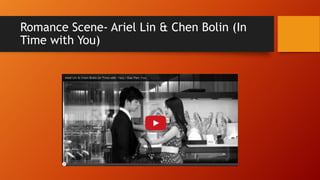
Romance Scene- Ariel Lin & Chen Bolin (In
Time with You)
Sources
• http://en.wikipedia.org/wiki/Caizi_jiaren
• http://sitemaker.umich.edu/psy457_lamyiu/culture_s_role
• http://www.neoamericanist.org/review/romantic-comedy-boy-
meets-girl-meets-genre
Chinese Comedy Movies
Characteristics and examples of both Chinese and American comedy
movies
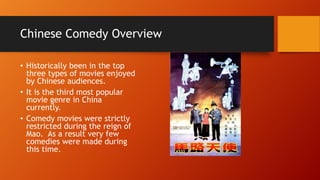
Chinese Comedy Overview
• Historically been in the top
three types of movies enjoyed
by Chinese audiences.
• It is the third most popular
movie genre in China
currently.
• Comedy movies were strictly
restricted during the reign of
Mao. As a result very few
comedies were made during
this time.
Common Elements of Chinese Humor:
• Slapstick (闹剧 or 喜剧)
• Mo Lei Tau (Cantonese) ---- 無厘頭
• Kung Fu Comedy
• Comedy has been an important part of Chinese cinema since its
creation.
• It has been used to foil serious concepts such as wealth inequality and
the urban poor.
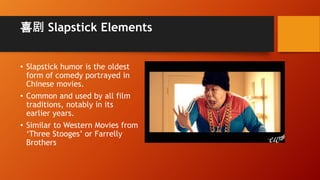
喜剧 Slapstick Elements
• Slapstick humor is the oldest
form of comedy portrayed in
Chinese movies.
• Common and used by all film
traditions, notably in its
earlier years.
• Similar to Western Movies from
‘Three Stooges’ or Farrelly
Brothers
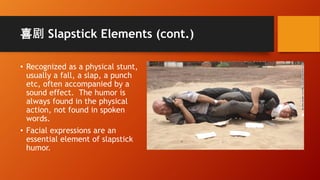
喜剧 Slapstick Elements (cont.)
• Recognized as a physical stunt,
usually a fall, a slap, a punch
etc, often accompanied by a
sound effect. The humor is
always found in the physical
action, not found in spoken
words.
• Facial expressions are an
essential element of slapstick
humor.
喜剧 Slapstick Elements (cont.)
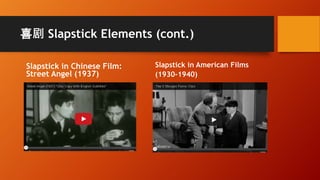
Slapstick in Chinese Film:
Street Angel (1937)
Slapstick in American Films
(1930-1940)
喜剧 Slapstick Elements (cont.)
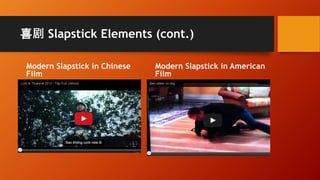
Modern Slapstick in Chinese
Film
Modern Slapstick in American
Film
無厘頭 Elements
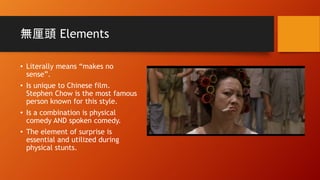
• Literally means “makes no
sense”.
• Is unique to Chinese film.
Stephen Chow is the most famous
person known for this style.
• Is a combination is physical
comedy AND spoken comedy.
• The element of surprise is
essential and utilized during
physical stunts.
無厘頭 Elements (cont.)
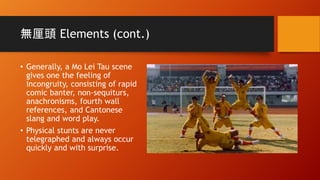
• Generally, a Mo Lei Tau scene
gives one the feeling of
incongruity, consisting of rapid
comic banter, non-sequiturs,
anachronisms, fourth wall
references, and Cantonese
slang and word play.
• Physical stunts are never
telegraphed and always occur
quickly and with surprise.
無厘頭 Elements (cont.)
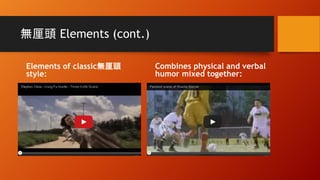
Elements of classic無厘頭
style:
Combines physical and verbal
humor mixed together:
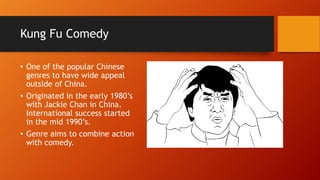
Kung Fu Comedy
• One of the popular Chinese
genres to have wide appeal
outside of China.
• Originated in the early 1980’s
with Jackie Chan in China.
International success started
in the mid 1990’s.
• Genre aims to combine action
with comedy.
Kung Fu Comedy
• The comedy variant of kung fu
differs from traditional action
fighting scenes by focus on
escape instead of the elimination
of foes.
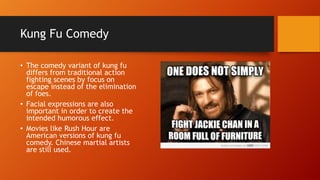
• Facial expressions are also
important in order to create the
intended humorous effect.
• Movies like Rush Hour are
American versions of kung fu
comedy. Chinese martial artists
are still used.
Kung Fu Comedy
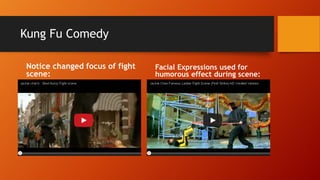
Notice changed focus of fight
scene:
Facial Expressions used for
humorous effect during scene:
Sources
https://www.youtube.com/v/xhRdIdVMcwY
https://www.youtube.com/v/VVHCWvlVfiw
https://www.youtube.com/v/W9kQf_te2EA
https://www.youtube.com/v/1lEGksNbk18
https://www.youtube.com/v/9QBF-uqqF1M
https://www.youtube.com/v/uV-dqhGd-YQ
https://www.youtube.com/v/7QL_SzgixGk
https://www.youtube.com/v/zTK6eJei7wY
https://www.youtube.com/v/DrRFzwPE0d4
Chinese Action Movies
Types of Chinese Action Movies
• 武俠 (Martial Hero)
• 功夫 (Kung Fu)
武俠 Background
• Genre of Chinese fiction that focuses on the adventures of martial
artists in Ancient China.
• The martial artist usually follows the code of xia (遊俠), which
literally means “wandering force”
• Refers to how the martial artists travel throughout China to help
the common people against the powerful and corrupt (Such as the
monarchy)
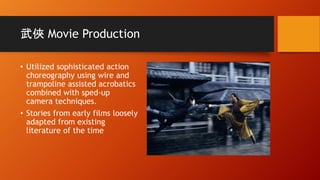
武俠 Movie Production
• Utilized sophisticated action
choreography using wire and
trampoline assisted acrobatics
combined with sped-up
camera techniques.
• Stories from early films loosely
adapted from existing
literature of the time
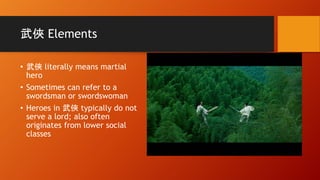
武俠 Elements
• 武俠 literally means martial
hero
• Sometimes can refer to a
swordsman or swordswoman
• Heroes in 武俠 typically do not
serve a lord; also often
originates from lower social
classes
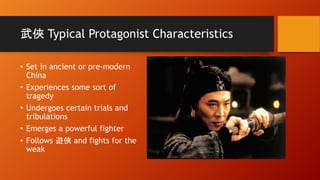
武俠 Typical Protagonist Characteristics
• Set in ancient or pre-modern
China
• Experiences some sort of
tragedy
• Undergoes certain trials and
tribulations
• Emerges a powerful fighter
• Follows 遊俠 and fights for the
weak
武俠 Fight Scenes
Hero
Crouching Tiger Hidden
Dragon
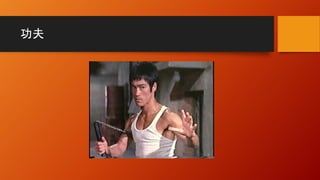
功夫
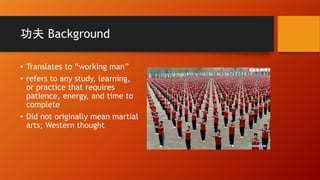
功夫 Background
• Translates to “working man”
• refers to any study, learning,
or practice that requires
patience, energy, and time to
complete
• Did not originally mean martial
arts; Western thought
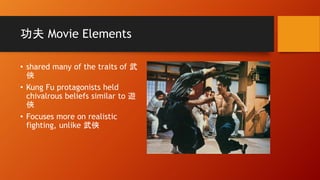
功夫 Movie Elements
• shared many of the traits of 武
俠
• Kung Fu protagonists held
chivalrous beliefs similar to 遊
俠
• Focuses more on realistic
fighting, unlike 武俠
功夫 Movie Scenes
Enter the Dragon IP Man
Image sources
• https://kiaikick.files.wordpress.com/2011/02/crouching.jpg
• http://cdn.collider.com/wp-content/image-
base/movies/h/hero/hero%20jet%20li%20movie%20image.jpg
• http://i.ytimg.com/vi/5cqzOo6B0Ic/hqdefault.jpg
• http://ui.sina.com/2014/1020/U45P5029DT20141020143124.jpg
• https://arsuka.files.wordpress.com/2008/09/hero_b.jpg
Sources
• http://chinafilmbiz.com/tag/china-box-office-share-by-genre/
• http://factsanddetails.com/china/cat7/sub42/item245.html

Chinese cinema

  • 1.
    History of Chinese Cinema Abrief introduction and overview:
  • 2.
    History of ChineseCinema (Cont.) • Historically there have been 3 distinct threads of Chinese cinema: Chinese cinema, Cinema of Hong Kong, and Cinema of Taiwan. • Cinema was introduced to China in 1896. The first film with sound was created in 1931. The first film to use color was developed in 1948. • The 1930’s was considered the first ‘golden age’ of Chinese cinema. The second golden age took place after World War II. Many films created during this time are, to this day, well received by audiences and critics alike.
  • 3.
    Popular forms ofChinese film • Mainland China- Historical dramas • Hong Kong- Westernized mainstream (comedies/action movies) • Taiwan- TV dramas • All three movie businesses are intertwined. For example, a Taiwanese-financed movie could be filmed in Mainland China with Hong Kong actors. (Crouching Tiger Hidden Dragon)
  • 4.
    Chinese Film Popularity •China is the fastest growing movie market in the world • Box Office sale have risen 64% in 2010 and 29% in 2011(over 2 billion dollars) • Third largest film producer in the world (After India and US) • Makes over 500 films a year
  • 5.
    Growth and Popularityof Chinese Cinema
  • 6.
  • 7.
    Chinese Romantic Tradition •才子佳人: literature of the late Ming and early Qing Dynasties • Romantic films are often historical. • Chinese romance does not depend on a happy ending. These stories are often tragic. • Often reflect the collectivistic society (presentation of match- makers, as well as parental influence in partner selection)
  • 8.
    China (cont’d) • Emphasison the union benefiting community. (interpersonal harmony) • More recent films express more concern for mutual attraction and companionate romance. • Functional relationship dynamics / purposeful • Modern romance in China follows a plot similar to the American pattern. (ex: 不能說的秘密(2007)
  • 9.
    American Romance • Heavilyinfluenced by French romantic tradition of courtly love. • Cinema is sometimes historical or refigured from literary works. • Romance in America is usually light-hearted and endearingly funny. (Rom-Com) • Focuses on the physical attraction and compatibility of the couple, esp. sexually.
  • 10.
    America (cont’d) • Emphasison personal preference and satisfaction. (Recent Example: Cinderella [2015]) • Rom-Com’s follow a predictable, genre specific plot pattern. We know how it will go. Everytime. (Ex: Pretty Woman; The Bounty Hunter)
  • 11.
    Romance Scene- ArielLin & Chen Bolin (In Time with You)
  • 12.
    Sources • http://en.wikipedia.org/wiki/Caizi_jiaren • http://sitemaker.umich.edu/psy457_lamyiu/culture_s_role •http://www.neoamericanist.org/review/romantic-comedy-boy- meets-girl-meets-genre
  • 13.
    Chinese Comedy Movies Characteristicsand examples of both Chinese and American comedy movies
  • 14.
    Chinese Comedy Overview •Historically been in the top three types of movies enjoyed by Chinese audiences. • It is the third most popular movie genre in China currently. • Comedy movies were strictly restricted during the reign of Mao. As a result very few comedies were made during this time.
  • 15.
    Common Elements ofChinese Humor: • Slapstick (闹剧 or 喜剧) • Mo Lei Tau (Cantonese) ---- 無厘頭 • Kung Fu Comedy • Comedy has been an important part of Chinese cinema since its creation. • It has been used to foil serious concepts such as wealth inequality and the urban poor.
  • 16.
    喜剧 Slapstick Elements •Slapstick humor is the oldest form of comedy portrayed in Chinese movies. • Common and used by all film traditions, notably in its earlier years. • Similar to Western Movies from ‘Three Stooges’ or Farrelly Brothers
  • 17.
    喜剧 Slapstick Elements(cont.) • Recognized as a physical stunt, usually a fall, a slap, a punch etc, often accompanied by a sound effect. The humor is always found in the physical action, not found in spoken words. • Facial expressions are an essential element of slapstick humor.
  • 18.
    喜剧 Slapstick Elements(cont.) Slapstick in Chinese Film: Street Angel (1937) Slapstick in American Films (1930-1940)
  • 19.
    喜剧 Slapstick Elements(cont.) Modern Slapstick in Chinese Film Modern Slapstick in American Film
  • 20.
    無厘頭 Elements • Literallymeans “makes no sense”. • Is unique to Chinese film. Stephen Chow is the most famous person known for this style. • Is a combination is physical comedy AND spoken comedy. • The element of surprise is essential and utilized during physical stunts.
  • 21.
    無厘頭 Elements (cont.) •Generally, a Mo Lei Tau scene gives one the feeling of incongruity, consisting of rapid comic banter, non-sequiturs, anachronisms, fourth wall references, and Cantonese slang and word play. • Physical stunts are never telegraphed and always occur quickly and with surprise.
  • 22.
    無厘頭 Elements (cont.) Elementsof classic無厘頭 style: Combines physical and verbal humor mixed together:
  • 23.
    Kung Fu Comedy •One of the popular Chinese genres to have wide appeal outside of China. • Originated in the early 1980’s with Jackie Chan in China. International success started in the mid 1990’s. • Genre aims to combine action with comedy.
  • 24.
    Kung Fu Comedy •The comedy variant of kung fu differs from traditional action fighting scenes by focus on escape instead of the elimination of foes. • Facial expressions are also important in order to create the intended humorous effect. • Movies like Rush Hour are American versions of kung fu comedy. Chinese martial artists are still used.
  • 25.
    Kung Fu Comedy Noticechanged focus of fight scene: Facial Expressions used for humorous effect during scene:
  • 26.
  • 27.
  • 28.
    Types of ChineseAction Movies • 武俠 (Martial Hero) • 功夫 (Kung Fu)
  • 29.
    武俠 Background • Genreof Chinese fiction that focuses on the adventures of martial artists in Ancient China. • The martial artist usually follows the code of xia (遊俠), which literally means “wandering force” • Refers to how the martial artists travel throughout China to help the common people against the powerful and corrupt (Such as the monarchy)
  • 30.
    武俠 Movie Production •Utilized sophisticated action choreography using wire and trampoline assisted acrobatics combined with sped-up camera techniques. • Stories from early films loosely adapted from existing literature of the time
  • 31.
    武俠 Elements • 武俠literally means martial hero • Sometimes can refer to a swordsman or swordswoman • Heroes in 武俠 typically do not serve a lord; also often originates from lower social classes
  • 32.
    武俠 Typical ProtagonistCharacteristics • Set in ancient or pre-modern China • Experiences some sort of tragedy • Undergoes certain trials and tribulations • Emerges a powerful fighter • Follows 遊俠 and fights for the weak
  • 33.
  • 34.
  • 35.
    功夫 Background • Translatesto “working man” • refers to any study, learning, or practice that requires patience, energy, and time to complete • Did not originally mean martial arts; Western thought
  • 36.
    功夫 Movie Elements •shared many of the traits of 武 俠 • Kung Fu protagonists held chivalrous beliefs similar to 遊 俠 • Focuses more on realistic fighting, unlike 武俠
  • 37.
    功夫 Movie Scenes Enterthe Dragon IP Man
  • 38.
    Image sources • https://kiaikick.files.wordpress.com/2011/02/crouching.jpg •http://cdn.collider.com/wp-content/image- base/movies/h/hero/hero%20jet%20li%20movie%20image.jpg • http://i.ytimg.com/vi/5cqzOo6B0Ic/hqdefault.jpg • http://ui.sina.com/2014/1020/U45P5029DT20141020143124.jpg • https://arsuka.files.wordpress.com/2008/09/hero_b.jpg
  • 39.