Children’‛s World Peace Organization


     Power Point
     Presentation
Children’‛s World Peace
                  Organization
 Statement in Governor’‛s Monthly Newsletter
                March 2012
                                 Sakuji Tanaka
                 Rotary International President 2012-2013
  “In  Rotary,  our  business  is  not  profit.    Our  business  is  peace.    Our  
reward is not financial, but the happiness and satisfaction of seeing a
better, more peaceful world, one that we have achieved through our
                                   own efforts.


 Rotary International President-elect Sakuji Tanaka will ask Rotary club
         members to build Peace Through Service in 2012-13.
Children’‛s World Peace
             Organization
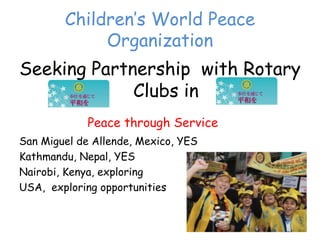
Seeking Partnership with Rotary
             Clubs in
             Peace through Service
San Miguel de Allende, Mexico, YES
Kathmandu, Nepal, YES
Nairobi, Kenya, exploring
USA, exploring opportunities
Children’‛s World Peace Organization
           Our Purpose

To enable children to create a more
    peaceful environment in their
  schools and communities and, by
   feeling safer and more secure,
 empower them to grow up to create
       a more peaceful world.
Children’‛s World Peace Organization
 The values that guide us
       Awareness
         Honesty
      Responsibility
Children’‛s World Peace Organization
                    What we do
 We work with both private and public elementary schools in
  Mexico, Nepal and Kenya.
 Our curriculum focuses on primary age students, grades 1
  through 6.
 Teams of 3 facilitators, spend 1 school period a week in each
  class room, every week during the school year.
 There is no charge to the school and we do ask that the
  teachers participate in the activities.
 We follow a 40 week curriculum introducing 22 peace
  activities.
 We organize a one-on-one drawing exchange program
  between classmates in Mexico, Nepal and Kenya.
Children’‛s World Peace Organization


         Why we do it.
Children’‛s World Peace Organization

  Our program creates change.
         In the classroom
           In the school
           In our staff
Children’‛s World Peace Organization
      What happens in the class room?
 Student attendance is up. (Report Principals)
 Students have better listening skills. (Report
   Teachers)

 Long standing conflicts between students are
  resolved. (Report Facilitators)
 Family life is improved. (Report Students)
 Students are inspired to lead more joyful,
  productive lives. (Report Students)
Children’‛s World Peace Organization
        What happens In the School?
   Student Enrollment is up. (Report Principals)
   Students have fewer fights. (Report Principals)
   Teacher turnover goes down. (Report Principals)
   Parents participate more. (Report Principals)
Children’‛s World Peace Organization
       What happens for Our Staff?
 One Staff member elected a new major in college in
  social work based on his experience with CWOP.
 45 facilitators have a job doing what they love to do
  and are now contributing members of their families.
 Friendship extend beyond the organization to enrich
  their lives.
 A family violence ended after one member used the CC
  skills she was teaching.
 One staff member could not see his children in the
  US and due to his employment with CWPO he may be
  eligible for a visa soon
Children’‛s World Peace Organization


            When we
            started.
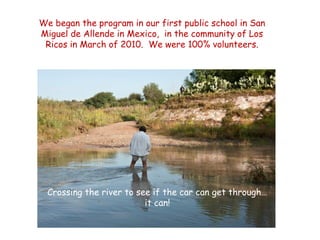
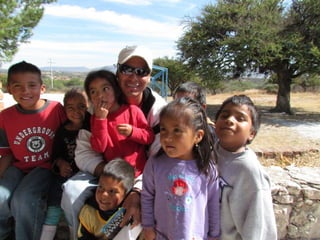
We began the program in our first public school in San
Miguel de Allende in Mexico, in the community of Los
 Ricos in March of 2010. We were 100% volunteers.


  Crossing the river to see if the car can get through…
                          it can!
Children’‛s World Peace Organization

• In the fall of 2010 we began hiring staff as we
       continued to add schools in Mexico.

   • By the end of 2010 we are in 6 schools
         reaching 639 students weekly.
Children’‛s World Peace Organization


           Where we
            work.
Children’‛s World Peace Organization


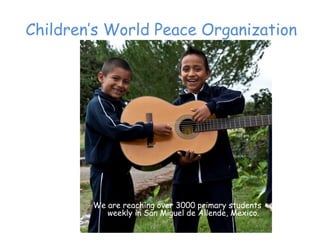
        We are reaching over 3000 primary students
           weekly in San Miguel de Allende, Mexico.
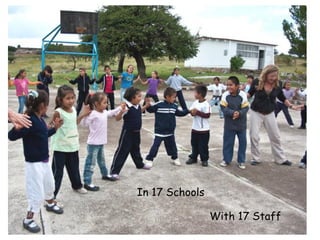
In 17 Schools

                With 17 Staff
Children’‛s World Peace
      Organization


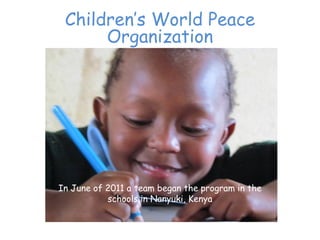
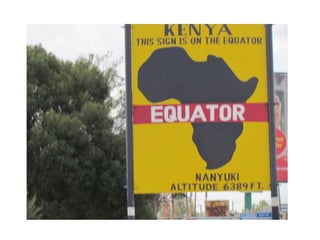
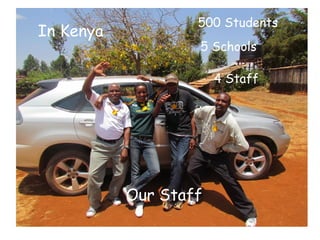
In June of 2011 a team began the program in the
           schools in Nanyuki, Kenya
500 Students
In Kenya
                   5 Schools

                       4 Staff


           Our Staff
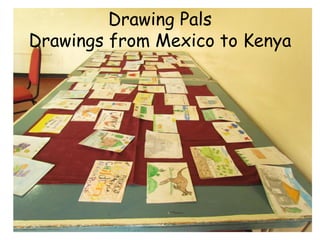
Drawing Pals
Drawings from Mexico to Kenya
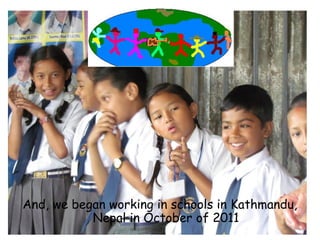
And, we began working in schools in Kathmandu,
           Nepal in October of 2011
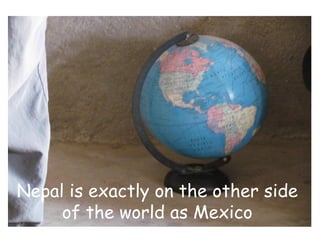
Nepal is exactly on the other side
     of the world as Mexico
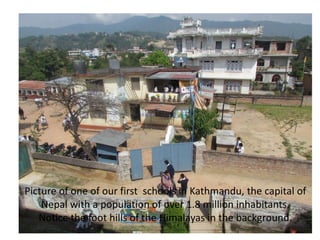
Picture of one of our first schools in Kathmandu, the capital of
    Nepal with a population of over 1.8 million inhabitants.
   Notice the foot hills of the Himalayas in the background.
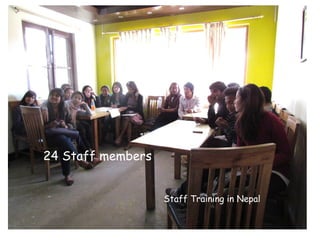
24 Staff members


                   Staff Training in Nepal
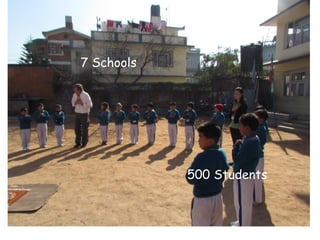
7 Schools


            500 Students
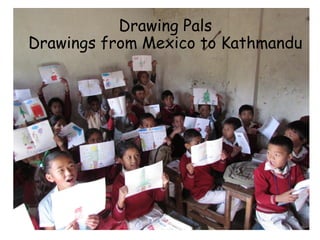
Drawing Pals
Drawings from Mexico to Kathmandu
Children’‛s World Peace Organization


         How we do it.
Children’‛s World Peace Organization
        Our work in the schools includes
             Enhancing Our skill at

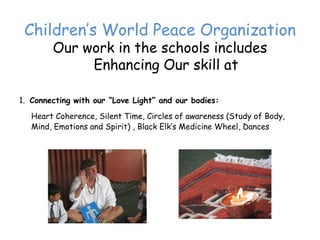
1. Connecting with our “Love Light” and our bodies:
   Heart Coherence, Silent Time, Circles of awareness (Study of Body,
   Mind, Emotions and Spirit) , Black Elk’‛s Medicine Wheel, Dances
Children’‛s World Peace Organization


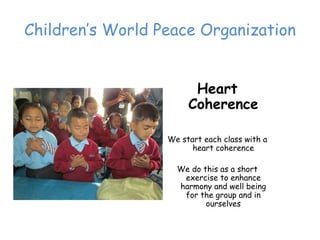
                        Heart
                       Coherence

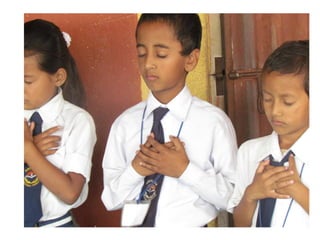
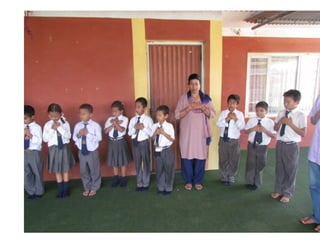
                  We start each class with a
                        heart coherence

                    We do this as a short
                     exercise to enhance
                    harmony and well being
                     for the group and in
                           ourselves
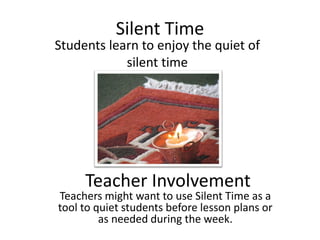
Silent Time
Students learn to enjoy the quiet of
            silent time


     Teacher Involvement
Teachers might want to use Silent Time as a
tool to quiet students before lesson plans or
         as needed during the week.
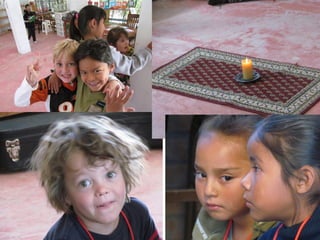
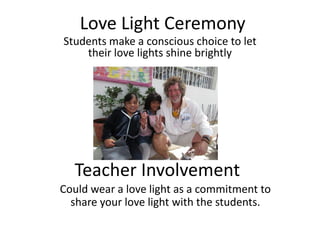
Love Light Ceremony
Students make a conscious choice to let
    their love lights shine brightly


  Teacher Involvement
Could wear a love light as a commitment to
  share your love light with the students.
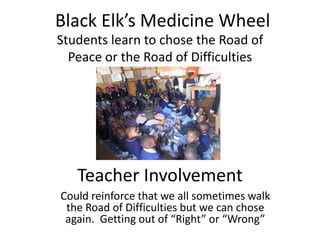
Black  Elk’s  Medicine  Wheel
Students learn to chose the Road of
  Peace or the Road of Difficulties


   Teacher Involvement
Could reinforce that we all sometimes walk
 the Road of Difficulties but we can chose
 again.    Getting  out  of  “Right”  or  “Wrong”
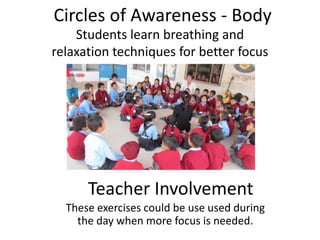
Circles of Awareness - Body
    Students learn breathing and
relaxation techniques for better focus


      Teacher Involvement
  These exercises could be use used during
    the day when more focus is needed.
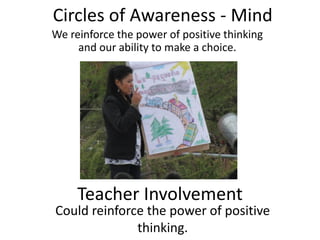
Circles of Awareness - Mind
We reinforce the power of positive thinking
     and our ability to make a choice.


     Teacher Involvement
Could reinforce the power of positive
              thinking.
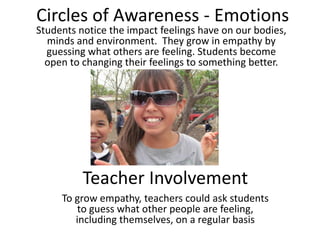
Circles of Awareness - Emotions
Students notice the impact feelings have on our bodies,
  minds and environment. They grow in empathy by
  guessing what others are feeling. Students become
  open to changing their feelings to something better.


          Teacher Involvement
     To grow empathy, teachers could ask students
         to guess what other people are feeling,
        including themselves, on a regular basis
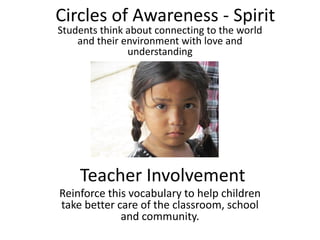
Circles of Awareness - Spirit
Students think about connecting to the world
    and their environment with love and
               understanding


    Teacher Involvement
Reinforce this vocabulary to help children
take better care of the classroom, school
             and community.
Children’‛s World Peace Organization
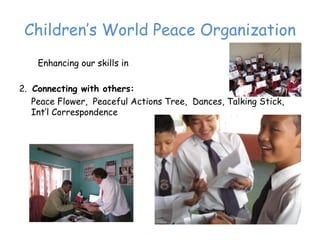
    Enhancing our skills in

2. Connecting with others:
   Peace Flower, Peaceful Actions Tree, Dances, Talking Stick,
   Int’‛l Correspondence
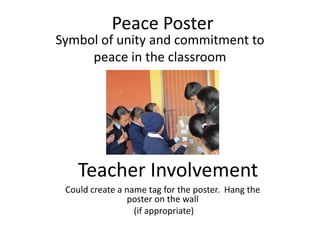
Peace Poster
Symbol of unity and commitment to
     peace in the classroom


    Teacher Involvement
 Could create a name tag for the poster. Hang the
                poster on the wall
                  (if appropriate)
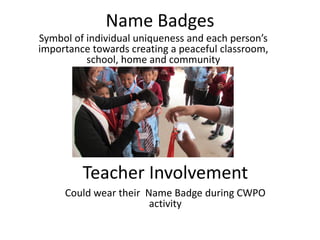
Name Badges
Symbol  of  individual  uniqueness  and  each  person’s  
importance towards creating a peaceful classroom,
            school, home and community


          Teacher Involvement
      Could wear their Name Badge during CWPO
                        activity
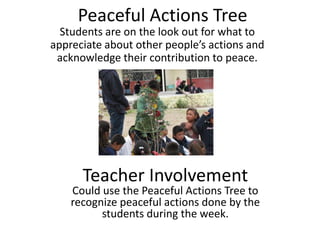
Peaceful Actions Tree
  Students are on the look out for what to
appreciate  about  other  people’s  actions  and  
 acknowledge their contribution to peace.


       Teacher Involvement
    Could use the Peaceful Actions Tree to
    recognize peaceful actions done by the
          students during the week.
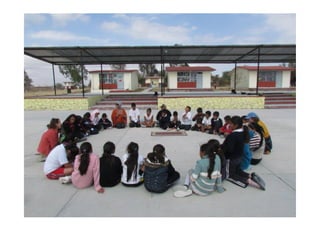
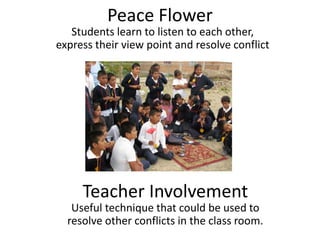
Peace Flower
   Students learn to listen to each other,
express their view point and resolve conflict


     Teacher Involvement
   Useful technique that could be used to
  resolve other conflicts in the class room.
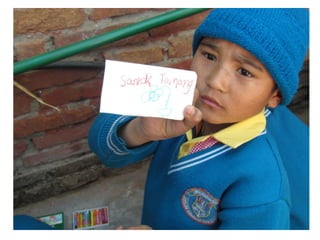
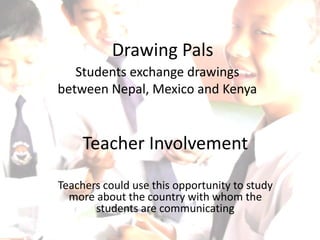
Drawing Pals
   Students exchange drawings
between Nepal, Mexico and Kenya


     Teacher Involvement

Teachers could use this opportunity to study
  more about the country with whom the
       students are communicating
Children’‛s World Peace Organization
     Enhancing skills in


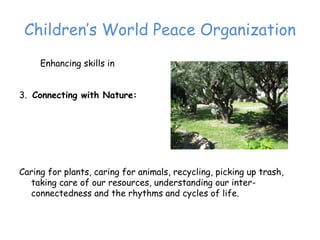
3. Connecting with Nature:


Caring for plants, caring for animals, recycling, picking up trash,
  taking care of our resources, understanding our inter-
  connectedness and the rhythms and cycles of life.
Children’‛s World Peace Organization

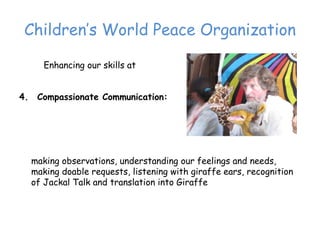
     Enhancing our skills at


4. Compassionate Communication:


  making observations, understanding our feelings and needs,
  making doable requests, listening with giraffe ears, recognition
  of Jackal Talk and translation into Giraffe
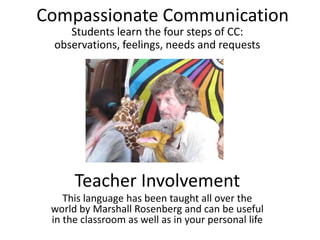
Compassionate Communication
    Students learn the four steps of CC:
 observations, feelings, needs and requests


      Teacher Involvement
    This language has been taught all over the
 world by Marshall Rosenberg and can be useful
 in the classroom as well as in your personal life
Children’‛s World Peace Organization

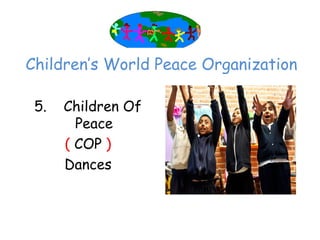
 5.   Children Of
        Peace
      ( COP )
      Dances
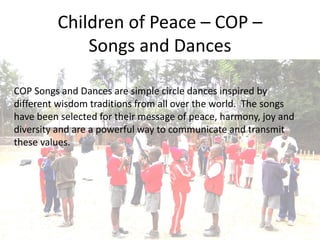
Children of Peace – COP –
             Songs and Dances

COP Songs and Dances are simple circle dances inspired by
different wisdom traditions from all over the world. The songs
have been selected for their message of peace, harmony, joy and
diversity and are a powerful way to communicate and transmit
these values.
Children’‛s World Peace Organization
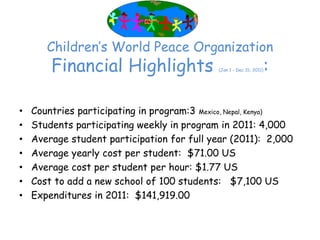
        Financial Highlights                 (Jan 1 - Dec 31, 2011)   :

•   Countries participating in program:3 Mexico, Nepal, Kenya)
•   Students participating weekly in program in 2011: 4,000
•   Average student participation for full year (2011): 2,000
•   Average yearly cost per student: $71.00 US
•   Average cost per student per hour: $1.77 US
•   Cost to add a new school of 100 students: $7,100 US
•   Expenditures in 2011: $141,919.00
Children’‛s World Peace Organization
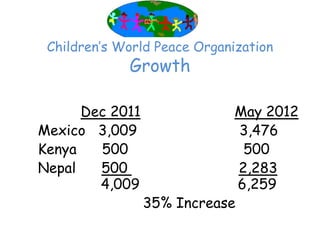
              Growth

      Dec 2011               May 2012
Mexico 3,009                  3,476
Kenya   500                    500
Nepal   500                   2,283
        4,009                 6,259
                 35% Increase
Children’‛s World Peace Organization
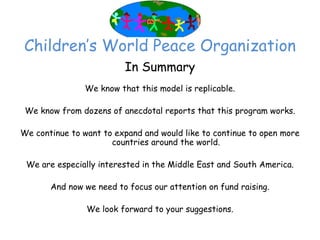
                         In Summary
               We know that this model is replicable.

 We know from dozens of anecdotal reports that this program works.

We continue to want to expand and would like to continue to open more
                      countries around the world.

 We are especially interested in the Middle East and South America.

       And now we need to focus our attention on fund raising.

                We look forward to your suggestions.
Children’‛s World Peace Organization


Thank you for taking the time to
    look at our presentation.

 We look forward to hearing from you with
  questions, comments and/or suggestions.
Logo

Children’‛s World Peace Organization


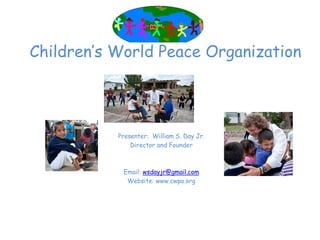
           Presenter: William S. Day Jr.
               Director and Founder


            Email: wsdayjr@gmail.com
             Website: www.cwpo.org

Children's World Peace Organization

  • 1.
    Children’‛s World PeaceOrganization Power Point Presentation
  • 2.
    Children’‛s World Peace Organization Statement in Governor’‛s Monthly Newsletter March 2012 Sakuji Tanaka Rotary International President 2012-2013 “In  Rotary,  our  business  is  not  profit.    Our  business  is  peace.    Our   reward is not financial, but the happiness and satisfaction of seeing a better, more peaceful world, one that we have achieved through our own efforts. Rotary International President-elect Sakuji Tanaka will ask Rotary club members to build Peace Through Service in 2012-13.
  • 3.
    Children’‛s World Peace Organization Seeking Partnership with Rotary Clubs in Peace through Service San Miguel de Allende, Mexico, YES Kathmandu, Nepal, YES Nairobi, Kenya, exploring USA, exploring opportunities
  • 4.
    Children’‛s World PeaceOrganization Our Purpose To enable children to create a more peaceful environment in their schools and communities and, by feeling safer and more secure, empower them to grow up to create a more peaceful world.
  • 5.
    Children’‛s World PeaceOrganization The values that guide us Awareness Honesty Responsibility
  • 6.
    Children’‛s World PeaceOrganization What we do  We work with both private and public elementary schools in Mexico, Nepal and Kenya.  Our curriculum focuses on primary age students, grades 1 through 6.  Teams of 3 facilitators, spend 1 school period a week in each class room, every week during the school year.  There is no charge to the school and we do ask that the teachers participate in the activities.  We follow a 40 week curriculum introducing 22 peace activities.  We organize a one-on-one drawing exchange program between classmates in Mexico, Nepal and Kenya.
  • 7.
    Children’‛s World PeaceOrganization Why we do it.
  • 8.
    Children’‛s World PeaceOrganization Our program creates change. In the classroom In the school In our staff
  • 9.
    Children’‛s World PeaceOrganization What happens in the class room?  Student attendance is up. (Report Principals)  Students have better listening skills. (Report Teachers)  Long standing conflicts between students are resolved. (Report Facilitators)  Family life is improved. (Report Students)  Students are inspired to lead more joyful, productive lives. (Report Students)
  • 10.
    Children’‛s World PeaceOrganization What happens In the School?  Student Enrollment is up. (Report Principals)  Students have fewer fights. (Report Principals)  Teacher turnover goes down. (Report Principals)  Parents participate more. (Report Principals)
  • 11.
    Children’‛s World PeaceOrganization What happens for Our Staff?  One Staff member elected a new major in college in social work based on his experience with CWOP.  45 facilitators have a job doing what they love to do and are now contributing members of their families.  Friendship extend beyond the organization to enrich their lives.  A family violence ended after one member used the CC skills she was teaching.  One staff member could not see his children in the US and due to his employment with CWPO he may be eligible for a visa soon
  • 12.
    Children’‛s World PeaceOrganization When we started.
  • 13.
    We began theprogram in our first public school in San Miguel de Allende in Mexico, in the community of Los Ricos in March of 2010. We were 100% volunteers. Crossing the river to see if the car can get through… it can!
  • 14.
    Children’‛s World PeaceOrganization • In the fall of 2010 we began hiring staff as we continued to add schools in Mexico. • By the end of 2010 we are in 6 schools reaching 639 students weekly.
  • 15.
    Children’‛s World PeaceOrganization Where we work.
  • 16.
    Children’‛s World PeaceOrganization We are reaching over 3000 primary students weekly in San Miguel de Allende, Mexico.
  • 17.
    In 17 Schools With 17 Staff
  • 22.
    Children’‛s World Peace Organization In June of 2011 a team began the program in the schools in Nanyuki, Kenya
  • 24.
    500 Students In Kenya 5 Schools 4 Staff Our Staff
  • 28.
  • 29.
    And, we beganworking in schools in Kathmandu, Nepal in October of 2011
  • 30.
    Nepal is exactlyon the other side of the world as Mexico
  • 31.
    Picture of oneof our first schools in Kathmandu, the capital of Nepal with a population of over 1.8 million inhabitants. Notice the foot hills of the Himalayas in the background.
  • 32.
    24 Staff members Staff Training in Nepal
  • 33.
    7 Schools 500 Students
  • 39.
    Drawing Pals Drawings fromMexico to Kathmandu
  • 40.
    Children’‛s World PeaceOrganization How we do it.
  • 41.
    Children’‛s World PeaceOrganization Our work in the schools includes Enhancing Our skill at 1. Connecting with our “Love Light” and our bodies: Heart Coherence, Silent Time, Circles of awareness (Study of Body, Mind, Emotions and Spirit) , Black Elk’‛s Medicine Wheel, Dances
  • 42.
    Children’‛s World PeaceOrganization Heart Coherence We start each class with a heart coherence We do this as a short exercise to enhance harmony and well being for the group and in ourselves
  • 43.
    Silent Time Students learnto enjoy the quiet of silent time Teacher Involvement Teachers might want to use Silent Time as a tool to quiet students before lesson plans or as needed during the week.
  • 44.
    Love Light Ceremony Studentsmake a conscious choice to let their love lights shine brightly Teacher Involvement Could wear a love light as a commitment to share your love light with the students.
  • 45.
    Black  Elk’s  Medicine Wheel Students learn to chose the Road of Peace or the Road of Difficulties Teacher Involvement Could reinforce that we all sometimes walk the Road of Difficulties but we can chose again.    Getting  out  of  “Right”  or  “Wrong”
  • 46.
    Circles of Awareness- Body Students learn breathing and relaxation techniques for better focus Teacher Involvement These exercises could be use used during the day when more focus is needed.
  • 47.
    Circles of Awareness- Mind We reinforce the power of positive thinking and our ability to make a choice. Teacher Involvement Could reinforce the power of positive thinking.
  • 48.
    Circles of Awareness- Emotions Students notice the impact feelings have on our bodies, minds and environment. They grow in empathy by guessing what others are feeling. Students become open to changing their feelings to something better. Teacher Involvement To grow empathy, teachers could ask students to guess what other people are feeling, including themselves, on a regular basis
  • 49.
    Circles of Awareness- Spirit Students think about connecting to the world and their environment with love and understanding Teacher Involvement Reinforce this vocabulary to help children take better care of the classroom, school and community.
  • 50.
    Children’‛s World PeaceOrganization Enhancing our skills in 2. Connecting with others: Peace Flower, Peaceful Actions Tree, Dances, Talking Stick, Int’‛l Correspondence
  • 51.
    Peace Poster Symbol ofunity and commitment to peace in the classroom Teacher Involvement Could create a name tag for the poster. Hang the poster on the wall (if appropriate)
  • 52.
    Name Badges Symbol  of individual  uniqueness  and  each  person’s   importance towards creating a peaceful classroom, school, home and community Teacher Involvement Could wear their Name Badge during CWPO activity
  • 53.
    Peaceful Actions Tree Students are on the look out for what to appreciate  about  other  people’s  actions  and   acknowledge their contribution to peace. Teacher Involvement Could use the Peaceful Actions Tree to recognize peaceful actions done by the students during the week.
  • 54.
    Peace Flower Students learn to listen to each other, express their view point and resolve conflict Teacher Involvement Useful technique that could be used to resolve other conflicts in the class room.
  • 55.
    Drawing Pals Students exchange drawings between Nepal, Mexico and Kenya Teacher Involvement Teachers could use this opportunity to study more about the country with whom the students are communicating
  • 56.
    Children’‛s World PeaceOrganization Enhancing skills in 3. Connecting with Nature: Caring for plants, caring for animals, recycling, picking up trash, taking care of our resources, understanding our inter- connectedness and the rhythms and cycles of life.
  • 57.
    Children’‛s World PeaceOrganization Enhancing our skills at 4. Compassionate Communication: making observations, understanding our feelings and needs, making doable requests, listening with giraffe ears, recognition of Jackal Talk and translation into Giraffe
  • 58.
    Compassionate Communication Students learn the four steps of CC: observations, feelings, needs and requests Teacher Involvement This language has been taught all over the world by Marshall Rosenberg and can be useful in the classroom as well as in your personal life
  • 59.
    Children’‛s World PeaceOrganization 5. Children Of Peace ( COP ) Dances
  • 60.
    Children of Peace– COP – Songs and Dances COP Songs and Dances are simple circle dances inspired by different wisdom traditions from all over the world. The songs have been selected for their message of peace, harmony, joy and diversity and are a powerful way to communicate and transmit these values.
  • 61.
    Children’‛s World PeaceOrganization Financial Highlights (Jan 1 - Dec 31, 2011) : • Countries participating in program:3 Mexico, Nepal, Kenya) • Students participating weekly in program in 2011: 4,000 • Average student participation for full year (2011): 2,000 • Average yearly cost per student: $71.00 US • Average cost per student per hour: $1.77 US • Cost to add a new school of 100 students: $7,100 US • Expenditures in 2011: $141,919.00
  • 62.
    Children’‛s World PeaceOrganization Growth Dec 2011 May 2012 Mexico 3,009 3,476 Kenya 500 500 Nepal 500 2,283 4,009 6,259 35% Increase
  • 63.
    Children’‛s World PeaceOrganization In Summary We know that this model is replicable. We know from dozens of anecdotal reports that this program works. We continue to want to expand and would like to continue to open more countries around the world. We are especially interested in the Middle East and South America. And now we need to focus our attention on fund raising. We look forward to your suggestions.
  • 64.
    Children’‛s World PeaceOrganization Thank you for taking the time to look at our presentation. We look forward to hearing from you with questions, comments and/or suggestions.
  • 65.
    Logo Children’‛s World PeaceOrganization Presenter: William S. Day Jr. Director and Founder Email: wsdayjr@gmail.com Website: www.cwpo.org