Chessboard Puzzles: Independence 
Part 2 of a 4-part Series of Papers on the Mathematics of the Chessboard 
by Dan Freeman 
May 1, 2014
Dan Freeman Chessboard Puzzles: Independence 
MAT 9000 Graduate Math Seminar 
Table of Contents 
Table of Figures .............................................................................................................................. 3 
Introduction ..................................................................................................................................... 4 
Definition of Independence............................................................................................................. 4 
Rooks Independence ....................................................................................................................... 5 
Bishops Independence..................................................................................................................... 7 
Kings Independence ...................................................................................................................... 10 
Knights Independence................................................................................................................... 12 
The 8-queens Problem .................................................................................................................. 14 
Proof that β(Qnxn) = n .................................................................................................................... 17 
The n-queens Problem .................................................................................................................. 21 
Conclusion .................................................................................................................................... 23 
Sources Cited ................................................................................................................................ 25 
2
Dan Freeman Chessboard Puzzles: Independence 
MAT 9000 Graduate Math Seminar 
Table of Figures 
Image 1: Rook Movement............................................................................................................... 5 
Image 2: Eight Independent Rooks on 8x8 Board .......................................................................... 6 
Image 3: All Six Permutations of Three Independent Rooks on 3x3 Boards ................................. 7 
Image 4: Bishop Movement ............................................................................................................ 7 
Image 5: Maximum Set of Independent Bishops on 8x8 Board ..................................................... 8 
Image 6: Pairs of Independent Bishops on Either the Top and Bottom Rows 
or the Left and Right Columns...................................................................................................... 10 
Image 7: King Movement ............................................................................................................. 10 
Image 8: Maximum Set of Independent Kings on 8x8 Board ...................................................... 11 
Image 9: Maximum Set of Independent Kings on 9x9 Board ...................................................... 12 
Image 10: Knight Movement ........................................................................................................ 13 
Image 11: Queen Movement......................................................................................................... 14 
Image 12: The 1 5 8 6 3 7 2 4 Solution to the 8-queens Problem................................................. 15 
Image 13: The 4 2 8 5 7 1 3 6 Solution to the 8-queens Problem................................................. 17 
Image 14: Ten Independent Queens on 10x10 Board................................................................... 18 
Image 15: Eight Independent Queens on 8x8 Board Using Cloning Construction ...................... 19 
Image 16: Nine Independent Queens on 9x9 Board Using Clone Construction .......................... 21 
Image 17: Doubly Centrosymmetric Solution to the 5-queens Problem ...................................... 22 
Table 1: Independence Number Notation ....................................................................................... 4 
Table 2: Sum of Row and Column Numbers for the 1 5 8 6 3 7 2 4 Solution.............................. 15 
Table 3: Sum of Row and Column Numbers for the 1 5 8 6 3 7 2 4 Solution.............................. 15 
Table 4: Permutations of Solutions to the 8-queens Problem ....................................................... 16 
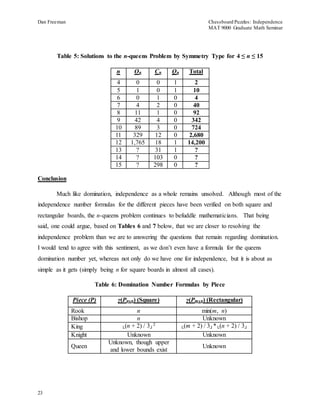
Table 5: Solutions to the n-queens Problem by Symmetry Type for 4 ≤ n ≤ 15 .......................... 23 
Table 6: Domination Number Formulas by Piece ........................................................................ 23 
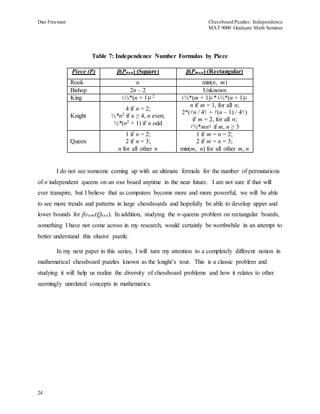
Table 7: Independence Number Formulas by Piece ..................................................................... 24 
3
Dan Freeman Chessboard Puzzles: Independence 
MAT 9000 Graduate Math Seminar 
Introduction 
4 
This paper analyzes the concept of chessboard independence, a similar but different idea 
from domination, which was examined in my first paper on chessboard puzzles. Like 
domination, independence is a problem that involves placing an optimal amount of chess pieces 
of a particular type on a chessboard. However, unlike domination, which is a minimization 
problem, independence is a maximization problem. Therefore, the way to attack puzzles with 
independence differs somewhat from the approach used in domination. In addition, the level of 
knowledge and understanding regarding formulas and patterns associated with independence will 
naturally deviate from what is known about domination. 
In a structure that closely parallels my first paper in this series, this paper seeks to 
provide a full survey of chessboard independence among rooks, bishops, kings, knights and 
queens. In doing this, I hope to be able to make the link between the two ideas of domination 
and independence by comparing and contrasting what has already been established vs. what 
remains as an open problem. 
Definition of Independence 
An independent set of chess pieces is one such that no piece in the set attacks another 
piece in the set. The independence number for a certain piece and certain size mxn1chessboard is 
the maximum number of independent pieces that can be placed on the board; a set of such 
maximum size is called a maximum independent set [1, p. 163]. Independence numbers are 
denoted by β(Pmxn) where P represents the type of chess piece, as denoted in Table 1. 
Table 1: Independence Number Notation 
Piece Abbreviation 
Knight N 
Bishop B 
Rook R 
Queen Q 
King K 
1 Throughout this paper, m and n refer to arbitrary positive integers denoting the number of rows and columns of a 
chessboard, respectively.
Dan Freeman Chessboard Puzzles: Independence 
MAT 9000 Graduate Math Seminar 
5 
Note that the domination number γ(Pmxn) ≤ β(Pmxn) for all pieces P and for all m and n. 
To see why this is the case, suppose that a maximum independent set of pieces, call it I, fails to 
dominate a chessboard. In other words, there exists at least one square on the board that is not 
covered by any piece in I and hence γ(Pmxn) > β(Pmxn). Then one could simply add as many 
independent pieces as are required on the uncovered squares so as to dominate the entire board. 
But then this dominating set of pieces, call it D, would be an independent set larger than I, 
contradicting the fact that I is a maximum independent set. Therefore, the number of pieces in a 
maximum independent set I must be at least as many as the number of pieces in a minimum 
dominating set D. Put more concisely, γ(Pmxn) ≤ β(Pmxn) [1, p. 164]. 
Rooks Independence 
Recall from my first paper on chessboard domination that rooks are permitted to move 
any number of squares either horizontally or vertically, as long as they do not take the place of a 
friendly piece or pass through any piece (own or opponent’s) currently on the board. In Image 
1, the white rook can move to any of the squares with a white circle and the black rook can move 
to any of the squares with a black circle [4]. 
Image 1: Rook Movement 
As with domination, independence among rooks is the simplest of all chess pieces and 
β(Rnxn) = n. The proof for this formula is quite simple. There are n rows and n columns on an 
nxn board. In order to be independent, no two rooks may lie on the same column or same row. 
Therefore, an independent set of rooks may contain no more than n rooks. Furthermore, n rooks 
placed along the main diagonal is an independent set since no two rooks share the same row or
Dan Freeman Chessboard Puzzles: Independence 
MAT 9000 Graduate Math Seminar 
the same column. As a result, we have that β(Rnxn) ≤ n and β(Rnxn) ≥ n, which implies that 
β(Rnxn) = n. This result is illustrated in Image 2. 
6 
Image 2: Eight Independent 
Rooks on 8x8 Board 
Also in line with rooks domination is the fact that for a general rectangular mxn 
chessboard, β(Rmxn) = min(m, n). The argument that is this case closely parallels that for the 
square chessboard. Without loss of generality, suppose that m < n. Clearly, if there are more 
than m rooks on the board, then there exists a pair of rooks that lie on the same row. Therefore, 
β(Rmxn) ≤ m. Also, if m rooks are placed in a diagonal fashion on the board, then this set of rooks 
is independent and β(Rmxn) ≥ m. Since we have designated m as the lesser of m and n, we have 
that β(Rmxn) = m = min(m, n). A symmetric argument works if we suppose that m > n so the 
proof is complete. 
A formula for the number of permutations of maximum independent sets of rooks on an 
nxn square board is also well-known. The number of such permutation is n!,[1, p. 179] and we 
shall denote this number by βPerm(Rnxn), where the subscripted “Perm” is a shorthand indication 
for the number of permutations. As with the proof for the rooks independence number, the proof 
that βPerm(Rnxn) = n! is straightforward. A rook may be placed on any of the n squares of the first 
column. Another rook may be placed on any of the n – 1 squares in the second column not in the 
same row as the rook in the first column. Yet another rook may be placed on any of the n – 2 
squares in the third column not in the same row as either of the rooks in the first two columns. 
This process continues until the nth and final column is reached when just 1 square will remain 
for the final rook. Therefore, the number of permutations is n*(n – 1)*(n – 2) * … *3*2*1 = n!.
Dan Freeman Chessboard Puzzles: Independence 
MAT 9000 Graduate Math Seminar 
The six different permutations of sets of three independent rooks on a 3x3 board are shown in 
Image 3 [1, p. 179]. 
Bishops Independence 
7 
Image 3: All Six Permutations of Three 
Independent Rooks on 3x3 Boards 
Recall that bishops move diagonally any number of squares as long as they do not take 
the place of a friendly piece or pass through any piece (own or opponent’s) currently on the 
board. In Image 4, the white bishop can move to any of the squares with a white circle and the 
black bishop can move to any of the squares with a black circle [4]. 
Image 4: Bishop Movement 
The formula for the bishops independence number differs from the formula for the 
bishops domination number. While γ(Bnxn) = n, β(Bnxn) = 2n – 2. The proof is fairly 
straightforward. For any nxn chessboard, there are 2n – 1 positive diagonals (as well as 2n – 1
Dan Freeman Chessboard Puzzles: Independence 
MAT 9000 Graduate Math Seminar 
negative diagonals2). Except for opposite corner squares, exactly one bishop may be placed in 
each diagonal so as to have an independent set of bishops. In the case of opposing corner 
squares, only one bishop may be placed on one of the two squares, in order to avoid two bishops 
attacking each other from corner to corner. Therefore, the number of pieces in an independent 
set of bishops must be no more than one fewer than the number of diagonals, or (2n – 1) – 1 = 2n 
– 2. Additionally, one may place n – 1 bishops along the top row and n – 1 bishops along the 
bottom row, as in Image 5, for a total of 2n – 2 bishops that are independent. Therefore, β(Bnxn) 
= 2n – 2 [1, p. 182]. 
8 
Image 5: Maximum Set of 
Independent Bishops on 8x8 Board 
As might be expected, as is the case with the bishops domination number, no formula is 
currently known for the bishops independence number on a general rectangular board [2, p. 13]. 
In 1964, the Yaglom brothers proved that a maximum set of independent bishops must be 
placed on the outermost edges of the board. That is, either half of the 2n – 2 bishops must be 
placed on the top row and half on the bottom row, or the bishops need to be placed half and half 
on the left and right edges. To begin, assume that 2n – 2 independent bishops have been placed 
on the board. Label each square with the number of bishops that cover it. A square cannot be 
controlled by more than two bishops as this would result in at least one pair of bishops that attack 
each other. Also, a square cannot be controlled by zero bishops, since then the set of 
2 Hereafter within the Bishops Independence section of this paper, the sign (positive or negative) associated with 
diagonals will be omitted, as this is not an important distinction.
Dan Freeman Chessboard Puzzles: Independence 
MAT 9000 Graduate Math Seminar 
independent bishops would not be maximum. Therefore, each square gets assigned a label of 1 
or 2 [1, p. 183]. 
9 
Now we will show that at least 2n squares on the board are labeled with a 1. The four 
corner squares can only be controlled by a single bishop, whether the squares are occupied or 
not. At least two of the corner squares must be unoccupied in order to have an independent set 
of bishops. In addition, the 2n – 2 squares containing bishops clearly have a label of 1. 
Together, the 2 unoccupied corner squares and the 2n – 2 squares containing bishops each having 
a label of 1 result in there being at least (2n – 2) + 2 = 2n squares with a label of 1 [1, pp. 183- 
184]. 
Next, let S be the sum of the labels for the entire chessboard. Since there are at least 2n 
squares with a label of 1, the remaining n2 – 2n squares have a label of 1 or 2. This results in the 
following inequality: S ≤ 1*(2n) + 2*(n2 – 2n) = 2n2 – 2n = n*(2n – 2). Now we seek to obtain a 
lower bound for S. A bishop on the outer ring of edge squares (top, bottom, left or right edges) 
covers exactly n squares. A bishop inside of the outermost ring controls at least n + 2 squares 
(this number increases by 2 for each move the bishop makes closer to the center of the board). 
Let a be the number of bishops in the interior of the board and b be the number of bishops on the 
outermost ring. So, by construction, a + b = 2n – 2 and we have the following inequality: S ≥ 
b*n + a*(n+2) = n*(a + b) + 2a = n*(2n – 2) + 2a. All together, we now have S bounded below 
and above, as follows: n*(2n – 2) + 2a ≤ S ≤ n*(2n – 2), which implies that n*(2n – 2) + 2a ≤ 
n*(2n – 2). The only way this latter inequality can possibly hold is if a = 0. In other words, 
there cannot be any bishops on the interior of the board, and so all of them must be on the 
outermost ring [1, p. 184]. 
Now that we have proved that all bishops in a maximum independent set must be placed 
on the outer ring of edge squares, we are well-equipped to go about proving a formula for the 
number of permutations of 2n – 2 independent bishops on an nxn square chessboard. There are 
2n such arrangements. Because a bishop must be on an edge square, we need only consider the 
possible arrangements of bishops on the top row. First consider the squares on the four corners 
of the board. A bishop may be placed on one of two opposite corners. Since there are two pairs 
of opposite corners, there are 2*2 = 4 permutations of independent bishops on the corner squares. 
Next we turn our attention to the non-corner squares. For any non-corner square in the top row,
Dan Freeman Chessboard Puzzles: Independence 
MAT 9000 Graduate Math Seminar 
either that square in the top row and the square straight down from it in the bottom row contain 
bishops while the two squares on the left and right edge diagonally from the top and bottom 
squares are unoccupied or the top and bottom squares are left open and the squares on the left 
and right edges contain bishops. These facts are illustrated in Image 6. So for each of the n – 2 
columns not on the left or right edges of the board, there are two possible arrangements of 
independent bishops. Combined with the fact that are two permutations for each of the columns 
on the left and right edges, we conclude that βPerm(Bnxn) = 22*2n – 2 = 2n [1, pp. 184-185]. 
Kings Independence 
10 
Image 6: Pairs of Independent Bishops on Either the 
Top and Bottom Rows or the Left and Right Columns 
Recall that kings are allowed to move exactly one square in any direction as long as they 
do not take the place of a friendly piece. In Image 7, the king can move to any of the squares 
with a white circle [4]. 
Image 7: King Movement
Dan Freeman Chessboard Puzzles: Independence 
MAT 9000 Graduate Math Seminar 
11 
As with the kings domination number, a formula has been established for the kings 
independence number. The formula, β(Knxn) = └½*(n + 1)┘ 
2, is different from the kings 
domination number formula (recall that that γ(Knxn) = └(n + 2) / 3┘ 
2) but similar in that both 
formulas involve the floor function and a term that gets squared. The proof is relatively 
straightforward [1, p. 185]. 
First, note that any 2x2 square on a chessboard may contain at most one independent 
king. When n is even, the board can be split into (½*n)2 squares and so β(Knxn) = (½*n)2 [1, pp. 
185-186]. The case when n is even is illustrated on an 8x8 board in Image 8. 
Image 8: Maximum Set of 
Independent Kings on 8x8 Board 
Now if n is odd, one can divide the board into (½*(n – 1)2 2x2 squares, ½*(n – 1) 1x2 
rectangles, ½*(n – 1) 2x1 rectangles and one 1x1 square. Each of these areas may contain at 
most one independent king, so β(Knxn) = (½*(n – 1)2 + 2*(½*(n – 1)) + 1 = (½*(n + 1)2. The 
formulas for n even and n odd can be condensed into a single formula using the floor function3, 
as follows: β(Knxn) = └½*(n + 1)┘ 
2. Since n is odd, the king in the 1x1 square fixes the 
arrangement of all the other kings on the board; hence such a maximum arrangement of 
independent kings is unique [1, p. 186]. The case when n is odd is shown on a 9x9 board in 
Image 9. 
3 Throughout this paper, the symbols ‘└’ and ‘┘’ will be used to indicate the greatest integer or floor function.
Dan Freeman Chessboard Puzzles: Independence 
MAT 9000 Graduate Math Seminar 
12 
Image 9: Maximum Set of 
Independent Kings on 9x9 Board 
Furthermore, like we were able to do with the kings domination number formula, we can 
generalize kings independence to rectangular boards by expanding the squared term in the 
formula into two separate factors and replacing the n variable with an m variable in one of them, 
as follows: β(Kmxn) = └½*(m + 1)┘*└½*(n + 1)┘. 
Knights Independence 
Recall that knights move two squares in one direction (either horizontally or vertically) 
and one square in the other direction as long as they don’t take the place of a friendly piece. In 
Image 10, the white and black knights can move to squares with circles of the corresponding 
color [4].
Dan Freeman Chessboard Puzzles: Independence 
MAT 9000 Graduate Math Seminar 
13 
Image 10: Knight Movement 
Unlike with knights domination, a formula is known for the knights independence 
number. The formula is broken into three separate cases, as follows [1, p. 181]: 
4 if n = 2 
β(N 
nxn 
) = ½*n2 if n ≥ 4, n even 
½*(n2 + 1) if n odd 
I will omit the proof of the above formula since it relies on a concept known as the 
knight’s tour that we won’t explore until the third paper in this series. I will be sure to revisit 
this proof at the appropriate point in that paper. 
For the sake of completeness, it should be mentioned that a somewhat more complicated 
formula (which we will not prove in this or any subsequent paper) is known for the knights 
independence number on a general mxn rectangular board. The formula, which makes use of the 
ceiling function4, is as follows [5]: 
n if m = 1 
β(N 
m xn 
) = 2*(┌n / 4┐ + ┌(n – 1) / 4┐) if m = 2 
┌½*mn┐ if m, n ≥ 3 
4 Throughout this paper, the symbols ‘┌’ and ‘┐’ will be used to indicate the least integer or ceiling function.
Dan Freeman Chessboard Puzzles: Independence 
MAT 9000 Graduate Math Seminar 
The 8-queens Problem 
14 
Recall that queens move horizontally, vertically and diagonally any number of squares as 
long as they do not take the place of a friendly piece or pass through any piece (own or 
opponent’s) currently on the board. In Image 11, the queen can move to any of the squares with 
a black circle [4]. 
Image 11: Queen Movement 
A classic chessboard puzzle is the 8-queens problem, in which one attempts to place 8 
independent queens on an 8x8 chessboard. The problem was first presented by a chess player 
named Max Bezzel in a German newspaper in September 1948. Less than two years later, in 
June 1850, Franz Nauck posed the problem in another German newspaper. Nauck correctly 
published all 92 solutions to the 8-queens problem in the same paper on September 21, 1850. 
During that same summer, Carl Friedrich Gauss read Nauck’s account of the problem and began 
studying it on his own [1, pp. 164-165]. 
In all his brilliance, Gauss used permutations of the numbers 1 through 8 to analyze 
solutions to the 8-queens problem. For example, the permutation 1 5 8 6 3 7 2 4 corresponds to a 
solution to the 8-queens problem (shown in Image 12) in which the queen in the first column 
from the left is placed in the first row from the bottom, the queen in the second column from the 
left is placed in the fifth row from the bottom, and so on. Gauss devised a method for 
determining whether an arrangement of 8 queens on an 8x8 board is independent. For each 
queen, if the sum of its row number and column number (again, from bottom to top, from left to 
right) is unique to this sum for all other queens, then it follows that no two queens lie on the 
same negative diagonal. Additionally, for each queen, if the sum of its row number and reverse 
column number (from bottom to top, from right to left) is distinct from that of all other queens,
Dan Freeman Chessboard Puzzles: Independence 
MAT 9000 Graduate Math Seminar 
then it follows that no two queens lie on the same positive diagonal. If these two conditions 
hold, then the 8 queens are independent [1, pp. 165-166]. 
15 
Image 12: The 1 5 8 6 3 7 2 4 
Solution to the 8-queens Problem 
In the aforementioned 1 5 8 6 3 7 2 4 permutation of 8 queens, the sums of the row 
numbers and column numbers and the sums of the row numbers and reverse column numbers for 
each queen are shown in Tables 2 and 3, respectively. 
Table 2: Sum of Row and Column Numbers for the 1 5 8 6 3 7 2 4 Solution 
Row # 1 5 8 6 3 7 2 4 
Column # 1 2 3 4 5 6 7 8 
Sum 2 7 11 10 8 13 9 12 
Table 3: Sum of Row and Column Numbers for the 1 5 8 6 3 7 2 4 Solution 
Row # 1 5 8 6 3 7 2 4 
Reverse 
8 7 6 5 4 3 2 1 
Column # 
Sum 9 12 14 11 7 10 4 5 
In his 1953 book Mathematical Recreations, Maurice Kraitchik provided all 92 solutions 
to the 8-queens problem. There are 11 permutations which account for 8 different arrangements 
when all rotations and reflections are considered and one additional permutation which is
Dan Freeman Chessboard Puzzles: Independence 
MAT 9000 Graduate Math Seminar 
symmetric under rotations of 180° and hence gives rise to 4 different solutions. These 12 
different permutations are shown in Table 4 [1, pp. 166-167]. 
16 
Table 4: Permutations of Solutions to the 8-queens Problem 
Permutation No. of Solutions 
1 5 8 6 3 7 2 4 8 
1 6 8 3 7 4 2 5 8 
2 4 6 8 3 1 7 5 8 
2 5 7 1 3 8 6 4 8 
2 5 7 4 1 8 6 3 8 
2 6 1 7 4 8 3 5 8 
2 6 8 3 1 4 7 5 8 
2 7 3 6 8 5 1 4 8 
2 7 5 8 1 4 6 3 8 
3 5 8 4 1 7 2 6 8 
3 6 2 5 8 1 7 4 8 
3 5 2 8 1 7 4 6 4 
As an additional note on the 8-queens problem, H.E. Dudeney observed that all but one 
of the 12 fundamental solutions consists of three queens lying on a straight line (though 
obviously not along the same row, column or diagonal, for then the set of queens would not be 
independent). For instance, in the 1 5 8 6 3 7 2 4 solution shown in Image 12, the queens on 
squares (2, 5), (4, 6) and (6, 7) lie on a straight line, where the coordinates (x, y) correspond to 
the xth column from the left and the yth row from the bottom5. One solution to the 8-queens 
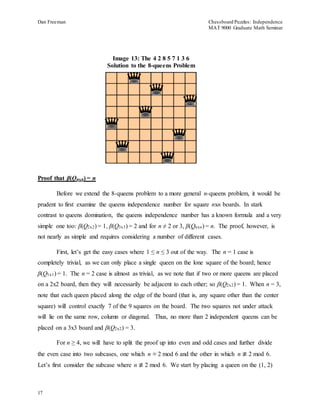
problem that does not exhibit three queens in a straight line is 4 2 8 5 7 1 3 6, shown in Image 13 
[1, pp. 167-168]. 
5Throughout this paper, this (x, y) coordinate notation will be used.
Dan Freeman Chessboard Puzzles: Independence 
MAT 9000 Graduate Math Seminar 
Proof that β(Qnxn) = n 
17 
Image 13: The 4 2 8 5 7 1 3 6 
Solution to the 8-queens Problem 
Before we extend the 8-queens problem to a more general n-queens problem, it would be 
prudent to first examine the queens independence number for square nxn boards. In stark 
contrast to queens domination, the queens independence number has a known formula and a very 
simple one too: β(Q2x2) = 1, β(Q3x3) = 2 and for n ≠ 2 or 3, β(Qnxn) = n. The proof, however, is 
not nearly as simple and requires considering a number of different cases. 
First, let’s get the easy cases where 1 ≤ n ≤ 3 out of the way. The n = 1 case is 
completely trivial, as we can only place a single queen on the lone square of the board; hence 
β(Q1x1) = 1. The n = 2 case is almost as trivial, as we note that if two or more queens are placed 
on a 2x2 board, then they will necessarily be adjacent to each other; so β(Q2x2) = 1. When n = 3, 
note that each queen placed along the edge of the board (that is, any square other than the center 
square) will control exactly 7 of the 9 squares on the board. The two squares not under attack 
will lie on the same row, column or diagonal. Thus, no more than 2 independent queens can be 
placed on a 3x3 board and β(Q2x2) = 3. 
For n ≥ 4, we will have to split the proof up into even and odd cases and further divide 
the even case into two subcases, one which n ≡ 2 mod 6 and the other in which n ≢ 2 mod 6. 
Let’s first consider the subcase where n ≢ 2 mod 6. We start by placing a queen on the (1, 2)
Dan Freeman Chessboard Puzzles: Independence 
MAT 9000 Graduate Math Seminar 
square and make repeated knight’s moves, one square and two squares up, until you hit the top 
row. At this point, we have placed ½*n queens on the board that control all of the columns on 
the left half of the board and all of the even-numbered rows. Now we place a queen in the 
bottom row, one column over from where we left off, and continue the same placement of 
queens until we reach the right edge of the board. These ½*n queens on the right side of the 
board control all of the columns on the right half of the board, as well as all of the odd-numbered 
rows. We have now placed n independent queens on an nxn board where n ≢ 2 mod 6; this is 
shown for n = 10 in Image 14 [1, pp. 170-171]. 
18 
Image 14: Ten Independent Queens 
on 10x10 Board 
Now the only thing we need to worry about in the case where n ≢ 2 mod 6 is whether or 
not any of the queens on the left half of the board lie on the same negative diagonal as any of the 
queens on the right half of the board. Let n = 2k. The rth queen on the left side of the board is 
on square (r, 2r) and the sum of these two coordinates is 3r. The sth queen on the right side of 
the board is at (k + s, 2s – 1). If these two queens occupy the same negative diagonal, then (k + 
s) + (2s – 1) = 3r, that is, 3s + k – 1 = 3r. If we substitute k with ½*n and isolate n, the equation 
becomes n = 6*(r – s) + 2. This implies that if two queens are on the same negative diagonal, 
then n ≡ 2 mod 6. Therefore, our construction above works precisely for even n where n ≢ 2 
mod 6 [1, pp. 171].
Dan Freeman Chessboard Puzzles: Independence 
MAT 9000 Graduate Math Seminar 
19 
Now for n = 8, 14, 20, …, that is n ≡ 2 mod 6, we start by placing a queen at (2, 3) and 
then doing repeated knight’s moves, as we did before, until we reach the second row from the 
top. At this point, the leftmost column and the bottom row are uncovered. In order to account 
for these uncovered squares, we revert to the second-to-last knight we placed (the one on the 
fourth row from the top), and “clone” it into two copies. We move one copy straight over to the 
leftmost column and the other straight down to the bottom row. Letting n = 2k, we now have 
placed k queens that control all of the columns in the left half of the board as well as all of the 
odd-numbered rows. In order to take care of the right half of the board, rotate the board 180° 
and repeat the same knight’s move construction. This construction on an 8x8 board is illustrated 
in Image 15, in which the squares on which the “cloned” queens originated are shaded in gray 
with arrows pointing to the final destinations of the cloned queens [1, pp. 172-173]. 
Image 15: Eight Independent 
Queens on 8x8 Board Using 
Cloning Construction 
In order to verify that this construction works for all n ≡ 2 mod 6, imagine that the 
cloning steps described above were skipped. That is, the cloned queens in the left column and 
the bottom row were removed from the board and the queen from where they came was placed 
back on the board. Likewise, the cloned queens in the right column and the top row disappear 
and the queen from where they originated reappears. In order to confirm that these remaining n 
– 2 queens are independent, we need only check that no queen from the left half of the board 
occupies the same negative diagonal as a queen from the right half of the board. The rth queen 
on the left side of the board occupies square (r + 1, 2r + 1) while the sth queen on the right side
Dan Freeman Chessboard Puzzles: Independence 
MAT 9000 Graduate Math Seminar 
of the board occupies square (k + s, 2s). If two queens lie on the same negative diagonal, then (r 
+ 1) + (2r + 1) = (k + s) + (2s), that is, 3r + 2 = 3s + k. Since n = 2k, this equation resolves to n = 
6*(r – s) + 4, which implies that n ≡ 4 mod 6, contradicting the fact that n ≡ 2 mod 6. Therefore, 
these n – 2 queens are independent [1, pp. 172-173]. 
20 
The only piece that remains to show is that the introduction of the cloned queens does not 
compromise the independence of the n queens. It suffices to check that the cloned queens do not 
lie on the same negative diagonal as one of the other queens on the board. The clone on the left 
edge is situated at (1, n – 3) and the rth queen on the left side of the board is located at (r + 1, 2r 
+ 1). So if these two queens lie on the same negative diagonal, then (1) + (n – 3) = (r + 1) + (2r 
+ 1), which simplifies to n – 2 = 3r + 2. Therefore, n = 3r + 4 ≡ 1 mod 3, contradicting the fact n 
≡ 2 mod 6. If the cloned queen at (1, n – 3) lies on the same diagonal as an sth queen on the right 
side of the board, then n – 2 = (k + s) + (2s) = 3s + k. Since n = 2k, we have that n – 2 = 3s + 
½*n, which implies that n = 6s + 4 ≡ 4 mod 6, another contradiction. Now the cloned queen on 
the bottom row is at square (k – 1, 1), and if this queen lies on the same negative diagonal as the 
rth queen on the left half of the board, then (k – 1) + (1) = (r + 1) + (2r + 1). This simplifies to k 
= 3r + 2, or equivalently n = 6r + 4, which, again, contradicts the fact that n ≡ 2 mod 6. Also, if 
this cloned queen lies on the same negative diagonal as the sth queen on the right half of the 
board, then k = 3s + k, which implies that s = 0, which is nonsense, since s is a positive integer. 
This fact makes intuitive sense since the queen is at the bottom of the board on the left side and 
so cannot possibly share a negative diagonal with any queen on the right side of the board. 
Lastly, a symmetric argument works for the cloned queen on the right side of the board and the 
one on the top row [1, pp. 173-174]. 
Now the proof that β(Qnxn) = n for all even n ≥ 4 is complete. This makes the proof for 
odd-sized boards is easy. The construction we used for even boards, whether n ≡ 2 mod 6 or not, 
leaves the main positive diagonal unoccupied. Therefore, for any even n, we simply add a row to 
the top and a column to the right of the board and place a queen in the upper-right hand corner to 
produce a set of n + 1 independent queens on this new (n + 1)x(n + 1) board. Image 16 shows 
this construction for a 9x9 board, with the additional row and column shaded in orange. This 
completes the longwinded proof [1, p. 174].
Dan Freeman Chessboard Puzzles: Independence 
MAT 9000 Graduate Math Seminar 
21 
Image 16: Nine Independent 
Queens on 9x9 Board Using 
Clone Construction 
As a bonus, it has been shown that β(Qmxn) = min(m, n) for any mxn rectangular board 
with the exception of the aforementioned 2x2 and 3x3 cases [3, p. 9]. 
The n-queens Problem 
Now we turn our attention to the n-queens problem, that is, how many different ways can 
one place n independent queens on an nxn board? While we have a value for β(Qnxn) for all 
values of n, the n-queens problem itself remains far from solved. In Mathematical Recreations, 
Maurice Kraitchik provides the number of solutions of arrangements of n independent queens for 
small values of n and classifies these solutions based on their level of symmetry, as follows [1, 
pp. 174-175]: 
 Ordinary solutions (O): solutions with no symmetry and thus yield a total of 8 
solutions under rotation and reflection 
 Centrosymmetric solutions (C): solutions that are unchanged under rotations of 
180° but are changed by other rotations or reflections and thus yield a total of 4 
solutions
Dan Freeman Chessboard Puzzles: Independence 
MAT 9000 Graduate Math Seminar 
22 
 Doubly Centrosymmetric solutions (Q): solutions that are unchanged under any 
rotation but are changed by reflections and yield a total of 2 solutions 
An example of an ordinary solution to the n-queens problem is the 1 5 8 6 3 7 2 4 
solution to the 8-queens problem in Image 12. A centrosymmetric solution is the 5 3 1 7 2 8 6 4 
solution in which we used the cloning construction in Image 15. Finally, the 2 5 3 1 4 solution 
to the 5-queens problem is doubly centrosymmetric and is shown in Image 17 [1, pp. 175]. 
Image 17: Doubly 
Centrosymmetric Solution 
to the 5-queens Problem 
Kraitchik identified the number of solutions to the n-queens problem by symmetry type 
for 4 ≤ n ≤ 15, as shown in Table 5. Per the definitions above, the total number of solutions for 
each value of n is 8On + 4Cn + 2Qn. As can be inferred from the fact that the number of solutions 
to the problem for n = 13, 14 and 15 are unknown, much work still needs to be done to solve this 
puzzle. Also worth pointing out is that the number of solutions decreases dramatically as the 
level of symmetry increases. For example, there are a whopping 1,765 distinct ordinary 
solutions to the 12-queens problem, but only 18 centrosymmetric solutions and just 1 doubly 
centrosymmetric solution [1, pp. 175].
Dan Freeman Chessboard Puzzles: Independence 
MAT 9000 Graduate Math Seminar 
23 
Table 5: Solutions to the n-queens Problem by Symmetry Type for 4 ≤ n ≤ 15 
n On Cn Qn Total 
4 0 0 1 2 
5 1 0 1 10 
6 0 1 0 4 
7 4 2 0 40 
8 11 1 0 92 
9 42 4 0 342 
10 89 3 0 724 
11 329 12 0 2,680 
12 1,765 18 1 14,200 
13 ? 31 1 ? 
14 ? 103 0 ? 
15 ? 298 0 ? 
Conclusion 
Much like domination, independence as a whole remains unsolved. Although most of the 
independence number formulas for the different pieces have been verified on both square and 
rectangular boards, the n-queens problem continues to befuddle mathematicians. That being 
said, one could argue, based on Tables 6 and 7 below, that we are closer to resolving the 
independence problem than we are to answering the questions that remain regarding domination. 
I would tend to agree with this sentiment, as we don’t even have a formula for the queens 
domination number yet, whereas not only do we have one for independence, but it is about as 
simple as it gets (simply being n for square boards in almost all cases). 
Table 6: Domination Number Formulas by Piece 
Piece (P) γ(Pnxn) (Square) γ(Pmxn) (Rectangular) 
Rook n min(m, n) 
Bishop n Unknown 
King └(n + 2) / 3┘ 
2 └(m + 2) / 3┘*└(n + 2) / 3┘ 
Knight Unknown Unknown 
Queen 
Unknown, though upper 
and lower bounds exist 
Unknown
Dan Freeman Chessboard Puzzles: Independence 
MAT 9000 Graduate Math Seminar 
24 
Table 7: Independence Number Formulas by Piece 
Piece (P) β(Pnxn) (Square) β(Pmxn) (Rectangular) 
Rook n min(n, m) 
Bishop 2n – 2 Unknown 
King └½*(n + 1)┘ 
2 └½*(m + 1)┘*└½*(n + 1)┘ 
Knight 
4 if n = 2; 
½*n2 if n ≥ 4, n even; 
½*(n2 + 1) if n odd 
n if m = 1, for all n; 
2*(┌n / 4┐ + ┌(n – 1) / 4┐) 
if m = 2, for all n; 
┌½*mn┐ if m, n ≥ 3 
Queen 
1 if n = 2; 
2 if n = 3; 
n for all other n 
1 if m = n = 2; 
2 if m = n = 3; 
min(m, n) for all other m, n 
I do not see someone coming up with an ultimate formula for the number of permutations 
of n independent queens on an nxn board anytime in the near future. I am not sure if that will 
ever transpire, but I believe that as computers become more and more powerful, we will be able 
to see more trends and patterns in large chessboards and hopefully be able to develop upper and 
lower bounds for βPerm(Qnxn). In addition, studying the n-queens problem on rectangular boards, 
something I have not come across in my research, would certainly be worthwhile in an attempt to 
better understand this elusive puzzle. 
In my next paper in this series, I will turn my attention to a completely different notion in 
mathematical chessboard puzzles known as the knight’s tour. This is a classic problem and 
studying it will help us realize the diversity of chessboard problems and how it relates to other 
seemingly unrelated concepts in mathematics.
Dan Freeman Chessboard Puzzles: Independence 
MAT 9000 Graduate Math Seminar 
Sources Cited 
[1] J.J. Watkins. Across the Board: The Mathematics of Chessboard Problems. Princeton, New 
Jersey: Princeton University Press, 2004. 
[2] J. DeMaio, W.P. Faust. Domination on the mxn Toroidal Chessboard by Rooks and Bishops. 
Department of Mathematics and Statistics, Kennesaw State University. 
[3] S. Wagon. Hex Graphs. Department of Mathematics, Statistics and Computer Science, 
Macalester College. 
[4] “Chess.” Wikipedia, Wikimedia Foundation. http://en.wikipedia.org/wiki/Chess 
[5] A. Tamid. “Math Forum Discussions. ” 
http://mathforum.org/kb/message.jspa?messageID=363988 
25

Chessboard Puzzles Part 2 - Independence

  • 1.
    Chessboard Puzzles: Independence Part 2 of a 4-part Series of Papers on the Mathematics of the Chessboard by Dan Freeman May 1, 2014
  • 2.
    Dan Freeman ChessboardPuzzles: Independence MAT 9000 Graduate Math Seminar Table of Contents Table of Figures .............................................................................................................................. 3 Introduction ..................................................................................................................................... 4 Definition of Independence............................................................................................................. 4 Rooks Independence ....................................................................................................................... 5 Bishops Independence..................................................................................................................... 7 Kings Independence ...................................................................................................................... 10 Knights Independence................................................................................................................... 12 The 8-queens Problem .................................................................................................................. 14 Proof that β(Qnxn) = n .................................................................................................................... 17 The n-queens Problem .................................................................................................................. 21 Conclusion .................................................................................................................................... 23 Sources Cited ................................................................................................................................ 25 2
  • 3.
    Dan Freeman ChessboardPuzzles: Independence MAT 9000 Graduate Math Seminar Table of Figures Image 1: Rook Movement............................................................................................................... 5 Image 2: Eight Independent Rooks on 8x8 Board .......................................................................... 6 Image 3: All Six Permutations of Three Independent Rooks on 3x3 Boards ................................. 7 Image 4: Bishop Movement ............................................................................................................ 7 Image 5: Maximum Set of Independent Bishops on 8x8 Board ..................................................... 8 Image 6: Pairs of Independent Bishops on Either the Top and Bottom Rows or the Left and Right Columns...................................................................................................... 10 Image 7: King Movement ............................................................................................................. 10 Image 8: Maximum Set of Independent Kings on 8x8 Board ...................................................... 11 Image 9: Maximum Set of Independent Kings on 9x9 Board ...................................................... 12 Image 10: Knight Movement ........................................................................................................ 13 Image 11: Queen Movement......................................................................................................... 14 Image 12: The 1 5 8 6 3 7 2 4 Solution to the 8-queens Problem................................................. 15 Image 13: The 4 2 8 5 7 1 3 6 Solution to the 8-queens Problem................................................. 17 Image 14: Ten Independent Queens on 10x10 Board................................................................... 18 Image 15: Eight Independent Queens on 8x8 Board Using Cloning Construction ...................... 19 Image 16: Nine Independent Queens on 9x9 Board Using Clone Construction .......................... 21 Image 17: Doubly Centrosymmetric Solution to the 5-queens Problem ...................................... 22 Table 1: Independence Number Notation ....................................................................................... 4 Table 2: Sum of Row and Column Numbers for the 1 5 8 6 3 7 2 4 Solution.............................. 15 Table 3: Sum of Row and Column Numbers for the 1 5 8 6 3 7 2 4 Solution.............................. 15 Table 4: Permutations of Solutions to the 8-queens Problem ....................................................... 16 Table 5: Solutions to the n-queens Problem by Symmetry Type for 4 ≤ n ≤ 15 .......................... 23 Table 6: Domination Number Formulas by Piece ........................................................................ 23 Table 7: Independence Number Formulas by Piece ..................................................................... 24 3
  • 4.
    Dan Freeman ChessboardPuzzles: Independence MAT 9000 Graduate Math Seminar Introduction 4 This paper analyzes the concept of chessboard independence, a similar but different idea from domination, which was examined in my first paper on chessboard puzzles. Like domination, independence is a problem that involves placing an optimal amount of chess pieces of a particular type on a chessboard. However, unlike domination, which is a minimization problem, independence is a maximization problem. Therefore, the way to attack puzzles with independence differs somewhat from the approach used in domination. In addition, the level of knowledge and understanding regarding formulas and patterns associated with independence will naturally deviate from what is known about domination. In a structure that closely parallels my first paper in this series, this paper seeks to provide a full survey of chessboard independence among rooks, bishops, kings, knights and queens. In doing this, I hope to be able to make the link between the two ideas of domination and independence by comparing and contrasting what has already been established vs. what remains as an open problem. Definition of Independence An independent set of chess pieces is one such that no piece in the set attacks another piece in the set. The independence number for a certain piece and certain size mxn1chessboard is the maximum number of independent pieces that can be placed on the board; a set of such maximum size is called a maximum independent set [1, p. 163]. Independence numbers are denoted by β(Pmxn) where P represents the type of chess piece, as denoted in Table 1. Table 1: Independence Number Notation Piece Abbreviation Knight N Bishop B Rook R Queen Q King K 1 Throughout this paper, m and n refer to arbitrary positive integers denoting the number of rows and columns of a chessboard, respectively.
  • 5.
    Dan Freeman ChessboardPuzzles: Independence MAT 9000 Graduate Math Seminar 5 Note that the domination number γ(Pmxn) ≤ β(Pmxn) for all pieces P and for all m and n. To see why this is the case, suppose that a maximum independent set of pieces, call it I, fails to dominate a chessboard. In other words, there exists at least one square on the board that is not covered by any piece in I and hence γ(Pmxn) > β(Pmxn). Then one could simply add as many independent pieces as are required on the uncovered squares so as to dominate the entire board. But then this dominating set of pieces, call it D, would be an independent set larger than I, contradicting the fact that I is a maximum independent set. Therefore, the number of pieces in a maximum independent set I must be at least as many as the number of pieces in a minimum dominating set D. Put more concisely, γ(Pmxn) ≤ β(Pmxn) [1, p. 164]. Rooks Independence Recall from my first paper on chessboard domination that rooks are permitted to move any number of squares either horizontally or vertically, as long as they do not take the place of a friendly piece or pass through any piece (own or opponent’s) currently on the board. In Image 1, the white rook can move to any of the squares with a white circle and the black rook can move to any of the squares with a black circle [4]. Image 1: Rook Movement As with domination, independence among rooks is the simplest of all chess pieces and β(Rnxn) = n. The proof for this formula is quite simple. There are n rows and n columns on an nxn board. In order to be independent, no two rooks may lie on the same column or same row. Therefore, an independent set of rooks may contain no more than n rooks. Furthermore, n rooks placed along the main diagonal is an independent set since no two rooks share the same row or
  • 6.
    Dan Freeman ChessboardPuzzles: Independence MAT 9000 Graduate Math Seminar the same column. As a result, we have that β(Rnxn) ≤ n and β(Rnxn) ≥ n, which implies that β(Rnxn) = n. This result is illustrated in Image 2. 6 Image 2: Eight Independent Rooks on 8x8 Board Also in line with rooks domination is the fact that for a general rectangular mxn chessboard, β(Rmxn) = min(m, n). The argument that is this case closely parallels that for the square chessboard. Without loss of generality, suppose that m < n. Clearly, if there are more than m rooks on the board, then there exists a pair of rooks that lie on the same row. Therefore, β(Rmxn) ≤ m. Also, if m rooks are placed in a diagonal fashion on the board, then this set of rooks is independent and β(Rmxn) ≥ m. Since we have designated m as the lesser of m and n, we have that β(Rmxn) = m = min(m, n). A symmetric argument works if we suppose that m > n so the proof is complete. A formula for the number of permutations of maximum independent sets of rooks on an nxn square board is also well-known. The number of such permutation is n!,[1, p. 179] and we shall denote this number by βPerm(Rnxn), where the subscripted “Perm” is a shorthand indication for the number of permutations. As with the proof for the rooks independence number, the proof that βPerm(Rnxn) = n! is straightforward. A rook may be placed on any of the n squares of the first column. Another rook may be placed on any of the n – 1 squares in the second column not in the same row as the rook in the first column. Yet another rook may be placed on any of the n – 2 squares in the third column not in the same row as either of the rooks in the first two columns. This process continues until the nth and final column is reached when just 1 square will remain for the final rook. Therefore, the number of permutations is n*(n – 1)*(n – 2) * … *3*2*1 = n!.
  • 7.
    Dan Freeman ChessboardPuzzles: Independence MAT 9000 Graduate Math Seminar The six different permutations of sets of three independent rooks on a 3x3 board are shown in Image 3 [1, p. 179]. Bishops Independence 7 Image 3: All Six Permutations of Three Independent Rooks on 3x3 Boards Recall that bishops move diagonally any number of squares as long as they do not take the place of a friendly piece or pass through any piece (own or opponent’s) currently on the board. In Image 4, the white bishop can move to any of the squares with a white circle and the black bishop can move to any of the squares with a black circle [4]. Image 4: Bishop Movement The formula for the bishops independence number differs from the formula for the bishops domination number. While γ(Bnxn) = n, β(Bnxn) = 2n – 2. The proof is fairly straightforward. For any nxn chessboard, there are 2n – 1 positive diagonals (as well as 2n – 1
  • 8.
    Dan Freeman ChessboardPuzzles: Independence MAT 9000 Graduate Math Seminar negative diagonals2). Except for opposite corner squares, exactly one bishop may be placed in each diagonal so as to have an independent set of bishops. In the case of opposing corner squares, only one bishop may be placed on one of the two squares, in order to avoid two bishops attacking each other from corner to corner. Therefore, the number of pieces in an independent set of bishops must be no more than one fewer than the number of diagonals, or (2n – 1) – 1 = 2n – 2. Additionally, one may place n – 1 bishops along the top row and n – 1 bishops along the bottom row, as in Image 5, for a total of 2n – 2 bishops that are independent. Therefore, β(Bnxn) = 2n – 2 [1, p. 182]. 8 Image 5: Maximum Set of Independent Bishops on 8x8 Board As might be expected, as is the case with the bishops domination number, no formula is currently known for the bishops independence number on a general rectangular board [2, p. 13]. In 1964, the Yaglom brothers proved that a maximum set of independent bishops must be placed on the outermost edges of the board. That is, either half of the 2n – 2 bishops must be placed on the top row and half on the bottom row, or the bishops need to be placed half and half on the left and right edges. To begin, assume that 2n – 2 independent bishops have been placed on the board. Label each square with the number of bishops that cover it. A square cannot be controlled by more than two bishops as this would result in at least one pair of bishops that attack each other. Also, a square cannot be controlled by zero bishops, since then the set of 2 Hereafter within the Bishops Independence section of this paper, the sign (positive or negative) associated with diagonals will be omitted, as this is not an important distinction.
  • 9.
    Dan Freeman ChessboardPuzzles: Independence MAT 9000 Graduate Math Seminar independent bishops would not be maximum. Therefore, each square gets assigned a label of 1 or 2 [1, p. 183]. 9 Now we will show that at least 2n squares on the board are labeled with a 1. The four corner squares can only be controlled by a single bishop, whether the squares are occupied or not. At least two of the corner squares must be unoccupied in order to have an independent set of bishops. In addition, the 2n – 2 squares containing bishops clearly have a label of 1. Together, the 2 unoccupied corner squares and the 2n – 2 squares containing bishops each having a label of 1 result in there being at least (2n – 2) + 2 = 2n squares with a label of 1 [1, pp. 183- 184]. Next, let S be the sum of the labels for the entire chessboard. Since there are at least 2n squares with a label of 1, the remaining n2 – 2n squares have a label of 1 or 2. This results in the following inequality: S ≤ 1*(2n) + 2*(n2 – 2n) = 2n2 – 2n = n*(2n – 2). Now we seek to obtain a lower bound for S. A bishop on the outer ring of edge squares (top, bottom, left or right edges) covers exactly n squares. A bishop inside of the outermost ring controls at least n + 2 squares (this number increases by 2 for each move the bishop makes closer to the center of the board). Let a be the number of bishops in the interior of the board and b be the number of bishops on the outermost ring. So, by construction, a + b = 2n – 2 and we have the following inequality: S ≥ b*n + a*(n+2) = n*(a + b) + 2a = n*(2n – 2) + 2a. All together, we now have S bounded below and above, as follows: n*(2n – 2) + 2a ≤ S ≤ n*(2n – 2), which implies that n*(2n – 2) + 2a ≤ n*(2n – 2). The only way this latter inequality can possibly hold is if a = 0. In other words, there cannot be any bishops on the interior of the board, and so all of them must be on the outermost ring [1, p. 184]. Now that we have proved that all bishops in a maximum independent set must be placed on the outer ring of edge squares, we are well-equipped to go about proving a formula for the number of permutations of 2n – 2 independent bishops on an nxn square chessboard. There are 2n such arrangements. Because a bishop must be on an edge square, we need only consider the possible arrangements of bishops on the top row. First consider the squares on the four corners of the board. A bishop may be placed on one of two opposite corners. Since there are two pairs of opposite corners, there are 2*2 = 4 permutations of independent bishops on the corner squares. Next we turn our attention to the non-corner squares. For any non-corner square in the top row,
  • 10.
    Dan Freeman ChessboardPuzzles: Independence MAT 9000 Graduate Math Seminar either that square in the top row and the square straight down from it in the bottom row contain bishops while the two squares on the left and right edge diagonally from the top and bottom squares are unoccupied or the top and bottom squares are left open and the squares on the left and right edges contain bishops. These facts are illustrated in Image 6. So for each of the n – 2 columns not on the left or right edges of the board, there are two possible arrangements of independent bishops. Combined with the fact that are two permutations for each of the columns on the left and right edges, we conclude that βPerm(Bnxn) = 22*2n – 2 = 2n [1, pp. 184-185]. Kings Independence 10 Image 6: Pairs of Independent Bishops on Either the Top and Bottom Rows or the Left and Right Columns Recall that kings are allowed to move exactly one square in any direction as long as they do not take the place of a friendly piece. In Image 7, the king can move to any of the squares with a white circle [4]. Image 7: King Movement
  • 11.
    Dan Freeman ChessboardPuzzles: Independence MAT 9000 Graduate Math Seminar 11 As with the kings domination number, a formula has been established for the kings independence number. The formula, β(Knxn) = └½*(n + 1)┘ 2, is different from the kings domination number formula (recall that that γ(Knxn) = └(n + 2) / 3┘ 2) but similar in that both formulas involve the floor function and a term that gets squared. The proof is relatively straightforward [1, p. 185]. First, note that any 2x2 square on a chessboard may contain at most one independent king. When n is even, the board can be split into (½*n)2 squares and so β(Knxn) = (½*n)2 [1, pp. 185-186]. The case when n is even is illustrated on an 8x8 board in Image 8. Image 8: Maximum Set of Independent Kings on 8x8 Board Now if n is odd, one can divide the board into (½*(n – 1)2 2x2 squares, ½*(n – 1) 1x2 rectangles, ½*(n – 1) 2x1 rectangles and one 1x1 square. Each of these areas may contain at most one independent king, so β(Knxn) = (½*(n – 1)2 + 2*(½*(n – 1)) + 1 = (½*(n + 1)2. The formulas for n even and n odd can be condensed into a single formula using the floor function3, as follows: β(Knxn) = └½*(n + 1)┘ 2. Since n is odd, the king in the 1x1 square fixes the arrangement of all the other kings on the board; hence such a maximum arrangement of independent kings is unique [1, p. 186]. The case when n is odd is shown on a 9x9 board in Image 9. 3 Throughout this paper, the symbols ‘└’ and ‘┘’ will be used to indicate the greatest integer or floor function.
  • 12.
    Dan Freeman ChessboardPuzzles: Independence MAT 9000 Graduate Math Seminar 12 Image 9: Maximum Set of Independent Kings on 9x9 Board Furthermore, like we were able to do with the kings domination number formula, we can generalize kings independence to rectangular boards by expanding the squared term in the formula into two separate factors and replacing the n variable with an m variable in one of them, as follows: β(Kmxn) = └½*(m + 1)┘*└½*(n + 1)┘. Knights Independence Recall that knights move two squares in one direction (either horizontally or vertically) and one square in the other direction as long as they don’t take the place of a friendly piece. In Image 10, the white and black knights can move to squares with circles of the corresponding color [4].
  • 13.
    Dan Freeman ChessboardPuzzles: Independence MAT 9000 Graduate Math Seminar 13 Image 10: Knight Movement Unlike with knights domination, a formula is known for the knights independence number. The formula is broken into three separate cases, as follows [1, p. 181]: 4 if n = 2 β(N nxn ) = ½*n2 if n ≥ 4, n even ½*(n2 + 1) if n odd I will omit the proof of the above formula since it relies on a concept known as the knight’s tour that we won’t explore until the third paper in this series. I will be sure to revisit this proof at the appropriate point in that paper. For the sake of completeness, it should be mentioned that a somewhat more complicated formula (which we will not prove in this or any subsequent paper) is known for the knights independence number on a general mxn rectangular board. The formula, which makes use of the ceiling function4, is as follows [5]: n if m = 1 β(N m xn ) = 2*(┌n / 4┐ + ┌(n – 1) / 4┐) if m = 2 ┌½*mn┐ if m, n ≥ 3 4 Throughout this paper, the symbols ‘┌’ and ‘┐’ will be used to indicate the least integer or ceiling function.
  • 14.
    Dan Freeman ChessboardPuzzles: Independence MAT 9000 Graduate Math Seminar The 8-queens Problem 14 Recall that queens move horizontally, vertically and diagonally any number of squares as long as they do not take the place of a friendly piece or pass through any piece (own or opponent’s) currently on the board. In Image 11, the queen can move to any of the squares with a black circle [4]. Image 11: Queen Movement A classic chessboard puzzle is the 8-queens problem, in which one attempts to place 8 independent queens on an 8x8 chessboard. The problem was first presented by a chess player named Max Bezzel in a German newspaper in September 1948. Less than two years later, in June 1850, Franz Nauck posed the problem in another German newspaper. Nauck correctly published all 92 solutions to the 8-queens problem in the same paper on September 21, 1850. During that same summer, Carl Friedrich Gauss read Nauck’s account of the problem and began studying it on his own [1, pp. 164-165]. In all his brilliance, Gauss used permutations of the numbers 1 through 8 to analyze solutions to the 8-queens problem. For example, the permutation 1 5 8 6 3 7 2 4 corresponds to a solution to the 8-queens problem (shown in Image 12) in which the queen in the first column from the left is placed in the first row from the bottom, the queen in the second column from the left is placed in the fifth row from the bottom, and so on. Gauss devised a method for determining whether an arrangement of 8 queens on an 8x8 board is independent. For each queen, if the sum of its row number and column number (again, from bottom to top, from left to right) is unique to this sum for all other queens, then it follows that no two queens lie on the same negative diagonal. Additionally, for each queen, if the sum of its row number and reverse column number (from bottom to top, from right to left) is distinct from that of all other queens,
  • 15.
    Dan Freeman ChessboardPuzzles: Independence MAT 9000 Graduate Math Seminar then it follows that no two queens lie on the same positive diagonal. If these two conditions hold, then the 8 queens are independent [1, pp. 165-166]. 15 Image 12: The 1 5 8 6 3 7 2 4 Solution to the 8-queens Problem In the aforementioned 1 5 8 6 3 7 2 4 permutation of 8 queens, the sums of the row numbers and column numbers and the sums of the row numbers and reverse column numbers for each queen are shown in Tables 2 and 3, respectively. Table 2: Sum of Row and Column Numbers for the 1 5 8 6 3 7 2 4 Solution Row # 1 5 8 6 3 7 2 4 Column # 1 2 3 4 5 6 7 8 Sum 2 7 11 10 8 13 9 12 Table 3: Sum of Row and Column Numbers for the 1 5 8 6 3 7 2 4 Solution Row # 1 5 8 6 3 7 2 4 Reverse 8 7 6 5 4 3 2 1 Column # Sum 9 12 14 11 7 10 4 5 In his 1953 book Mathematical Recreations, Maurice Kraitchik provided all 92 solutions to the 8-queens problem. There are 11 permutations which account for 8 different arrangements when all rotations and reflections are considered and one additional permutation which is
  • 16.
    Dan Freeman ChessboardPuzzles: Independence MAT 9000 Graduate Math Seminar symmetric under rotations of 180° and hence gives rise to 4 different solutions. These 12 different permutations are shown in Table 4 [1, pp. 166-167]. 16 Table 4: Permutations of Solutions to the 8-queens Problem Permutation No. of Solutions 1 5 8 6 3 7 2 4 8 1 6 8 3 7 4 2 5 8 2 4 6 8 3 1 7 5 8 2 5 7 1 3 8 6 4 8 2 5 7 4 1 8 6 3 8 2 6 1 7 4 8 3 5 8 2 6 8 3 1 4 7 5 8 2 7 3 6 8 5 1 4 8 2 7 5 8 1 4 6 3 8 3 5 8 4 1 7 2 6 8 3 6 2 5 8 1 7 4 8 3 5 2 8 1 7 4 6 4 As an additional note on the 8-queens problem, H.E. Dudeney observed that all but one of the 12 fundamental solutions consists of three queens lying on a straight line (though obviously not along the same row, column or diagonal, for then the set of queens would not be independent). For instance, in the 1 5 8 6 3 7 2 4 solution shown in Image 12, the queens on squares (2, 5), (4, 6) and (6, 7) lie on a straight line, where the coordinates (x, y) correspond to the xth column from the left and the yth row from the bottom5. One solution to the 8-queens problem that does not exhibit three queens in a straight line is 4 2 8 5 7 1 3 6, shown in Image 13 [1, pp. 167-168]. 5Throughout this paper, this (x, y) coordinate notation will be used.
  • 17.
    Dan Freeman ChessboardPuzzles: Independence MAT 9000 Graduate Math Seminar Proof that β(Qnxn) = n 17 Image 13: The 4 2 8 5 7 1 3 6 Solution to the 8-queens Problem Before we extend the 8-queens problem to a more general n-queens problem, it would be prudent to first examine the queens independence number for square nxn boards. In stark contrast to queens domination, the queens independence number has a known formula and a very simple one too: β(Q2x2) = 1, β(Q3x3) = 2 and for n ≠ 2 or 3, β(Qnxn) = n. The proof, however, is not nearly as simple and requires considering a number of different cases. First, let’s get the easy cases where 1 ≤ n ≤ 3 out of the way. The n = 1 case is completely trivial, as we can only place a single queen on the lone square of the board; hence β(Q1x1) = 1. The n = 2 case is almost as trivial, as we note that if two or more queens are placed on a 2x2 board, then they will necessarily be adjacent to each other; so β(Q2x2) = 1. When n = 3, note that each queen placed along the edge of the board (that is, any square other than the center square) will control exactly 7 of the 9 squares on the board. The two squares not under attack will lie on the same row, column or diagonal. Thus, no more than 2 independent queens can be placed on a 3x3 board and β(Q2x2) = 3. For n ≥ 4, we will have to split the proof up into even and odd cases and further divide the even case into two subcases, one which n ≡ 2 mod 6 and the other in which n ≢ 2 mod 6. Let’s first consider the subcase where n ≢ 2 mod 6. We start by placing a queen on the (1, 2)
  • 18.
    Dan Freeman ChessboardPuzzles: Independence MAT 9000 Graduate Math Seminar square and make repeated knight’s moves, one square and two squares up, until you hit the top row. At this point, we have placed ½*n queens on the board that control all of the columns on the left half of the board and all of the even-numbered rows. Now we place a queen in the bottom row, one column over from where we left off, and continue the same placement of queens until we reach the right edge of the board. These ½*n queens on the right side of the board control all of the columns on the right half of the board, as well as all of the odd-numbered rows. We have now placed n independent queens on an nxn board where n ≢ 2 mod 6; this is shown for n = 10 in Image 14 [1, pp. 170-171]. 18 Image 14: Ten Independent Queens on 10x10 Board Now the only thing we need to worry about in the case where n ≢ 2 mod 6 is whether or not any of the queens on the left half of the board lie on the same negative diagonal as any of the queens on the right half of the board. Let n = 2k. The rth queen on the left side of the board is on square (r, 2r) and the sum of these two coordinates is 3r. The sth queen on the right side of the board is at (k + s, 2s – 1). If these two queens occupy the same negative diagonal, then (k + s) + (2s – 1) = 3r, that is, 3s + k – 1 = 3r. If we substitute k with ½*n and isolate n, the equation becomes n = 6*(r – s) + 2. This implies that if two queens are on the same negative diagonal, then n ≡ 2 mod 6. Therefore, our construction above works precisely for even n where n ≢ 2 mod 6 [1, pp. 171].
  • 19.
    Dan Freeman ChessboardPuzzles: Independence MAT 9000 Graduate Math Seminar 19 Now for n = 8, 14, 20, …, that is n ≡ 2 mod 6, we start by placing a queen at (2, 3) and then doing repeated knight’s moves, as we did before, until we reach the second row from the top. At this point, the leftmost column and the bottom row are uncovered. In order to account for these uncovered squares, we revert to the second-to-last knight we placed (the one on the fourth row from the top), and “clone” it into two copies. We move one copy straight over to the leftmost column and the other straight down to the bottom row. Letting n = 2k, we now have placed k queens that control all of the columns in the left half of the board as well as all of the odd-numbered rows. In order to take care of the right half of the board, rotate the board 180° and repeat the same knight’s move construction. This construction on an 8x8 board is illustrated in Image 15, in which the squares on which the “cloned” queens originated are shaded in gray with arrows pointing to the final destinations of the cloned queens [1, pp. 172-173]. Image 15: Eight Independent Queens on 8x8 Board Using Cloning Construction In order to verify that this construction works for all n ≡ 2 mod 6, imagine that the cloning steps described above were skipped. That is, the cloned queens in the left column and the bottom row were removed from the board and the queen from where they came was placed back on the board. Likewise, the cloned queens in the right column and the top row disappear and the queen from where they originated reappears. In order to confirm that these remaining n – 2 queens are independent, we need only check that no queen from the left half of the board occupies the same negative diagonal as a queen from the right half of the board. The rth queen on the left side of the board occupies square (r + 1, 2r + 1) while the sth queen on the right side
  • 20.
    Dan Freeman ChessboardPuzzles: Independence MAT 9000 Graduate Math Seminar of the board occupies square (k + s, 2s). If two queens lie on the same negative diagonal, then (r + 1) + (2r + 1) = (k + s) + (2s), that is, 3r + 2 = 3s + k. Since n = 2k, this equation resolves to n = 6*(r – s) + 4, which implies that n ≡ 4 mod 6, contradicting the fact that n ≡ 2 mod 6. Therefore, these n – 2 queens are independent [1, pp. 172-173]. 20 The only piece that remains to show is that the introduction of the cloned queens does not compromise the independence of the n queens. It suffices to check that the cloned queens do not lie on the same negative diagonal as one of the other queens on the board. The clone on the left edge is situated at (1, n – 3) and the rth queen on the left side of the board is located at (r + 1, 2r + 1). So if these two queens lie on the same negative diagonal, then (1) + (n – 3) = (r + 1) + (2r + 1), which simplifies to n – 2 = 3r + 2. Therefore, n = 3r + 4 ≡ 1 mod 3, contradicting the fact n ≡ 2 mod 6. If the cloned queen at (1, n – 3) lies on the same diagonal as an sth queen on the right side of the board, then n – 2 = (k + s) + (2s) = 3s + k. Since n = 2k, we have that n – 2 = 3s + ½*n, which implies that n = 6s + 4 ≡ 4 mod 6, another contradiction. Now the cloned queen on the bottom row is at square (k – 1, 1), and if this queen lies on the same negative diagonal as the rth queen on the left half of the board, then (k – 1) + (1) = (r + 1) + (2r + 1). This simplifies to k = 3r + 2, or equivalently n = 6r + 4, which, again, contradicts the fact that n ≡ 2 mod 6. Also, if this cloned queen lies on the same negative diagonal as the sth queen on the right half of the board, then k = 3s + k, which implies that s = 0, which is nonsense, since s is a positive integer. This fact makes intuitive sense since the queen is at the bottom of the board on the left side and so cannot possibly share a negative diagonal with any queen on the right side of the board. Lastly, a symmetric argument works for the cloned queen on the right side of the board and the one on the top row [1, pp. 173-174]. Now the proof that β(Qnxn) = n for all even n ≥ 4 is complete. This makes the proof for odd-sized boards is easy. The construction we used for even boards, whether n ≡ 2 mod 6 or not, leaves the main positive diagonal unoccupied. Therefore, for any even n, we simply add a row to the top and a column to the right of the board and place a queen in the upper-right hand corner to produce a set of n + 1 independent queens on this new (n + 1)x(n + 1) board. Image 16 shows this construction for a 9x9 board, with the additional row and column shaded in orange. This completes the longwinded proof [1, p. 174].
  • 21.
    Dan Freeman ChessboardPuzzles: Independence MAT 9000 Graduate Math Seminar 21 Image 16: Nine Independent Queens on 9x9 Board Using Clone Construction As a bonus, it has been shown that β(Qmxn) = min(m, n) for any mxn rectangular board with the exception of the aforementioned 2x2 and 3x3 cases [3, p. 9]. The n-queens Problem Now we turn our attention to the n-queens problem, that is, how many different ways can one place n independent queens on an nxn board? While we have a value for β(Qnxn) for all values of n, the n-queens problem itself remains far from solved. In Mathematical Recreations, Maurice Kraitchik provides the number of solutions of arrangements of n independent queens for small values of n and classifies these solutions based on their level of symmetry, as follows [1, pp. 174-175]:  Ordinary solutions (O): solutions with no symmetry and thus yield a total of 8 solutions under rotation and reflection  Centrosymmetric solutions (C): solutions that are unchanged under rotations of 180° but are changed by other rotations or reflections and thus yield a total of 4 solutions
  • 22.
    Dan Freeman ChessboardPuzzles: Independence MAT 9000 Graduate Math Seminar 22  Doubly Centrosymmetric solutions (Q): solutions that are unchanged under any rotation but are changed by reflections and yield a total of 2 solutions An example of an ordinary solution to the n-queens problem is the 1 5 8 6 3 7 2 4 solution to the 8-queens problem in Image 12. A centrosymmetric solution is the 5 3 1 7 2 8 6 4 solution in which we used the cloning construction in Image 15. Finally, the 2 5 3 1 4 solution to the 5-queens problem is doubly centrosymmetric and is shown in Image 17 [1, pp. 175]. Image 17: Doubly Centrosymmetric Solution to the 5-queens Problem Kraitchik identified the number of solutions to the n-queens problem by symmetry type for 4 ≤ n ≤ 15, as shown in Table 5. Per the definitions above, the total number of solutions for each value of n is 8On + 4Cn + 2Qn. As can be inferred from the fact that the number of solutions to the problem for n = 13, 14 and 15 are unknown, much work still needs to be done to solve this puzzle. Also worth pointing out is that the number of solutions decreases dramatically as the level of symmetry increases. For example, there are a whopping 1,765 distinct ordinary solutions to the 12-queens problem, but only 18 centrosymmetric solutions and just 1 doubly centrosymmetric solution [1, pp. 175].
  • 23.
    Dan Freeman ChessboardPuzzles: Independence MAT 9000 Graduate Math Seminar 23 Table 5: Solutions to the n-queens Problem by Symmetry Type for 4 ≤ n ≤ 15 n On Cn Qn Total 4 0 0 1 2 5 1 0 1 10 6 0 1 0 4 7 4 2 0 40 8 11 1 0 92 9 42 4 0 342 10 89 3 0 724 11 329 12 0 2,680 12 1,765 18 1 14,200 13 ? 31 1 ? 14 ? 103 0 ? 15 ? 298 0 ? Conclusion Much like domination, independence as a whole remains unsolved. Although most of the independence number formulas for the different pieces have been verified on both square and rectangular boards, the n-queens problem continues to befuddle mathematicians. That being said, one could argue, based on Tables 6 and 7 below, that we are closer to resolving the independence problem than we are to answering the questions that remain regarding domination. I would tend to agree with this sentiment, as we don’t even have a formula for the queens domination number yet, whereas not only do we have one for independence, but it is about as simple as it gets (simply being n for square boards in almost all cases). Table 6: Domination Number Formulas by Piece Piece (P) γ(Pnxn) (Square) γ(Pmxn) (Rectangular) Rook n min(m, n) Bishop n Unknown King └(n + 2) / 3┘ 2 └(m + 2) / 3┘*└(n + 2) / 3┘ Knight Unknown Unknown Queen Unknown, though upper and lower bounds exist Unknown
  • 24.
    Dan Freeman ChessboardPuzzles: Independence MAT 9000 Graduate Math Seminar 24 Table 7: Independence Number Formulas by Piece Piece (P) β(Pnxn) (Square) β(Pmxn) (Rectangular) Rook n min(n, m) Bishop 2n – 2 Unknown King └½*(n + 1)┘ 2 └½*(m + 1)┘*└½*(n + 1)┘ Knight 4 if n = 2; ½*n2 if n ≥ 4, n even; ½*(n2 + 1) if n odd n if m = 1, for all n; 2*(┌n / 4┐ + ┌(n – 1) / 4┐) if m = 2, for all n; ┌½*mn┐ if m, n ≥ 3 Queen 1 if n = 2; 2 if n = 3; n for all other n 1 if m = n = 2; 2 if m = n = 3; min(m, n) for all other m, n I do not see someone coming up with an ultimate formula for the number of permutations of n independent queens on an nxn board anytime in the near future. I am not sure if that will ever transpire, but I believe that as computers become more and more powerful, we will be able to see more trends and patterns in large chessboards and hopefully be able to develop upper and lower bounds for βPerm(Qnxn). In addition, studying the n-queens problem on rectangular boards, something I have not come across in my research, would certainly be worthwhile in an attempt to better understand this elusive puzzle. In my next paper in this series, I will turn my attention to a completely different notion in mathematical chessboard puzzles known as the knight’s tour. This is a classic problem and studying it will help us realize the diversity of chessboard problems and how it relates to other seemingly unrelated concepts in mathematics.
  • 25.
    Dan Freeman ChessboardPuzzles: Independence MAT 9000 Graduate Math Seminar Sources Cited [1] J.J. Watkins. Across the Board: The Mathematics of Chessboard Problems. Princeton, New Jersey: Princeton University Press, 2004. [2] J. DeMaio, W.P. Faust. Domination on the mxn Toroidal Chessboard by Rooks and Bishops. Department of Mathematics and Statistics, Kennesaw State University. [3] S. Wagon. Hex Graphs. Department of Mathematics, Statistics and Computer Science, Macalester College. [4] “Chess.” Wikipedia, Wikimedia Foundation. http://en.wikipedia.org/wiki/Chess [5] A. Tamid. “Math Forum Discussions. ” http://mathforum.org/kb/message.jspa?messageID=363988 25