Chessboard Puzzles 
Part 4: Other Surfaces 
and Variations 
Dan Freeman 
April 27, 2014 
Villanova University 
MAT 9000 Graduate Math Seminar
Any Questions from Last Time? 
2
Introduction 
• In the first three presentations, we looked at 
the concepts chessboard domination, 
chessboard independence and the knight’s tour 
• Tonight we will conclude this series of 
presentations with a look at these three 
concepts on non-regular surfaces 
• We will also touch on a few other concepts 
associated with chessboard mathematics 
3
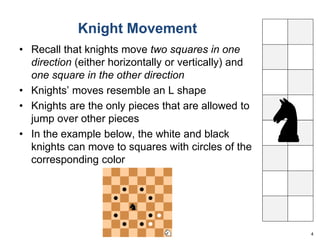
Knight Movement 
• Recall that knights move two squares in one 
direction (either horizontally or vertically) and 
one square in the other direction 
• Knights’ moves resemble an L shape 
• Knights are the only pieces that are allowed to 
jump over other pieces 
• In the example below, the white and black 
knights can move to squares with circles of the 
corresponding color 
4
Knight’s Tour Revisited 
• A knight’s tour is a succession of moves made 
by a knight that traverse every square on a 
chessboard once and only once 
• There are two kinds of knight’s tours, a closed 
knight’s tour and an open knight’s tour: 
– A closed knight’s tour is one in which the knight’s last 
move in the tour places it a single move away from 
where it started 
– An open knight’s tour is one in which the knight’s last 
move in the tour places it on a square that is not a 
single move away from where it started 
5
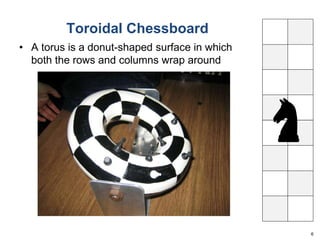
Toroidal Chessboard 
6 
• A torus is a donut-shaped surface in which 
both the rows and columns wrap around
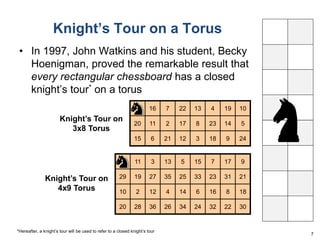
Knight’s Tour on a Torus 
• In 1997, John Watkins and his student, Becky 
Hoenigman, proved the remarkable result that 
every rectangular chessboard has a closed 
knight’s tour* on a torus 
7 
1 
16 7 22 13 4 19 10 
20 11 2 17 8 23 14 5 
15 6 21 12 3 18 9 24 
Knight’s Tour on 
3x8 Torus 
Knight’s Tour on 
4x9 Torus 
11 3 13 5 15 7 17 9 
1 
29 19 27 35 25 33 23 31 21 
10 2 12 4 14 6 16 8 18 
20 28 36 26 34 24 32 22 30 
*Hereafter, a knight’s tour will be used to refer to a closed knight’s tour
Knight’s Tour on a Cylinder 
• Unlike a torus, a cylinder only wraps in one 
dimension, not both 
• In 2000, John Watkins proved that a knight’s 
tour exists on an mxn cylindrical chessboard 
unless one of the following two conditions 
holds: 
1) m = 1 and n > 1; or 
2) m = 2 or 4 and n is even 
• Here is why the above cases are excluded: 
– If m = 1, a knight can’t move at all 
– If m = 2 and n is even, then each move would take 
the knight left or right by two columns and so then 
only at most half of the columns would be visited 
– If m = 4 and n is even, then the coloring argument by 
Louis Pósa from the last presentation holds 
8
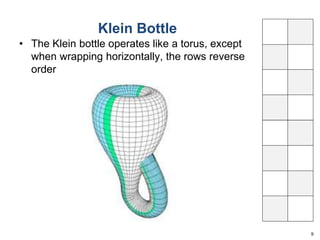
Klein Bottle 
9 
• The Klein bottle operates like a torus, except 
when wrapping horizontally, the rows reverse 
order
Knight’s Tour on Klein Bottle 
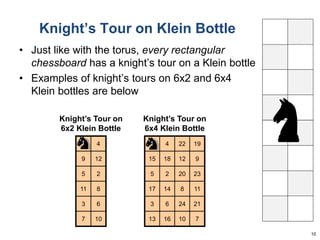
• Just like with the torus, every rectangular 
chessboard has a knight’s tour on a Klein bottle 
• Examples of knight’s tours on 6x2 and 6x4 
Klein bottles are below 
10 
1 4 
9 12 
5 2 
11 8 
3 6 
7 10 
4 22 19 
15 18 12 9 
5 2 20 23 
17 14 8 11 
3 6 24 21 
13 16 10 7 
Knight’s Tour on 
6x2 Klein Bottle 
Knight’s Tour on 
6x4 Klein Bottle 
1 1
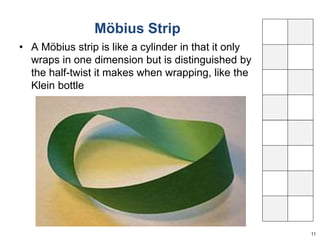
Möbius Strip 
11 
• A Möbius strip is like a cylinder in that it only 
wraps in one dimension but is distinguished by 
the half-twist it makes when wrapping, like the 
Klein bottle
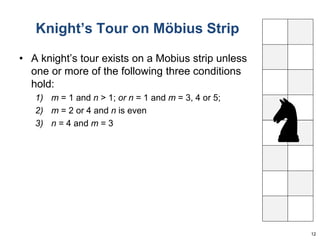
Knight’s Tour on Möbius Strip 
12 
• A knight’s tour exists on a Mobius strip unless 
one or more of the following three conditions 
hold: 
1) m = 1 and n > 1; or n = 1 and m = 3, 4 or 5; 
2) m = 2 or 4 and n is even 
3) n = 4 and m = 3
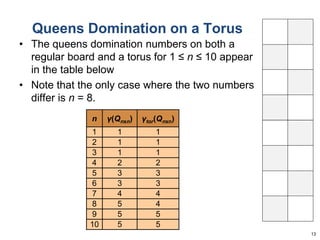
Queens Domination on a Torus 
• The queens domination numbers on both a 
regular board and a torus for 1 ≤ n ≤ 10 appear 
in the table below 
• Note that the only case where the two numbers 
differ is n = 8. 
13 
n γ(Qnxn) γtor(Qnxn) 
1 1 1 
2 1 1 
3 1 1 
4 2 2 
5 3 3 
6 3 3 
7 4 4 
8 5 4 
9 5 5 
10 5 5
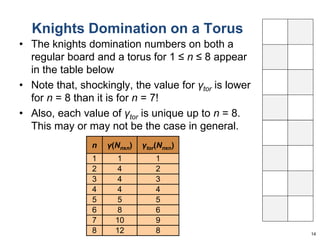
Knights Domination on a Torus 
• The knights domination numbers on both a 
regular board and a torus for 1 ≤ n ≤ 8 appear 
in the table below 
• Note that, shockingly, the value for γtor is lower 
for n = 8 than it is for n = 7! 
• Also, each value of γtor is unique up to n = 8. 
This may or may not be the case in general. 
14 
n γ(Nnxn) γtor(Nnxn) 
1 1 1 
2 4 2 
3 4 3 
4 4 4 
5 5 5 
6 8 6 
7 10 9 
8 12 8
Rooks Domination on a Torus 
• Since it doesn’t make any difference whether a 
rook is on a regular board or on a torus, it 
follows that γ(Rnxn) = γtor(Rnxn) = n 
15
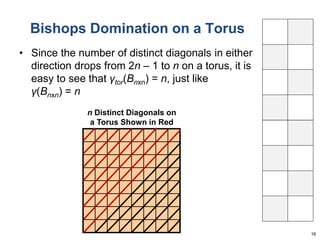
Bishops Domination on a Torus 
• Since the number of distinct diagonals in either 
direction drops from 2n – 1 to n on a torus, it is 
easy to see that γtor(Bnxn) = n, just like 
γ(Bnxn) = n 
16 
n Distinct Diagonals on 
a Torus Shown in Red
Kings Domination on a Torus 
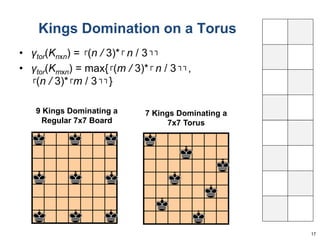
• γtor(Knxn) = ┌(n / 3)*┌ n / 3 ┐┐ 
• γtor(Kmxn) = max{┌(m / 3)*┌ n / 3 ┐┐, 
┌(n / 3)*┌m / 3 ┐┐} 
17 
9 Kings Dominating a 
Regular 7x7 Board 
7 Kings Dominating a 
7x7 Torus
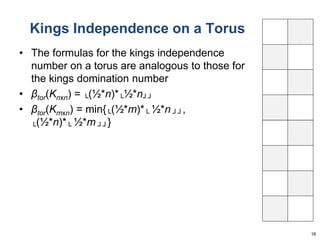
Kings Independence on a Torus 
• The formulas for the kings independence 
number on a torus are analogous to those for 
the kings domination number 
• βtor(Knxn) = └(½*n)*└½*n┘┘ 
• βtor(Kmxn) = min{└(½*m)*└ ½*n ┘┘, 
└(½*n)*└ ½*m┘┘} 
18
n-queens Problem on Cylinder 
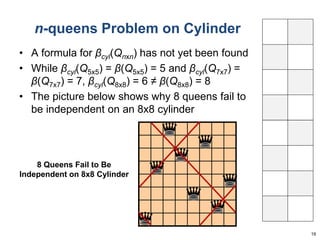
• A formula for βcyl(Qnxn) has not yet been found 
• While βcyl(Q5x5) = β(Q5x5) = 5 and βcyl(Q7x7) = 
β(Q7x7) = 7, βcyl(Q8x8) = 6 ≠ β(Q8x8) = 8 
• The picture below shows why 8 queens fail to 
be independent on an 8x8 cylinder 
19 
8 Queens Fail to Be 
Independent on 8x8 Cylinder
Independent Domination Number 
• The independent domination number for a 
given piece P and a given mxn chessboard is 
the minimum size of an independent 
dominating set, denoted i(Pmxn) 
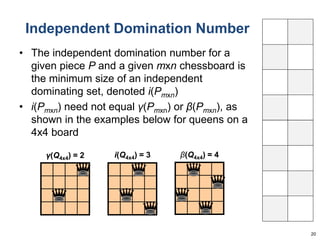
• i(Pmxn) need not equal γ(Pmxn) or β(Pmxn), as 
shown in the examples below for queens on a 
4x4 board 
20 
γ(Q4x4) = 2 i(Q4x4) = 3 β(Q4x4) = 4
Irredundance Number 
• An irredundant set of chess pieces is one in 
which each piece in the set either occupies a 
square that is not covered by another piece or 
else it covers a square that no other piece 
covers 
• A maximal irredundant set is one that is not a 
proper subset of any irredundant set 
• The irredundance number for a given piece P 
and a given mxn chessboard is the minimum 
size of a maximal irredundant set 
21
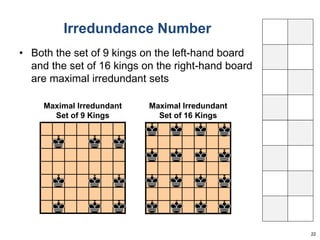
Irredundance Number 
• Both the set of 9 kings on the left-hand board 
and the set of 16 kings on the right-hand board 
are maximal irredundant sets 
22 
Maximal Irredundant 
Set of 9 Kings 
Maximal Irredundant 
Set of 16 Kings
Total Domination Number 
• W.W. Rouse Ball introduced the concept of 
total domination in 1987 
• The total domination number is the minimum 
number of pieces of a given type P on a given 
mxn chessboard that are required to attack 
every square on the board, including occupied 
ones 
23
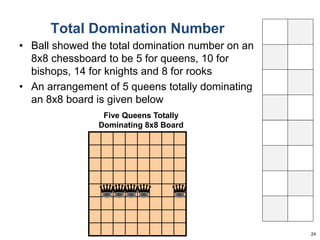
Total Domination Number 
• Ball showed the total domination number on an 
8x8 chessboard to be 5 for queens, 10 for 
bishops, 14 for knights and 8 for rooks 
• An arrangement of 5 queens totally dominating 
an 8x8 board is given below 
24 
Five Queens Totally 
Dominating 8x8 Board
Sources Cited 
• J.J. Watkins. Across the Board: The Mathematics of 
Chessboard Problems. Princeton, New Jersey: 
Princeton University Press, 2004. 
25

Chessboard Puzzles Part 4 - Other Surfaces and Variations

  • 1.
    Chessboard Puzzles Part4: Other Surfaces and Variations Dan Freeman April 27, 2014 Villanova University MAT 9000 Graduate Math Seminar
  • 2.
    Any Questions fromLast Time? 2
  • 3.
    Introduction • Inthe first three presentations, we looked at the concepts chessboard domination, chessboard independence and the knight’s tour • Tonight we will conclude this series of presentations with a look at these three concepts on non-regular surfaces • We will also touch on a few other concepts associated with chessboard mathematics 3
  • 4.
    Knight Movement •Recall that knights move two squares in one direction (either horizontally or vertically) and one square in the other direction • Knights’ moves resemble an L shape • Knights are the only pieces that are allowed to jump over other pieces • In the example below, the white and black knights can move to squares with circles of the corresponding color 4
  • 5.
    Knight’s Tour Revisited • A knight’s tour is a succession of moves made by a knight that traverse every square on a chessboard once and only once • There are two kinds of knight’s tours, a closed knight’s tour and an open knight’s tour: – A closed knight’s tour is one in which the knight’s last move in the tour places it a single move away from where it started – An open knight’s tour is one in which the knight’s last move in the tour places it on a square that is not a single move away from where it started 5
  • 6.
    Toroidal Chessboard 6 • A torus is a donut-shaped surface in which both the rows and columns wrap around
  • 7.
    Knight’s Tour ona Torus • In 1997, John Watkins and his student, Becky Hoenigman, proved the remarkable result that every rectangular chessboard has a closed knight’s tour* on a torus 7 1 16 7 22 13 4 19 10 20 11 2 17 8 23 14 5 15 6 21 12 3 18 9 24 Knight’s Tour on 3x8 Torus Knight’s Tour on 4x9 Torus 11 3 13 5 15 7 17 9 1 29 19 27 35 25 33 23 31 21 10 2 12 4 14 6 16 8 18 20 28 36 26 34 24 32 22 30 *Hereafter, a knight’s tour will be used to refer to a closed knight’s tour
  • 8.
    Knight’s Tour ona Cylinder • Unlike a torus, a cylinder only wraps in one dimension, not both • In 2000, John Watkins proved that a knight’s tour exists on an mxn cylindrical chessboard unless one of the following two conditions holds: 1) m = 1 and n > 1; or 2) m = 2 or 4 and n is even • Here is why the above cases are excluded: – If m = 1, a knight can’t move at all – If m = 2 and n is even, then each move would take the knight left or right by two columns and so then only at most half of the columns would be visited – If m = 4 and n is even, then the coloring argument by Louis Pósa from the last presentation holds 8
  • 9.
    Klein Bottle 9 • The Klein bottle operates like a torus, except when wrapping horizontally, the rows reverse order
  • 10.
    Knight’s Tour onKlein Bottle • Just like with the torus, every rectangular chessboard has a knight’s tour on a Klein bottle • Examples of knight’s tours on 6x2 and 6x4 Klein bottles are below 10 1 4 9 12 5 2 11 8 3 6 7 10 4 22 19 15 18 12 9 5 2 20 23 17 14 8 11 3 6 24 21 13 16 10 7 Knight’s Tour on 6x2 Klein Bottle Knight’s Tour on 6x4 Klein Bottle 1 1
  • 11.
    Möbius Strip 11 • A Möbius strip is like a cylinder in that it only wraps in one dimension but is distinguished by the half-twist it makes when wrapping, like the Klein bottle
  • 12.
    Knight’s Tour onMöbius Strip 12 • A knight’s tour exists on a Mobius strip unless one or more of the following three conditions hold: 1) m = 1 and n > 1; or n = 1 and m = 3, 4 or 5; 2) m = 2 or 4 and n is even 3) n = 4 and m = 3
  • 13.
    Queens Domination ona Torus • The queens domination numbers on both a regular board and a torus for 1 ≤ n ≤ 10 appear in the table below • Note that the only case where the two numbers differ is n = 8. 13 n γ(Qnxn) γtor(Qnxn) 1 1 1 2 1 1 3 1 1 4 2 2 5 3 3 6 3 3 7 4 4 8 5 4 9 5 5 10 5 5
  • 14.
    Knights Domination ona Torus • The knights domination numbers on both a regular board and a torus for 1 ≤ n ≤ 8 appear in the table below • Note that, shockingly, the value for γtor is lower for n = 8 than it is for n = 7! • Also, each value of γtor is unique up to n = 8. This may or may not be the case in general. 14 n γ(Nnxn) γtor(Nnxn) 1 1 1 2 4 2 3 4 3 4 4 4 5 5 5 6 8 6 7 10 9 8 12 8
  • 15.
    Rooks Domination ona Torus • Since it doesn’t make any difference whether a rook is on a regular board or on a torus, it follows that γ(Rnxn) = γtor(Rnxn) = n 15
  • 16.
    Bishops Domination ona Torus • Since the number of distinct diagonals in either direction drops from 2n – 1 to n on a torus, it is easy to see that γtor(Bnxn) = n, just like γ(Bnxn) = n 16 n Distinct Diagonals on a Torus Shown in Red
  • 17.
    Kings Domination ona Torus • γtor(Knxn) = ┌(n / 3)*┌ n / 3 ┐┐ • γtor(Kmxn) = max{┌(m / 3)*┌ n / 3 ┐┐, ┌(n / 3)*┌m / 3 ┐┐} 17 9 Kings Dominating a Regular 7x7 Board 7 Kings Dominating a 7x7 Torus
  • 18.
    Kings Independence ona Torus • The formulas for the kings independence number on a torus are analogous to those for the kings domination number • βtor(Knxn) = └(½*n)*└½*n┘┘ • βtor(Kmxn) = min{└(½*m)*└ ½*n ┘┘, └(½*n)*└ ½*m┘┘} 18
  • 19.
    n-queens Problem onCylinder • A formula for βcyl(Qnxn) has not yet been found • While βcyl(Q5x5) = β(Q5x5) = 5 and βcyl(Q7x7) = β(Q7x7) = 7, βcyl(Q8x8) = 6 ≠ β(Q8x8) = 8 • The picture below shows why 8 queens fail to be independent on an 8x8 cylinder 19 8 Queens Fail to Be Independent on 8x8 Cylinder
  • 20.
    Independent Domination Number • The independent domination number for a given piece P and a given mxn chessboard is the minimum size of an independent dominating set, denoted i(Pmxn) • i(Pmxn) need not equal γ(Pmxn) or β(Pmxn), as shown in the examples below for queens on a 4x4 board 20 γ(Q4x4) = 2 i(Q4x4) = 3 β(Q4x4) = 4
  • 21.
    Irredundance Number •An irredundant set of chess pieces is one in which each piece in the set either occupies a square that is not covered by another piece or else it covers a square that no other piece covers • A maximal irredundant set is one that is not a proper subset of any irredundant set • The irredundance number for a given piece P and a given mxn chessboard is the minimum size of a maximal irredundant set 21
  • 22.
    Irredundance Number •Both the set of 9 kings on the left-hand board and the set of 16 kings on the right-hand board are maximal irredundant sets 22 Maximal Irredundant Set of 9 Kings Maximal Irredundant Set of 16 Kings
  • 23.
    Total Domination Number • W.W. Rouse Ball introduced the concept of total domination in 1987 • The total domination number is the minimum number of pieces of a given type P on a given mxn chessboard that are required to attack every square on the board, including occupied ones 23
  • 24.
    Total Domination Number • Ball showed the total domination number on an 8x8 chessboard to be 5 for queens, 10 for bishops, 14 for knights and 8 for rooks • An arrangement of 5 queens totally dominating an 8x8 board is given below 24 Five Queens Totally Dominating 8x8 Board
  • 25.
    Sources Cited •J.J. Watkins. Across the Board: The Mathematics of Chessboard Problems. Princeton, New Jersey: Princeton University Press, 2004. 25