This is certified that Ma. AJAY KUMAR PRAJAPATI has completed the project titled –
“ To study the presence of Oxalate Ions in Different Guava Samples” with sincerely
and obedience . He is obedient and hard working .
I hereby declare that he is well behaved to the best of my knowledge . This project may
be considered as fulfillment for AISSCE conducted by CBSE Board.
MR. A.K. PANDEY EXTERNAL PRINCIPAL
(HEAD OF CHEMISTRY DEPT.) JNV CHURHAT
I wish to express my deep gratitude and sincere thanks to the Principal
Mrs. Beena Bhattacharya , Jawahar Navodaya Vidyalaya Churhat Distt. Sidhi
(M.P.) for her encouragement and for all the facilities that she provides for this
project work. I sincerely appreciate this magnanimity by taking me into her fold for
which I shall remain indebted to her . I extend my heartily thanks to MR. A.K.
PANDEY , Chemistry Teacher, who guided me to the successful completion of this
project.
I can’t forget to offer my sincere thanks to Laboratory Attendent Mr.R.P.
Kori & also to my classmate who helped me to carry out this project work
suscessfully & for their valuable advice and support , which I received from them
time to time .
I do hereby declare that this project work has been
originally carried under the guidance and supervision of
Mr. A.K.Pandey, Head of Chemistry Department ,
Jawahar Navodaya Vidyalaya Churhat ,Distt. Sidhi (M.P.)
Student’s Name :-
AJAY KUMAR PARAJAPATI
JAWAHAR NAVODAYA VIDYALAYA CHURHAT
DISTT.SIDHI (M.P.)
1. AIM
2. INTRODUCTION
3. THEORY
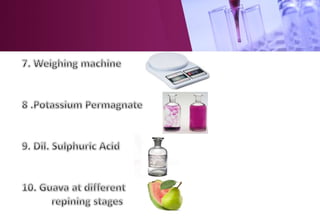
4. APPARATUS
5. PROCEDURE
6. PRECAUTIONS
7. OBSERVATION
8. CALCULATIONS
9. RESULT
10.CONCLUSION
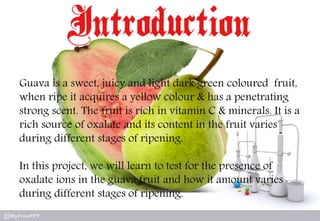
Guava is a sweet, juicy and light dark green coloured fruit,
when ripe it acquires a yellow colour & has a penetrating
strong scent. The fruit is rich in vitamin C & minerals. It is a
rich source of oxalate and its content in the fruit varies
during different stages of ripening.
In this project, we will learn to test for the presence of
oxalate ions in the guava fruit and how it amount varies
during different stages of ripening.
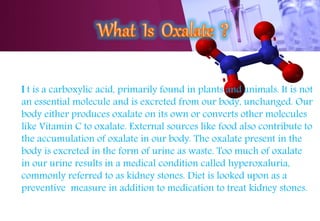
I t is a carboxylic acid, primarily found in plants and animals. It is not
an essential molecule and is excreted from our body, unchanged. Our
body either produces oxalate on its own or converts other molecules
like Vitamin C to oxalate. External sources like food also contribute to
the accumulation of oxalate in our body. The oxalate present in the
body is excreted in the form of urine as waste. Too much of oxalate
in our urine results in a medical condition called hyperoxaluria,
commonly referred to as kidney stones. Diet is looked upon as a
preventive measure in addition to medication to treat kidney stones.
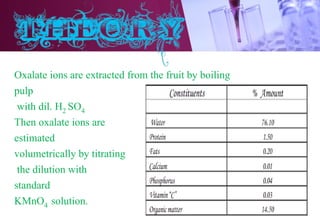
Oxalate ions are extracted from the fruit by boiling
pulp
with dil. H2 SO4
Then oxalate ions are
estimated
volumetrically by titrating
the dilution with
standard
KMnO4 solution.
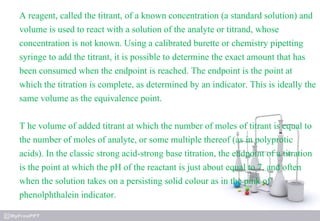
A reagent, called the titrant, of a known concentration (a standard solution) and
volume is used to react with a solution of the analyte or titrand, whose
concentration is not known. Using a calibrated burette or chemistry pipetting
syringe to add the titrant, it is possible to determine the exact amount that has
been consumed when the endpoint is reached. The endpoint is the point at
which the titration is complete, as determined by an indicator. This is ideally the
same volume as the equivalence point.
T he volume of added titrant at which the number of moles of titrant is equal to
the number of moles of analyte, or some multiple thereof (as in polyprotic
acids). In the classic strong acid-strong base titration, the endpoint of a titration
is the point at which the pH of the reactant is just about equal to 7, and often
when the solution takes on a persisting solid colour as in the pink of
phenolphthalein indicator.
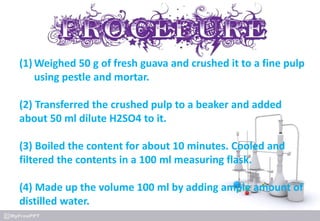
(1) Weighed 50 g of fresh guava and crushed it to a fine pulp
using pestle and mortar.
(2) Transferred the crushed pulp to a beaker and added
about 50 ml dilute H2SO4 to it.
(3) Boiled the content for about 10 minutes. Cooled and
filtered the contents in a 100 ml measuring flask.
(4) Made up the volume 100 ml by adding ample amount of
distilled water.
(5) Took 20 ml of the solution from the flask and added 20
ml of dilute sulphuric acid to it.
(6) Heated the mixture to about 600 C and titrated it
against (n/10) KMnO4 solution taken in a burette till the
end point had an appearance of pink colour.
(7) Repeated the above experiment with 50 g of 1day, 2
day and 3 day old guava fruits.
1. There should be no parallax while taking measurements.
2. Spillage of chemicals should be checked.
3. Avoid the use of burette having a rubber tap as KMnO4attacks rubber.
4. In order to get some idea about the temperature of the solution touch
the flask with the back side of your hand. When it becomes unbearable to
touch, the required temperature is reached.
5. Add about an equal volume of dil. H2SO4 to the guava extract to be
titrated (say a full test tube) before adding KMnO4.
6. Read the upper meniscus while taking burette reading with KMnO4
solution.
7. In case, on addition of KMnO4 a brown ppt. appears, this shows that
either H2SO4 has not been added or has been added in insufficient
amount. In such a case, throw away the solution and titrate again.
1. Weight of the guava fruit for each time was 50 g.
2. Volume of guava extract taken for each titration was 20 ml.
3. Normality of KMnO4 solution was (1/10).
4. END POINT: Colour Changes to pink
Guava
Solution
Burette
reading
Initial
Final
Reading
Volume of
KMnO4
Concurrent
Reading
Raw 150 18 132
136.06
Semi-
ripened
150 13 137
Ripened 150 10.8 139.2
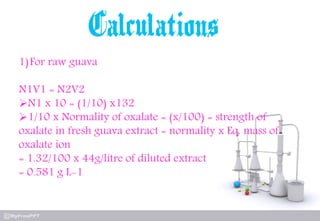
1)For raw guava
N1V1 = N2V2
N1 x 10 = (1/10) x132
1/10 x Normality of oxalate = (x/100) = strength of
oxalate in fresh guava extract = normality x Eq. mass of
oxalate ion
= 1.32/100 x 44g/litre of diluted extract
= 0.581 g L-1
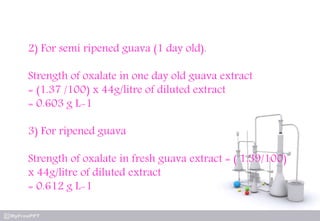
2) For semi ripened guava (1 day old).
Strength of oxalate in one day old guava extract
= (1.37 /100) x 44g/litre of diluted extract
= 0.603 g L-1
3) For ripened guava
Strength of oxalate in fresh guava extract = ( 1.39/100)
x 44g/litre of diluted extract
= 0.612 g L-1
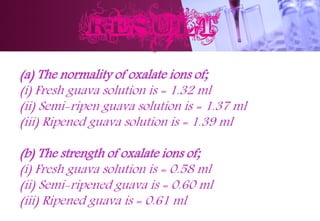
(a) The normality of oxalate ions of;
(i) Fresh guava solution is = 1.32 ml
(ii) Semi-ripen guava solution is = 1.37 ml
(iii) Ripened guava solution is = 1.39 ml
(b) The strength of oxalate ions of;
(i) Fresh guava solution is = 0.58 ml
(ii) Semi-ripened guava is = 0.60 ml
(iii) Ripened guava is = 0.61 ml
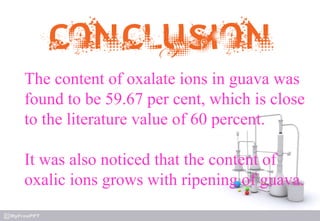
The content of oxalate ions in guava was
found to be 59.67 per cent, which is close
to the literature value of 60 percent.
It was also noticed that the content of
oxalic ions grows with ripening of guava.
Chemistry 190324134212

Chemistry 190324134212

  • 2.
    This is certifiedthat Ma. AJAY KUMAR PRAJAPATI has completed the project titled – “ To study the presence of Oxalate Ions in Different Guava Samples” with sincerely and obedience . He is obedient and hard working . I hereby declare that he is well behaved to the best of my knowledge . This project may be considered as fulfillment for AISSCE conducted by CBSE Board. MR. A.K. PANDEY EXTERNAL PRINCIPAL (HEAD OF CHEMISTRY DEPT.) JNV CHURHAT
  • 3.
    I wish toexpress my deep gratitude and sincere thanks to the Principal Mrs. Beena Bhattacharya , Jawahar Navodaya Vidyalaya Churhat Distt. Sidhi (M.P.) for her encouragement and for all the facilities that she provides for this project work. I sincerely appreciate this magnanimity by taking me into her fold for which I shall remain indebted to her . I extend my heartily thanks to MR. A.K. PANDEY , Chemistry Teacher, who guided me to the successful completion of this project. I can’t forget to offer my sincere thanks to Laboratory Attendent Mr.R.P. Kori & also to my classmate who helped me to carry out this project work suscessfully & for their valuable advice and support , which I received from them time to time .
  • 4.
    I do herebydeclare that this project work has been originally carried under the guidance and supervision of Mr. A.K.Pandey, Head of Chemistry Department , Jawahar Navodaya Vidyalaya Churhat ,Distt. Sidhi (M.P.) Student’s Name :- AJAY KUMAR PARAJAPATI JAWAHAR NAVODAYA VIDYALAYA CHURHAT DISTT.SIDHI (M.P.)
  • 5.
    1. AIM 2. INTRODUCTION 3.THEORY 4. APPARATUS 5. PROCEDURE 6. PRECAUTIONS 7. OBSERVATION 8. CALCULATIONS 9. RESULT 10.CONCLUSION
  • 7.
    Guava is asweet, juicy and light dark green coloured fruit, when ripe it acquires a yellow colour & has a penetrating strong scent. The fruit is rich in vitamin C & minerals. It is a rich source of oxalate and its content in the fruit varies during different stages of ripening. In this project, we will learn to test for the presence of oxalate ions in the guava fruit and how it amount varies during different stages of ripening.
  • 8.
    I t isa carboxylic acid, primarily found in plants and animals. It is not an essential molecule and is excreted from our body, unchanged. Our body either produces oxalate on its own or converts other molecules like Vitamin C to oxalate. External sources like food also contribute to the accumulation of oxalate in our body. The oxalate present in the body is excreted in the form of urine as waste. Too much of oxalate in our urine results in a medical condition called hyperoxaluria, commonly referred to as kidney stones. Diet is looked upon as a preventive measure in addition to medication to treat kidney stones.
  • 9.
    Oxalate ions areextracted from the fruit by boiling pulp with dil. H2 SO4 Then oxalate ions are estimated volumetrically by titrating the dilution with standard KMnO4 solution.
  • 10.
    A reagent, calledthe titrant, of a known concentration (a standard solution) and volume is used to react with a solution of the analyte or titrand, whose concentration is not known. Using a calibrated burette or chemistry pipetting syringe to add the titrant, it is possible to determine the exact amount that has been consumed when the endpoint is reached. The endpoint is the point at which the titration is complete, as determined by an indicator. This is ideally the same volume as the equivalence point. T he volume of added titrant at which the number of moles of titrant is equal to the number of moles of analyte, or some multiple thereof (as in polyprotic acids). In the classic strong acid-strong base titration, the endpoint of a titration is the point at which the pH of the reactant is just about equal to 7, and often when the solution takes on a persisting solid colour as in the pink of phenolphthalein indicator.
  • 13.
    (1) Weighed 50g of fresh guava and crushed it to a fine pulp using pestle and mortar. (2) Transferred the crushed pulp to a beaker and added about 50 ml dilute H2SO4 to it. (3) Boiled the content for about 10 minutes. Cooled and filtered the contents in a 100 ml measuring flask. (4) Made up the volume 100 ml by adding ample amount of distilled water.
  • 14.
    (5) Took 20ml of the solution from the flask and added 20 ml of dilute sulphuric acid to it. (6) Heated the mixture to about 600 C and titrated it against (n/10) KMnO4 solution taken in a burette till the end point had an appearance of pink colour. (7) Repeated the above experiment with 50 g of 1day, 2 day and 3 day old guava fruits.
  • 15.
    1. There shouldbe no parallax while taking measurements. 2. Spillage of chemicals should be checked. 3. Avoid the use of burette having a rubber tap as KMnO4attacks rubber. 4. In order to get some idea about the temperature of the solution touch the flask with the back side of your hand. When it becomes unbearable to touch, the required temperature is reached. 5. Add about an equal volume of dil. H2SO4 to the guava extract to be titrated (say a full test tube) before adding KMnO4. 6. Read the upper meniscus while taking burette reading with KMnO4 solution. 7. In case, on addition of KMnO4 a brown ppt. appears, this shows that either H2SO4 has not been added or has been added in insufficient amount. In such a case, throw away the solution and titrate again.
  • 16.
    1. Weight ofthe guava fruit for each time was 50 g. 2. Volume of guava extract taken for each titration was 20 ml. 3. Normality of KMnO4 solution was (1/10). 4. END POINT: Colour Changes to pink Guava Solution Burette reading Initial Final Reading Volume of KMnO4 Concurrent Reading Raw 150 18 132 136.06 Semi- ripened 150 13 137 Ripened 150 10.8 139.2
  • 17.
    1)For raw guava N1V1= N2V2 N1 x 10 = (1/10) x132 1/10 x Normality of oxalate = (x/100) = strength of oxalate in fresh guava extract = normality x Eq. mass of oxalate ion = 1.32/100 x 44g/litre of diluted extract = 0.581 g L-1
  • 18.
    2) For semiripened guava (1 day old). Strength of oxalate in one day old guava extract = (1.37 /100) x 44g/litre of diluted extract = 0.603 g L-1 3) For ripened guava Strength of oxalate in fresh guava extract = ( 1.39/100) x 44g/litre of diluted extract = 0.612 g L-1
  • 19.
    (a) The normalityof oxalate ions of; (i) Fresh guava solution is = 1.32 ml (ii) Semi-ripen guava solution is = 1.37 ml (iii) Ripened guava solution is = 1.39 ml (b) The strength of oxalate ions of; (i) Fresh guava solution is = 0.58 ml (ii) Semi-ripened guava is = 0.60 ml (iii) Ripened guava is = 0.61 ml
  • 20.
    The content ofoxalate ions in guava was found to be 59.67 per cent, which is close to the literature value of 60 percent. It was also noticed that the content of oxalic ions grows with ripening of guava.