ILYANA ISKANDAR
LIEN HOLDER CAVEAT
1) What is meant by ‘lien’?
a. Halsbury’s Laws of England - “Lien is a right in one man to retain that which is
in his possession belonging to another man until certain demands of the person in
possession are satisfied.”
b. Palaniappa Chetty v Dupire Brothers & Anor - A lien is one and a special
form of security. In fact ‘security’ is the genus of which ‘lien’ is a species. Its
very meaning..derived through the French from the Latin ligo, ‘ligamen’ is that of
binding or securing something.
2) Who may create a lien?
a. See s.281(1) – proprietor/lessee
3) How created?
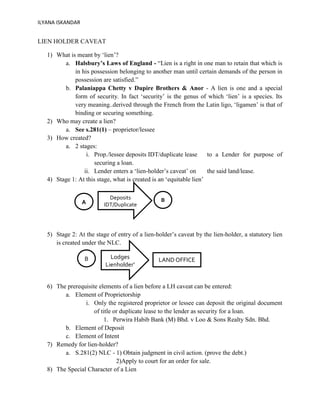
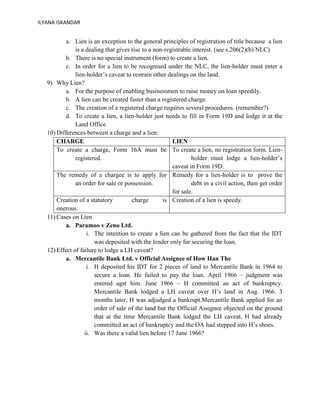
a. 2 stages:
i. Prop./lessee deposits IDT/duplicate lease to a Lender for purpose of
securing a loan.
ii. Lender enters a ‘lien-holder’s caveat’ on the said land/lease.
4) Stage 1: At this stage, what is created is an ‘equitable lien’
5) Stage 2: At the stage of entry of a lien-holder’s caveat by the lien-holder, a statutory lien
is created under the NLC.
6) The prerequisite elements of a lien before a LH caveat can be entered:
a. Element of Proprietorship
i. Only the registered proprietor or lessee can deposit the original document
of title or duplicate lease to the lender as security for a loan.
1. Perwira Habib Bank (M) Bhd. v Loo & Sons Realty Sdn. Bhd.
b. Element of Deposit
c. Element of Intent
7) Remedy for lien-holder?
a. S.281(2) NLC - 1) Obtain judgment in civil action. (prove the debt.)
2)Apply to court for an order for sale.
8) The Special Character of a Lien
A
Deposits
IDT/Duplicate
Lease
B
B Lodges
Lienholder’
s Caveat
LAND OFFICE
ILYANA ISKANDAR
a. Lien is an exception to the general principles of registration of title because a lien
is a dealing that gives rise to a non-registrable interest. (see s.206(2)(b) NLC)
b. There is no special instrument (form) to create a lien.
c. In order for a lien to be recognised under the NLC, the lien-holder must enter a
lien-holder’s caveat to restrain other dealings on the land.
9) Why Lien?
a. For the purpose of enabling businessmen to raise money on loan speedily.
b. A lien can be created faster than a registered charge.
c. The creation of a registered charge requires several procedures. (remember?)
d. To create a lien, a lien-holder just needs to fill in Form 19D and lodge it at the
Land Office.
10) Differences between a charge and a lien:
CHARGE LIEN
To create a charge, Form 16A must be
registered.
To create a lien, no registration form. Lien-
holder must lodge a lien-holder’s
caveat in Form 19D.
The remedy of a chargee is to apply for
an order for sale or possession.
Remedy for a lien-holder is to prove the
debt in a civil action, then get order
for sale.
Creation of a statutory charge is
onerous.
Creation of a lien is speedy.
11) Cases on Lien
a. Paramoo v Zeno Ltd.
i. The intention to create a lien can be gathered from the fact that the IDT
was deposited with the lender only for securing the loan.
12) Effect of failure to lodge a LH caveat?
a. Mercantile Bank Ltd. v Official Assignee of How Han The
i. H deposited his IDT for 2 pieces of land to Mercantile Bank in 1964 to
secure a loan. He failed to pay the loan. April 1966 – judgment was
entered agst him. June 1966 – H committed an act of bankruptcy.
Mercantile Bank lodged a LH caveat over H’s land in Aug. 1966. 3
months later, H was adjudged a bankrupt.Mercantile Bank applied for an
order of sale of the land but the Official Assignee objected on the ground
that at the time Mercantile Bank lodged the LH caveat, H had already
committed an act of bankruptcy and the OA had stepped into H’s shoes.
ii. Was there a valid lien before 17 June 1966?
ILYANA ISKANDAR
iii. Thus, it was alleged that Mercantile Bank had no lien over the lands.
iv. Although registration of a LH caveat is essential for a valid statutory lien,
the court can still give effect to equitable rights existing between the
parties. Thus, Mercantile bank has an equitable right to a lien.
13) Intention to Create Lien
a. Perwira Habib Bank M’sia Bhd. v Tin Siang S/B - Issue: Whether a financier
is entitled to a lien once the title is deposited? 2nd Df had stood as guarantor for
loan granted to the 1st Df. And as security, had deposited with the Pf. The
document of title of a piece of land. 1st Df. defaulted in the loan and judgment ws
entered agst the 2nd Def. as guarantor. P applied for an order for sale of the land
under s.281(2) NLC. 2nd Df. opposed on the ground that there was no agreement
betw. the parties that a LH caveat be entered. As the 2nd Df. Had deposited the
title as security for the loan, the Pf. is entitled to a lien under s.281(2) of the NLC.
i. Implication? There is no necessity for express consent of the title
depositor for a lien-holder’s caveat to be entered. HOWEVER: If the
express consent of the title depositor is not needed to lodge a valid lien-
holder’s caveat, how do we guard against ‘fraud’ in creation of the
security?
b. Nallamal v Karuppanan - The 1st Pf. And 2nd Pf. are wife and husband aged
64 and 71 respectively. Ist P was illiterate whilst the 2nd Pf. could only read and
write in Tamil.1st Pf. = registered prop. of the land.Feb. 1977 – 1st Df. went to
the Pf.’s house and asked to borrow the document of title. He said he required it to
secure a contract job. After being persuaded by her husband, the 1st Pf. handed
over the title to the 1st Df. to be returned in 1 or 2 months.2 years later, the 1st Df.
again went to see the 1st Pf. And brought with him a letter for the 1st Pf. to affix
her thumbprint.Unknown to the 1st Pf. this was a letter from herself authorising
Bank Buruh to lodge a LH caveat on her land. Not aware of the effect of the
document, 1st Pf. thumbprinted it.When the 1st Pf. asked for the title to be
returned, the 1st Df. told the Pfs. that he had handed it to Bank Buruh as security
for a loan. The Pfs. sued the Df. and Bank Buruh and alleged fraud in obtaining
the title. 1)The 1st Df. did defraud the Pf.’s to get the title and hence Bank
Buruh cannot enforce the security agst the 1st Pf.2)The title was wrongfully
ILYANA ISKANDAR
taken by the 1st Df. to create a lien and the LH caveat was wrongfully
lodged.
14) Can a lien be created in respect of a loan to a 3rd party?
a. Hong Leong Bank Berhad v Staghorn S/B and Or. Appeal , whether ss. 281(1)
and s.330 of the NLC envisage that a registered prop. of land may deposit his IDT
as security for a loan to a 3rd party?
Whether the judgment to be obtained under s.281(2) NLC is a
judgment to be obtained against the borrower of the loan or against the
registered prop. of the land?
1) S. 281(1) NLC speaks of the registered proprietor depositing
his IDT ‘as security for a loan’ but does not specify the borrower and
neither does it restrict the loan to a loan to the registered prop. The loan
may be a loan to a 3rd party. Where the loan is to a 3rd party, the
judgment in s.281(2) must be agst such 3rd party.
2)The registered proprietor need not deposit the title himself. He
may authorise or instruct the actual depositing to be done by someone
else.

3) lien holder caveat

  • 1.
    ILYANA ISKANDAR LIEN HOLDERCAVEAT 1) What is meant by ‘lien’? a. Halsbury’s Laws of England - “Lien is a right in one man to retain that which is in his possession belonging to another man until certain demands of the person in possession are satisfied.” b. Palaniappa Chetty v Dupire Brothers & Anor - A lien is one and a special form of security. In fact ‘security’ is the genus of which ‘lien’ is a species. Its very meaning..derived through the French from the Latin ligo, ‘ligamen’ is that of binding or securing something. 2) Who may create a lien? a. See s.281(1) – proprietor/lessee 3) How created? a. 2 stages: i. Prop./lessee deposits IDT/duplicate lease to a Lender for purpose of securing a loan. ii. Lender enters a ‘lien-holder’s caveat’ on the said land/lease. 4) Stage 1: At this stage, what is created is an ‘equitable lien’ 5) Stage 2: At the stage of entry of a lien-holder’s caveat by the lien-holder, a statutory lien is created under the NLC. 6) The prerequisite elements of a lien before a LH caveat can be entered: a. Element of Proprietorship i. Only the registered proprietor or lessee can deposit the original document of title or duplicate lease to the lender as security for a loan. 1. Perwira Habib Bank (M) Bhd. v Loo & Sons Realty Sdn. Bhd. b. Element of Deposit c. Element of Intent 7) Remedy for lien-holder? a. S.281(2) NLC - 1) Obtain judgment in civil action. (prove the debt.) 2)Apply to court for an order for sale. 8) The Special Character of a Lien A Deposits IDT/Duplicate Lease B B Lodges Lienholder’ s Caveat LAND OFFICE
  • 2.
    ILYANA ISKANDAR a. Lienis an exception to the general principles of registration of title because a lien is a dealing that gives rise to a non-registrable interest. (see s.206(2)(b) NLC) b. There is no special instrument (form) to create a lien. c. In order for a lien to be recognised under the NLC, the lien-holder must enter a lien-holder’s caveat to restrain other dealings on the land. 9) Why Lien? a. For the purpose of enabling businessmen to raise money on loan speedily. b. A lien can be created faster than a registered charge. c. The creation of a registered charge requires several procedures. (remember?) d. To create a lien, a lien-holder just needs to fill in Form 19D and lodge it at the Land Office. 10) Differences between a charge and a lien: CHARGE LIEN To create a charge, Form 16A must be registered. To create a lien, no registration form. Lien- holder must lodge a lien-holder’s caveat in Form 19D. The remedy of a chargee is to apply for an order for sale or possession. Remedy for a lien-holder is to prove the debt in a civil action, then get order for sale. Creation of a statutory charge is onerous. Creation of a lien is speedy. 11) Cases on Lien a. Paramoo v Zeno Ltd. i. The intention to create a lien can be gathered from the fact that the IDT was deposited with the lender only for securing the loan. 12) Effect of failure to lodge a LH caveat? a. Mercantile Bank Ltd. v Official Assignee of How Han The i. H deposited his IDT for 2 pieces of land to Mercantile Bank in 1964 to secure a loan. He failed to pay the loan. April 1966 – judgment was entered agst him. June 1966 – H committed an act of bankruptcy. Mercantile Bank lodged a LH caveat over H’s land in Aug. 1966. 3 months later, H was adjudged a bankrupt.Mercantile Bank applied for an order of sale of the land but the Official Assignee objected on the ground that at the time Mercantile Bank lodged the LH caveat, H had already committed an act of bankruptcy and the OA had stepped into H’s shoes. ii. Was there a valid lien before 17 June 1966?
  • 3.
    ILYANA ISKANDAR iii. Thus,it was alleged that Mercantile Bank had no lien over the lands. iv. Although registration of a LH caveat is essential for a valid statutory lien, the court can still give effect to equitable rights existing between the parties. Thus, Mercantile bank has an equitable right to a lien. 13) Intention to Create Lien a. Perwira Habib Bank M’sia Bhd. v Tin Siang S/B - Issue: Whether a financier is entitled to a lien once the title is deposited? 2nd Df had stood as guarantor for loan granted to the 1st Df. And as security, had deposited with the Pf. The document of title of a piece of land. 1st Df. defaulted in the loan and judgment ws entered agst the 2nd Def. as guarantor. P applied for an order for sale of the land under s.281(2) NLC. 2nd Df. opposed on the ground that there was no agreement betw. the parties that a LH caveat be entered. As the 2nd Df. Had deposited the title as security for the loan, the Pf. is entitled to a lien under s.281(2) of the NLC. i. Implication? There is no necessity for express consent of the title depositor for a lien-holder’s caveat to be entered. HOWEVER: If the express consent of the title depositor is not needed to lodge a valid lien- holder’s caveat, how do we guard against ‘fraud’ in creation of the security? b. Nallamal v Karuppanan - The 1st Pf. And 2nd Pf. are wife and husband aged 64 and 71 respectively. Ist P was illiterate whilst the 2nd Pf. could only read and write in Tamil.1st Pf. = registered prop. of the land.Feb. 1977 – 1st Df. went to the Pf.’s house and asked to borrow the document of title. He said he required it to secure a contract job. After being persuaded by her husband, the 1st Pf. handed over the title to the 1st Df. to be returned in 1 or 2 months.2 years later, the 1st Df. again went to see the 1st Pf. And brought with him a letter for the 1st Pf. to affix her thumbprint.Unknown to the 1st Pf. this was a letter from herself authorising Bank Buruh to lodge a LH caveat on her land. Not aware of the effect of the document, 1st Pf. thumbprinted it.When the 1st Pf. asked for the title to be returned, the 1st Df. told the Pfs. that he had handed it to Bank Buruh as security for a loan. The Pfs. sued the Df. and Bank Buruh and alleged fraud in obtaining the title. 1)The 1st Df. did defraud the Pf.’s to get the title and hence Bank Buruh cannot enforce the security agst the 1st Pf.2)The title was wrongfully
  • 4.
    ILYANA ISKANDAR taken bythe 1st Df. to create a lien and the LH caveat was wrongfully lodged. 14) Can a lien be created in respect of a loan to a 3rd party? a. Hong Leong Bank Berhad v Staghorn S/B and Or. Appeal , whether ss. 281(1) and s.330 of the NLC envisage that a registered prop. of land may deposit his IDT as security for a loan to a 3rd party? Whether the judgment to be obtained under s.281(2) NLC is a judgment to be obtained against the borrower of the loan or against the registered prop. of the land? 1) S. 281(1) NLC speaks of the registered proprietor depositing his IDT ‘as security for a loan’ but does not specify the borrower and neither does it restrict the loan to a loan to the registered prop. The loan may be a loan to a 3rd party. Where the loan is to a 3rd party, the judgment in s.281(2) must be agst such 3rd party. 2)The registered proprietor need not deposit the title himself. He may authorise or instruct the actual depositing to be done by someone else.