Characteristics of
Learners and their
Learning Styles
PEC 102 – ANDRAGOGY OF LEARNING INCLUDING PRINCIPLES OF TM I
Review
In making a design you should consider the
following:
1. Adult Learning Principles
2. Characteristics of your trainees
Basic characteristics that maybe
potential barriers in training should
be identified and addressed on a
trainee per trainee basis when
planning training sessions.
3. Learning Styles of your trainees
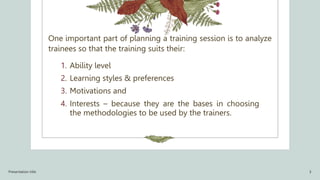
One important part of planning a training session is to analyze
trainees so that the training suits their:
1. Ability level
2. Learning styles & preferences
3. Motivations and
4. Interests – because they are the bases in choosing
the methodologies to be used by the trainers.
Presentation title 3
Competency-Based Training
CBT
One of the most important data that you
must have when planning training
sessions is the characteristics of your
trainees. In CBT, we consider individual
differences in training because CBT is
self-paced. The design of training and
instructional materials should therefore
suit characteristics of each trainee.
This lesson will discuss the
different characteristics that you should
know about your learner so that you will
be able to plan training for each of
them.
Presentation title 4
Characteristics of Learners
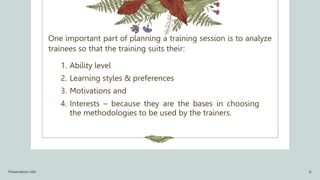
One important part of planning a training session is to analyze
trainees so that the training suits their:
1. Ability level
2. Learning styles & preferences
3. Motivations and
4. Interests – because they are the bases in choosing
the methodologies to be used by the trainers.
Presentation title 6
It is important to note that:
a. One of the key features of competency-based training is that, it is customized and
personalized. This is difficult to achieve if trainers are not aware of, either the
differences among trainees, or how they may be able to work with these trainees to
address their specific needs to allow them to demonstrate competence.
b. While the issues are diverse, the solutions are frequently applicable across different
topics.
c. Not all issues for trainers are issues for trainees.
d. By altering some simple components of training, issues can be resolved; e.g.
language issues – having assessment in the local language rather than in English.
Presentation title 7
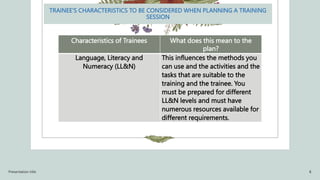
TRAINEE’S CHARACTERISTICS TO BE CONSIDERED WHEN PLANNING A TRAINING
SESSION
Characteristics of Trainees What does this mean to the
plan?
Language, Literacy and
Numeracy (LL&N)
This influences the methods you
can use and the activities and the
tasks that are suitable to the
training and the trainee. You
must be prepared for different
LL&N levels and must have
numerous resources available for
different requirements.
Presentation title 8
TRAINEE’S CHARACTERISTICS TO BE CONSIDERED WHEN PLANNING A TRAINING
SESSION
Characteristics of Trainees What does this mean to the
plan?
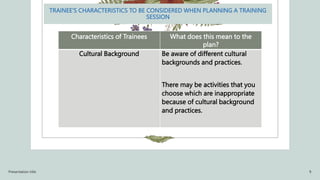
Cultural Background Be aware of different cultural
backgrounds and practices.
There may be activities that you
choose which are inappropriate
because of cultural background
and practices.

Presentation title 9
TRAINEE’S CHARACTERISTICS TO BE CONSIDERED WHEN PLANNING A TRAINING
SESSION
Characteristics of Trainees What does this mean to the
plan?
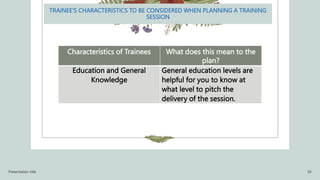
Education and General
Knowledge
General education levels are
helpful for you to know at
what level to pitch the
delivery of the session.
Presentation title 10
TRAINEE’S CHARACTERISTICS TO BE CONSIDERED WHEN PLANNING A TRAINING
SESSION
Characteristics of Trainees What does this mean to the
plan?
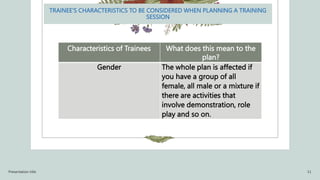
Gender The whole plan is affected if
you have a group of all
female, all male or a mixture if
there are activities that
involve demonstration, role
play and so on.
Presentation title 11
TRAINEE’S CHARACTERISTICS TO BE CONSIDERED WHEN PLANNING A TRAINING
SESSION
Characteristics of Trainees What does this mean to the
plan?
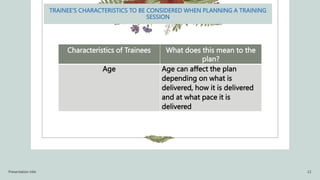
Age Age can affect the plan
depending on what is
delivered, how it is delivered
and at what pace it is
delivered
Presentation title 12
TRAINEE’S CHARACTERISTICS TO BE CONSIDERED WHEN PLANNING A TRAINING
SESSION
Characteristics of Trainees What does this mean to the
plan?
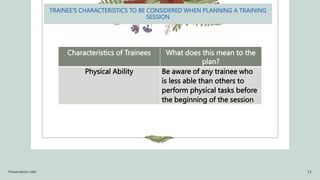
Physical Ability Be aware of any trainee who
is less able than others to
perform physical tasks before
the beginning of the session
Presentation title 13
TRAINEE’S CHARACTERISTICS TO BE CONSIDERED WHEN PLANNING A TRAINING
SESSION
Characteristics of Trainees What does this mean to the
plan?
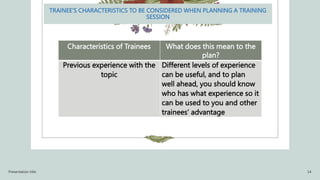
Previous experience with the
topic
Different levels of experience
can be useful, and to plan
well ahead, you should know
who has what experience so it
can be used to you and other
trainees’ advantage
Presentation title 14
TRAINEE’S CHARACTERISTICS TO BE CONSIDERED WHEN PLANNING A TRAINING
SESSION
Characteristics of Trainees What does this mean to the
plan?
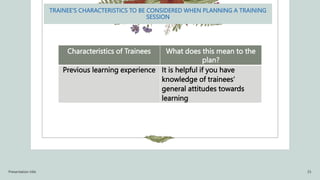
Previous learning experience It is helpful if you have
knowledge of trainees’
general attitudes towards
learning
Presentation title 15
TRAINEE’S CHARACTERISTICS TO BE CONSIDERED WHEN PLANNING A TRAINING
SESSION
Characteristics of Trainees What does this mean to the
plan?
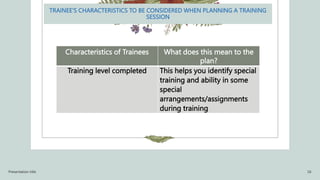
Training level completed This helps you identify special
training and ability in some
special
arrangements/assignments
during training
Presentation title 16
TRAINEE’S CHARACTERISTICS TO BE CONSIDERED WHEN PLANNING A TRAINING
SESSION
Characteristics of Trainees What does this mean to the
plan?
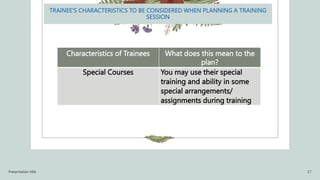
Special Courses You may use their special
training and ability in some
special arrangements/
assignments during training
Presentation title 17
TRAINEE’S CHARACTERISTICS TO BE CONSIDERED WHEN PLANNING A TRAINING
SESSION
Characteristics of Trainees What does this mean to the
plan?
Learning Style A trainee could be auditory,
visual or kinesthetic
Presentation title 18
TRAINEE’S CHARACTERISTICS TO BE CONSIDERED WHEN PLANNING A TRAINING
SESSION
Characteristics of Trainees What does this mean to the
plan?
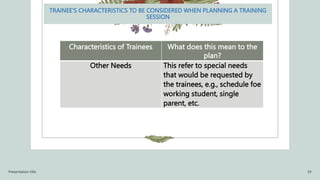
Other Needs This refer to special needs
that would be requested by
the trainees, e.g., schedule foe
working student, single
parent, etc.
Presentation title 19
Learning Styles
What are Learning Styles?
Simply put, learning styles are different methods of
learning or understanding new information.
Learning styles are the way a person takes in,
understands, expresses and remembers information.
Presentation title 21
Again…
In making a design you should consider the
following:
1. Adult Learning Principles
2. Characteristics of your trainees
3. Learning Styles of your trainees
Varied learning styles would require
variations in the methodologies to be
employed with CBT. Your training design
should be able to provide learning
activities for every trainee considering
his learning style.
Determine Your Learning
Styles
LEARNING STYLES
• https://vark-learn.com/the-vark-
questionnaire/
Presentation title 23
Visual Learning
“
”
Visual Learning
• Visual learners learn through seeing
• Visual displays of information are
especially useful
• Tools to utilize:
Diagrams, charts, picture, etc.
• When taking notes, rewrite words with
symbols or initials
• Try different spatial arrangements with
your notes
• Underline and use different colours and
highlighters
Presentation title 25
Visual Learner
• The visual learner often lose focus during
long oral lectures, especially if these are not
accompanied by drawings and illustrations. The
visual learner takes mental pictures of
information given, so in order for this kind of
learner to retain information, oral or written,
presentations of new information must contain
diagrams and drawings, preferably in color. The
visual learner can’t concentrate with a lot of
activity around him and will focus better and
learn faster in a quiet study environment.
Presentation title 26
Auditory learning
“
”
Auditory Learning
• Auditory learners learn through
listening
• Lectures and discussion groups are
important for this types of learner
• Tools to utilize: read text out loud, pay
attention to tone of speaker, discuss
concepts with others for increased
understanding
• Record your summarized notes on tape
and listen to them later
Presentation title 28
Auditory Learning
• Discuss the concepts being taught with
another person
• Use these discussion to expand your
lecture notes (leave extra space so this
is possible)
• Attending lectures and tutorials is very
important – you want to hear how the
professor will explain a concept
Presentation title 29
Auditory Learner
• For the auditory learner, oral
presentations are crucial for
understanding a subject, as this kind of
learner has the ability to remember
speeches and lectures in detail but has a
hard time with written text. Having to read
long texts is pointless and will not be
retained by the auditory learner unless it
is read aloud.
Presentation title 30
Read/write learning
“
”
READ/WRITE LEARNING
• READ/Write learners learn through just
that – reading and writing.
• Tools to utilize: glossaries, re-reading
notes and textbooks, re-writing your
notes out into different words
• Use many lists, and rearrange these
lists into multiple choice questions
Presentation title 32
READ/WRITE LEARNING
• It is very important to understand the
words used in your course: keep a
running glossary of any new or
unfamiliar terms for future reference
• Re-read and Re-write textbook and
lecture notes
Presentation title 33
Kinesthetic learning
“
”
KINESTHETIC LEARNING
• Kinesthetic learner learn through doing
• Use all of you senses – sight, touch,
taste, smell, hearing
• Tools to utilize: incorporate examples
into notes, attend labs or tutorials
• Include many examples in your notes
• Use of practice exams or questions will
be especially helpful
Presentation title 35
KINESTHETIC LEARNING
• Kinesthetic learners are described as
the students in the classroom, who
have problems sitting still and who
often bounce their legs while tapping
their fingers on the desks. They are
often referred to as hyperactive
students with concentration issues.
Presentation title 36
Thank you
Prepared by:
Ma. Venus D. De La Paz
Instructor I

Characteristics-of-Learners-and-their-Learning-Styles (1).pptx

  • 1.
    Characteristics of Learners andtheir Learning Styles PEC 102 – ANDRAGOGY OF LEARNING INCLUDING PRINCIPLES OF TM I
  • 2.
    Review In making adesign you should consider the following: 1. Adult Learning Principles 2. Characteristics of your trainees Basic characteristics that maybe potential barriers in training should be identified and addressed on a trainee per trainee basis when planning training sessions. 3. Learning Styles of your trainees
  • 3.
    One important partof planning a training session is to analyze trainees so that the training suits their: 1. Ability level 2. Learning styles & preferences 3. Motivations and 4. Interests – because they are the bases in choosing the methodologies to be used by the trainers. Presentation title 3
  • 4.
    Competency-Based Training CBT One ofthe most important data that you must have when planning training sessions is the characteristics of your trainees. In CBT, we consider individual differences in training because CBT is self-paced. The design of training and instructional materials should therefore suit characteristics of each trainee. This lesson will discuss the different characteristics that you should know about your learner so that you will be able to plan training for each of them. Presentation title 4
  • 5.
  • 6.
    One important partof planning a training session is to analyze trainees so that the training suits their: 1. Ability level 2. Learning styles & preferences 3. Motivations and 4. Interests – because they are the bases in choosing the methodologies to be used by the trainers. Presentation title 6
  • 7.
    It is importantto note that: a. One of the key features of competency-based training is that, it is customized and personalized. This is difficult to achieve if trainers are not aware of, either the differences among trainees, or how they may be able to work with these trainees to address their specific needs to allow them to demonstrate competence. b. While the issues are diverse, the solutions are frequently applicable across different topics. c. Not all issues for trainers are issues for trainees. d. By altering some simple components of training, issues can be resolved; e.g. language issues – having assessment in the local language rather than in English. Presentation title 7
  • 8.
    TRAINEE’S CHARACTERISTICS TOBE CONSIDERED WHEN PLANNING A TRAINING SESSION Characteristics of Trainees What does this mean to the plan? Language, Literacy and Numeracy (LL&N) This influences the methods you can use and the activities and the tasks that are suitable to the training and the trainee. You must be prepared for different LL&N levels and must have numerous resources available for different requirements. Presentation title 8
  • 9.
    TRAINEE’S CHARACTERISTICS TOBE CONSIDERED WHEN PLANNING A TRAINING SESSION Characteristics of Trainees What does this mean to the plan? Cultural Background Be aware of different cultural backgrounds and practices. There may be activities that you choose which are inappropriate because of cultural background and practices. Presentation title 9
  • 10.
    TRAINEE’S CHARACTERISTICS TOBE CONSIDERED WHEN PLANNING A TRAINING SESSION Characteristics of Trainees What does this mean to the plan? Education and General Knowledge General education levels are helpful for you to know at what level to pitch the delivery of the session. Presentation title 10
  • 11.
    TRAINEE’S CHARACTERISTICS TOBE CONSIDERED WHEN PLANNING A TRAINING SESSION Characteristics of Trainees What does this mean to the plan? Gender The whole plan is affected if you have a group of all female, all male or a mixture if there are activities that involve demonstration, role play and so on. Presentation title 11
  • 12.
    TRAINEE’S CHARACTERISTICS TOBE CONSIDERED WHEN PLANNING A TRAINING SESSION Characteristics of Trainees What does this mean to the plan? Age Age can affect the plan depending on what is delivered, how it is delivered and at what pace it is delivered Presentation title 12
  • 13.
    TRAINEE’S CHARACTERISTICS TOBE CONSIDERED WHEN PLANNING A TRAINING SESSION Characteristics of Trainees What does this mean to the plan? Physical Ability Be aware of any trainee who is less able than others to perform physical tasks before the beginning of the session Presentation title 13
  • 14.
    TRAINEE’S CHARACTERISTICS TOBE CONSIDERED WHEN PLANNING A TRAINING SESSION Characteristics of Trainees What does this mean to the plan? Previous experience with the topic Different levels of experience can be useful, and to plan well ahead, you should know who has what experience so it can be used to you and other trainees’ advantage Presentation title 14
  • 15.
    TRAINEE’S CHARACTERISTICS TOBE CONSIDERED WHEN PLANNING A TRAINING SESSION Characteristics of Trainees What does this mean to the plan? Previous learning experience It is helpful if you have knowledge of trainees’ general attitudes towards learning Presentation title 15
  • 16.
    TRAINEE’S CHARACTERISTICS TOBE CONSIDERED WHEN PLANNING A TRAINING SESSION Characteristics of Trainees What does this mean to the plan? Training level completed This helps you identify special training and ability in some special arrangements/assignments during training Presentation title 16
  • 17.
    TRAINEE’S CHARACTERISTICS TOBE CONSIDERED WHEN PLANNING A TRAINING SESSION Characteristics of Trainees What does this mean to the plan? Special Courses You may use their special training and ability in some special arrangements/ assignments during training Presentation title 17
  • 18.
    TRAINEE’S CHARACTERISTICS TOBE CONSIDERED WHEN PLANNING A TRAINING SESSION Characteristics of Trainees What does this mean to the plan? Learning Style A trainee could be auditory, visual or kinesthetic Presentation title 18
  • 19.
    TRAINEE’S CHARACTERISTICS TOBE CONSIDERED WHEN PLANNING A TRAINING SESSION Characteristics of Trainees What does this mean to the plan? Other Needs This refer to special needs that would be requested by the trainees, e.g., schedule foe working student, single parent, etc. Presentation title 19
  • 20.
  • 21.
    What are LearningStyles? Simply put, learning styles are different methods of learning or understanding new information. Learning styles are the way a person takes in, understands, expresses and remembers information. Presentation title 21
  • 22.
    Again… In making adesign you should consider the following: 1. Adult Learning Principles 2. Characteristics of your trainees 3. Learning Styles of your trainees Varied learning styles would require variations in the methodologies to be employed with CBT. Your training design should be able to provide learning activities for every trainee considering his learning style.
  • 23.
    Determine Your Learning Styles LEARNINGSTYLES • https://vark-learn.com/the-vark- questionnaire/ Presentation title 23
  • 24.
  • 25.
    Visual Learning • Visuallearners learn through seeing • Visual displays of information are especially useful • Tools to utilize: Diagrams, charts, picture, etc. • When taking notes, rewrite words with symbols or initials • Try different spatial arrangements with your notes • Underline and use different colours and highlighters Presentation title 25
  • 26.
    Visual Learner • Thevisual learner often lose focus during long oral lectures, especially if these are not accompanied by drawings and illustrations. The visual learner takes mental pictures of information given, so in order for this kind of learner to retain information, oral or written, presentations of new information must contain diagrams and drawings, preferably in color. The visual learner can’t concentrate with a lot of activity around him and will focus better and learn faster in a quiet study environment. Presentation title 26
  • 27.
  • 28.
    Auditory Learning • Auditorylearners learn through listening • Lectures and discussion groups are important for this types of learner • Tools to utilize: read text out loud, pay attention to tone of speaker, discuss concepts with others for increased understanding • Record your summarized notes on tape and listen to them later Presentation title 28
  • 29.
    Auditory Learning • Discussthe concepts being taught with another person • Use these discussion to expand your lecture notes (leave extra space so this is possible) • Attending lectures and tutorials is very important – you want to hear how the professor will explain a concept Presentation title 29
  • 30.
    Auditory Learner • Forthe auditory learner, oral presentations are crucial for understanding a subject, as this kind of learner has the ability to remember speeches and lectures in detail but has a hard time with written text. Having to read long texts is pointless and will not be retained by the auditory learner unless it is read aloud. Presentation title 30
  • 31.
  • 32.
    READ/WRITE LEARNING • READ/Writelearners learn through just that – reading and writing. • Tools to utilize: glossaries, re-reading notes and textbooks, re-writing your notes out into different words • Use many lists, and rearrange these lists into multiple choice questions Presentation title 32
  • 33.
    READ/WRITE LEARNING • Itis very important to understand the words used in your course: keep a running glossary of any new or unfamiliar terms for future reference • Re-read and Re-write textbook and lecture notes Presentation title 33
  • 34.
  • 35.
    KINESTHETIC LEARNING • Kinestheticlearner learn through doing • Use all of you senses – sight, touch, taste, smell, hearing • Tools to utilize: incorporate examples into notes, attend labs or tutorials • Include many examples in your notes • Use of practice exams or questions will be especially helpful Presentation title 35
  • 36.
    KINESTHETIC LEARNING • Kinestheticlearners are described as the students in the classroom, who have problems sitting still and who often bounce their legs while tapping their fingers on the desks. They are often referred to as hyperactive students with concentration issues. Presentation title 36
  • 37.
    Thank you Prepared by: Ma.Venus D. De La Paz Instructor I