Research Methodology
Wondwossen Bogale (PhD)
Associate Professor, AAiT, AAU
wondwossenboge@gmail.com
Chapter 4 : Data Collection
1. METHODS OF DATA COLLECTION
• Data collection is simply how information is
gathered
• The task of data collection begins after a research
problem has been defined and research
design/plan chalked out.
• While deciding about the method of data collection
to be used for the study, the researcher should
keep in mind two types of data viz., primary and
secondary. The primary data are those which are
collected afresh and for the first time, and thus
happens to be original in character.
2
1. METHODS OF DATA COLLECTION
• The data which is collected from the field under
the control and supervision of an investigator.
• The secondary data, on the other hand, are those
which have already been collected by someone
else and which have already been passed
through the statistical process. It involves less
cost, time and effort. For example : data from
book
3
1. METHODS OF DATA COLLECTION
Advantages of using Primary data
• The investigator collects data specific to the
problem under study.
• There is no doubt about the quality of the data
collected (for the investigator).
Disadvantages of using Primary data
1. The investigator has to contend with all the
hassles of data
collection
• Deciding why, what, how, when to collect
4
1. METHODS OF DATA COLLECTION
• Getting the data collected (personally or through
others)
• Getting funding and dealing with funding
agencies
• Ethical considerations (consent, permissions,
etc.)
2. Ensuring the data collected is of a high
standard
3. Cost of obtaining the data is often the major
expense in studies
5
1. METHODS OF DATA COLLECTION
Advantages of using Secondary data
• No hassles of data collection
• It is less expensive
• The investigator is not personally responsible
for the quality of data (“I didn’t do it”)
Disadvantages of using Secondary data
• The investigator cannot decide what is to be
collected
• One can only hope that the data is of good quality
• Obtaining additional data is not possible
6
4.1. COLLECTION OF PRIMARY DATA
• There are several methods of collecting primary
data : Important ones are:
(i) Observation method
(ii) Interview method
(iii) Through questionnaires, and
(iv) Other methods which include :Warranty cards
,Distributor audits, Consumer panels, Using
mechanical devices and Depth interviews, etc.
• We will discuss briefly each method separately
7
4.2. OBSERVATION METHOD
• The observation method is the most commonly used
method specially in studies relating to behavioral
sciences.
• In a way we all observe things around us, but this
sort of observation is not scientific observation.
• Observation becomes a scientific tool and the
method of data collection for the researcher, when
it serves a formulated research purpose is
systematically planned and recorded and is
subjected to checks and controls on validity and
reliability.
8
4.1. COLLECTION OF PRIMARY DATA
• Under the observation method, the information is
sought by way of investigator’s own direct
observation without asking from the respondent.
For instance, in a study relating to consumer
behavior, the investigator instead of asking the
brand of wrist watch used by the respondent, may
himself look at the watch.
9
4.2. OBSERVATION METHOD
Observation as a method of data collection has
certain characteristics.
1. It is both a physical and a mental activity. The
observation eye ‘catches’ many things which are
sighted, but attention is focussed on data that
are relevant to the given study.
10
4.2. OBSERVATION METHOD
1. Observation is selective. A researcher does not
observe anything and everything, but select the
range of things to be observed on the basis of the
nature, scope and objectives of his study.
2. Observation is purposive and not casual. It is
made for the specific purpose of nothing things
relevant to the study.
11
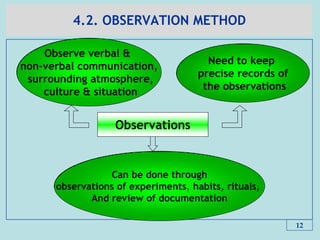
4.2. OBSERVATION METHOD
12
Observe verbal &
non-verbal communication,
surrounding atmosphere,
culture & situation
Observations
Need to keep
precise records of
the observations
Can be done through
observations of experiments, habits, rituals,
And review of documentation
4.2. OBSERVATION METHOD
13
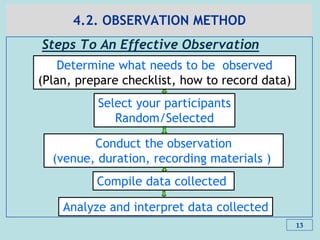
Determine what needs to be observed
(Plan, prepare checklist, how to record data)
Select your participants
Random/Selected
Conduct the observation
(venue, duration, recording materials )
Analyze and interpret data collected
Compile data collected
Steps To An Effective Observation
4.3. INTERVIEW METHOD
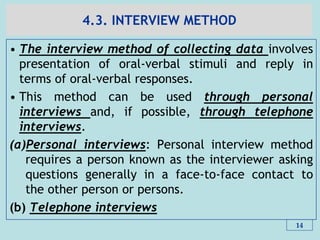
• The interview method of collecting data involves
presentation of oral-verbal stimuli and reply in
terms of oral-verbal responses.
• This method can be used through personal
interviews and, if possible, through telephone
interviews.
(a)Personal interviews: Personal interview method
requires a person known as the interviewer asking
questions generally in a face-to-face contact to
the other person or persons.
(b) Telephone interviews
14
4.3. INTERVIEW METHOD
15
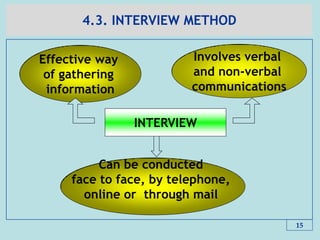
Effective way
of gathering
information
INTERVIEW
Involves verbal
and non-verbal
communications
Can be conducted
face to face, by telephone,
online or through mail
4.3. INTERVIEW METHOD
16
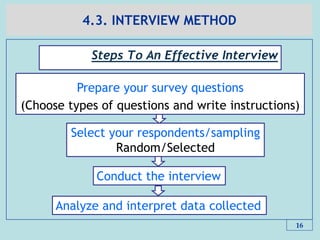
Conduct the interview
Analyze and interpret data collected
Prepare your survey questions
(Choose types of questions and write instructions)
Select your respondents/sampling
Random/Selected
Steps To An Effective Interview
4.3. INTERVIEW METHOD
Prerequisites for successful interview
Preparation
• It is necessary for the researcher to prepare
before the actual interview.
• Once the interview is conducted the researcher
needs to make sure that the respondents have :
– A clear idea of why they have been approached
– Basic information about the purpose of the
interview and the research project of which it is
a part
17
4.3. INTERVIEW METHOD
– Some idea of the probable length of the
interview and that you would like to record it
– A clear idea of precisely where and when the
interview will take place .
Expertise
• The researcher ought to have the following skills
and abilities for the effective interview : An ability
to be non-judgmental; An ability to listen ; A good
memory; Ability to think on his/her feet ; Sense of
humor
18
4.4. COLLECTION OF DATA THROUGH
QUESTIONNAIRES
• This method of data collection is quite popular
• It is being adopted by individuals, researchers,
private and public organizations and even by
governments.
• A questionnaire is sent (by post or mail)
• A questionnaire consists of a number of questions
• The questionnaire is mailed to respondents who are
expected to read and understand the questions.
• The respondents have to answer the questions
on their own.
19
4.4. COLLECTION OF DATA THROUGH
QUESTIONNAIRES
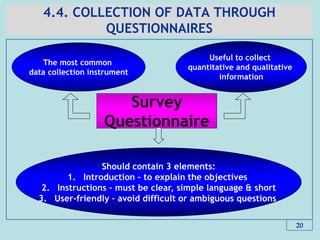
20
The most common
data collection instrument
Survey
Questionnaire
Useful to collect
quantitative and qualitative
information
Should contain 3 elements:
1. Introduction – to explain the objectives
2. Instructions – must be clear, simple language & short
3. User-friendly – avoid difficult or ambiguous questions
4.4. COLLECTION OF DATA THROUGH
QUESTIONNAIRES
• The method of collecting data by mailing the
questionnaires to respondents is most
extensively employed.
• The benefits of using this methods are as follows:
1. There is low cost even when the universe is large
and is widely spread geographically.
2. It is free from the bias of the interviewer
3. Respondents have adequate time
4. Respondents can be reached conveniently.
5. Large samples can be collected
21
4.5. SOME OTHER METHODS OF DATA
COLLECTION
• Let us consider some other methods of data
collection, particularly used by big business houses
in modern times.
1. Warranty cards
Warranty cards are usually postal sized cards which
are used by dealers of consumer durables to collect
information regarding their products
2. Store audits or records
3. Consumer panels
4. Use of mechanical devices
22
4.6. COLLECTION OF SECONDARY DATA
• Secondary data means data that are already
available i.e., they refer to the data which have
already been collected and analyzed by someone
else.
• When the researcher utilizes secondary data, then
he has to look into various sources from where he
can obtain them.
• In this case he is certainly not confronted with the
problems that are usually associated with the
collection of original data.
23
4.6. COLLECTION OF SECONDARY DATA
• Secondary data may either be published data or
unpublished data. Usually published data are
available in:
(a) Various publications of the central, state are
local governments;
(b)Various publications of foreign governments or of
international bodies and their subsidiary
organizations
(c)Technical and trade journals
(d)Books, magazines and newspapers
24
4.6. COLLECTION OF SECONDARY DATA
(b)Reports and publications of various associations
connected with business and industry, banks,
stock exchanges, etc.
(c)Reports prepared by research scholars,
universities, economists, etc. in different fields;
(d)Public records and statistics, historical
documents, and other sources of published
information.
25
4.6. COLLECTION OF SECONDARY DATA
• By way of caution, the researcher, before using
secondary data, must see that they possess
following characteristics:
1. Reliability of data: The reliability can be
tested by finding out such things about the said
data:
(a)Who collected the data?
(b)What were the sources of data?
(c) Were they collected by using proper methods
(d)At what time were they collected?
26
4.6. COLLECTION OF SECONDARY DATA
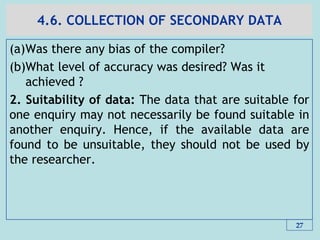
(a)Was there any bias of the compiler?
(b)What level of accuracy was desired? Was it
achieved ?
2. Suitability of data: The data that are suitable for
one enquiry may not necessarily be found suitable in
another enquiry. Hence, if the available data are
found to be unsuitable, they should not be used by
the researcher.
27
4.6. COLLECTION OF SECONDARY DATA
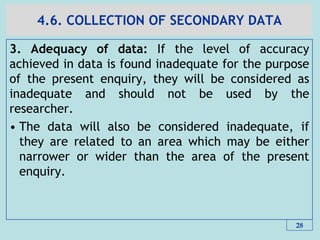
3. Adequacy of data: If the level of accuracy
achieved in data is found inadequate for the purpose
of the present enquiry, they will be considered as
inadequate and should not be used by the
researcher.
• The data will also be considered inadequate, if
they are related to an area which may be either
narrower or wider than the area of the present
enquiry.
28
4.6. COLLECTION OF SECONDARY DATA
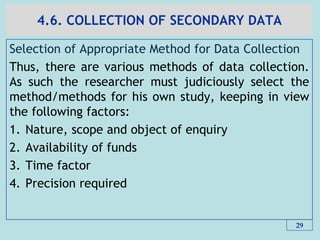
Selection of Appropriate Method for Data Collection
Thus, there are various methods of data collection.
As such the researcher must judiciously select the
method/methods for his own study, keeping in view
the following factors:
1. Nature, scope and object of enquiry
2. Availability of funds
3. Time factor
4. Precision required
29
End of Module 4

Chapter_4_Scientific_Research_Methods_Methods_of_Data_Collection.pdf

  • 1.
    Research Methodology Wondwossen Bogale(PhD) Associate Professor, AAiT, AAU wondwossenboge@gmail.com Chapter 4 : Data Collection
  • 2.
    1. METHODS OFDATA COLLECTION • Data collection is simply how information is gathered • The task of data collection begins after a research problem has been defined and research design/plan chalked out. • While deciding about the method of data collection to be used for the study, the researcher should keep in mind two types of data viz., primary and secondary. The primary data are those which are collected afresh and for the first time, and thus happens to be original in character. 2
  • 3.
    1. METHODS OFDATA COLLECTION • The data which is collected from the field under the control and supervision of an investigator. • The secondary data, on the other hand, are those which have already been collected by someone else and which have already been passed through the statistical process. It involves less cost, time and effort. For example : data from book 3
  • 4.
    1. METHODS OFDATA COLLECTION Advantages of using Primary data • The investigator collects data specific to the problem under study. • There is no doubt about the quality of the data collected (for the investigator). Disadvantages of using Primary data 1. The investigator has to contend with all the hassles of data collection • Deciding why, what, how, when to collect 4
  • 5.
    1. METHODS OFDATA COLLECTION • Getting the data collected (personally or through others) • Getting funding and dealing with funding agencies • Ethical considerations (consent, permissions, etc.) 2. Ensuring the data collected is of a high standard 3. Cost of obtaining the data is often the major expense in studies 5
  • 6.
    1. METHODS OFDATA COLLECTION Advantages of using Secondary data • No hassles of data collection • It is less expensive • The investigator is not personally responsible for the quality of data (“I didn’t do it”) Disadvantages of using Secondary data • The investigator cannot decide what is to be collected • One can only hope that the data is of good quality • Obtaining additional data is not possible 6
  • 7.
    4.1. COLLECTION OFPRIMARY DATA • There are several methods of collecting primary data : Important ones are: (i) Observation method (ii) Interview method (iii) Through questionnaires, and (iv) Other methods which include :Warranty cards ,Distributor audits, Consumer panels, Using mechanical devices and Depth interviews, etc. • We will discuss briefly each method separately 7
  • 8.
    4.2. OBSERVATION METHOD •The observation method is the most commonly used method specially in studies relating to behavioral sciences. • In a way we all observe things around us, but this sort of observation is not scientific observation. • Observation becomes a scientific tool and the method of data collection for the researcher, when it serves a formulated research purpose is systematically planned and recorded and is subjected to checks and controls on validity and reliability. 8
  • 9.
    4.1. COLLECTION OFPRIMARY DATA • Under the observation method, the information is sought by way of investigator’s own direct observation without asking from the respondent. For instance, in a study relating to consumer behavior, the investigator instead of asking the brand of wrist watch used by the respondent, may himself look at the watch. 9
  • 10.
    4.2. OBSERVATION METHOD Observationas a method of data collection has certain characteristics. 1. It is both a physical and a mental activity. The observation eye ‘catches’ many things which are sighted, but attention is focussed on data that are relevant to the given study. 10
  • 11.
    4.2. OBSERVATION METHOD 1.Observation is selective. A researcher does not observe anything and everything, but select the range of things to be observed on the basis of the nature, scope and objectives of his study. 2. Observation is purposive and not casual. It is made for the specific purpose of nothing things relevant to the study. 11
  • 12.
    4.2. OBSERVATION METHOD 12 Observeverbal & non-verbal communication, surrounding atmosphere, culture & situation Observations Need to keep precise records of the observations Can be done through observations of experiments, habits, rituals, And review of documentation
  • 13.
    4.2. OBSERVATION METHOD 13 Determinewhat needs to be observed (Plan, prepare checklist, how to record data) Select your participants Random/Selected Conduct the observation (venue, duration, recording materials ) Analyze and interpret data collected Compile data collected Steps To An Effective Observation
  • 14.
    4.3. INTERVIEW METHOD •The interview method of collecting data involves presentation of oral-verbal stimuli and reply in terms of oral-verbal responses. • This method can be used through personal interviews and, if possible, through telephone interviews. (a)Personal interviews: Personal interview method requires a person known as the interviewer asking questions generally in a face-to-face contact to the other person or persons. (b) Telephone interviews 14
  • 15.
    4.3. INTERVIEW METHOD 15 Effectiveway of gathering information INTERVIEW Involves verbal and non-verbal communications Can be conducted face to face, by telephone, online or through mail
  • 16.
    4.3. INTERVIEW METHOD 16 Conductthe interview Analyze and interpret data collected Prepare your survey questions (Choose types of questions and write instructions) Select your respondents/sampling Random/Selected Steps To An Effective Interview
  • 17.
    4.3. INTERVIEW METHOD Prerequisitesfor successful interview Preparation • It is necessary for the researcher to prepare before the actual interview. • Once the interview is conducted the researcher needs to make sure that the respondents have : – A clear idea of why they have been approached – Basic information about the purpose of the interview and the research project of which it is a part 17
  • 18.
    4.3. INTERVIEW METHOD –Some idea of the probable length of the interview and that you would like to record it – A clear idea of precisely where and when the interview will take place . Expertise • The researcher ought to have the following skills and abilities for the effective interview : An ability to be non-judgmental; An ability to listen ; A good memory; Ability to think on his/her feet ; Sense of humor 18
  • 19.
    4.4. COLLECTION OFDATA THROUGH QUESTIONNAIRES • This method of data collection is quite popular • It is being adopted by individuals, researchers, private and public organizations and even by governments. • A questionnaire is sent (by post or mail) • A questionnaire consists of a number of questions • The questionnaire is mailed to respondents who are expected to read and understand the questions. • The respondents have to answer the questions on their own. 19
  • 20.
    4.4. COLLECTION OFDATA THROUGH QUESTIONNAIRES 20 The most common data collection instrument Survey Questionnaire Useful to collect quantitative and qualitative information Should contain 3 elements: 1. Introduction – to explain the objectives 2. Instructions – must be clear, simple language & short 3. User-friendly – avoid difficult or ambiguous questions
  • 21.
    4.4. COLLECTION OFDATA THROUGH QUESTIONNAIRES • The method of collecting data by mailing the questionnaires to respondents is most extensively employed. • The benefits of using this methods are as follows: 1. There is low cost even when the universe is large and is widely spread geographically. 2. It is free from the bias of the interviewer 3. Respondents have adequate time 4. Respondents can be reached conveniently. 5. Large samples can be collected 21
  • 22.
    4.5. SOME OTHERMETHODS OF DATA COLLECTION • Let us consider some other methods of data collection, particularly used by big business houses in modern times. 1. Warranty cards Warranty cards are usually postal sized cards which are used by dealers of consumer durables to collect information regarding their products 2. Store audits or records 3. Consumer panels 4. Use of mechanical devices 22
  • 23.
    4.6. COLLECTION OFSECONDARY DATA • Secondary data means data that are already available i.e., they refer to the data which have already been collected and analyzed by someone else. • When the researcher utilizes secondary data, then he has to look into various sources from where he can obtain them. • In this case he is certainly not confronted with the problems that are usually associated with the collection of original data. 23
  • 24.
    4.6. COLLECTION OFSECONDARY DATA • Secondary data may either be published data or unpublished data. Usually published data are available in: (a) Various publications of the central, state are local governments; (b)Various publications of foreign governments or of international bodies and their subsidiary organizations (c)Technical and trade journals (d)Books, magazines and newspapers 24
  • 25.
    4.6. COLLECTION OFSECONDARY DATA (b)Reports and publications of various associations connected with business and industry, banks, stock exchanges, etc. (c)Reports prepared by research scholars, universities, economists, etc. in different fields; (d)Public records and statistics, historical documents, and other sources of published information. 25
  • 26.
    4.6. COLLECTION OFSECONDARY DATA • By way of caution, the researcher, before using secondary data, must see that they possess following characteristics: 1. Reliability of data: The reliability can be tested by finding out such things about the said data: (a)Who collected the data? (b)What were the sources of data? (c) Were they collected by using proper methods (d)At what time were they collected? 26
  • 27.
    4.6. COLLECTION OFSECONDARY DATA (a)Was there any bias of the compiler? (b)What level of accuracy was desired? Was it achieved ? 2. Suitability of data: The data that are suitable for one enquiry may not necessarily be found suitable in another enquiry. Hence, if the available data are found to be unsuitable, they should not be used by the researcher. 27
  • 28.
    4.6. COLLECTION OFSECONDARY DATA 3. Adequacy of data: If the level of accuracy achieved in data is found inadequate for the purpose of the present enquiry, they will be considered as inadequate and should not be used by the researcher. • The data will also be considered inadequate, if they are related to an area which may be either narrower or wider than the area of the present enquiry. 28
  • 29.
    4.6. COLLECTION OFSECONDARY DATA Selection of Appropriate Method for Data Collection Thus, there are various methods of data collection. As such the researcher must judiciously select the method/methods for his own study, keeping in view the following factors: 1. Nature, scope and object of enquiry 2. Availability of funds 3. Time factor 4. Precision required 29
  • 30.