Administrative Law
and
Administrative Agencies
Explanation of Administrative Law
∗The laws that define the legal powers and
legal limits of government agencies
∗Sets out the means agencies use to apply
its powers and the remedies individuals
seek if injured by an agency’s decision.
What is Administrative Law?
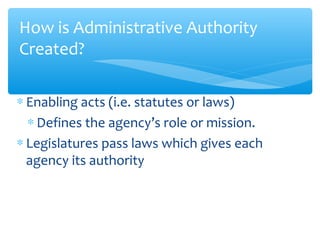
∗ Enabling acts (i.e. statutes or laws)
∗ Defines the agency’s role or mission.
∗ Legislatures pass laws which gives each
agency its authority
How is Administrative Authority
Created?
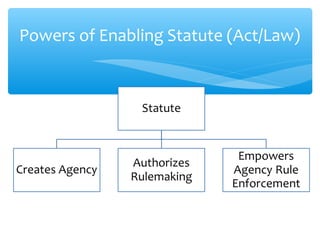
Powers of Enabling Statute (Act/Law)
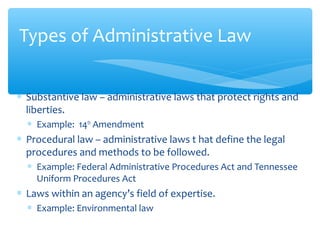
∗ Substantive law – administrative laws that protect rights and
liberties.
∗ Example: 14th
Amendment
∗ Procedural law – administrative laws t hat define the legal
procedures and methods to be followed.
∗ Example: Federal Administrative Procedures Act and Tennessee
Uniform Procedures Act
∗ Laws within an agency’s field of expertise.
∗ Example: Environmental law
Types of Administrative Law
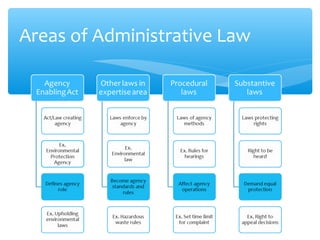
Areas of Administrative Law
Explanation of Administrative Agency
∗ Government body or organization created by
legislatures to serve citizens by overseeing
and administering laws in designated areas of
expertise.
∗ Created to solve problems of public interest
quickly and inexpensively.
What are administrative agencies?
∗ Legislatures delegate limited powers to
agencies
∗ Lack of time/resources
∗ Complex problems needing expertise
∗ The enabling statutes that create agencies
delineates the exact powers and limitations of
the agency
What are administrative agencies?
∗ In TN, administrative agencies are created at
Tenn. Code Ann. § 4-3-101 et. seq.
∗ Creation of each administrative agencies
∗ Organization
∗ Powers and duties
What are administrative agencies?
∗ Set standards
∗ Makes rules and regulations
∗ Prosecute against those who refuse to obey the
regulations
∗ Make decisions on those actions that come before it
in claims and hearings
∗ Investigate complaints
Powers of administrative agencies
∗ Social welfare
∗ Regulatory
∗ Independent
∗ Executive
Categories of administrative agencies
Regulatory Agencies
∗ Direct or regulate certain areas of public and private interests.
∗ Staffed by individuals in the occupational field being
regulated.
∗ Powers, usually include:
∗ Define and establish regulations
∗ Monitor compliance with regulations
∗ Prosecute if regulations are violated
∗ Examples: Licensing of transportation, health related boards,
board of professional responsibility
Regulatory Agencies
Social Welfare Agencies
∗ Administer and provide assistance on both federal
and state levels
∗ Examples include:
∗ Disability
∗ Old age benefits
∗ Worker’s compensation
∗ Consumer protection
∗ Environmental protection
Social Welfare Agencies
Independent Agencies
∗ Agencies that make decisions on matters affecting the
economy, such as stocks
∗ Staff consist of a board of five to seven members, often called
commissions
∗ Purpose – specific task and they are specialists in their field.
∗ Called independent because they may only be removed by just
cause.
∗ Examples: federal deposit insurance corporation, TSSAA
Independent Agencies
Executive Agencies
∗ Part of the executive branches of federal and state
governments
∗ May both regulate and provide assistance
∗ The head of the department is appointed by the executive
(e.g., president, governor). Therefore the agency is not
independent of political influences.
∗ Head may not be an expert in the field and is easily
removable.
∗ Examples: Department of Education, Department of
Agriculture, Department of Health and Human Services
Executive Agencies

Chapter1.admin law&adminagency

  • 1.
  • 2.
  • 3.
    ∗The laws thatdefine the legal powers and legal limits of government agencies ∗Sets out the means agencies use to apply its powers and the remedies individuals seek if injured by an agency’s decision. What is Administrative Law?
  • 4.
    ∗ Enabling acts(i.e. statutes or laws) ∗ Defines the agency’s role or mission. ∗ Legislatures pass laws which gives each agency its authority How is Administrative Authority Created?
  • 5.
    Powers of EnablingStatute (Act/Law)
  • 6.
    ∗ Substantive law– administrative laws that protect rights and liberties. ∗ Example: 14th Amendment ∗ Procedural law – administrative laws t hat define the legal procedures and methods to be followed. ∗ Example: Federal Administrative Procedures Act and Tennessee Uniform Procedures Act ∗ Laws within an agency’s field of expertise. ∗ Example: Environmental law Types of Administrative Law
  • 7.
  • 8.
  • 9.
    ∗ Government bodyor organization created by legislatures to serve citizens by overseeing and administering laws in designated areas of expertise. ∗ Created to solve problems of public interest quickly and inexpensively. What are administrative agencies?
  • 10.
    ∗ Legislatures delegatelimited powers to agencies ∗ Lack of time/resources ∗ Complex problems needing expertise ∗ The enabling statutes that create agencies delineates the exact powers and limitations of the agency What are administrative agencies?
  • 11.
    ∗ In TN,administrative agencies are created at Tenn. Code Ann. § 4-3-101 et. seq. ∗ Creation of each administrative agencies ∗ Organization ∗ Powers and duties What are administrative agencies?
  • 12.
    ∗ Set standards ∗Makes rules and regulations ∗ Prosecute against those who refuse to obey the regulations ∗ Make decisions on those actions that come before it in claims and hearings ∗ Investigate complaints Powers of administrative agencies
  • 13.
    ∗ Social welfare ∗Regulatory ∗ Independent ∗ Executive Categories of administrative agencies
  • 14.
  • 15.
    ∗ Direct orregulate certain areas of public and private interests. ∗ Staffed by individuals in the occupational field being regulated. ∗ Powers, usually include: ∗ Define and establish regulations ∗ Monitor compliance with regulations ∗ Prosecute if regulations are violated ∗ Examples: Licensing of transportation, health related boards, board of professional responsibility Regulatory Agencies
  • 16.
  • 17.
    ∗ Administer andprovide assistance on both federal and state levels ∗ Examples include: ∗ Disability ∗ Old age benefits ∗ Worker’s compensation ∗ Consumer protection ∗ Environmental protection Social Welfare Agencies
  • 18.
  • 19.
    ∗ Agencies thatmake decisions on matters affecting the economy, such as stocks ∗ Staff consist of a board of five to seven members, often called commissions ∗ Purpose – specific task and they are specialists in their field. ∗ Called independent because they may only be removed by just cause. ∗ Examples: federal deposit insurance corporation, TSSAA Independent Agencies
  • 20.
  • 21.
    ∗ Part ofthe executive branches of federal and state governments ∗ May both regulate and provide assistance ∗ The head of the department is appointed by the executive (e.g., president, governor). Therefore the agency is not independent of political influences. ∗ Head may not be an expert in the field and is easily removable. ∗ Examples: Department of Education, Department of Agriculture, Department of Health and Human Services Executive Agencies