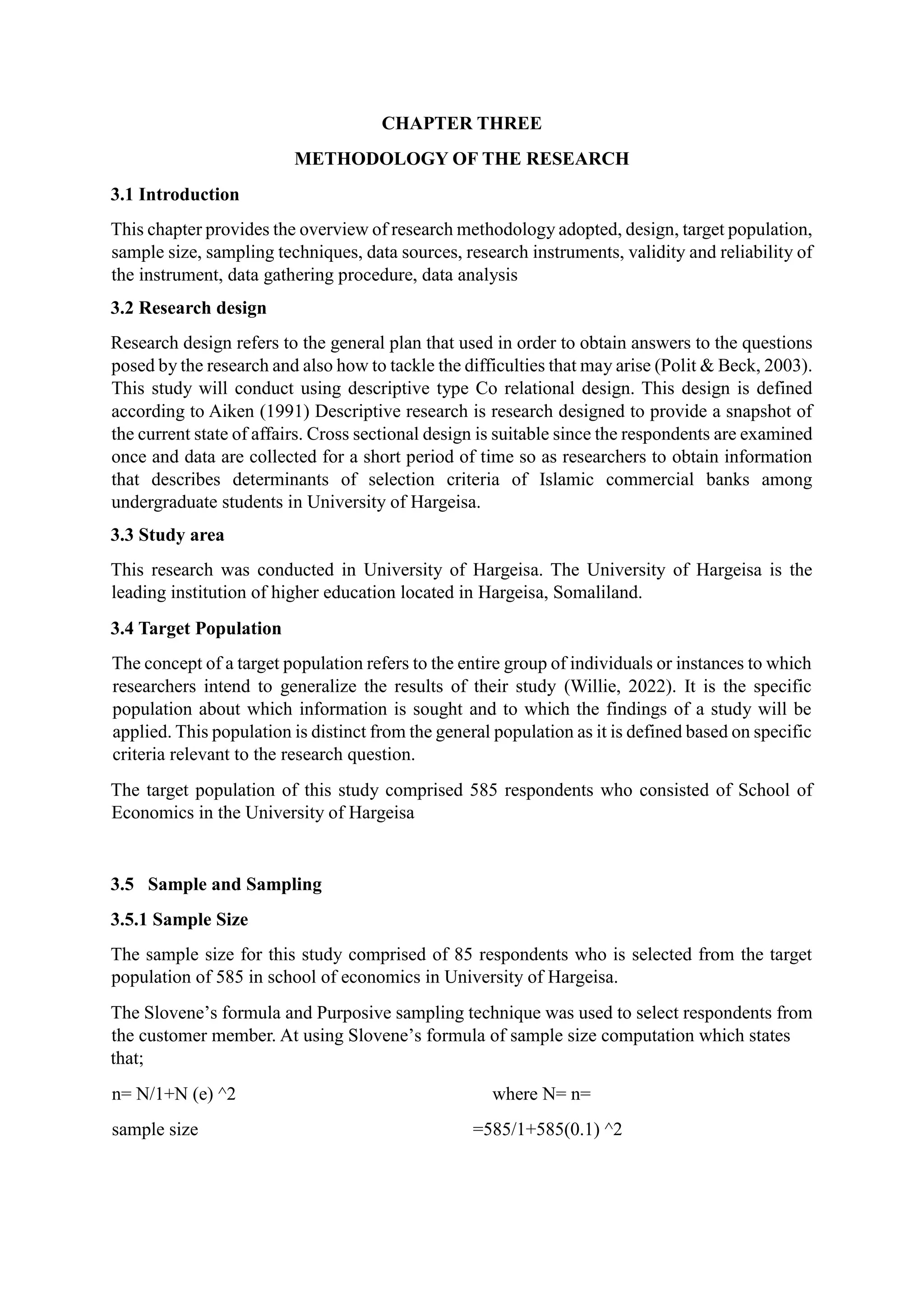
CHAPTER THREE
METHODOLOGY OF THE RESEARCH
3.1 Introduction
This chapter provides the overview of research methodology adopted, design, target population,
sample size, sampling techniques, data sources, research instruments, validity and reliability of
the instrument, data gathering procedure, data analysis
3.2 Research design
Research design refers to the general plan that used in order to obtain answers to the questions
posed by the research and also how to tackle the difficulties that may arise (Polit & Beck, 2003).
This study will conduct using descriptive type Co relational design. This design is defined
according to Aiken (1991) Descriptive research is research designed to provide a snapshot of
the current state of affairs. Cross sectional design is suitable since the respondents are examined
once and data are collected for a short period of time so as researchers to obtain information
that describes determinants of selection criteria of Islamic commercial banks among
undergraduate students in University of Hargeisa.
3.3 Study area
This research was conducted in University of Hargeisa. The University of Hargeisa is the
leading institution of higher education located in Hargeisa, Somaliland.
3.4 Target Population
The concept of a target population refers to the entire group of individuals or instances to which
researchers intend to generalize the results of their study (Willie, 2022). It is the specific
population about which information is sought and to which the findings of a study will be
applied. This population is distinct from the general population as it is defined based on specific
criteria relevant to the research question.
The target population of this study comprised 585 respondents who consisted of School of
Economics in the University of Hargeisa
3.5 Sample and Sampling
3.5.1 Sample Size
The sample size for this study comprised of 85 respondents who is selected from the target
population of 585 in school of economics in University of Hargeisa.
The Slovene’s formula and Purposive sampling technique was used to select respondents from
the customer member. At using Slovene’s formula of sample size computation which states
that;
n= N/1+N (e) ^2 where N= n=
sample size =585/1+585(0.1) ^2
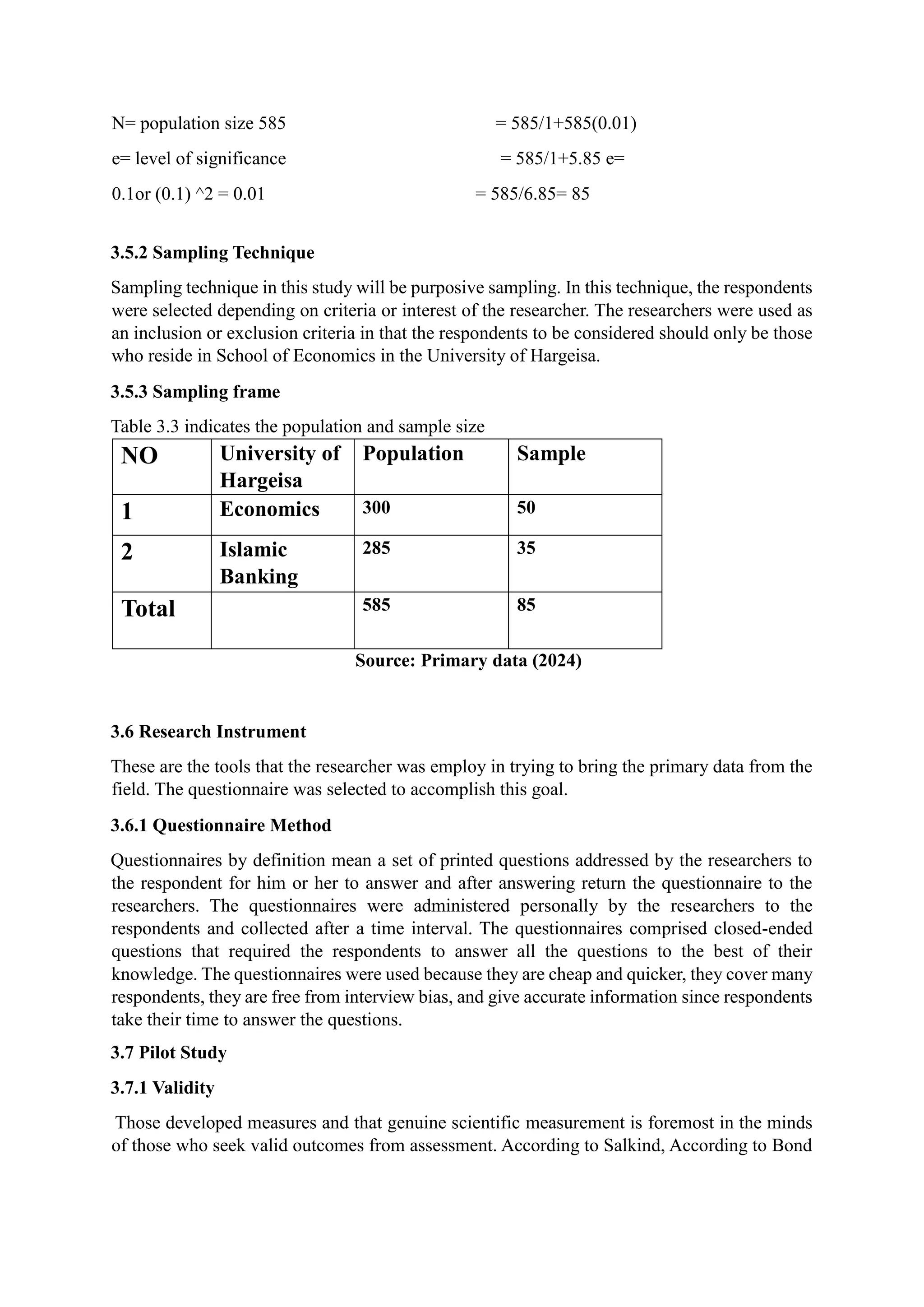
N= population size 585 = 585/1+585(0.01)
e= level of significance = 585/1+5.85 e=
0.1or (0.1) ^2 = 0.01 = 585/6.85= 85
3.5.2 Sampling Technique
Sampling technique in this study will be purposive sampling. In this technique, the respondents
were selected depending on criteria or interest of the researcher. The researchers were used as
an inclusion or exclusion criteria in that the respondents to be considered should only be those
who reside in School of Economics in the University of Hargeisa.
3.5.3 Sampling frame
Table 3.3 indicates the population and sample size
NO University of
Hargeisa
Population Sample
1 Economics 300 50
2 Islamic
Banking
285 35
Total 585 85
Source: Primary data (2024)
3.6 Research Instrument
These are the tools that the researcher was employ in trying to bring the primary data from the
field. The questionnaire was selected to accomplish this goal.
3.6.1 Questionnaire Method
Questionnaires by definition mean a set of printed questions addressed by the researchers to
the respondent for him or her to answer and after answering return the questionnaire to the
researchers. The questionnaires were administered personally by the researchers to the
respondents and collected after a time interval. The questionnaires comprised closed-ended
questions that required the respondents to answer all the questions to the best of their
knowledge. The questionnaires were used because they are cheap and quicker, they cover many
respondents, they are free from interview bias, and give accurate information since respondents
take their time to answer the questions.
3.7 Pilot Study
3.7.1 Validity
Those developed measures and that genuine scientific measurement is foremost in the minds
of those who seek valid outcomes from assessment. According to Salkind, According to Bond
(2003) comments that validity is foremost on the mind of (2000) validity is the quality of the
test doing what is designed to do.
3.7.2 Reliability
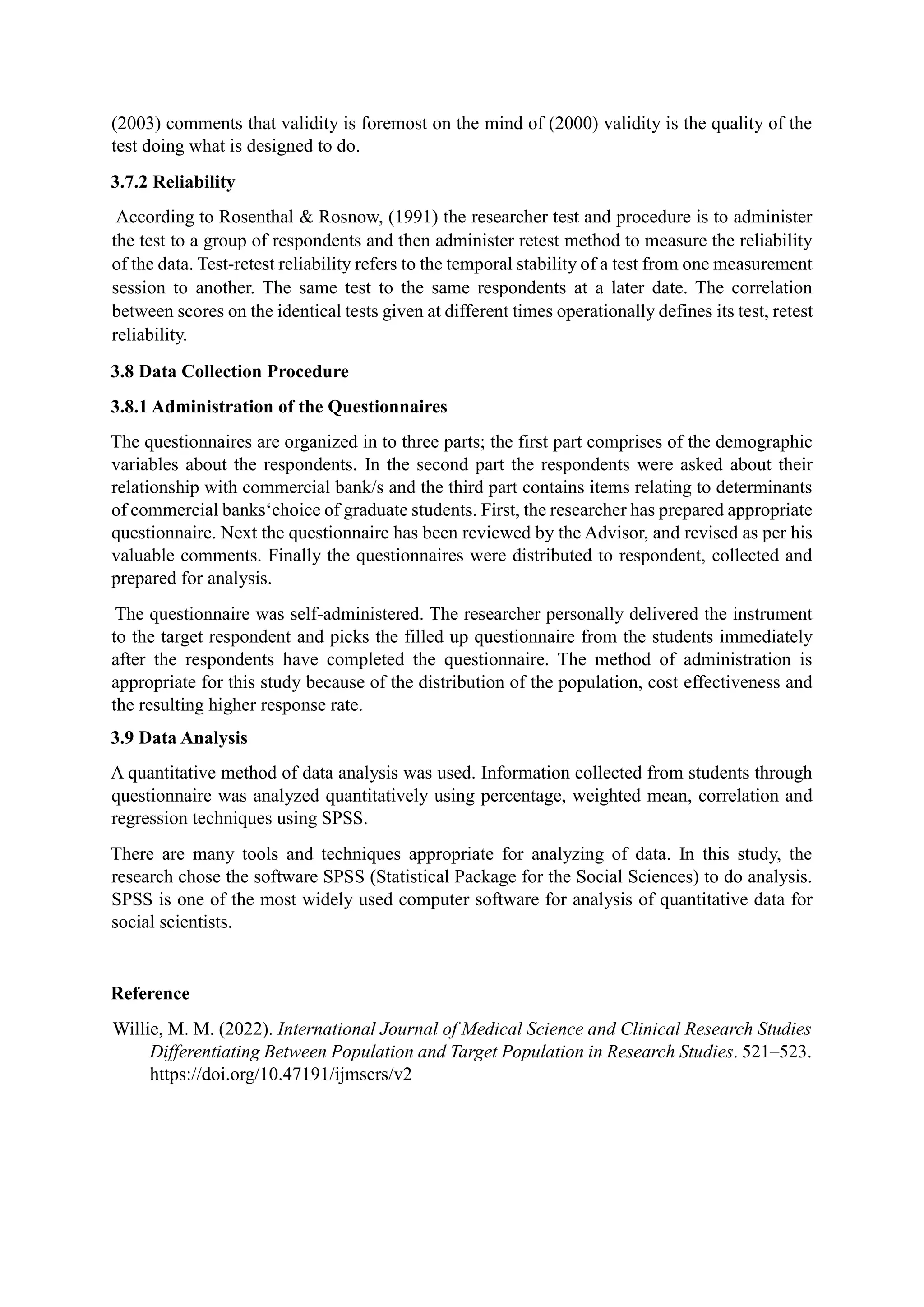
According to Rosenthal & Rosnow, (1991) the researcher test and procedure is to administer
the test to a group of respondents and then administer retest method to measure the reliability
of the data. Test-retest reliability refers to the temporal stability of a test from one measurement
session to another. The same test to the same respondents at a later date. The correlation
between scores on the identical tests given at different times operationally defines its test, retest
reliability.
3.8 Data Collection Procedure
3.8.1 Administration of the Questionnaires
The questionnaires are organized in to three parts; the first part comprises of the demographic
variables about the respondents. In the second part the respondents were asked about their
relationship with commercial bank/s and the third part contains items relating to determinants
of commercial banks‘choice of graduate students. First, the researcher has prepared appropriate
questionnaire. Next the questionnaire has been reviewed by the Advisor, and revised as per his
valuable comments. Finally the questionnaires were distributed to respondent, collected and
prepared for analysis.
The questionnaire was self-administered. The researcher personally delivered the instrument
to the target respondent and picks the filled up questionnaire from the students immediately
after the respondents have completed the questionnaire. The method of administration is
appropriate for this study because of the distribution of the population, cost effectiveness and
the resulting higher response rate.
3.9 Data Analysis
A quantitative method of data analysis was used. Information collected from students through
questionnaire was analyzed quantitatively using percentage, weighted mean, correlation and
regression techniques using SPSS.
There are many tools and techniques appropriate for analyzing of data. In this study, the
research chose the software SPSS (Statistical Package for the Social Sciences) to do analysis.
SPSS is one of the most widely used computer software for analysis of quantitative data for
social scientists.
Reference
Willie, M. M. (2022). International Journal of Medical Science and Clinical Research Studies
Differentiating Between Population and Target Population in Research Studies. 521–523.
https://doi.org/10.47191/ijmscrs/v2

CHAPTER THREE by university of Hargeisa lol

  • 1.
    CHAPTER THREE METHODOLOGY OFTHE RESEARCH 3.1 Introduction This chapter provides the overview of research methodology adopted, design, target population, sample size, sampling techniques, data sources, research instruments, validity and reliability of the instrument, data gathering procedure, data analysis 3.2 Research design Research design refers to the general plan that used in order to obtain answers to the questions posed by the research and also how to tackle the difficulties that may arise (Polit & Beck, 2003). This study will conduct using descriptive type Co relational design. This design is defined according to Aiken (1991) Descriptive research is research designed to provide a snapshot of the current state of affairs. Cross sectional design is suitable since the respondents are examined once and data are collected for a short period of time so as researchers to obtain information that describes determinants of selection criteria of Islamic commercial banks among undergraduate students in University of Hargeisa. 3.3 Study area This research was conducted in University of Hargeisa. The University of Hargeisa is the leading institution of higher education located in Hargeisa, Somaliland. 3.4 Target Population The concept of a target population refers to the entire group of individuals or instances to which researchers intend to generalize the results of their study (Willie, 2022). It is the specific population about which information is sought and to which the findings of a study will be applied. This population is distinct from the general population as it is defined based on specific criteria relevant to the research question. The target population of this study comprised 585 respondents who consisted of School of Economics in the University of Hargeisa 3.5 Sample and Sampling 3.5.1 Sample Size The sample size for this study comprised of 85 respondents who is selected from the target population of 585 in school of economics in University of Hargeisa. The Slovene’s formula and Purposive sampling technique was used to select respondents from the customer member. At using Slovene’s formula of sample size computation which states that; n= N/1+N (e) ^2 where N= n= sample size =585/1+585(0.1) ^2
  • 2.
    N= population size585 = 585/1+585(0.01) e= level of significance = 585/1+5.85 e= 0.1or (0.1) ^2 = 0.01 = 585/6.85= 85 3.5.2 Sampling Technique Sampling technique in this study will be purposive sampling. In this technique, the respondents were selected depending on criteria or interest of the researcher. The researchers were used as an inclusion or exclusion criteria in that the respondents to be considered should only be those who reside in School of Economics in the University of Hargeisa. 3.5.3 Sampling frame Table 3.3 indicates the population and sample size NO University of Hargeisa Population Sample 1 Economics 300 50 2 Islamic Banking 285 35 Total 585 85 Source: Primary data (2024) 3.6 Research Instrument These are the tools that the researcher was employ in trying to bring the primary data from the field. The questionnaire was selected to accomplish this goal. 3.6.1 Questionnaire Method Questionnaires by definition mean a set of printed questions addressed by the researchers to the respondent for him or her to answer and after answering return the questionnaire to the researchers. The questionnaires were administered personally by the researchers to the respondents and collected after a time interval. The questionnaires comprised closed-ended questions that required the respondents to answer all the questions to the best of their knowledge. The questionnaires were used because they are cheap and quicker, they cover many respondents, they are free from interview bias, and give accurate information since respondents take their time to answer the questions. 3.7 Pilot Study 3.7.1 Validity Those developed measures and that genuine scientific measurement is foremost in the minds of those who seek valid outcomes from assessment. According to Salkind, According to Bond
  • 3.
    (2003) comments thatvalidity is foremost on the mind of (2000) validity is the quality of the test doing what is designed to do. 3.7.2 Reliability According to Rosenthal & Rosnow, (1991) the researcher test and procedure is to administer the test to a group of respondents and then administer retest method to measure the reliability of the data. Test-retest reliability refers to the temporal stability of a test from one measurement session to another. The same test to the same respondents at a later date. The correlation between scores on the identical tests given at different times operationally defines its test, retest reliability. 3.8 Data Collection Procedure 3.8.1 Administration of the Questionnaires The questionnaires are organized in to three parts; the first part comprises of the demographic variables about the respondents. In the second part the respondents were asked about their relationship with commercial bank/s and the third part contains items relating to determinants of commercial banks‘choice of graduate students. First, the researcher has prepared appropriate questionnaire. Next the questionnaire has been reviewed by the Advisor, and revised as per his valuable comments. Finally the questionnaires were distributed to respondent, collected and prepared for analysis. The questionnaire was self-administered. The researcher personally delivered the instrument to the target respondent and picks the filled up questionnaire from the students immediately after the respondents have completed the questionnaire. The method of administration is appropriate for this study because of the distribution of the population, cost effectiveness and the resulting higher response rate. 3.9 Data Analysis A quantitative method of data analysis was used. Information collected from students through questionnaire was analyzed quantitatively using percentage, weighted mean, correlation and regression techniques using SPSS. There are many tools and techniques appropriate for analyzing of data. In this study, the research chose the software SPSS (Statistical Package for the Social Sciences) to do analysis. SPSS is one of the most widely used computer software for analysis of quantitative data for social scientists. Reference Willie, M. M. (2022). International Journal of Medical Science and Clinical Research Studies Differentiating Between Population and Target Population in Research Studies. 521–523. https://doi.org/10.47191/ijmscrs/v2