BRONCHIECTASIS
prepared BY:
MRS.GAYATHRI.P
ASSISTANT PROFESSOR
DEPT.MEDICAL SURGICAL NURSING
SHRI SATHYA SAI COLLEGE OF NURSING, chennai
AFFILIATED BY SHRI BALAJI VIDYAPEETH
UNIVERSITY-PUDucherry
Bronchiectasis
INTRODUCTION
Bronchiectasis is a chronic lung disease ,defined
pathologically dilatation of the bronchi. The clinical course
of the disease is chronic and progressive and in most
cases , causes lung damage over many years.
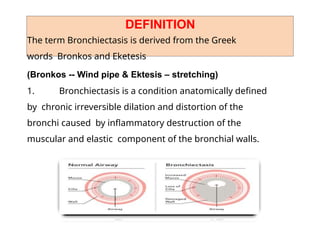
DEFINITION
The term Bronchiectasis is derived from the Greek
words Bronkos and Eketesis
(Bronkos -- Wind pipe & Ektesis – stretching)
1. Bronchiectasis is a condition anatomically defined
by chronic irreversible dilation and distortion of the
bronchi caused by inflammatory destruction of the
muscular and elastic component of the bronchial walls.
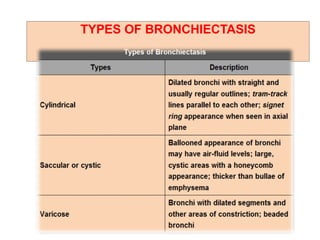
TYPES OF BRONCHIECTASIS
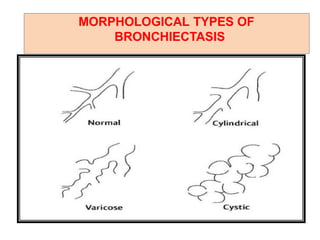
MORPHOLOGICAL TYPES OF
BRONCHIECTASIS
CAUSES OF BRONCHIECTASIS
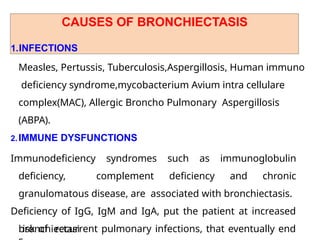
1.INFECTIONS
Measles, Pertussis, Tuberculosis,Aspergillosis, Human immuno
deficiency syndrome,mycobacterium Avium intra cellulare
complex(MAC), Allergic Broncho Pulmonary Aspergillosis
(ABPA).
2.IMMUNE DYSFUNCTIONS
Immunodeficiency syndromes such as immunoglobulin
deficiency, complement deficiency and chronic
granulomatous disease, are associated with bronchiectasis.
Deficiency of IgG, IgM and IgA, put the patient at increased
risk of recurrent pulmonary infections, that eventually end
bronchiectasi
3.CYSTIC FIBROSIS
An autosomal recessive genetic disorder causing
ineffective clearance of secretions,cystic fibrosis presents
with recurrent pneumonias, sinusitis, pancreatic
insufficiency and infertility.
The gene responsible for cystic fibrosis (CF), the cystic
fibrosis transmembrane regulator (CFTR), is
shown to occur in high frequency in children with idiopathic
Bronchiectasis.
It is suggested that CFTR mutation acts with other
CAUSES OF BRONCHIECTASIS
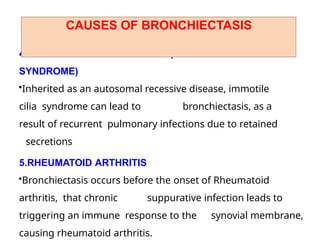
4 . IMMOTILE CILIA SYNDROME (KARTAGENER'S
SYNDROME)
•Inherited as an autosomal recessive disease, immotile
cilia syndrome can lead to bronchiectasis, as a
result of recurrent pulmonary infections due to retained
secretions
5.RHEUMATOID ARTHRITIS
•Bronchiectasis occurs before the onset of Rheumatoid
arthritis, that chronic suppurative infection leads to
triggering an immune response to the synovial membrane,
causing rheumatoid arthritis.
CAUSES OF BRONCHIECTASIS
6.INFLAMMATORY BOWEL DISEASE
• Patients with inflammatory bowel disease, develop
bronchiectasis
after colectomy.
• Post colectomy ,as the inflammatory and auto immune
processes
shift from the bowel to the lung
7.BRONCHOLITHIASIS
• Broncholithiasis Calcified or ossified material within the
bronchial
lumen can cause focal bronchiectasis.
• Erosion by and extrusion of a calcified adjacent lymphnode,
usually associated with a long-standing focus of necrotizing
CAUSES OF BRONCHIECTASIS
8.ENDOLUMINAL OBSTRUCTION BY TUMOR:
• Most carcinoid tumors are primarily endobronchial
lesions,
occurring in the central, main, or segmental bronchi
• Some small tumors are located entirely within the
lumen.
CAUSES OF BRONCHIECTASIS
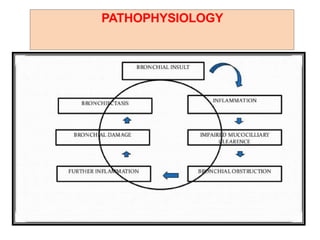
PATHOPHYSIOLOGY
CLINICAL MANIFESTATIONS
•Low-grade fever (rare) & symptoms like fatigue,
malaise
•Increased viscidity of the sputum
•A foul odor of the sputum
• Increased sputum production over baseline
•Increased dyspnea ,shortness of breath,
wheezing, pleuritic pain
Findings on physical examination are nonspecific and may
include the following
•Crackles, rhonchi, scattered wheezing, and inspiratory
squeaks on auscultation
•Digital clubbing (2-3% of patients; more frequent in
moderate-to- severe cases)
•cyanosis and plethora with polycythemia from chronic
hypoxia (rare)
•Wasting and weight loss Nasal polyps and signs of
chronic sinusitis
CLINICAL MANIFESTATIONS
Quantitative
immunoglobulins
(IgA ,IgM
,IgG)
To rule out immuno
deficiency
Aspergillous specific IgE
IgG level test,
To rule out allergic broncho
pulmonary
aspergillosis (ABPA)
Alpha 1 anti trypsin level To rule out alpha 1 anti
trypsin
deficiency
Sweat cholride test/CF
mutation screening
To rule out cystic fibrosis
DIAGNOSTIC TESTS
Ciliary biopsy, ciliary
functional testing,nasal
nitric oxide
Primary ciliary dyskinesia
Bronchoscopy with myco
bacterial culture
To rule out tuberculosis
Swallow evaluation of
esophageal pH
measurement
Gastroesophageal refux
disease
/aspiration
DIAGNOSTIC TESTS
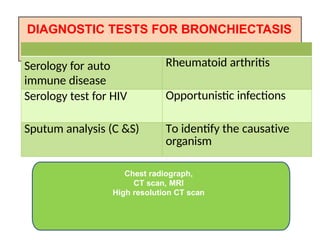
DIAGNOSTIC TESTS FOR BRONCHIECTASIS
Chest radiograph,
CT scan, MRI
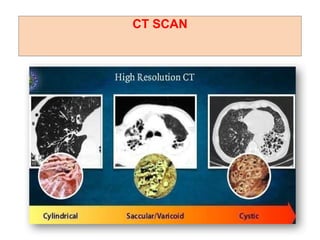
High resolution CT scan
Serology for auto
immune disease
Rheumatoid arthritis
Serology test for HIV Opportunistic infections
Sputum analysis (C &S) To identify the causative
organism
SPUTUM ANALYSIS
CYSTIC BRONCHIECTASIS. X-RAY
SIGNET RING SIGN
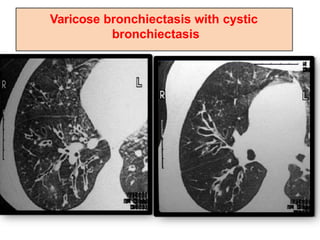
Varicose bronchiectasis with cystic
bronchiectasis
CYLINDRICAL BRONCHIECTASIS
CT SCAN
MEDICAL MANAGEMENT
• Antibiotics & antimicrobial
therapy
• Bronchodilators
• Postural drainage
• Chest physiotherapy
• Breathing exercises
• Smoking cessation
• Hydration status
• Amoxicillin500mg, Tetracycline
500mg,Trimethoprim-sulfamethoxazole
Antibiotics
Antibiotics
• Macrolides- azithromycin or
clarithromycin500mg
• Fluoroquinolone-
ciprofloxacin& gemi floxacin
antibiotics
• II generation cephalosporins
• Cefaclor1 gm and cefuroxime 1
gm
For mild to moderate
cases
TREATMENT
Antibiotics
• parenteral antibiotics
• Aminoglycoside gentamicin, tobramycin)
• Mycobacterium avium complex 3- to 4-drug treatment regimen
with clarithromycin, rifampin, ethambutol, and possibly
streptomycin
(18-24 months)
Antibiotics
• Antipseudomonal synthetic penicillin
• Third-generation cephalosporincefotaxime, Ceftriaxone &
Cefixime.
• bronchiectasis from Cystic fibrosis are often infected with mucoid
Pseudomonas species, and, as such, tobramycin is often the drug of
choice for acute exacerbation.
Antibiotics
For moderate to severe
cases
TREATMENT
category example Route of
administration
corticosteroids 1.Hydrocortisone
2.Methyl prednisolone
Intravenous Oral/IV
Beta 2 adrenergic
agonist
1.Albuterol
2.levalbuterol
Nebulizer,MDI, Oral
extended release
Broncho dilators
Methyl xanthines
1.Amino phylline
2.theophylline
oral
Leukotriene receptor
blocker
1.Zafirlukast 2.Monte
lu kast
oral
PHARMACOLOGICAL MANAGEMENT
Postural drainage withpercussion and
vibration is
used to loosen and mobilize secretions
TREATMENT
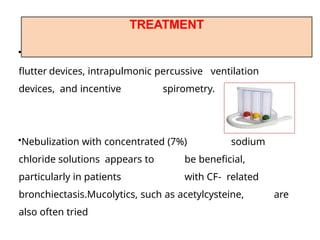
•Devices available to assist withmucus clearance include
flutter devices, intrapulmonic percussive ventilation
devices, and incentive spirometry.
•Nebulization with concentrated (7%) sodium
chloride solutions appears to be beneficial,
particularly in patients with CF- related
bronchiectasis.Mucolytics, such as acetylcysteine, are
also often tried
TREATMENT
April
8,
38
SURGICAL MANAGEMENT
• Segmental resection ( segment of a lobe)
• Lobectomy (removal of entire lobe of a
lung)
• Pneumonectomy ( removal of the entire
lung)
NURSING MANAGEMENT
The early detection and management of lowerrespiratory
tract
infections will prevent the complications of bronchiectasis.
Educate about smoking cessation and avoid
exposure to irritants and pollution.
goal is to promote drainage of bronchial mucus.
Educate on deep breathing and coughing techniques
Chest physiotherapy and postural drainage on the affected
parts of the lung
Administration of prescribed medication
Rest is important to prevent overexertion
The patient should be aware of possible side effects that must
be reported to the physician.
Good nutrition is important .
Oral hygiene and
adequate litres/day) low
sodium fluid retention.
hydration(if it
not
contraindicated
3
is advisable
to
avoid systemic
fluid
Nebulisation with normal saline (hypertonic saline for aggressive
effect)
Educate the patient about usage of Flutter mucus clearance device
NURSING MANAGEMENT
COMPLICATIONS
THANK YOU

CHAPTER-IV RESPIRATORY SYSTEM Brochiectasis - .ppt

  • 1.
    BRONCHIECTASIS prepared BY: MRS.GAYATHRI.P ASSISTANT PROFESSOR DEPT.MEDICALSURGICAL NURSING SHRI SATHYA SAI COLLEGE OF NURSING, chennai AFFILIATED BY SHRI BALAJI VIDYAPEETH UNIVERSITY-PUDucherry
  • 2.
  • 3.
    INTRODUCTION Bronchiectasis is achronic lung disease ,defined pathologically dilatation of the bronchi. The clinical course of the disease is chronic and progressive and in most cases , causes lung damage over many years.
  • 4.
    DEFINITION The term Bronchiectasisis derived from the Greek words Bronkos and Eketesis (Bronkos -- Wind pipe & Ektesis – stretching) 1. Bronchiectasis is a condition anatomically defined by chronic irreversible dilation and distortion of the bronchi caused by inflammatory destruction of the muscular and elastic component of the bronchial walls.
  • 5.
  • 6.
  • 7.
    CAUSES OF BRONCHIECTASIS 1.INFECTIONS Measles,Pertussis, Tuberculosis,Aspergillosis, Human immuno deficiency syndrome,mycobacterium Avium intra cellulare complex(MAC), Allergic Broncho Pulmonary Aspergillosis (ABPA). 2.IMMUNE DYSFUNCTIONS Immunodeficiency syndromes such as immunoglobulin deficiency, complement deficiency and chronic granulomatous disease, are associated with bronchiectasis. Deficiency of IgG, IgM and IgA, put the patient at increased risk of recurrent pulmonary infections, that eventually end bronchiectasi
  • 8.
    3.CYSTIC FIBROSIS An autosomalrecessive genetic disorder causing ineffective clearance of secretions,cystic fibrosis presents with recurrent pneumonias, sinusitis, pancreatic insufficiency and infertility. The gene responsible for cystic fibrosis (CF), the cystic fibrosis transmembrane regulator (CFTR), is shown to occur in high frequency in children with idiopathic Bronchiectasis. It is suggested that CFTR mutation acts with other CAUSES OF BRONCHIECTASIS
  • 9.
    4 . IMMOTILECILIA SYNDROME (KARTAGENER'S SYNDROME) •Inherited as an autosomal recessive disease, immotile cilia syndrome can lead to bronchiectasis, as a result of recurrent pulmonary infections due to retained secretions 5.RHEUMATOID ARTHRITIS •Bronchiectasis occurs before the onset of Rheumatoid arthritis, that chronic suppurative infection leads to triggering an immune response to the synovial membrane, causing rheumatoid arthritis. CAUSES OF BRONCHIECTASIS
  • 10.
    6.INFLAMMATORY BOWEL DISEASE •Patients with inflammatory bowel disease, develop bronchiectasis after colectomy. • Post colectomy ,as the inflammatory and auto immune processes shift from the bowel to the lung 7.BRONCHOLITHIASIS • Broncholithiasis Calcified or ossified material within the bronchial lumen can cause focal bronchiectasis. • Erosion by and extrusion of a calcified adjacent lymphnode, usually associated with a long-standing focus of necrotizing CAUSES OF BRONCHIECTASIS
  • 11.
    8.ENDOLUMINAL OBSTRUCTION BYTUMOR: • Most carcinoid tumors are primarily endobronchial lesions, occurring in the central, main, or segmental bronchi • Some small tumors are located entirely within the lumen. CAUSES OF BRONCHIECTASIS
  • 12.
  • 13.
    CLINICAL MANIFESTATIONS •Low-grade fever(rare) & symptoms like fatigue, malaise •Increased viscidity of the sputum •A foul odor of the sputum • Increased sputum production over baseline •Increased dyspnea ,shortness of breath, wheezing, pleuritic pain
  • 14.
    Findings on physicalexamination are nonspecific and may include the following •Crackles, rhonchi, scattered wheezing, and inspiratory squeaks on auscultation •Digital clubbing (2-3% of patients; more frequent in moderate-to- severe cases) •cyanosis and plethora with polycythemia from chronic hypoxia (rare) •Wasting and weight loss Nasal polyps and signs of chronic sinusitis CLINICAL MANIFESTATIONS
  • 15.
    Quantitative immunoglobulins (IgA ,IgM ,IgG) To ruleout immuno deficiency Aspergillous specific IgE IgG level test, To rule out allergic broncho pulmonary aspergillosis (ABPA) Alpha 1 anti trypsin level To rule out alpha 1 anti trypsin deficiency Sweat cholride test/CF mutation screening To rule out cystic fibrosis DIAGNOSTIC TESTS
  • 16.
    Ciliary biopsy, ciliary functionaltesting,nasal nitric oxide Primary ciliary dyskinesia Bronchoscopy with myco bacterial culture To rule out tuberculosis Swallow evaluation of esophageal pH measurement Gastroesophageal refux disease /aspiration DIAGNOSTIC TESTS
  • 17.
    DIAGNOSTIC TESTS FORBRONCHIECTASIS Chest radiograph, CT scan, MRI High resolution CT scan Serology for auto immune disease Rheumatoid arthritis Serology test for HIV Opportunistic infections Sputum analysis (C &S) To identify the causative organism
  • 18.
  • 19.
  • 20.
  • 21.
    Varicose bronchiectasis withcystic bronchiectasis
  • 22.
  • 23.
  • 24.
    MEDICAL MANAGEMENT • Antibiotics& antimicrobial therapy • Bronchodilators • Postural drainage • Chest physiotherapy • Breathing exercises • Smoking cessation • Hydration status
  • 25.
    • Amoxicillin500mg, Tetracycline 500mg,Trimethoprim-sulfamethoxazole Antibiotics Antibiotics •Macrolides- azithromycin or clarithromycin500mg • Fluoroquinolone- ciprofloxacin& gemi floxacin antibiotics • II generation cephalosporins • Cefaclor1 gm and cefuroxime 1 gm For mild to moderate cases TREATMENT
  • 26.
    Antibiotics • parenteral antibiotics •Aminoglycoside gentamicin, tobramycin) • Mycobacterium avium complex 3- to 4-drug treatment regimen with clarithromycin, rifampin, ethambutol, and possibly streptomycin (18-24 months) Antibiotics • Antipseudomonal synthetic penicillin • Third-generation cephalosporincefotaxime, Ceftriaxone & Cefixime. • bronchiectasis from Cystic fibrosis are often infected with mucoid Pseudomonas species, and, as such, tobramycin is often the drug of choice for acute exacerbation. Antibiotics For moderate to severe cases TREATMENT
  • 27.
    category example Routeof administration corticosteroids 1.Hydrocortisone 2.Methyl prednisolone Intravenous Oral/IV Beta 2 adrenergic agonist 1.Albuterol 2.levalbuterol Nebulizer,MDI, Oral extended release Broncho dilators Methyl xanthines 1.Amino phylline 2.theophylline oral Leukotriene receptor blocker 1.Zafirlukast 2.Monte lu kast oral PHARMACOLOGICAL MANAGEMENT
  • 28.
    Postural drainage withpercussionand vibration is used to loosen and mobilize secretions TREATMENT
  • 29.
    •Devices available toassist withmucus clearance include flutter devices, intrapulmonic percussive ventilation devices, and incentive spirometry. •Nebulization with concentrated (7%) sodium chloride solutions appears to be beneficial, particularly in patients with CF- related bronchiectasis.Mucolytics, such as acetylcysteine, are also often tried TREATMENT
  • 30.
    April 8, 38 SURGICAL MANAGEMENT • Segmentalresection ( segment of a lobe) • Lobectomy (removal of entire lobe of a lung) • Pneumonectomy ( removal of the entire lung)
  • 31.
    NURSING MANAGEMENT The earlydetection and management of lowerrespiratory tract infections will prevent the complications of bronchiectasis. Educate about smoking cessation and avoid exposure to irritants and pollution. goal is to promote drainage of bronchial mucus. Educate on deep breathing and coughing techniques Chest physiotherapy and postural drainage on the affected parts of the lung Administration of prescribed medication
  • 32.
    Rest is importantto prevent overexertion The patient should be aware of possible side effects that must be reported to the physician. Good nutrition is important . Oral hygiene and adequate litres/day) low sodium fluid retention. hydration(if it not contraindicated 3 is advisable to avoid systemic fluid Nebulisation with normal saline (hypertonic saline for aggressive effect) Educate the patient about usage of Flutter mucus clearance device NURSING MANAGEMENT
  • 33.
  • 34.