Brainstorming Questions
1)What is result based monitoring and evaluation? Why it is
important?
2) How the result based monitoring and evaluation is different
from the traditional M & E?
3) How many approaches are there to begin resulted oriented M &
E? which approach is advisable for the developing countries?
4) How many steps does it involves to start/implement result
based monitoring and evaluation?
5) What are the key challenges to the result based monitoring and
Evaluation?
2
3.
3.1 Defining Results-BasedM&E
Result oriented monitoring and is the approach of
project monitoring and evaluation goes beyond
focusing on project implementation and provide
policy makers, managers, and stakeholders with
an understanding of the success or failure of that
project, program, or policy
3
4.
Results-based monitoringand evaluation (M&E) is a powerful
public management tool that can be used to track progress and
demonstrate the impact of a given project, program, or policy.
Results-based M&E systems is similar to traditional M&E
systems, but move beyond them in their focus on outcomes and
impacts— rather than simply ending with a focus on
implementation, that is, inputs, activities, and outputs.
4
5.
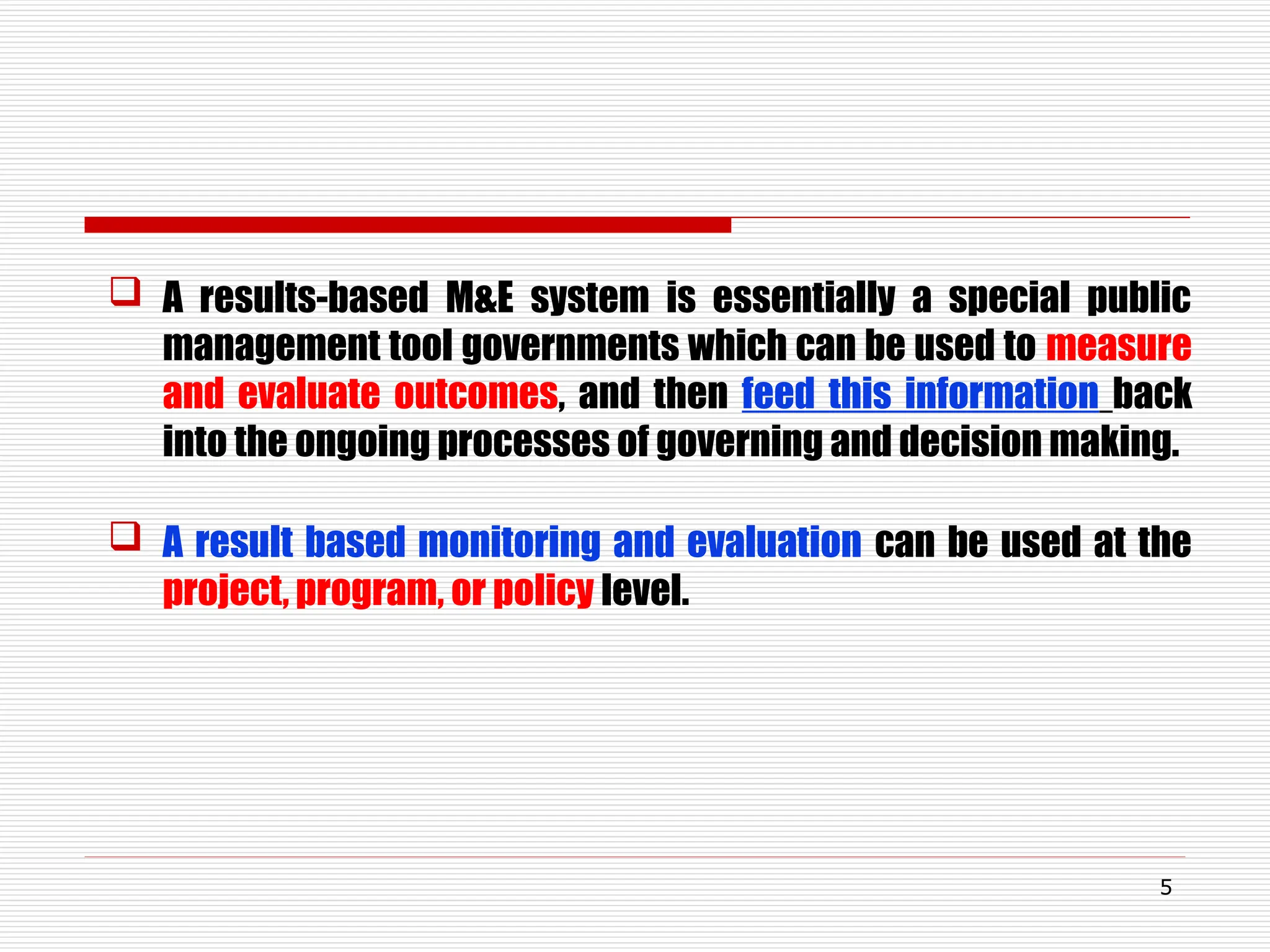
A results-basedM&E system is essentially a special public
management tool governments which can be used to measure
and evaluate outcomes, and then feed this information back
into the ongoing processes of governing and decision making.
A result based monitoring and evaluation can be used at the
project, program, or policy level.
5
6.
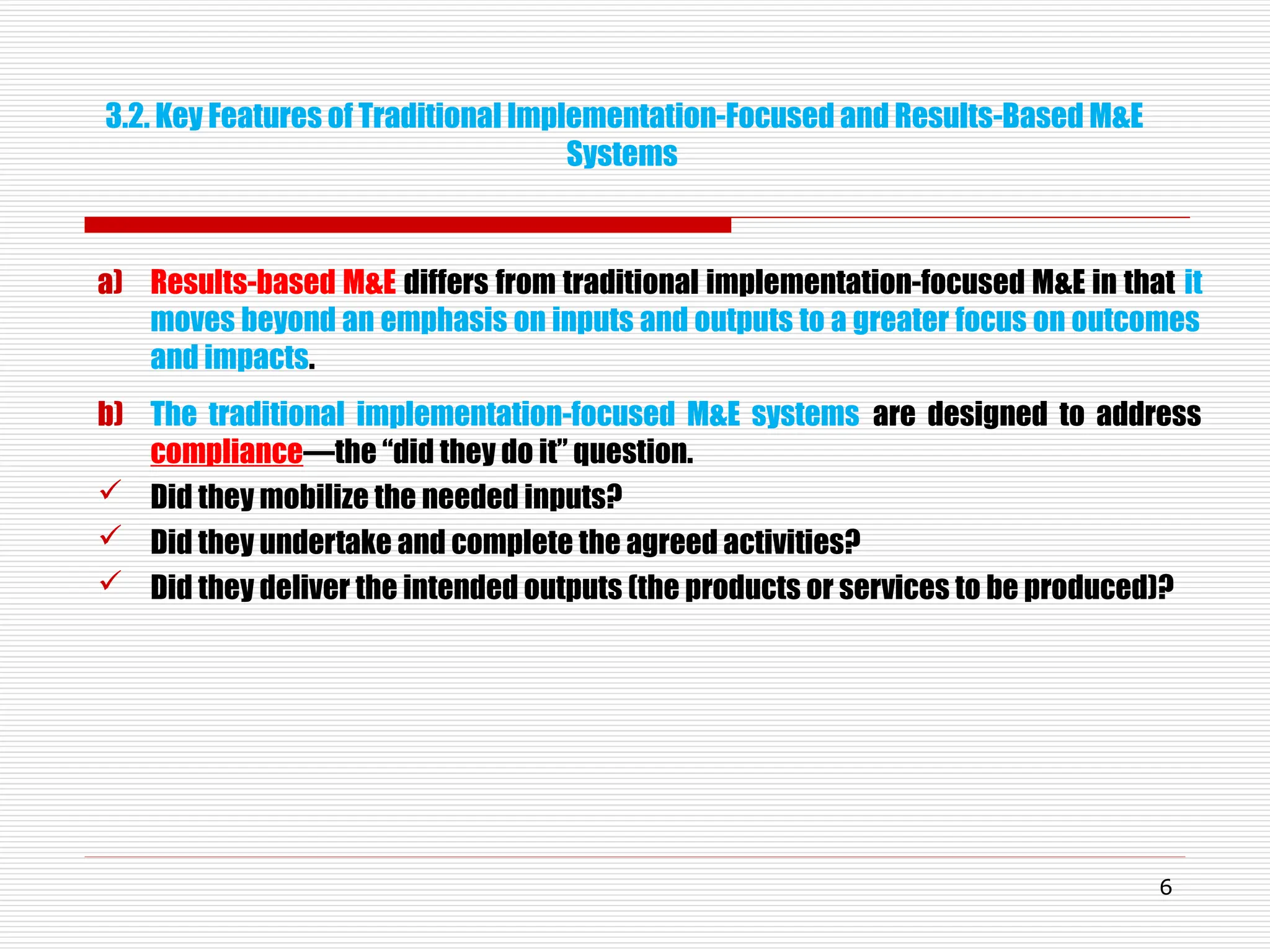
a) Results-based M&Ediffers from traditional implementation-focused M&E in that it
moves beyond an emphasis on inputs and outputs to a greater focus on outcomes
and impacts.
b) The traditional implementation-focused M&E systems are designed to address
compliance—the “did they do it” question.
Did they mobilize the needed inputs?
Did they undertake and complete the agreed activities?
Did they deliver the intended outputs (the products or services to be produced)?
6
3.2. Key Features of Traditional Implementation-Focused and Results-Based M&E
Systems
7.
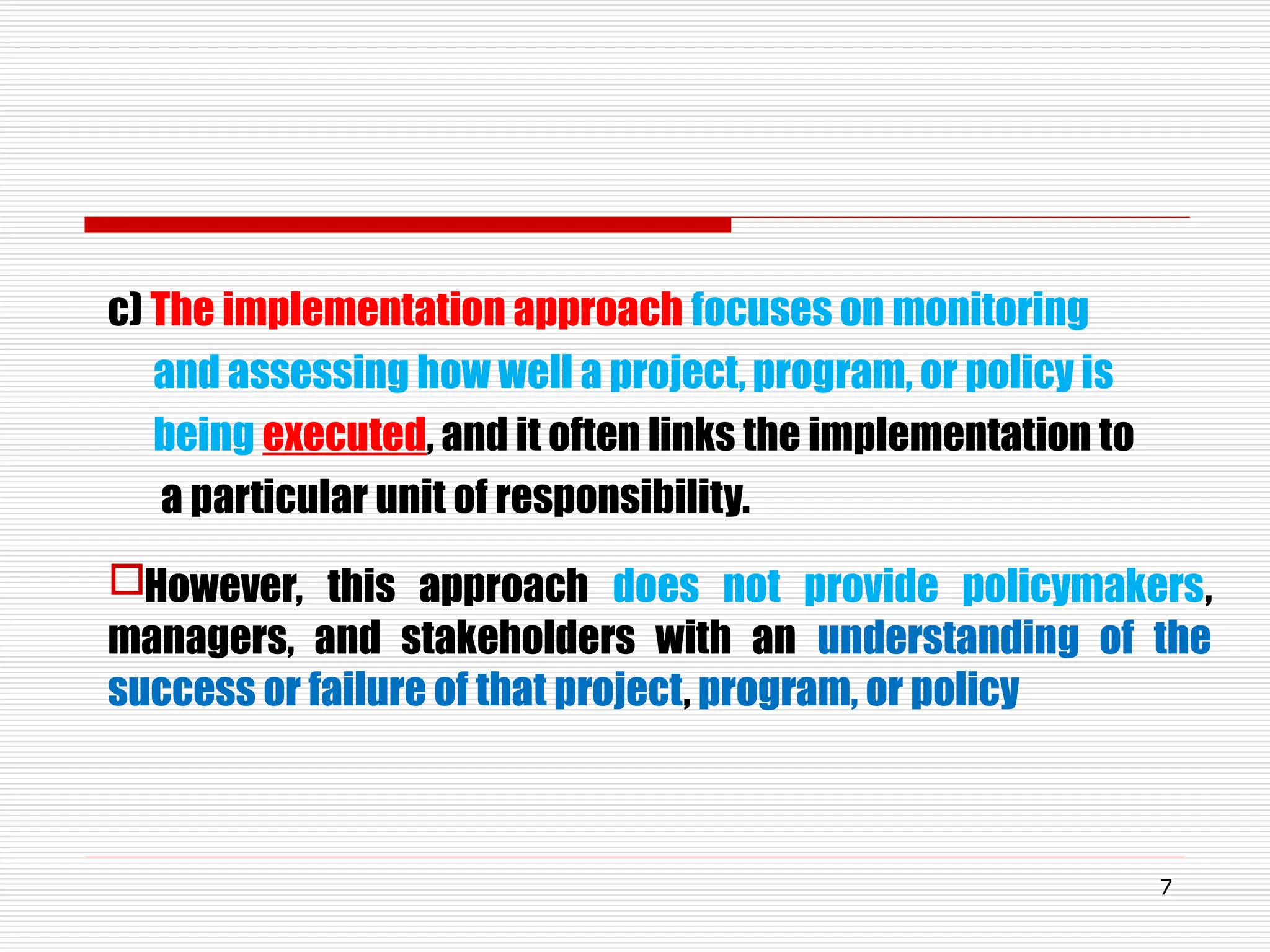
c) The implementationapproach focuses on monitoring
and assessing how well a project, program, or policy is
being executed, and it often links the implementation to
a particular unit of responsibility.
However, this approach does not provide policymakers,
managers, and stakeholders with an understanding of the
success or failure of that project, program, or policy
7
8.
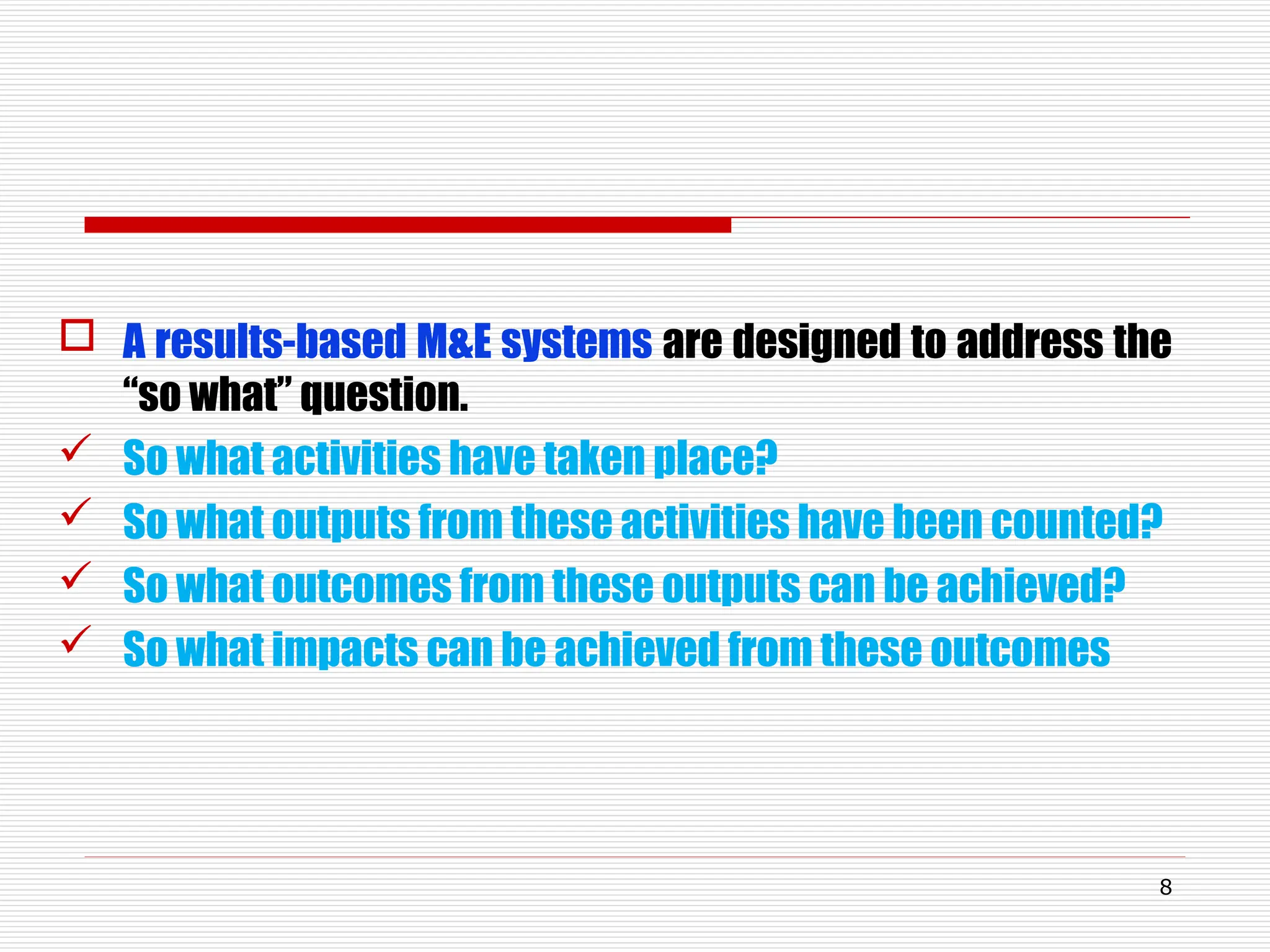
A results-basedM&E systems are designed to address the
“so what” question.
So what activities have taken place?
So what outputs from these activities have been counted?
So what outcomes from these outputs can be achieved?
So what impacts can be achieved from these outcomes
8
9.
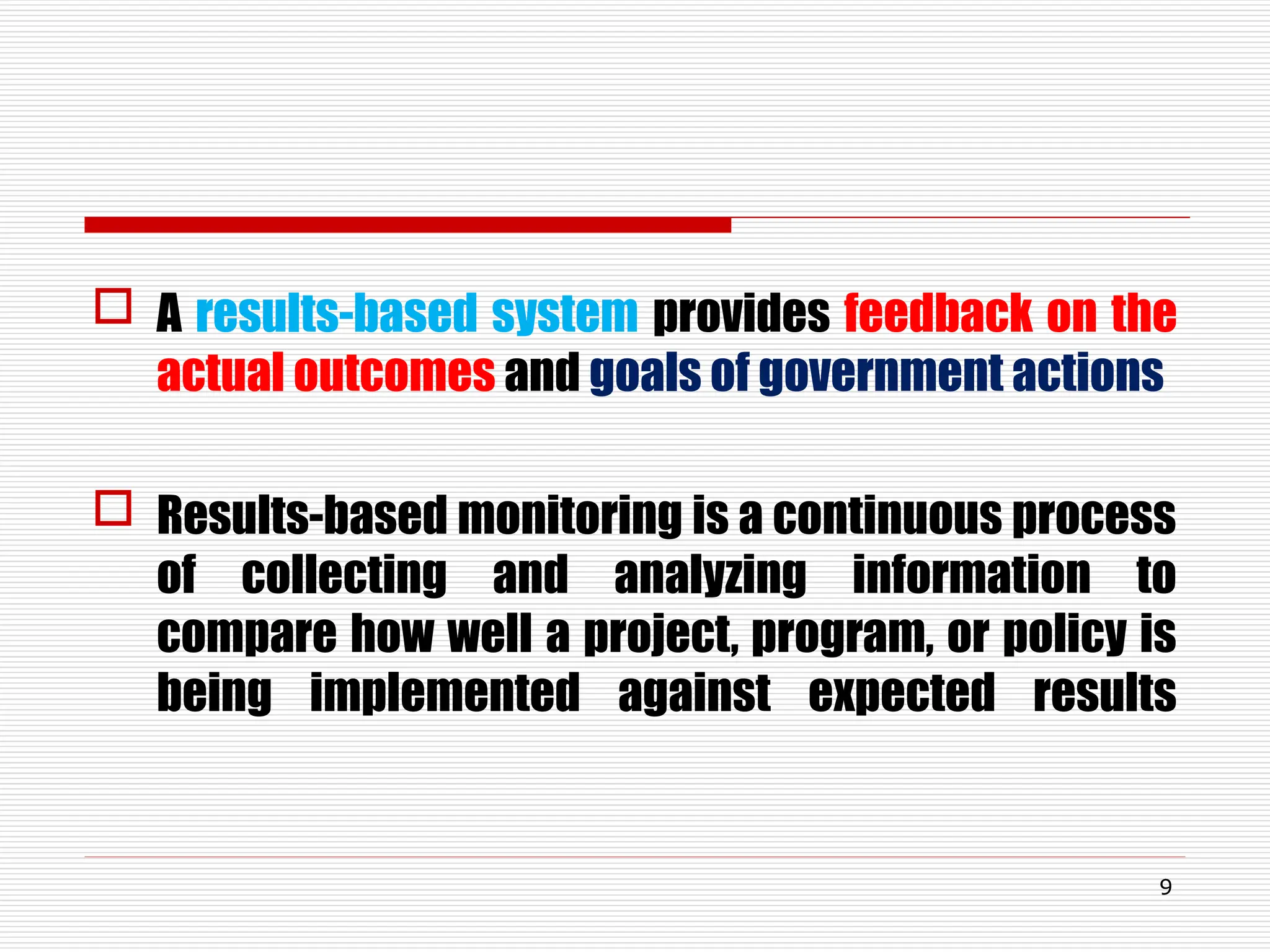
A results-basedsystem provides feedback on the
actual outcomes and goals of government actions
Results-based monitoring is a continuous process
of collecting and analyzing information to
compare how well a project, program, or policy is
being implemented against expected results
9
10.
10
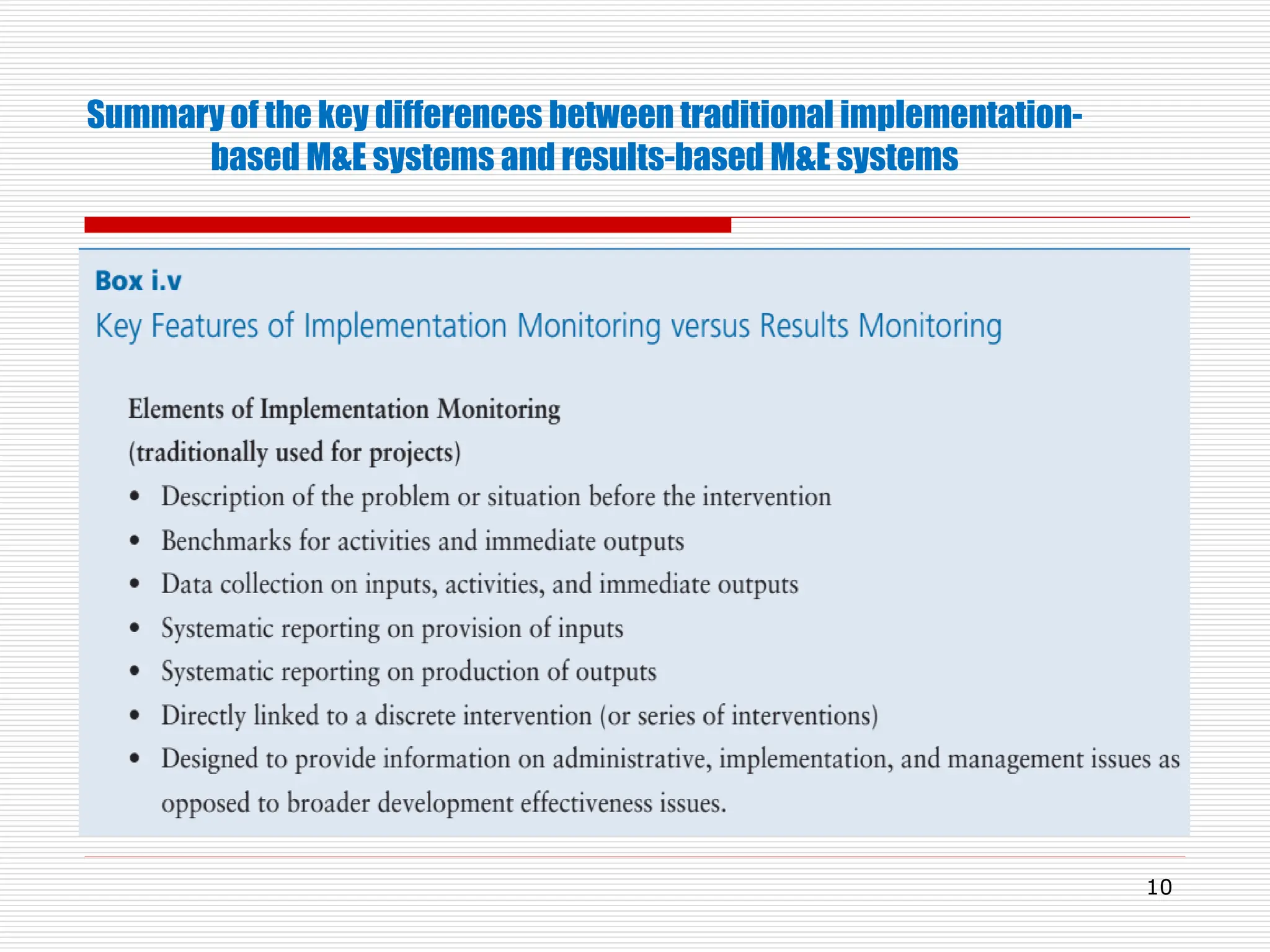
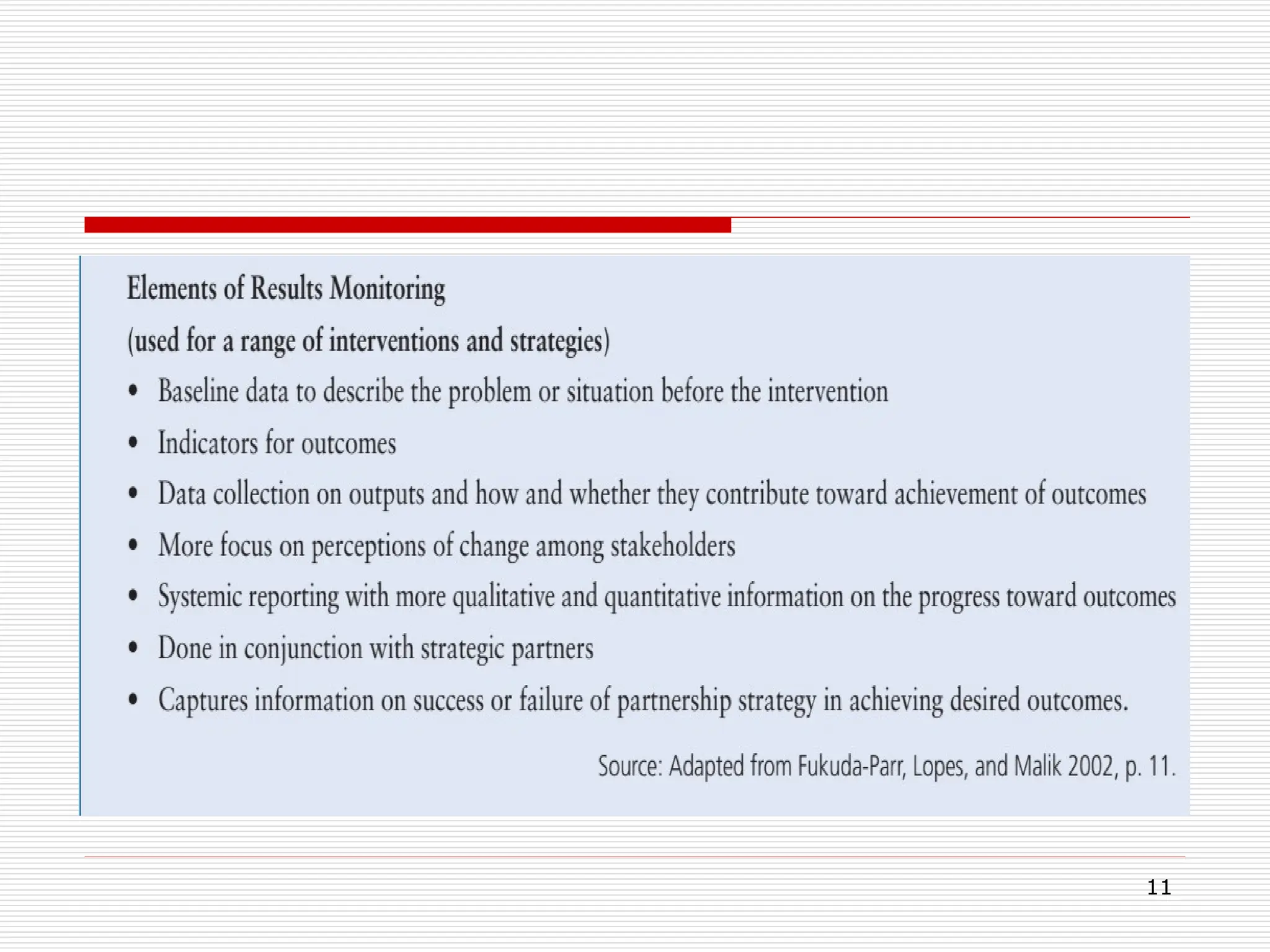
Summary of thekey differences between traditional implementation-
based M&E systems and results-based M&E systems
3.4 Approaches toResult based monitoring and Evaluation
system
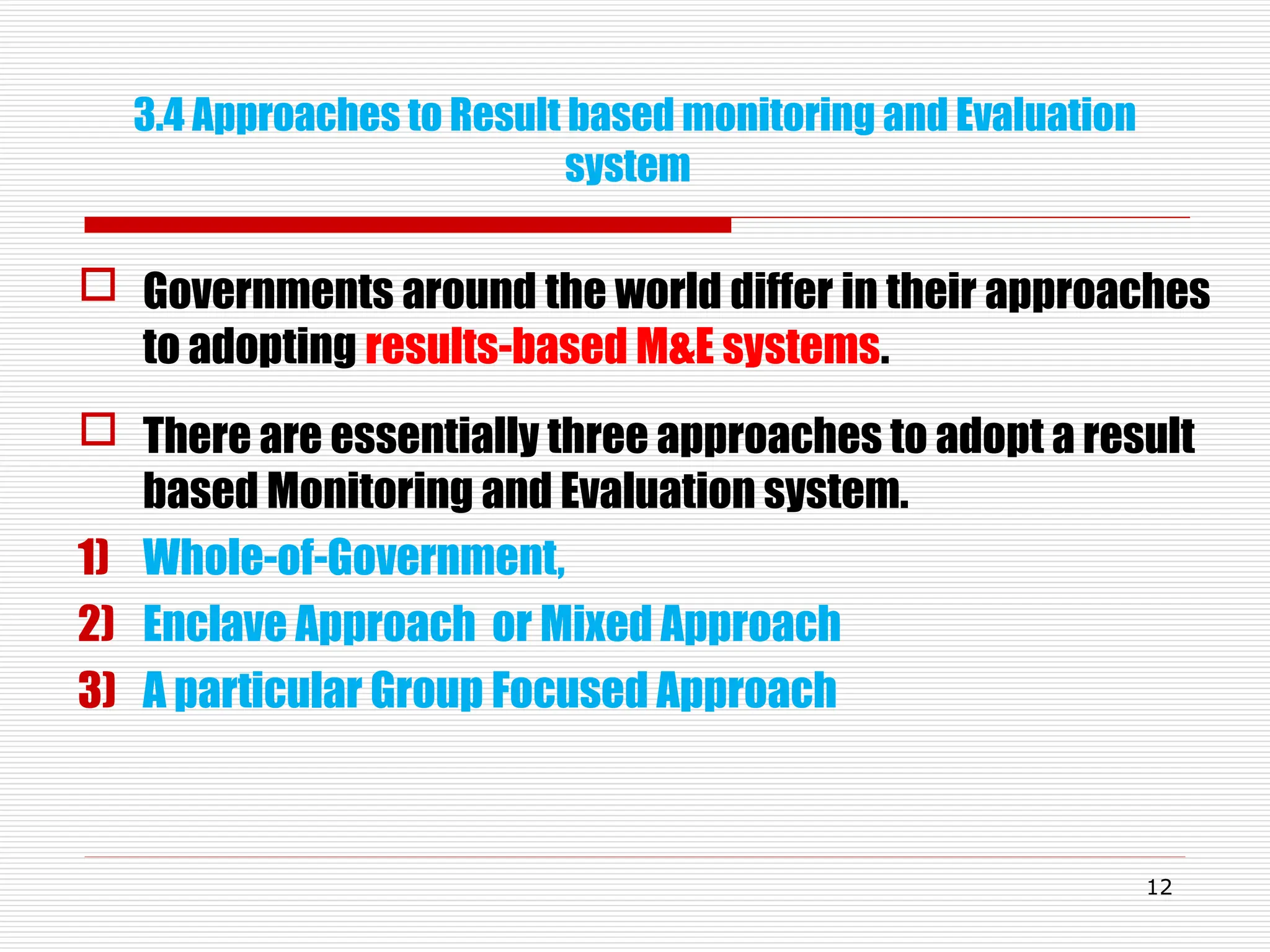
Governments around the world differ in their approaches
to adopting results-based M&E systems.
There are essentially three approaches to adopt a result
based Monitoring and Evaluation system.
1) Whole-of-Government,
2) Enclave Approach or Mixed Approach
3) A particular Group Focused Approach
12
13.
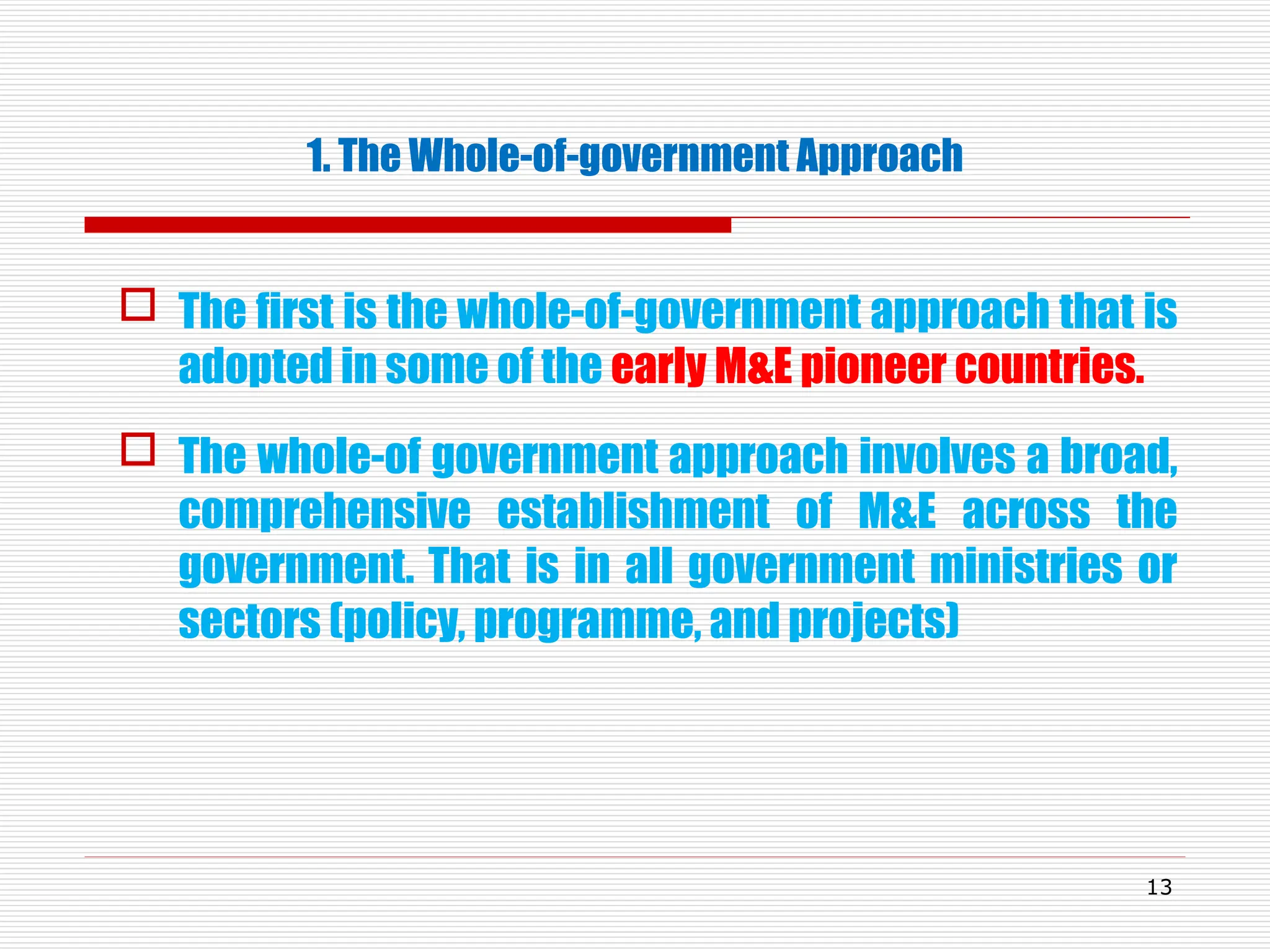
1. The Whole-of-governmentApproach
The first is the whole-of-government approach that is
adopted in some of the early M&E pioneer countries.
The whole-of government approach involves a broad,
comprehensive establishment of M&E across the
government. That is in all government ministries or
sectors (policy, programme, and projects)
13
14.
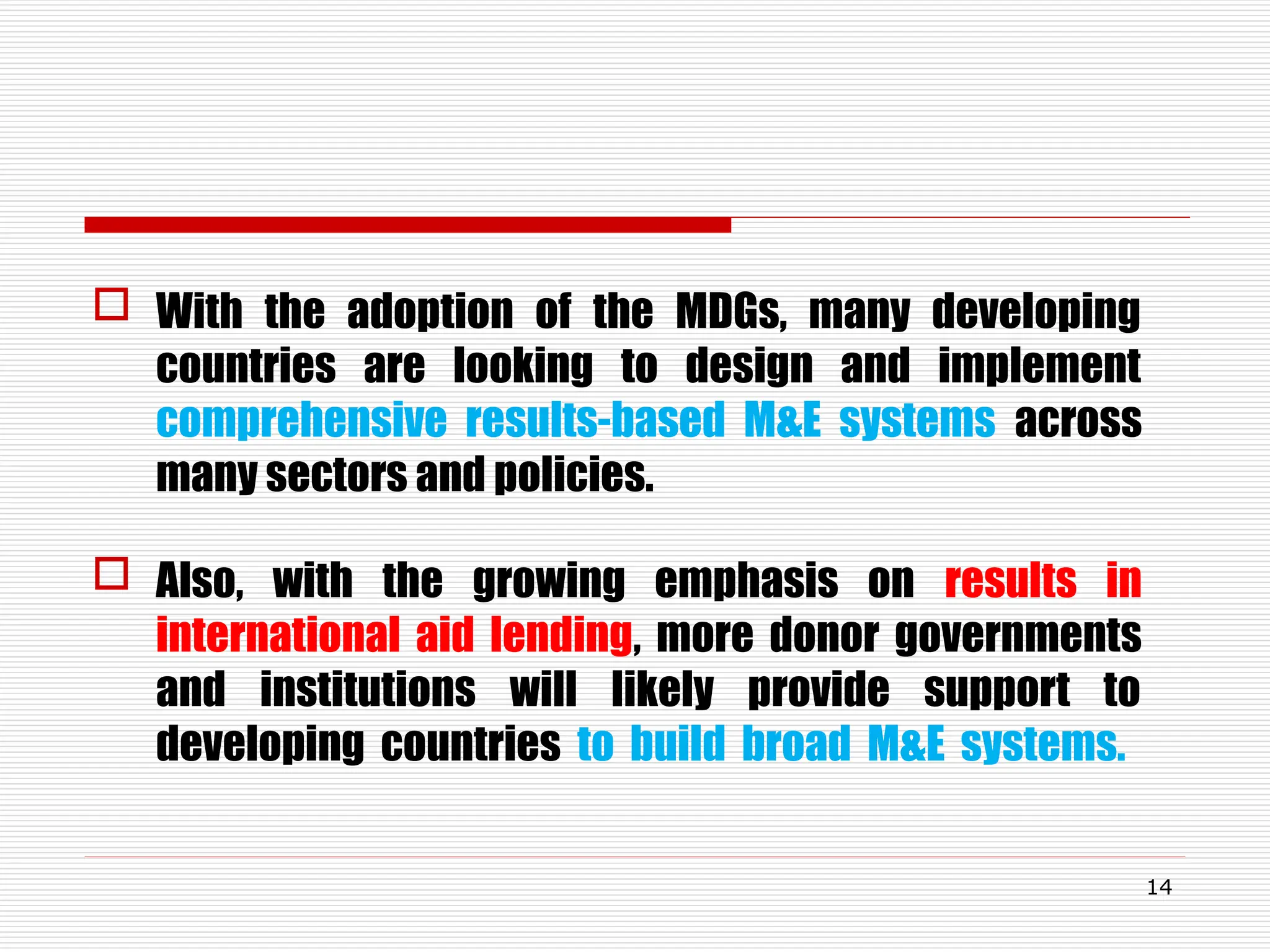
With theadoption of the MDGs, many developing
countries are looking to design and implement
comprehensive results-based M&E systems across
many sectors and policies.
Also, with the growing emphasis on results in
international aid lending, more donor governments
and institutions will likely provide support to
developing countries to build broad M&E systems.
14
15.
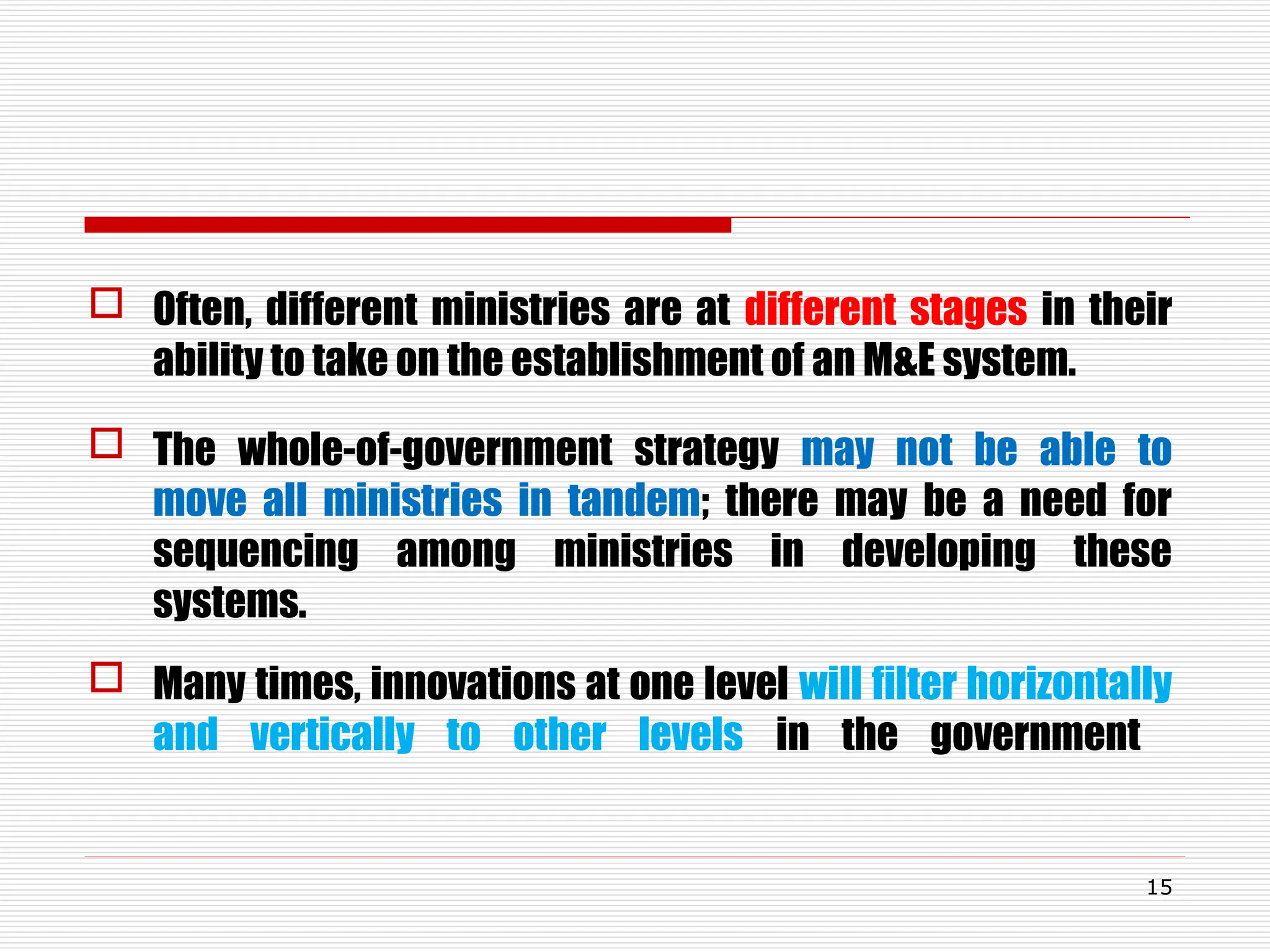
Often, differentministries are at different stages in their
ability to take on the establishment of an M&E system.
The whole-of-government strategy may not be able to
move all ministries in tandem; there may be a need for
sequencing among ministries in developing these
systems.
Many times, innovations at one level will filter horizontally
and vertically to other levels in the government
15
16.
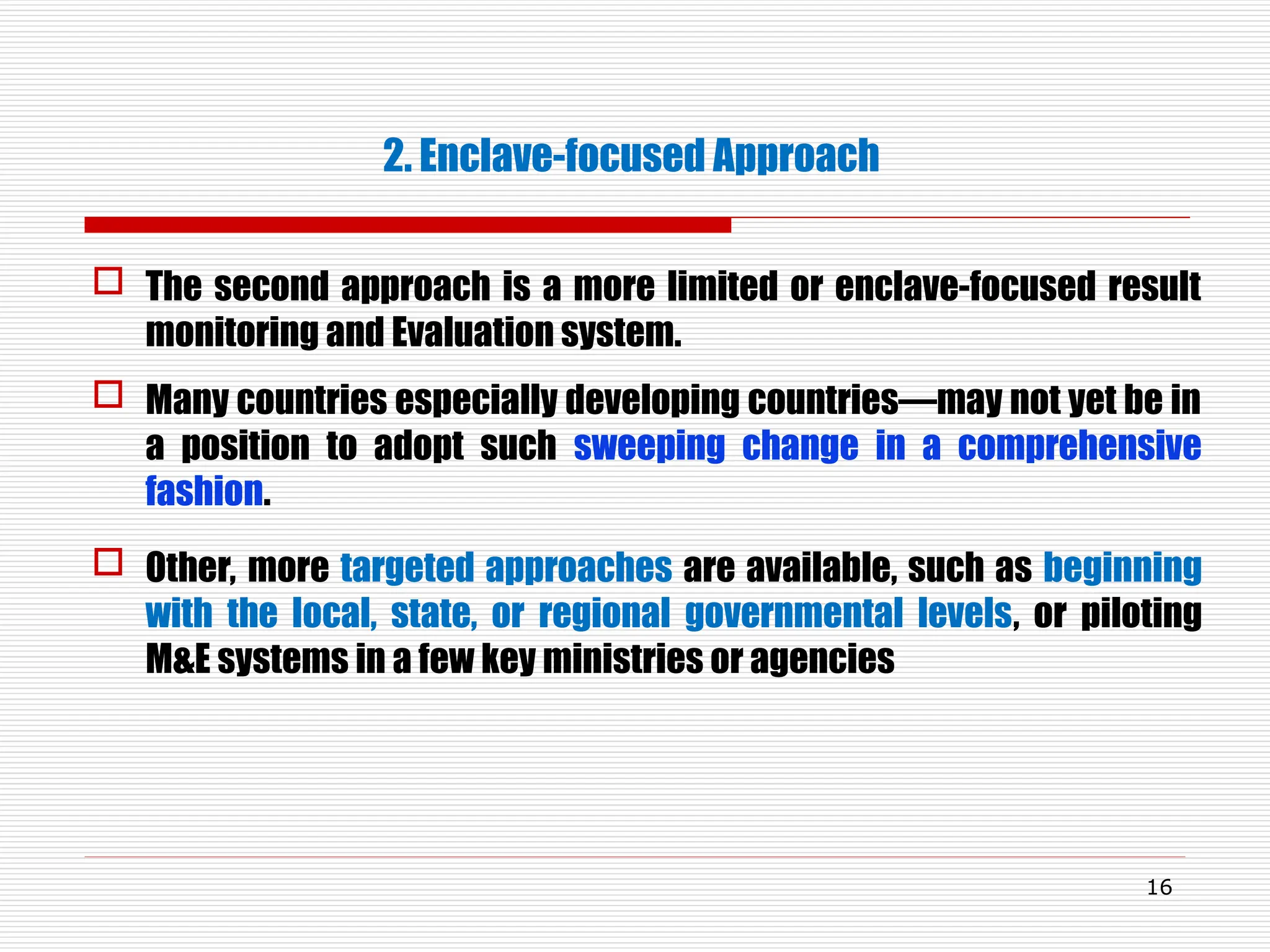
2. Enclave-focused Approach
The second approach is a more limited or enclave-focused result
monitoring and Evaluation system.
Many countries especially developing countries—may not yet be in
a position to adopt such sweeping change in a comprehensive
fashion.
Other, more targeted approaches are available, such as beginning
with the local, state, or regional governmental levels, or piloting
M&E systems in a few key ministries or agencies
16
17.
In ablended approach to M&E some projects are comprehensively
monitored and evaluated, while other areas receive more
sporadic attention.
This approach may be a plausible alternative for some developing
countries
Piloting of M&E systems is often recommended, regardless of
which approach is adopted.
The best strategy is to introduce M&E system into a country is to
first test a program in two or more pilot ministries or projects and
then scale it up.
17
18.
3 . Aparticular Customer Approach
Yet a third strategy for applying a results-oriented
program is a focus on a particular customer group.
Example: Focusing Resulted based monitoring and
Evaluation designed to improve its programs and
services to advance women’s issues.
Each line ministry is expected to identify its current
programs related to gender issues and assess the
performance of the programs.
18
19.
Therefore, countriesshould choose whether to adopt
a whole-of-government approach in instituting such
systems, or to begin by implementing an enclave
approach at only one level in a government, or within
a single ministry or small cluster of ministries.
19


![[DSC Europe 25] Debmalya Biswas - Agentification: the art of transforming man...](https://cdn.slidesharecdn.com/ss_thumbnails/r5azlggvtqiaiiusrqdr-4-251212103249-5a12c89b-thumbnail.jpg?width=640&height=640&fit=bounds)

![[DSC Europe 25] Hans Kleinsman - The Compliance Gearbox: How Tax Tech Mediate...](https://cdn.slidesharecdn.com/ss_thumbnails/dxdytie1toel0hr90bjs-2-251212103250-174fdbe7-thumbnail.jpg?width=640&height=640&fit=bounds)

![[DSC Europe 25] Branko Dzakula - From Defense to Attack: How AI Redefines Cyb...](https://cdn.slidesharecdn.com/ss_thumbnails/80bdzdxpr3ky2g0qvyk9-8-251211083048-ce5fc1ee-thumbnail.jpg?width=640&height=640&fit=bounds)


![[DSC Europe 25] Branko Urosevic -Rethinking Financial Talent: Integrating Cod...](https://cdn.slidesharecdn.com/ss_thumbnails/8jjrus8ttko6qj64f58f-3-251212103250-642c6374-thumbnail.jpg?width=640&height=640&fit=bounds)


![[DSC Europe 25] Uros Pesic - The Reality of AI in Marketing.pdf](https://cdn.slidesharecdn.com/ss_thumbnails/rtkodnmtycovsllvzsyn-9-251215095918-b0c6bfe3-thumbnail.jpg?width=640&height=640&fit=bounds)
![[DSC Europe 25] Behzad Hosseini - AI Agents in the Wild: Deploying Models tha...](https://cdn.slidesharecdn.com/ss_thumbnails/3qtejajvsjqrzwfept2c-10-251212103250-7f2b1068-thumbnail.jpg?width=640&height=640&fit=bounds)
![[DSC Europe 25] Kaja Kandare - LLM as a judge.pptx](https://cdn.slidesharecdn.com/ss_thumbnails/arxyccaxsdsd1ba99wjw-7-251212104007-2b4e3f64-thumbnail.jpg?width=640&height=640&fit=bounds)

![[DSC Europe 25] Ivan Peric - Intelligence Swarm Logic and Techno-Functional M...](https://cdn.slidesharecdn.com/ss_thumbnails/7my7c97fsduiccadgavw-2-251212103249-5a03f7c6-thumbnail.jpg?width=640&height=640&fit=bounds)
![[DSC Europe 25] Nikolay Burlutskiy - Best Practices for Building Enterprise M...](https://cdn.slidesharecdn.com/ss_thumbnails/uirvaiuvq8y1w8hzd9tx-7-251212103249-2619edb4-thumbnail.jpg?width=640&height=640&fit=bounds)