
CHAPTER 7:
INTERNATIONAL TRADE
FINANCING
MAJOR DR. MOHD ADIB ABD MUIN, IFP, CQIF (WEALTH MANAGEMENT)
SENIOR LECTURER
ISLAMIC BUSINESS SCHOOL (IBS), UUM
BWSB5053 Contemporary Islamic Banking - 2024
OUTLINE
BWSB5053
CONTEMPORARY
ISLAMIC
BANKING
2
 TYPES OF INTERNATIONAL TRADE FACILITIES.
 INTERNATIONAL TRADE PRACTICES.
 PROCEDURES INVOLVED.
International trade finance refers to the financial
support given by banks or other financial
institutions using a variety of financial tools, like
bank guarantees, letters of credit, to importers and
exporters to enable them carry out commercial
transactions without experiencing financial
hardships.
INTERNATIONAL TRADE FINANCING
4
BWSB5053
CONTEMPORARY
ISLAMIC
BANKING
 International trade financing is a critical component of global commerce,
facilitating the exchange of goods and services across borders.
 In Islamic finance, trade financing must comply with Shariah principles,
which prohibit interest (riba), excessive uncertainty (gharar), and
investments in haram (forbidden) activities.
 Shariah concept of Trade Financing - It refers to an arrangement to
purchase a commodity or asset on deferred payment term by way of
Murabahah (cost plus profit) or Musawamah (bargaining sale) from a
financier and subsequently sale the commodity/asset to a third party other
than the original seller on cash basis in order to obtain cash.
CONT..
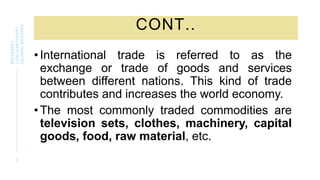
•International trade is referred to as the
exchange or trade of goods and services
between different nations. This kind of trade
contributes and increases the world economy.
•The most commonly traded commodities are
television sets, clothes, machinery, capital
goods, food, raw material, etc.
5
BWSB5053
CONTEMPORARY
ISLAMIC
BANKING
6
BWSB5053
CONTEMPORARY
ISLAMIC
BANKING
7
BWSB5053
CONTEMPORARY
ISLAMIC
BANKING
TYPES OF INTERNATIONAL TRADE
FACILITIES
oMalaysia, as a major player in global trade, offers various
international trade facilities to support exporters and
importers.
oThese facilities are provided by banks and financial
institutions to facilitate smooth and efficient trade
transactions.
8
BWSB5053
CONTEMPORARY
ISLAMIC
BANKING
TYPES OF INTERNATIONAL TRADE
FACILITIES
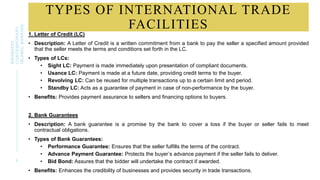
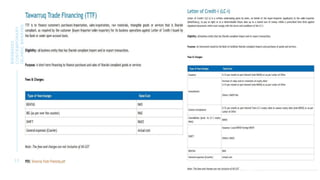
1. Letter of Credit (LC)
• Description: A Letter of Credit is a written commitment from a bank to pay the seller a specified amount provided
that the seller meets the terms and conditions set forth in the LC.
• Types of LCs:
• Sight LC: Payment is made immediately upon presentation of compliant documents.
• Usance LC: Payment is made at a future date, providing credit terms to the buyer.
• Revolving LC: Can be reused for multiple transactions up to a certain limit and period.
• Standby LC: Acts as a guarantee of payment in case of non-performance by the buyer.
• Benefits: Provides payment assurance to sellers and financing options to buyers.
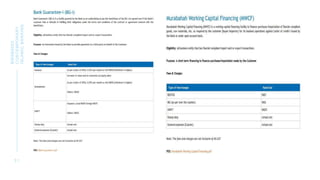
2. Bank Guarantees
• Description: A bank guarantee is a promise by the bank to cover a loss if the buyer or seller fails to meet
contractual obligations.
• Types of Bank Guarantees:
• Performance Guarantee: Ensures that the seller fulfills the terms of the contract.
• Advance Payment Guarantee: Protects the buyer’s advance payment if the seller fails to deliver.
• Bid Bond: Assures that the bidder will undertake the contract if awarded.
• Benefits: Enhances the credibility of businesses and provides security in trade transactions.
9
BWSB5053
CONTEMPORARY
ISLAMIC
BANKING
TYPES OF INTERNATIONAL TRADE
FACILITIES
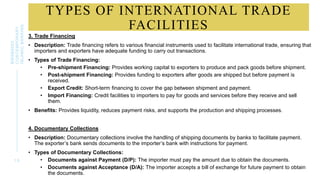
3. Trade Financing
• Description: Trade financing refers to various financial instruments used to facilitate international trade, ensuring that
importers and exporters have adequate funding to carry out transactions.
• Types of Trade Financing:
• Pre-shipment Financing: Provides working capital to exporters to produce and pack goods before shipment.
• Post-shipment Financing: Provides funding to exporters after goods are shipped but before payment is
received.
• Export Credit: Short-term financing to cover the gap between shipment and payment.
• Import Financing: Credit facilities to importers to pay for goods and services before they receive and sell
them.
• Benefits: Provides liquidity, reduces payment risks, and supports the production and shipping processes.
4. Documentary Collections
• Description: Documentary collections involve the handling of shipping documents by banks to facilitate payment.
The exporter’s bank sends documents to the importer’s bank with instructions for payment.
• Types of Documentary Collections:
• Documents against Payment (D/P): The importer must pay the amount due to obtain the documents.
• Documents against Acceptance (D/A): The importer accepts a bill of exchange for future payment to obtain
the documents.
1 0
BWSB5053
CONTEMPORARY
ISLAMIC
BANKING
TYPES OF INTERNATIONAL TRADE
FACILITIES
5. Export Credit Insurance
• Description: Export credit insurance protects exporters against the risk of non-payment by foreign
buyers due to commercial or political reasons.
• Benefits: Mitigates the risk of non-payment, encourages exporters to explore new markets, and
enhances the ability to obtain financing.
6. Factoring and Forfaiting
• Description: Factoring and forfaiting are financial services where the exporter sells receivables to a
third party (factor) at a discount.
• Factoring: Involves the sale of short-term receivables.
• Forfaiting: Involves the sale of medium- to long-term receivables.
• Benefits: Improves cash flow, reduces credit risk, and provides immediate working capital.
1 1
BWSB5053
CONTEMPORARY
ISLAMIC
BANKING
TYPES OF INTERNATIONAL TRADE
FACILITIES
7. Islamic Trade Finance
• Description: Islamic trade finance facilities comply with Shariah principles, avoiding interest
and ensuring ethical transactions.
• Types of Islamic Trade Finance:
• Murabaha: Cost-plus financing where the bank purchases goods and sells them to the
buyer at a profit margin.
• Ijara: Leasing arrangement where the bank leases equipment or assets to the client.
• Musharakah: Joint venture financing where profits and losses are shared according to
an agreed ratio.
• Istisna: Manufacturing contract where goods are produced and delivered at a future
date.
• Benefits: Provides Shariah-compliant financing options, promoting ethical trade practices.
1 2
BWSB5053
CONTEMPORARY
ISLAMIC
BANKING
INTERNATIONAL TRADE PRACTICES
1 3
BWSB5053
CONTEMPORARY
ISLAMIC
BANKING
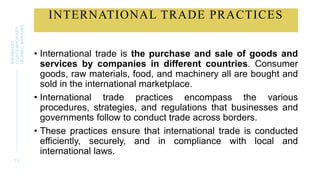
• International trade is the purchase and sale of goods and
services by companies in different countries. Consumer
goods, raw materials, food, and machinery all are bought and
sold in the international marketplace.
• International trade practices encompass the various
procedures, strategies, and regulations that businesses and
governments follow to conduct trade across borders.
• These practices ensure that international trade is conducted
efficiently, securely, and in compliance with local and
international laws.
INTERNATIONAL TRADE PRACTICES
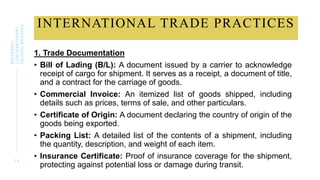
1. Trade Documentation
• Bill of Lading (B/L): A document issued by a carrier to acknowledge
receipt of cargo for shipment. It serves as a receipt, a document of title,
and a contract for the carriage of goods.
• Commercial Invoice: An itemized list of goods shipped, including
details such as prices, terms of sale, and other particulars.
• Certificate of Origin: A document declaring the country of origin of the
goods being exported.
• Packing List: A detailed list of the contents of a shipment, including
the quantity, description, and weight of each item.
• Insurance Certificate: Proof of insurance coverage for the shipment,
protecting against potential loss or damage during transit.
1 4
BWSB5053
CONTEMPORARY
ISLAMIC
BANKING
CONT…
2. Trade Financing and Payment Methods
• Letters of Credit (LCs): Financial instruments issued by a bank on
behalf of a buyer, guaranteeing payment to the seller upon
presentation of specified documents.
• Documentary Collections: A method where the seller’s bank
forwards documents to the buyer’s bank, which releases them to the
buyer against payment or acceptance of a bill of exchange.
• Open Account: The buyer pays the seller after receiving the goods,
typically within a set period.
• Advance Payment: The buyer pays the seller before the goods are
shipped.
1 5
BWSB5053
CONTEMPORARY
ISLAMIC
BANKING
CONT…
3. Incoterms (International Commercial Terms)
• EXW (Ex Works): The seller makes the goods available at their
premises, and the buyer bears all risks and costs from that point
onwards.
• FOB (Free on Board): The seller is responsible for delivering the
goods onto a vessel designated by the buyer. The buyer assumes all
risks and costs once the goods are on board.
• CIF (Cost, Insurance, and Freight): The seller covers the costs,
insurance, and freight to bring the goods to the port of destination. The
risk transfers to the buyer once the goods are on board the vessel.
• DAP (Delivered at Place): The seller delivers the goods to a specified
place, and the buyer is responsible for import duties and further
transportation.
1 6
BWSB5053
CONTEMPORARY
ISLAMIC
BANKING
CONT…
4. Customs Procedures
• Import and Export Licenses: Permissions required to import or
export certain goods, regulated by government authorities.
• Tariffs and Duties: Taxes imposed on imported goods, which vary by
country and product.
• Customs Declarations: Official statements providing details about the
goods being imported or exported, used for assessing tariffs and
ensuring compliance with regulations.
• HS Codes (Harmonized System Codes): A standardized numerical
method of classifying traded products, used by customs authorities to
identify goods and apply tariffs.
1 7
BWSB5053
CONTEMPORARY
ISLAMIC
BANKING
CONT…
5. Regulatory Compliance
• Sanctions and Embargoes: Legal restrictions on trade with specific
countries, entities, or individuals.
• Export Controls: Regulations governing the export of sensitive
technologies and goods that could impact national security.
• Anti-Dumping Laws: Measures to protect domestic industries from
foreign companies selling goods at unfairly low prices.
• Trade Agreements: Bilateral or multilateral agreements that facilitate
trade by reducing tariffs and other barriers.
1 8
BWSB5053
CONTEMPORARY
ISLAMIC
BANKING
CONT…
6. Risk Management
• Currency Risk: The potential for loss due to fluctuations in exchange
rates. Hedging strategies, such as forward contracts, can mitigate this
risk.
• Credit Risk: The risk that the buyer will not pay for the goods. Export
credit insurance and letters of credit can help manage this risk.
• Political Risk: The possibility of loss due to political instability or
changes in government policies. Political risk insurance can provide
protection.
1 9
BWSB5053
CONTEMPORARY
ISLAMIC
BANKING
CONT…
7. Trade Logistics and Supply Chain Management
• Freight Forwarding: The coordination of the shipment of goods from
the seller to the buyer, including transportation, customs clearance,
and warehousing.
• Warehousing and Distribution: The storage and management of
goods in warehouses, and their subsequent distribution to buyers.
• Transportation: The movement of goods by sea, air, road, or rail,
depending on the nature of the goods and the destination.
2 0
BWSB5053
CONTEMPORARY
ISLAMIC
BANKING
PROCEDURES INVOLVED IN ISLAMIC
TRADE FINANCING
• Islamic trade financing involves various procedures to
ensure compliance with Shariah principles, which prohibit
interest (riba) and ensure that all transactions are based on
tangible assets and ethical practices. Procedures involved in
Islamic trade financing:
2 1
BWSB5053
CONTEMPORARY
ISLAMIC
BANKING
PROCEDURES INVOLVED IN ISLAMIC
TRADE FINANCING:
1. Identification of Trade Financing Needs
• Assessment of Requirements: The business identifies its trade
financing needs, such as the purchase of raw materials, machinery, or
goods for resale.
• Selection of Islamic Financing Mode: Based on the nature of the
transaction, an appropriate Islamic financing mode is selected, such as
Murabaha, Ijara, or Musharakah.
2 2
BWSB5053
CONTEMPORARY
ISLAMIC
BANKING
CONT…
2. Murabaha (Cost-Plus Financing)
• Application and Approval: The business applies for Murabaha
financing with an Islamic bank, providing details of the goods to be
purchased.
• Purchase Order: Upon approval, the Islamic bank issues a purchase
order to the supplier to buy the goods on behalf of the business.
• Purchase and Ownership Transfer: The bank purchases the goods
from the supplier and takes ownership.
• Sale to the Business: The bank sells the goods to the business at a
cost-plus profit margin, which is agreed upon in advance.
• Repayment: The business repays the bank in installments or a lump
sum, as per the agreed terms.
2 3
BWSB5053
CONTEMPORARY
ISLAMIC
BANKING
CONT…
3. Ijara (Leasing)
• Application and Approval: The business applies for Ijara financing to
lease equipment, machinery, or other assets.
• Purchase and Lease Agreement: Upon approval, the Islamic bank
purchases the asset and enters into a lease agreement with the
business.
• Use of Asset: The business uses the asset and makes periodic lease
payments to the bank.
• Transfer of Ownership: At the end of the lease term, ownership of the
asset may be transferred to the business, if agreed upon (Ijara wa
Iqtina).
2 4
BWSB5053
CONTEMPORARY
ISLAMIC
BANKING
CONT…
4. Musharakah (Partnership)
• Partnership Agreement: The business and the Islamic bank enter
into a partnership agreement, where both parties contribute capital to a
joint venture.
• Project Execution: The business executes the project or trade activity
using the contributed capital.
• Profit and Loss Sharing: Profits are shared according to the pre-
agreed ratio, while losses are shared in proportion to the capital
contribution.
• Dissolution or Continuation: The partnership may be dissolved after
the project is completed, or it may continue for further business
activities.
2 5
BWSB5053
CONTEMPORARY
ISLAMIC
BANKING
CONT…
5. Istisna (Manufacturing Contract)
• Contract Agreement: The business enters into an Istisna contract
with the Islamic bank for the manufacture or construction of specific
goods or assets.
• Advance Payment: The business may make an advance payment to
the bank to initiate the manufacturing process.
• Manufacturing and Delivery: The Islamic bank arranges for the
manufacturing or construction of the goods/assets and delivers them to
the business.
• Payment: The business makes installment payments or a lump sum
payment upon completion and delivery of the goods/assets.
2 6
BWSB5053
CONTEMPORARY
ISLAMIC
BANKING
CONT…
6. Salam (Advance Payment Contract)
• Contract Agreement: The business enters into a Salam contract with
the Islamic bank, agreeing to purchase goods to be delivered at a
future date.
• Advance Payment: The business makes full payment in advance to
the bank.
• Delivery of Goods: The Islamic bank arranges for the delivery of the
specified goods at the agreed future date.
• Receipt of Goods: The business receives the goods as per the
contract terms.
2 7
BWSB5053
CONTEMPORARY
ISLAMIC
BANKING
CONT…
7. Wakalah (Agency Agreement)
• Agency Agreement: The business appoints the Islamic bank as its
agent to carry out trade transactions on its behalf.
• Fund Provision: The business provides the necessary funds to the
bank for purchasing goods or services.
• Trade Execution: The bank executes the trade transactions as per the
business's instructions.
• Reporting and Settlement: The bank reports the trade activities and
settlements to the business, along with any profits earned.
2 8
BWSB5053
CONTEMPORARY
ISLAMIC
BANKING
What is the difference between international finance
and international trade?
• International trade is a field in economics that applies
microeconomic models to help understand the
international economy. International finance focuses
on the interrelationships among aggregate economic
variables such as GDP, unemployment, inflation,
trade balances, exchange rates, and so on.
2 9
BWSB5053
CONTEMPORARY
ISLAMIC
BANKING
CONCLUSION
• Islamic trade financing involves a series of procedures that ensure
compliance with Shariah principles. These procedures include
assessing trade financing needs, selecting the appropriate financing
mode (such as Murabaha, Ijara, Musharakah, Istisna, Salam, or
Wakalah), and following the specific steps involved in each financing
mode. By adhering to these procedures, Islamic banks and businesses
can engage in trade activities that are ethical, transparent, and
compliant with Islamic law.
• International trade practices involve a complex set of procedures and
regulations designed to facilitate the smooth and secure exchange of
goods and services across borders. Key aspects include trade
documentation, financing and payment methods, Incoterms, customs
procedures, regulatory compliance, risk management, and logistics. By
understanding and adhering to these practices, businesses can
effectively navigate the global marketplace, minimize risks, and ensure
3 0
BWSB5053
CONTEMPORARY
ISLAMIC
BANKING
3 1
BWSB5053
CONTEMPORARY
ISLAMIC
BANKING
3 2
BWSB5053
CONTEMPORARY
ISLAMIC
BANKING
REFERENCES
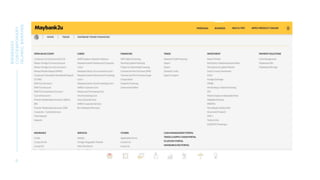
• https://www.maybank2u.com.my/maybank2u/malaysia/en/business/oth
ers/maybank_sme.page?gad_source=1&gclid=CjwKCAjwvvmzBhA2Ei
wAtHVrb_XEssp6Akcm9-0M2Qv8wrH-
PeUiWiQb6X47O7TfXldhpGMd03dbohoCKBAQAvD_BwE
• https://www.rhbgroup.com/islamic/imports-exports/trade-
financing/index.html
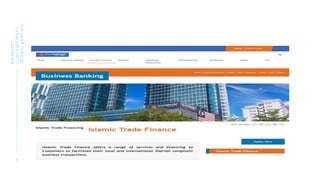
• https://www.bankrakyat.com.my/c/business/islamic_trade_financing/isl
amic_trade_finance-1
3 3
BWSB5053
CONTEMPORARY
ISLAMIC
BANKING
DR. MOHD ADIB ABD MUIN
mohdadib@uum.edu.my | +60134054974

CHAPTER 7 - International Trade Financing.pptx

  • 1.
    CHAPTER 7: INTERNATIONAL TRADE FINANCING MAJORDR. MOHD ADIB ABD MUIN, IFP, CQIF (WEALTH MANAGEMENT) SENIOR LECTURER ISLAMIC BUSINESS SCHOOL (IBS), UUM BWSB5053 Contemporary Islamic Banking - 2024
  • 2.
    OUTLINE BWSB5053 CONTEMPORARY ISLAMIC BANKING 2  TYPES OFINTERNATIONAL TRADE FACILITIES.  INTERNATIONAL TRADE PRACTICES.  PROCEDURES INVOLVED.
  • 3.
    International trade financerefers to the financial support given by banks or other financial institutions using a variety of financial tools, like bank guarantees, letters of credit, to importers and exporters to enable them carry out commercial transactions without experiencing financial hardships.
  • 4.
    INTERNATIONAL TRADE FINANCING 4 BWSB5053 CONTEMPORARY ISLAMIC BANKING International trade financing is a critical component of global commerce, facilitating the exchange of goods and services across borders.  In Islamic finance, trade financing must comply with Shariah principles, which prohibit interest (riba), excessive uncertainty (gharar), and investments in haram (forbidden) activities.  Shariah concept of Trade Financing - It refers to an arrangement to purchase a commodity or asset on deferred payment term by way of Murabahah (cost plus profit) or Musawamah (bargaining sale) from a financier and subsequently sale the commodity/asset to a third party other than the original seller on cash basis in order to obtain cash.
  • 5.
    CONT.. •International trade isreferred to as the exchange or trade of goods and services between different nations. This kind of trade contributes and increases the world economy. •The most commonly traded commodities are television sets, clothes, machinery, capital goods, food, raw material, etc. 5 BWSB5053 CONTEMPORARY ISLAMIC BANKING
  • 6.
  • 7.
  • 8.
    TYPES OF INTERNATIONALTRADE FACILITIES oMalaysia, as a major player in global trade, offers various international trade facilities to support exporters and importers. oThese facilities are provided by banks and financial institutions to facilitate smooth and efficient trade transactions. 8 BWSB5053 CONTEMPORARY ISLAMIC BANKING
  • 9.
    TYPES OF INTERNATIONALTRADE FACILITIES 1. Letter of Credit (LC) • Description: A Letter of Credit is a written commitment from a bank to pay the seller a specified amount provided that the seller meets the terms and conditions set forth in the LC. • Types of LCs: • Sight LC: Payment is made immediately upon presentation of compliant documents. • Usance LC: Payment is made at a future date, providing credit terms to the buyer. • Revolving LC: Can be reused for multiple transactions up to a certain limit and period. • Standby LC: Acts as a guarantee of payment in case of non-performance by the buyer. • Benefits: Provides payment assurance to sellers and financing options to buyers. 2. Bank Guarantees • Description: A bank guarantee is a promise by the bank to cover a loss if the buyer or seller fails to meet contractual obligations. • Types of Bank Guarantees: • Performance Guarantee: Ensures that the seller fulfills the terms of the contract. • Advance Payment Guarantee: Protects the buyer’s advance payment if the seller fails to deliver. • Bid Bond: Assures that the bidder will undertake the contract if awarded. • Benefits: Enhances the credibility of businesses and provides security in trade transactions. 9 BWSB5053 CONTEMPORARY ISLAMIC BANKING
  • 10.
    TYPES OF INTERNATIONALTRADE FACILITIES 3. Trade Financing • Description: Trade financing refers to various financial instruments used to facilitate international trade, ensuring that importers and exporters have adequate funding to carry out transactions. • Types of Trade Financing: • Pre-shipment Financing: Provides working capital to exporters to produce and pack goods before shipment. • Post-shipment Financing: Provides funding to exporters after goods are shipped but before payment is received. • Export Credit: Short-term financing to cover the gap between shipment and payment. • Import Financing: Credit facilities to importers to pay for goods and services before they receive and sell them. • Benefits: Provides liquidity, reduces payment risks, and supports the production and shipping processes. 4. Documentary Collections • Description: Documentary collections involve the handling of shipping documents by banks to facilitate payment. The exporter’s bank sends documents to the importer’s bank with instructions for payment. • Types of Documentary Collections: • Documents against Payment (D/P): The importer must pay the amount due to obtain the documents. • Documents against Acceptance (D/A): The importer accepts a bill of exchange for future payment to obtain the documents. 1 0 BWSB5053 CONTEMPORARY ISLAMIC BANKING
  • 11.
    TYPES OF INTERNATIONALTRADE FACILITIES 5. Export Credit Insurance • Description: Export credit insurance protects exporters against the risk of non-payment by foreign buyers due to commercial or political reasons. • Benefits: Mitigates the risk of non-payment, encourages exporters to explore new markets, and enhances the ability to obtain financing. 6. Factoring and Forfaiting • Description: Factoring and forfaiting are financial services where the exporter sells receivables to a third party (factor) at a discount. • Factoring: Involves the sale of short-term receivables. • Forfaiting: Involves the sale of medium- to long-term receivables. • Benefits: Improves cash flow, reduces credit risk, and provides immediate working capital. 1 1 BWSB5053 CONTEMPORARY ISLAMIC BANKING
  • 12.
    TYPES OF INTERNATIONALTRADE FACILITIES 7. Islamic Trade Finance • Description: Islamic trade finance facilities comply with Shariah principles, avoiding interest and ensuring ethical transactions. • Types of Islamic Trade Finance: • Murabaha: Cost-plus financing where the bank purchases goods and sells them to the buyer at a profit margin. • Ijara: Leasing arrangement where the bank leases equipment or assets to the client. • Musharakah: Joint venture financing where profits and losses are shared according to an agreed ratio. • Istisna: Manufacturing contract where goods are produced and delivered at a future date. • Benefits: Provides Shariah-compliant financing options, promoting ethical trade practices. 1 2 BWSB5053 CONTEMPORARY ISLAMIC BANKING
  • 13.
    INTERNATIONAL TRADE PRACTICES 13 BWSB5053 CONTEMPORARY ISLAMIC BANKING • International trade is the purchase and sale of goods and services by companies in different countries. Consumer goods, raw materials, food, and machinery all are bought and sold in the international marketplace. • International trade practices encompass the various procedures, strategies, and regulations that businesses and governments follow to conduct trade across borders. • These practices ensure that international trade is conducted efficiently, securely, and in compliance with local and international laws.
  • 14.
    INTERNATIONAL TRADE PRACTICES 1.Trade Documentation • Bill of Lading (B/L): A document issued by a carrier to acknowledge receipt of cargo for shipment. It serves as a receipt, a document of title, and a contract for the carriage of goods. • Commercial Invoice: An itemized list of goods shipped, including details such as prices, terms of sale, and other particulars. • Certificate of Origin: A document declaring the country of origin of the goods being exported. • Packing List: A detailed list of the contents of a shipment, including the quantity, description, and weight of each item. • Insurance Certificate: Proof of insurance coverage for the shipment, protecting against potential loss or damage during transit. 1 4 BWSB5053 CONTEMPORARY ISLAMIC BANKING
  • 15.
    CONT… 2. Trade Financingand Payment Methods • Letters of Credit (LCs): Financial instruments issued by a bank on behalf of a buyer, guaranteeing payment to the seller upon presentation of specified documents. • Documentary Collections: A method where the seller’s bank forwards documents to the buyer’s bank, which releases them to the buyer against payment or acceptance of a bill of exchange. • Open Account: The buyer pays the seller after receiving the goods, typically within a set period. • Advance Payment: The buyer pays the seller before the goods are shipped. 1 5 BWSB5053 CONTEMPORARY ISLAMIC BANKING
  • 16.
    CONT… 3. Incoterms (InternationalCommercial Terms) • EXW (Ex Works): The seller makes the goods available at their premises, and the buyer bears all risks and costs from that point onwards. • FOB (Free on Board): The seller is responsible for delivering the goods onto a vessel designated by the buyer. The buyer assumes all risks and costs once the goods are on board. • CIF (Cost, Insurance, and Freight): The seller covers the costs, insurance, and freight to bring the goods to the port of destination. The risk transfers to the buyer once the goods are on board the vessel. • DAP (Delivered at Place): The seller delivers the goods to a specified place, and the buyer is responsible for import duties and further transportation. 1 6 BWSB5053 CONTEMPORARY ISLAMIC BANKING
  • 17.
    CONT… 4. Customs Procedures •Import and Export Licenses: Permissions required to import or export certain goods, regulated by government authorities. • Tariffs and Duties: Taxes imposed on imported goods, which vary by country and product. • Customs Declarations: Official statements providing details about the goods being imported or exported, used for assessing tariffs and ensuring compliance with regulations. • HS Codes (Harmonized System Codes): A standardized numerical method of classifying traded products, used by customs authorities to identify goods and apply tariffs. 1 7 BWSB5053 CONTEMPORARY ISLAMIC BANKING
  • 18.
    CONT… 5. Regulatory Compliance •Sanctions and Embargoes: Legal restrictions on trade with specific countries, entities, or individuals. • Export Controls: Regulations governing the export of sensitive technologies and goods that could impact national security. • Anti-Dumping Laws: Measures to protect domestic industries from foreign companies selling goods at unfairly low prices. • Trade Agreements: Bilateral or multilateral agreements that facilitate trade by reducing tariffs and other barriers. 1 8 BWSB5053 CONTEMPORARY ISLAMIC BANKING
  • 19.
    CONT… 6. Risk Management •Currency Risk: The potential for loss due to fluctuations in exchange rates. Hedging strategies, such as forward contracts, can mitigate this risk. • Credit Risk: The risk that the buyer will not pay for the goods. Export credit insurance and letters of credit can help manage this risk. • Political Risk: The possibility of loss due to political instability or changes in government policies. Political risk insurance can provide protection. 1 9 BWSB5053 CONTEMPORARY ISLAMIC BANKING
  • 20.
    CONT… 7. Trade Logisticsand Supply Chain Management • Freight Forwarding: The coordination of the shipment of goods from the seller to the buyer, including transportation, customs clearance, and warehousing. • Warehousing and Distribution: The storage and management of goods in warehouses, and their subsequent distribution to buyers. • Transportation: The movement of goods by sea, air, road, or rail, depending on the nature of the goods and the destination. 2 0 BWSB5053 CONTEMPORARY ISLAMIC BANKING
  • 21.
    PROCEDURES INVOLVED INISLAMIC TRADE FINANCING • Islamic trade financing involves various procedures to ensure compliance with Shariah principles, which prohibit interest (riba) and ensure that all transactions are based on tangible assets and ethical practices. Procedures involved in Islamic trade financing: 2 1 BWSB5053 CONTEMPORARY ISLAMIC BANKING
  • 22.
    PROCEDURES INVOLVED INISLAMIC TRADE FINANCING: 1. Identification of Trade Financing Needs • Assessment of Requirements: The business identifies its trade financing needs, such as the purchase of raw materials, machinery, or goods for resale. • Selection of Islamic Financing Mode: Based on the nature of the transaction, an appropriate Islamic financing mode is selected, such as Murabaha, Ijara, or Musharakah. 2 2 BWSB5053 CONTEMPORARY ISLAMIC BANKING
  • 23.
    CONT… 2. Murabaha (Cost-PlusFinancing) • Application and Approval: The business applies for Murabaha financing with an Islamic bank, providing details of the goods to be purchased. • Purchase Order: Upon approval, the Islamic bank issues a purchase order to the supplier to buy the goods on behalf of the business. • Purchase and Ownership Transfer: The bank purchases the goods from the supplier and takes ownership. • Sale to the Business: The bank sells the goods to the business at a cost-plus profit margin, which is agreed upon in advance. • Repayment: The business repays the bank in installments or a lump sum, as per the agreed terms. 2 3 BWSB5053 CONTEMPORARY ISLAMIC BANKING
  • 24.
    CONT… 3. Ijara (Leasing) •Application and Approval: The business applies for Ijara financing to lease equipment, machinery, or other assets. • Purchase and Lease Agreement: Upon approval, the Islamic bank purchases the asset and enters into a lease agreement with the business. • Use of Asset: The business uses the asset and makes periodic lease payments to the bank. • Transfer of Ownership: At the end of the lease term, ownership of the asset may be transferred to the business, if agreed upon (Ijara wa Iqtina). 2 4 BWSB5053 CONTEMPORARY ISLAMIC BANKING
  • 25.
    CONT… 4. Musharakah (Partnership) •Partnership Agreement: The business and the Islamic bank enter into a partnership agreement, where both parties contribute capital to a joint venture. • Project Execution: The business executes the project or trade activity using the contributed capital. • Profit and Loss Sharing: Profits are shared according to the pre- agreed ratio, while losses are shared in proportion to the capital contribution. • Dissolution or Continuation: The partnership may be dissolved after the project is completed, or it may continue for further business activities. 2 5 BWSB5053 CONTEMPORARY ISLAMIC BANKING
  • 26.
    CONT… 5. Istisna (ManufacturingContract) • Contract Agreement: The business enters into an Istisna contract with the Islamic bank for the manufacture or construction of specific goods or assets. • Advance Payment: The business may make an advance payment to the bank to initiate the manufacturing process. • Manufacturing and Delivery: The Islamic bank arranges for the manufacturing or construction of the goods/assets and delivers them to the business. • Payment: The business makes installment payments or a lump sum payment upon completion and delivery of the goods/assets. 2 6 BWSB5053 CONTEMPORARY ISLAMIC BANKING
  • 27.
    CONT… 6. Salam (AdvancePayment Contract) • Contract Agreement: The business enters into a Salam contract with the Islamic bank, agreeing to purchase goods to be delivered at a future date. • Advance Payment: The business makes full payment in advance to the bank. • Delivery of Goods: The Islamic bank arranges for the delivery of the specified goods at the agreed future date. • Receipt of Goods: The business receives the goods as per the contract terms. 2 7 BWSB5053 CONTEMPORARY ISLAMIC BANKING
  • 28.
    CONT… 7. Wakalah (AgencyAgreement) • Agency Agreement: The business appoints the Islamic bank as its agent to carry out trade transactions on its behalf. • Fund Provision: The business provides the necessary funds to the bank for purchasing goods or services. • Trade Execution: The bank executes the trade transactions as per the business's instructions. • Reporting and Settlement: The bank reports the trade activities and settlements to the business, along with any profits earned. 2 8 BWSB5053 CONTEMPORARY ISLAMIC BANKING
  • 29.
    What is thedifference between international finance and international trade? • International trade is a field in economics that applies microeconomic models to help understand the international economy. International finance focuses on the interrelationships among aggregate economic variables such as GDP, unemployment, inflation, trade balances, exchange rates, and so on. 2 9 BWSB5053 CONTEMPORARY ISLAMIC BANKING
  • 30.
    CONCLUSION • Islamic tradefinancing involves a series of procedures that ensure compliance with Shariah principles. These procedures include assessing trade financing needs, selecting the appropriate financing mode (such as Murabaha, Ijara, Musharakah, Istisna, Salam, or Wakalah), and following the specific steps involved in each financing mode. By adhering to these procedures, Islamic banks and businesses can engage in trade activities that are ethical, transparent, and compliant with Islamic law. • International trade practices involve a complex set of procedures and regulations designed to facilitate the smooth and secure exchange of goods and services across borders. Key aspects include trade documentation, financing and payment methods, Incoterms, customs procedures, regulatory compliance, risk management, and logistics. By understanding and adhering to these practices, businesses can effectively navigate the global marketplace, minimize risks, and ensure 3 0 BWSB5053 CONTEMPORARY ISLAMIC BANKING
  • 31.
  • 32.
  • 33.
  • 34.
    DR. MOHD ADIBABD MUIN mohdadib@uum.edu.my | +60134054974