Zubair Mughal Chief Executive Officer AlHuda : Centre of Islamic Banking & Economics Editor in Chief. Islamic Banking and Finance News ,  True Banking.  An Introduction to Islamic Banking & Finance
Outline of Presentation Introduction to Microfinance Riba ( Interest ) Product of Islamic Microfinance Progress of Islamic Banking in Pakistan and Worldwide Difference between Islamic & Conventional MF..
Islam and Shariah Islam Aqidah (Faith & Belief) Shariah (Practices & Activities) Akhlaq (Morality & Ethics) IBADAT (Man to God Worship) Muamalat (Man to Man Activities) Political Activities Economic Activities Social Activities Banking & Financial Activities
Sources of Fiq’h in Islam  (Islamic Finance) Quran  Sunnah  Ijtehad / Qiyas  Ijama’e Ummah
Basic Difference between Islamic and Conventional MF Conventional Bank Client Money  Money + Money(interest) Bank Client Islamic Micro Finance Goods & Services money
Riba in Quran “ ...  God has permitted trade and forbidden interest... ” (Sura Al-Baqara 2:275)
Murabahah Ijarah Salam & Istisna etc Musharakah Modarabahah Other Products Human Financial Needs Fulfillment of Financial Needs  Own Capital Others’ Capital Equity Financing Debt Financing
PRODUCT TREE Islamic Microfinance  Modes Trade Based  Modes Partnership Based  Modes Rental Based  Modes Musharaka (Joint Venture Profit Sharing ) Mudaraba ( Trustee Profit Sharing) Murabaha (Cost Plus Profit Sale) Musawama (Bargain sale ) Salam (Commodity Sale) Istisna (Sale on Order) Ijarah ( Leasing ) Diminishing  Musharaka ( Transfer of Ownership)
Industry Progress in Pakistan 6 Full fledge Banks having 239 and 12 Conventional Banks have 167 SAIBBS and 10 Sub Branches till 1 st  January , 09 Total IB Branches = 519 Year  2001 Meezan Bank Al Baraka Meezan Bank Al Baraka MCB Alfalah SCB Bank AlHabib Habib AG Zur. Metropolitan Bank of Khyber Soneri Bank 2002 2003 Meezan Bank Al Baraka MCB Meezan Bank Al Baraka MCB Alfalah 2 10 2007 - 09 Meezan Bank (161)  Al Baraka (30)  MCB (8)  Alfalah(40)  SCB (11)  Bank AlHabib(4 )  HMB(4)  Bank of Khyber(16)  Soneri Bank ( 5)  HBL(1)  Bank Islami(102)  DIB (25)  EGIBL (40)  Dawood(21)  NBP(5)  RBS (3)  Askari(18)  UBL (5)  2004 - 06 18 4 3
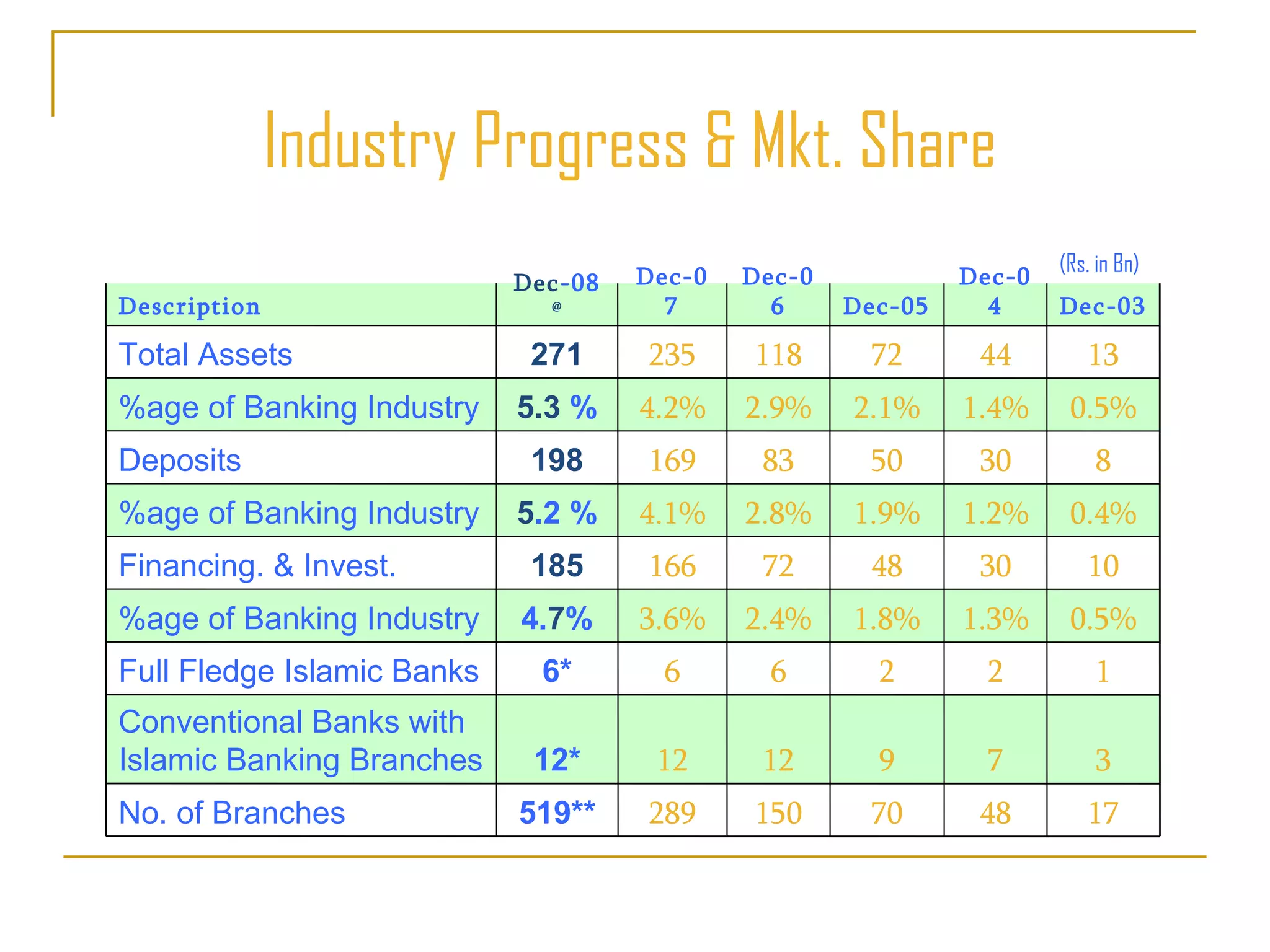
Industry Progress & Mkt. Share 17 48 70 150 289 519** No. of Branches 3 7 9 12 12 12* Conventional Banks with Islamic Banking Branches 1 2 2 6 6 6* Full Fledge Islamic Banks 0.5% 1.3% 1.8% 2.4% 3.6% 4. 7 % %age of Banking Industry 10 30 48 72 166 185 Financing. & Invest.  0.4% 1.2% 1.9% 2.8% 4.1% 5 .2   % %age of Banking Industry 8 30 50 83 169 198 Deposits  0.5% 1.4% 2.1% 2.9% 4.2% 5.3  % %age of Banking Industry 13 44 72 118 235 271 Total Assets  Dec-03 Dec-04 Dec-05 Dec-06 Dec-07 Dec -08 @ Description (Rs. in Bn)‏
City - Wise Breakup
City - Wise Breakup
Industry Progress in Pakistan
Islamic products and services offered by 300+  Financial Institutions around the world . United States: 20 -  Al Manzil Financial Services - American Finance House - Failaka Investments - HSBC  - Ameen Housing Cooperative Germany:4 - Bank Sepah - Commerz Bank - Deutsche Bank Switzerland: 6 UK: 26 - HSBC Amanah Finance  - Al Baraka International Ltd - Takafol UK Ltd - The Halal Mutual Investment Company - J Aron & Co Ltd (Goldman Sachs) Bahrain: 26   - Bahrain Islamic Bank - Al Baraka - ABC Islamic Bank  - CitiIslamic Investment Bank Malaysia: 49 2 - Pure Islamic Banks (Bank Islam, Bank Muamalat) Rest - conventional banks Saudi Arabia: 17 - Al Rajhi  - SAMBA - Saudi Hollandi  - Riyadh Bank   UAE: 13 - Dubai Islamic Bank - Abu Dhabi Islamic Bank - HSBC Amanah Qatar: 4 - Qatar Islamic Bank - Qatar International Islamic Kuwait: 9 - Kuwait Finance House Iran: 8 Egypt: 12 - Alwatany Bank of Egypt - Egyptian Saudi Finance  Indonesia: 4 Sudan: 9 Pakistan: 21 India: 3 Bangladesh:9 Turkey: 7 - Faisal Finance Institution - Ihlas Finance House Yemen: 5
International Overview  The size of Islamic Financial Industry has reached US$ 300 Bln. and its growing annually @ 15% per anum. 70 countries have Islamic Banking Institutions  37 Muslim countries including Bahrain, UAE, Saudi Arabia,  Malaysia, Brunei and Pakistan 34 non-Muslim countries including USA, UK, Canada, Switzerland, South Africa and Australia
Trade Based Modes of Islamic Microfinance
Basic Rules of Bai ( Buying & Selling ) Existence of Product/Commodity Ownership of Product/Commodity Possession of Product/Commodity
Basic Rules of Bai Unconditional basis Product have value/Price. Bai on Such product which is permissible in Islam.
Basic Rules of Bai Product Must be Identify, clear with all demanding Qualities. Not based on any incident, struggle etc Price must be clearly identified.
Bai (Buying & Selling) Basic Kinds of Bai
Kinds of Bai Bai Musawamah Bai Murabaha Bai Surf  Bai Salam Bai Istisna’ Bai Urboon
Basic Kinds of Bai Bai Eenna Bai Touliya Bai Wadhia
Bai  There are three basic type of Bai’s which are using in Islamic Banking as the mode of financing in Pakistan Murabahah Salam Istisna’
Murabahah Basically, it’s not a mode of financing but a source to avoid interest Dealing It’s not a type of loan, but a deal (Bai) Murabahah can be used as source of financing when client needs funds to purchase any product/Machinery etc.
Murabahah Sharing of Risk of loss differentiate Murabahah from the interest category Product Must be bought from third party for avoid buy back transaction Roll over is not Valid in Murabahah If actual cost can not be identified then Murabahah deal not possible.
Bai Important Note Following 3 Basic Rules of Bai are exceptional for Salam & Istisna’ Existence of Product/Commodity Ownership of Product/Commodity Possession of Product/Commodity
Salam Pay 100% amount in Advance. Product must be quantified, identified and Measured with quality. Date of delivery, Time, Place must be mentioned clearly in advance. Salam is not valid for a specific farm/land/garden.
Istisna’ Not necessary to pay the 100% amount in advance Like Bai salam. Price must be decided on beginning of the contract. Qualities, features of that product must be clearly identified.
Type of Bai according to Quality Bai Salah Bai Fasid Bai Batil Bai Maqoof
Type of Bai according to Quality Bai Majool Bai Muqayaddah Bai Mu’ajal
Encourage asset-based financing and based on commodity trading & Services Based on money trading. Money is a medium of exchange and not a commodity Partners, investor and traders, buyer or seller relationship Creditor-Debtor relationship Aim at maximising profit but subject to Sharia'h restrictions Aim at maximising profit without any restrictions Promote risk-sharing between provider of capital (investor) and user of funds (entrepreneurs) Investor is assured of pre-determined rate of interest Functions and operations are based on Sharia’h principles Functions and operations are based on fully man made principles Islamic MF Conventional MF
Deal in Zakat Do not Deal in Zakat ( Non Muslim Countries ) Islamic banks have no provision to charge any extra money from the defaulters  It can charge additional money in case of defaulters  No right of profit if there is no risk involved.  It is almost risk free banking and depositor has no risk of losing its money because interest is guaranteed. Islamic MF Conventional MF
Thank You.

Al huda presentation on introduction to islamic micro finance

  • 1.
  • 2.
    Zubair Mughal ChiefExecutive Officer AlHuda : Centre of Islamic Banking & Economics Editor in Chief. Islamic Banking and Finance News , True Banking. An Introduction to Islamic Banking & Finance
  • 3.
    Outline of PresentationIntroduction to Microfinance Riba ( Interest ) Product of Islamic Microfinance Progress of Islamic Banking in Pakistan and Worldwide Difference between Islamic & Conventional MF..
  • 4.
    Islam and ShariahIslam Aqidah (Faith & Belief) Shariah (Practices & Activities) Akhlaq (Morality & Ethics) IBADAT (Man to God Worship) Muamalat (Man to Man Activities) Political Activities Economic Activities Social Activities Banking & Financial Activities
  • 5.
    Sources of Fiq’hin Islam (Islamic Finance) Quran Sunnah Ijtehad / Qiyas Ijama’e Ummah
  • 6.
    Basic Difference betweenIslamic and Conventional MF Conventional Bank Client Money Money + Money(interest) Bank Client Islamic Micro Finance Goods & Services money
  • 7.
    Riba in Quran“ ... God has permitted trade and forbidden interest... ” (Sura Al-Baqara 2:275)
  • 8.
    Murabahah Ijarah Salam& Istisna etc Musharakah Modarabahah Other Products Human Financial Needs Fulfillment of Financial Needs Own Capital Others’ Capital Equity Financing Debt Financing
  • 9.
    PRODUCT TREE IslamicMicrofinance Modes Trade Based Modes Partnership Based Modes Rental Based Modes Musharaka (Joint Venture Profit Sharing ) Mudaraba ( Trustee Profit Sharing) Murabaha (Cost Plus Profit Sale) Musawama (Bargain sale ) Salam (Commodity Sale) Istisna (Sale on Order) Ijarah ( Leasing ) Diminishing Musharaka ( Transfer of Ownership)
  • 10.
    Industry Progress inPakistan 6 Full fledge Banks having 239 and 12 Conventional Banks have 167 SAIBBS and 10 Sub Branches till 1 st January , 09 Total IB Branches = 519 Year 2001 Meezan Bank Al Baraka Meezan Bank Al Baraka MCB Alfalah SCB Bank AlHabib Habib AG Zur. Metropolitan Bank of Khyber Soneri Bank 2002 2003 Meezan Bank Al Baraka MCB Meezan Bank Al Baraka MCB Alfalah 2 10 2007 - 09 Meezan Bank (161) Al Baraka (30) MCB (8) Alfalah(40) SCB (11) Bank AlHabib(4 ) HMB(4) Bank of Khyber(16) Soneri Bank ( 5) HBL(1) Bank Islami(102) DIB (25) EGIBL (40) Dawood(21) NBP(5) RBS (3) Askari(18) UBL (5) 2004 - 06 18 4 3
  • 11.
    Industry Progress &Mkt. Share 17 48 70 150 289 519** No. of Branches 3 7 9 12 12 12* Conventional Banks with Islamic Banking Branches 1 2 2 6 6 6* Full Fledge Islamic Banks 0.5% 1.3% 1.8% 2.4% 3.6% 4. 7 % %age of Banking Industry 10 30 48 72 166 185 Financing. & Invest. 0.4% 1.2% 1.9% 2.8% 4.1% 5 .2 % %age of Banking Industry 8 30 50 83 169 198 Deposits 0.5% 1.4% 2.1% 2.9% 4.2% 5.3 % %age of Banking Industry 13 44 72 118 235 271 Total Assets Dec-03 Dec-04 Dec-05 Dec-06 Dec-07 Dec -08 @ Description (Rs. in Bn)‏
  • 12.
    City - WiseBreakup
  • 13.
    City - WiseBreakup
  • 14.
  • 15.
    Islamic products andservices offered by 300+ Financial Institutions around the world . United States: 20 - Al Manzil Financial Services - American Finance House - Failaka Investments - HSBC - Ameen Housing Cooperative Germany:4 - Bank Sepah - Commerz Bank - Deutsche Bank Switzerland: 6 UK: 26 - HSBC Amanah Finance - Al Baraka International Ltd - Takafol UK Ltd - The Halal Mutual Investment Company - J Aron & Co Ltd (Goldman Sachs) Bahrain: 26 - Bahrain Islamic Bank - Al Baraka - ABC Islamic Bank - CitiIslamic Investment Bank Malaysia: 49 2 - Pure Islamic Banks (Bank Islam, Bank Muamalat) Rest - conventional banks Saudi Arabia: 17 - Al Rajhi - SAMBA - Saudi Hollandi - Riyadh Bank UAE: 13 - Dubai Islamic Bank - Abu Dhabi Islamic Bank - HSBC Amanah Qatar: 4 - Qatar Islamic Bank - Qatar International Islamic Kuwait: 9 - Kuwait Finance House Iran: 8 Egypt: 12 - Alwatany Bank of Egypt - Egyptian Saudi Finance Indonesia: 4 Sudan: 9 Pakistan: 21 India: 3 Bangladesh:9 Turkey: 7 - Faisal Finance Institution - Ihlas Finance House Yemen: 5
  • 16.
    International Overview The size of Islamic Financial Industry has reached US$ 300 Bln. and its growing annually @ 15% per anum. 70 countries have Islamic Banking Institutions 37 Muslim countries including Bahrain, UAE, Saudi Arabia, Malaysia, Brunei and Pakistan 34 non-Muslim countries including USA, UK, Canada, Switzerland, South Africa and Australia
  • 17.
    Trade Based Modesof Islamic Microfinance
  • 18.
    Basic Rules ofBai ( Buying & Selling ) Existence of Product/Commodity Ownership of Product/Commodity Possession of Product/Commodity
  • 19.
    Basic Rules ofBai Unconditional basis Product have value/Price. Bai on Such product which is permissible in Islam.
  • 20.
    Basic Rules ofBai Product Must be Identify, clear with all demanding Qualities. Not based on any incident, struggle etc Price must be clearly identified.
  • 21.
    Bai (Buying &Selling) Basic Kinds of Bai
  • 22.
    Kinds of BaiBai Musawamah Bai Murabaha Bai Surf Bai Salam Bai Istisna’ Bai Urboon
  • 23.
    Basic Kinds ofBai Bai Eenna Bai Touliya Bai Wadhia
  • 24.
    Bai Thereare three basic type of Bai’s which are using in Islamic Banking as the mode of financing in Pakistan Murabahah Salam Istisna’
  • 25.
    Murabahah Basically, it’snot a mode of financing but a source to avoid interest Dealing It’s not a type of loan, but a deal (Bai) Murabahah can be used as source of financing when client needs funds to purchase any product/Machinery etc.
  • 26.
    Murabahah Sharing ofRisk of loss differentiate Murabahah from the interest category Product Must be bought from third party for avoid buy back transaction Roll over is not Valid in Murabahah If actual cost can not be identified then Murabahah deal not possible.
  • 27.
    Bai Important NoteFollowing 3 Basic Rules of Bai are exceptional for Salam & Istisna’ Existence of Product/Commodity Ownership of Product/Commodity Possession of Product/Commodity
  • 28.
    Salam Pay 100%amount in Advance. Product must be quantified, identified and Measured with quality. Date of delivery, Time, Place must be mentioned clearly in advance. Salam is not valid for a specific farm/land/garden.
  • 29.
    Istisna’ Not necessaryto pay the 100% amount in advance Like Bai salam. Price must be decided on beginning of the contract. Qualities, features of that product must be clearly identified.
  • 30.
    Type of Baiaccording to Quality Bai Salah Bai Fasid Bai Batil Bai Maqoof
  • 31.
    Type of Baiaccording to Quality Bai Majool Bai Muqayaddah Bai Mu’ajal
  • 32.
    Encourage asset-based financingand based on commodity trading & Services Based on money trading. Money is a medium of exchange and not a commodity Partners, investor and traders, buyer or seller relationship Creditor-Debtor relationship Aim at maximising profit but subject to Sharia'h restrictions Aim at maximising profit without any restrictions Promote risk-sharing between provider of capital (investor) and user of funds (entrepreneurs) Investor is assured of pre-determined rate of interest Functions and operations are based on Sharia’h principles Functions and operations are based on fully man made principles Islamic MF Conventional MF
  • 33.
    Deal in ZakatDo not Deal in Zakat ( Non Muslim Countries ) Islamic banks have no provision to charge any extra money from the defaulters It can charge additional money in case of defaulters No right of profit if there is no risk involved. It is almost risk free banking and depositor has no risk of losing its money because interest is guaranteed. Islamic MF Conventional MF
  • 34.

Editor's Notes

  • #5 Source: Institute of Policy Studies
  • #6 Collective Ijtamaee Ijtehad at 4.5