Chapter 5 Modeling With Technologies
Learning by Building Models Technologies are developed by instructional designers to “teach” students Students often reply to the technology by answering questions which determine if they understood or remembered the information Computers are used to present information, judge answers, diagnose student understanding, and adapt to meet student needs
Learning by Building Models cont. When working with technologies, ask learners to conceptualize, organize, and solve problems Computers are meant to memorize and retrieve information so students can actually teach the computers Humans are natural model builders  and have models in the mind  called mental models
Mindtools (Purpose) Model domain knowledge (which is content that is supposed to be learned in school) Mindtools make people think harder in a different way about what they are studying They build models of systems They organize what people are learning They build models of problems by mentally constructing problem space   in the mind
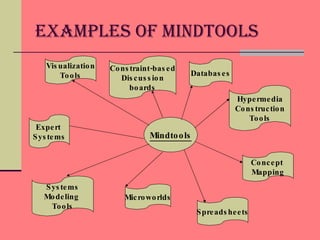
Examples of Mindtools Mindtools Databases Concept   Mapping Spreadsheets Microworlds Systems Modeling  Tools Expert  Systems Visualization Tools Constraint-based Discussion boards Hypermedia Construction Tools
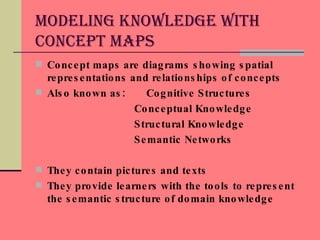
Modeling Knowledge With Concept Maps Concept maps are diagrams showing spatial representations and relationships of concepts Also known as:  Cognitive Structures   Conceptual Knowledge   Structural Knowledge   Semantic Networks They contain pictures and texts  They provide learners with the tools to represent the semantic structure of domain knowledge
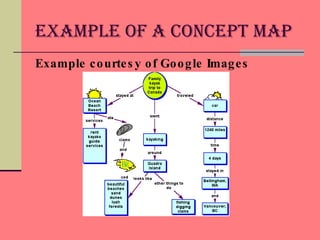
Example of a Concept Map Example courtesy of Google Images
Modeling Systems With Systems Dynamics Tools Illustrates causal interrelationships among the components of a system Components of a system affect other components which can affect the original Computer-based tools which include Stella, VenSim, and PowerSim, can help build these dynamic systems Once they are built, students can model and observe the output in graphs, tables, or animations
Modeling Problems With Spreadsheets Spreadsheets are computerized record-keeping systems They are examples of a mindtool that amplifies and reorganizes mental functioning The information can consist of text, numbers, and/or formulas There are 3 primary functions- Storing Calculating Presenting Information
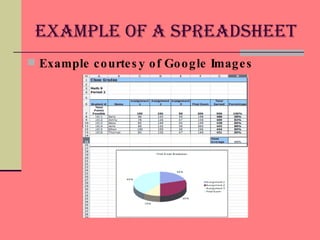
Example of a Spreadsheet Example courtesy of Google Images
Modeling Thinking With Expert Systems Computer programs that are designed to simulate expert reasoning to facilitate decision making for all problems Consist of knowledge base of facts about objects and rules Basically an artificial decision maker-(simulates the way human  experts solve problems) Approached by a novice with  a problem
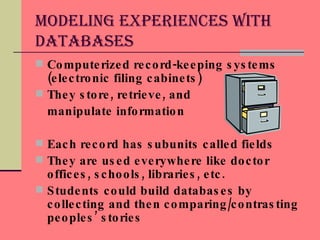
Modeling Experiences With Databases Computerized record-keeping systems (electronic filing cabinets) They store, retrieve, and  manipulate information Each record has subunits called fields They are used everywhere like doctor offices, schools, libraries, etc. Students could build databases by collecting and then comparing/contrasting peoples’ stories
Why Build Models With Mindtools? They are essentially constructivist They construct personal representations of experiences Modeling supports hypothesis testing and inferring Students own the knowledge Modeling motivates our efforts to make sense of the world WHY? WHY?
Presented By: Katie Walker Images By: Google Images and Clip Art

Chapter 5 Summary

  • 1.
    Chapter 5 ModelingWith Technologies
  • 2.
    Learning by BuildingModels Technologies are developed by instructional designers to “teach” students Students often reply to the technology by answering questions which determine if they understood or remembered the information Computers are used to present information, judge answers, diagnose student understanding, and adapt to meet student needs
  • 3.
    Learning by BuildingModels cont. When working with technologies, ask learners to conceptualize, organize, and solve problems Computers are meant to memorize and retrieve information so students can actually teach the computers Humans are natural model builders and have models in the mind called mental models
  • 4.
    Mindtools (Purpose) Modeldomain knowledge (which is content that is supposed to be learned in school) Mindtools make people think harder in a different way about what they are studying They build models of systems They organize what people are learning They build models of problems by mentally constructing problem space in the mind
  • 5.
    Examples of MindtoolsMindtools Databases Concept Mapping Spreadsheets Microworlds Systems Modeling Tools Expert Systems Visualization Tools Constraint-based Discussion boards Hypermedia Construction Tools
  • 6.
    Modeling Knowledge WithConcept Maps Concept maps are diagrams showing spatial representations and relationships of concepts Also known as: Cognitive Structures Conceptual Knowledge Structural Knowledge Semantic Networks They contain pictures and texts They provide learners with the tools to represent the semantic structure of domain knowledge
  • 7.
    Example of aConcept Map Example courtesy of Google Images
  • 8.
    Modeling Systems WithSystems Dynamics Tools Illustrates causal interrelationships among the components of a system Components of a system affect other components which can affect the original Computer-based tools which include Stella, VenSim, and PowerSim, can help build these dynamic systems Once they are built, students can model and observe the output in graphs, tables, or animations
  • 9.
    Modeling Problems WithSpreadsheets Spreadsheets are computerized record-keeping systems They are examples of a mindtool that amplifies and reorganizes mental functioning The information can consist of text, numbers, and/or formulas There are 3 primary functions- Storing Calculating Presenting Information
  • 10.
    Example of aSpreadsheet Example courtesy of Google Images
  • 11.
    Modeling Thinking WithExpert Systems Computer programs that are designed to simulate expert reasoning to facilitate decision making for all problems Consist of knowledge base of facts about objects and rules Basically an artificial decision maker-(simulates the way human experts solve problems) Approached by a novice with a problem
  • 12.
    Modeling Experiences WithDatabases Computerized record-keeping systems (electronic filing cabinets) They store, retrieve, and manipulate information Each record has subunits called fields They are used everywhere like doctor offices, schools, libraries, etc. Students could build databases by collecting and then comparing/contrasting peoples’ stories
  • 13.
    Why Build ModelsWith Mindtools? They are essentially constructivist They construct personal representations of experiences Modeling supports hypothesis testing and inferring Students own the knowledge Modeling motivates our efforts to make sense of the world WHY? WHY?
  • 14.
    Presented By: KatieWalker Images By: Google Images and Clip Art