CHAPTER 5:
Normal Flora of the
Human Body
Jhon Loyd Cydric M. Abilgos
Gwyneth R. Abanto
John Ramon Abrina
Ma. Pamela Aguilar
Audrey Nicole S. Abejero
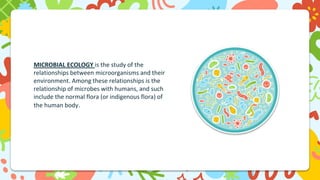
MICROBIAL ECOLOGY is the study of the
relationships between microorganisms and their
environment. Among these relationships is the
relationship of microbes with humans, and such
include the normal flora (or indigenous flora) of
the human body.
CHARACTERISTICS & DIFFERENCES
Normal Flora Transient Flora
Regularly found in a given area of the body at
a given age
Do not establish themselves permanently
Can inhibit the growth of pathogenic
organism by priming the immune system
Inhabit the skin and mucous membrane
temporarily for hours, days, or weeks
Protects the body organs and system that are
in direct contact with the external
environment
Colonizes the superficial layer of the skin
Synthesize important vitamins that are
essential to humans
Can cause infection if they are not remove
from the surface of the body (hand-washing)
NORMAL FLORA ON
DIFFERENT SITES OF THE
BODY
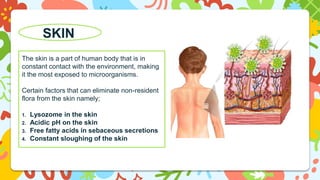
The skin is a part of human body that is in
constant contact with the environment, making
it the most exposed to microorganisms.
Certain factors that can eliminate non-resident
flora from the skin namely;
1. Lysozome in the skin
2. Acidic pH on the skin
3. Free fatty acids in sebaceous secretions
4. Constant sloughing of the skin
SKIN
PICTURE ORGANISM REMARKS
Staphylococcus epidermidis This is a major skin inhabitant,
comprising approximately 90% of
resident aerobic flora.
Staphylococcus aureus This is most commonly found in nose
and perineum, in the nose, number
varies with age (greater in newborns
than in adults)
Micrococci (Micrococcus luteus) This accounts for 20-80% of
micrococci in the skin
PICTURE ORGANISM REMARKS
Diphtheroids (Coryneforms) These are classified into: lipophilic
(common in axilla) or non-lipophilic
(more common on glabrous or
hairless skin such as palms of hands)
Gram-negative Bacilli (Enterobacter,
Klebsiella, Escherichia coli, and
Proteus spp.)
These are seen in moist intertriginous
areas such as toe webs and axilla
Nail Flora Microflora are similar to that of the
skin
Fungi may also be present
(Aspergillus, Penicillium
Cladosporium, or Mucorl
Mouth and Respiratory Tract
PARTS OF THE BODY MICROORGANISMS
Tongue and buccal mucosa Streptococcus Mutans, Streptococcus
Salivarius, Streptococcus Sanguinis.
Dental Caries Viridans Streptococci
Pharynx and trachea Haemophilus Influenza, Streptococcus
Pneumonia, Neisseria Meningitidis,
Mycoplasma
Upper respiratory tract Neisseria Meningitides, Corynebacterium
Diptheriae,
Bordetella Pertussis
Conjunctiva
PARTS OF THE BODY MICROORGANISMS
Conjunctiva Neisseria, Moraxella, Corynebacterium.
Digestive Tract
● Minimal bacteria may be found in the
stomach due to relatively hostile
environment in the stomach.
● Bacteria that may be found in the
stomach that are in those that may be
swallowed with food.
● Certain bacteria that can survive in the
acidity of the stomach is the
Helicobacter Pylori, the most common
cause of duodenal ulcers.
SMALL INTESTINE LARGE INTESTINE
Streptococci, Lactobacilli, Bacteriodes. Bacteriodes Fragilis,
Bifidobacterium/Lactubaccilus Bifidum,
Eubacterium, Peptostreptococcus,
Clostrodium
● In bottle-fed infants, the predominant
intestinal flora is Lactobacillus
Acidophilus
● About 1-4% of the flora of the colon are
facultative aerobes, predominantly
Escherichia Coli
Important roles of intestinal flora in the body:
1. Synthesis of Vt. B complex and Vt. K
2. Conversion of bile to bile acids
3. Competition with transient flora for nutrients
4. Prevention of colonization of transient flora
5. Production of pathogenic end-products of
metabolism which are toxic to transient flora
Genitourinary Tract
● The urinary tract is sterile above the
distal 1 cm of the urethra.
● Anterior urethra = Streptococcus
Epidermidis, Enterocci, Diptheroids.
● In both male and females,
Mycobacterium Smegmatis may be
found as normal commensals in their
secretions.
● Penile Urethra = Gardnerella Vaginalis
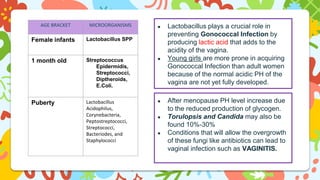
AGE BRACKET MICROORGANISMS
Female infants Lactobacillus SPP
1 month old Streptococcus
Epidermidis,
Streptococci,
Diptheroids,
E.Coli.
Puberty Lactobacillus
Acidophilus,
Corynebacteria,
Peptostreptococci,
Streptococci,
Bacteriodes, and
Staphylococci
● Lactobacillus plays a crucial role in
preventing Gonococcal Infection by
producing lactic acid that adds to the
acidity of the vagina.
● Young girls are more prone in acquiring
Gonococcal Infection than adult women
because of the normal acidic PH of the
vagina are not yet fully developed.
● After menopause PH level increase due
to the reduced production of glycogen.
● Torulopsis and Candida may also be
found 10%-30%
● Conditions that will allow the overgrowth
of these fungi like antibiotics can lead to
vaginal infection such as VAGINITIS.
THANK
YOU
!!!

CHAPTER 5 - MICROPARA LECTURE HAHAHAHAH

  • 1.
    CHAPTER 5: Normal Floraof the Human Body Jhon Loyd Cydric M. Abilgos Gwyneth R. Abanto John Ramon Abrina Ma. Pamela Aguilar Audrey Nicole S. Abejero
  • 2.
    MICROBIAL ECOLOGY isthe study of the relationships between microorganisms and their environment. Among these relationships is the relationship of microbes with humans, and such include the normal flora (or indigenous flora) of the human body.
  • 3.
    CHARACTERISTICS & DIFFERENCES NormalFlora Transient Flora Regularly found in a given area of the body at a given age Do not establish themselves permanently Can inhibit the growth of pathogenic organism by priming the immune system Inhabit the skin and mucous membrane temporarily for hours, days, or weeks Protects the body organs and system that are in direct contact with the external environment Colonizes the superficial layer of the skin Synthesize important vitamins that are essential to humans Can cause infection if they are not remove from the surface of the body (hand-washing)
  • 4.
    NORMAL FLORA ON DIFFERENTSITES OF THE BODY
  • 5.
    The skin isa part of human body that is in constant contact with the environment, making it the most exposed to microorganisms. Certain factors that can eliminate non-resident flora from the skin namely; 1. Lysozome in the skin 2. Acidic pH on the skin 3. Free fatty acids in sebaceous secretions 4. Constant sloughing of the skin SKIN
  • 6.
    PICTURE ORGANISM REMARKS Staphylococcusepidermidis This is a major skin inhabitant, comprising approximately 90% of resident aerobic flora. Staphylococcus aureus This is most commonly found in nose and perineum, in the nose, number varies with age (greater in newborns than in adults) Micrococci (Micrococcus luteus) This accounts for 20-80% of micrococci in the skin
  • 7.
    PICTURE ORGANISM REMARKS Diphtheroids(Coryneforms) These are classified into: lipophilic (common in axilla) or non-lipophilic (more common on glabrous or hairless skin such as palms of hands) Gram-negative Bacilli (Enterobacter, Klebsiella, Escherichia coli, and Proteus spp.) These are seen in moist intertriginous areas such as toe webs and axilla Nail Flora Microflora are similar to that of the skin Fungi may also be present (Aspergillus, Penicillium Cladosporium, or Mucorl
  • 8.
    Mouth and RespiratoryTract PARTS OF THE BODY MICROORGANISMS Tongue and buccal mucosa Streptococcus Mutans, Streptococcus Salivarius, Streptococcus Sanguinis. Dental Caries Viridans Streptococci Pharynx and trachea Haemophilus Influenza, Streptococcus Pneumonia, Neisseria Meningitidis, Mycoplasma Upper respiratory tract Neisseria Meningitides, Corynebacterium Diptheriae, Bordetella Pertussis
  • 9.
    Conjunctiva PARTS OF THEBODY MICROORGANISMS Conjunctiva Neisseria, Moraxella, Corynebacterium.
  • 10.
    Digestive Tract ● Minimalbacteria may be found in the stomach due to relatively hostile environment in the stomach. ● Bacteria that may be found in the stomach that are in those that may be swallowed with food. ● Certain bacteria that can survive in the acidity of the stomach is the Helicobacter Pylori, the most common cause of duodenal ulcers.
  • 11.
    SMALL INTESTINE LARGEINTESTINE Streptococci, Lactobacilli, Bacteriodes. Bacteriodes Fragilis, Bifidobacterium/Lactubaccilus Bifidum, Eubacterium, Peptostreptococcus, Clostrodium ● In bottle-fed infants, the predominant intestinal flora is Lactobacillus Acidophilus ● About 1-4% of the flora of the colon are facultative aerobes, predominantly Escherichia Coli Important roles of intestinal flora in the body: 1. Synthesis of Vt. B complex and Vt. K 2. Conversion of bile to bile acids 3. Competition with transient flora for nutrients 4. Prevention of colonization of transient flora 5. Production of pathogenic end-products of metabolism which are toxic to transient flora
  • 12.
    Genitourinary Tract ● Theurinary tract is sterile above the distal 1 cm of the urethra. ● Anterior urethra = Streptococcus Epidermidis, Enterocci, Diptheroids. ● In both male and females, Mycobacterium Smegmatis may be found as normal commensals in their secretions. ● Penile Urethra = Gardnerella Vaginalis
  • 13.
    AGE BRACKET MICROORGANISMS Femaleinfants Lactobacillus SPP 1 month old Streptococcus Epidermidis, Streptococci, Diptheroids, E.Coli. Puberty Lactobacillus Acidophilus, Corynebacteria, Peptostreptococci, Streptococci, Bacteriodes, and Staphylococci ● Lactobacillus plays a crucial role in preventing Gonococcal Infection by producing lactic acid that adds to the acidity of the vagina. ● Young girls are more prone in acquiring Gonococcal Infection than adult women because of the normal acidic PH of the vagina are not yet fully developed. ● After menopause PH level increase due to the reduced production of glycogen. ● Torulopsis and Candida may also be found 10%-30% ● Conditions that will allow the overgrowth of these fungi like antibiotics can lead to vaginal infection such as VAGINITIS.
  • 14.