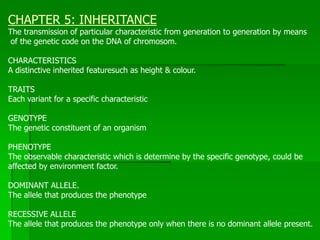
CHAPTER 5: INHERITANCE
The transmission of particular characteristic from generation to generation by means
of the genetic code on the DNA of chromosom.
CHARACTERISTICS
A distinctive inherited featuresuch as height & colour.
TRAITS
Each variant for a specific characteristic
GENOTYPE
The genetic constituent of an organism
PHENOTYPE
The observable characteristic which is determine by the specific genotype, could be
affected by environment factor.
DOMINANT ALLELE.
The allele that produces the phenotype
RECESSIVE ALLELE
The allele that produces the phenotype only when there is no dominant allele present.
HOMOZYGOTE
Both the allele of a particular gene of a pair of homologous chromosome
are identical.
HETEROZYGOTE
Both the allele of a particular gene of a pair of homologous chromosome
are diffeent.
GENE
A basic unit of inheritance that determines a particular characteristic
consist of a segment of DNA nucleotide on a specific locus of a
Chromosome. It controls a particular trait, Mendel called it ‘FACTOR’.
ALLELE
Alternative form og gene that has the same locus on homologous
chromosome, comes from the male parent & the other from the
female parent.
PURE LINE.
A population of organism, all having the same particular trait
that been genetically unchanged through many generations.
LOCUS.
Location of gene on the chromosome.
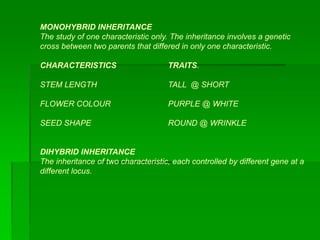
MONOHYBRID INHERITANCE
The study of one characteristic only. The inheritance involves a genetic
cross between two parents that differed in only one characteristic.
CHARACTERISTICS TRAITS.
STEM LENGTH TALL @ SHORT
FLOWER COLOUR PURPLE @ WHITE
SEED SHAPE ROUND @ WRINKLE
DIHYBRID INHERITANCE
The inheritance of two characteristic, each controlled by different gene at a
different locus.
MENDEL ‘ S FIRST LAW (SEGREGATION)
EACH INDIVIDUAL CHARACTERISTIC OF AN ORGANISM IS
DETERMINE BY PAIR OF ALLELE. THE PAIRS OF ALLELE SEGREGATE
DURING MEIOSIS AND ONLY ONE O F EACH PAIR OF ALLELE CAN
BE PRESENT IN A SINGLE GAMETE.
MENDEL ‘ S SECOND LAW (INDEPENDENT ASSORTMENT
DURING GAMETE FORMATION, EACH MEMBER OF A PAIR
OF ALLELEMAY COMBINE RANDOMLY WITH EITHER
MEMBER OF ANOTHER PAIR OF ALLELE.
ABO BLOOD GROUP SYSTEM
ALELE IA AND I B ARE CODOMINANT ( BOTH ARE EXPRESSED
EQUALY IN PHENOTYPE)
WHILE ALLELE I O IS RECESSIVE.
BLOOD GROUP TYPES OF
ANTIGEN
ANTIBODY IN
BLOOD PLASMA
GENOTYPE
A A ANTI-B I A IA , IA IO
B B ANTI -A I B IB , IB IO
AB A & B NONE I A IB
O NONE ANTI-A & ANTI-B IO IO
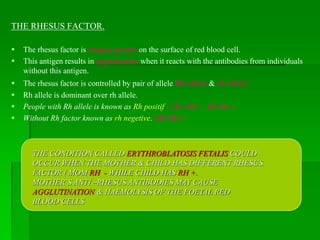
THE RHESUS FACTOR.
 The rhesus factor is antigen present on the surface of red blood cell.
 This antigen results in agglutination when it reacts with the antibodies from individuals
without this antigen.
 The rhesus factor is controlled by pair of allele Rh allele & rh allele.
 Rh allele is dominant over rh allele.
 People with Rh allele is known as Rh positif ( Rh+Rh+ , Rh-Rh- )
 Without Rh factor known as rh negetive. (Rh-Rh-)
THE CONDITION CALLED ERYTHROBLATOSIS FETALIS COULD
OCCUR WHEN THE MOTHER & CHILD HAS DIFFERENT RHESUS
FACTOR ( MOM RH - WHILE CHILD HAS RH +.
MOTHER’S ANTI –RHESUS ANTIBODIES MAY CAUSE
AGGLUTINATION & HAEMOLYSIS OF THE FOETAL RED
BLOOD CELLS
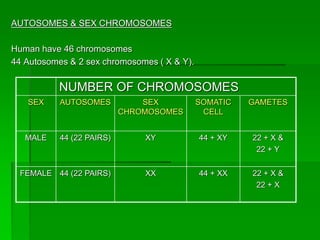
AUTOSOMES & SEX CHROMOSOMES
Human have 46 chromosomes
44 Autosomes & 2 sex chromosomes ( X & Y).
NUMBER OF CHROMOSOMES
SEX AUTOSOMES SEX
CHROMOSOMES
SOMATIC
CELL
GAMETES
MALE 44 (22 PAIRS) XY 44 + XY 22 + X &
22 + Y
FEMALE 44 (22 PAIRS) XX 44 + XX 22 + X &
22 + X
HUMAN KARYOTYPES
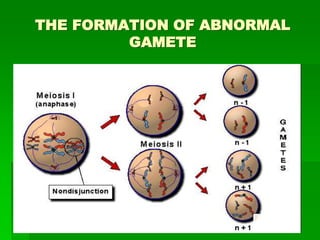
THE FORMATION OF ABNORMAL
GAMETE
NON DISJUNCTION DURING
ANAPHASE I
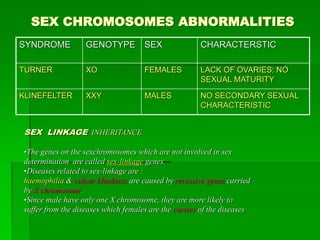
SEX CHROMOSOMES ABNORMALITIES
SYNDROME GENOTYPE SEX CHARACTERSTIC
TURNER XO FEMALES LACK OF OVARIES: NO
SEXUAL MATURITY
KLINEFELTER XXY MALES NO SECONDARY SEXUAL
CHARACTERISTIC
SEX LINKAGE INHERITANCE
•The genes on the sexchromosomes which are not involved in sex
determination are called sex-linkage genes.
•Diseases related to sex-linkage are :
haemophilia & colour blindness are caused by recessive genes carried
by X chromosome.
•Since male have only one X chromosome, they are more likely to
suffer from the diseases which females are the carries of the diseases
GENOTYPE
PHENOTYPE
HAEMOPHILIA COLOUR
BLINDNESS
MALE
NORMAL
XH Y XB Y
HAEMOPHILIAC/
COLOUR BLIND Xh Y XB Y
FEMALE
NORMAL
XH XH XB XB
CARIER
XH Xh XB
HAEMOPHILIAC/
COLOUR BLIND Xh Xh Xb Xb
HAEMOPHILIA DOMINANT ALLEL - XH
RECESSIVE ALLELE - Xh
COLOUR BLIND DOMINANT ALLEL - XB
RECESSIVE ALLELE - Xb
GENES, CHROMOSOMES, DNA
 A chromosome is thread like twisted structure in the
nucleus and carries genetic information
 It consists of hundreds or thousands genes
 Chromosomes can be divided into 2 parts:
1. Protein molecule: called histones, not carry any genetic information.
2. DNA molecule : carry genetic information
 DNA molecule consists of two polynucleotide strands coiled
together by hydrogen bonds to form double helix.
 Nitrogenous base are : Adenine pair with Thymine
 Guanine pair with Cytosin
STRUCTURE OF DNA
CELL NUCLEUS CHROMOSOME DNA GENE NUCLEOTIDE
PHOSPHATE
NITROGENOUS BASE
SUGAR (PENTOS)
STRUCTURE OF DNA
APPLICATION OF KNOWLWEDGE IN GENETICS
1. SELECTIVE BREEDING.
To produce offspring that possess desirable characteristic of both parents.
Eg: Tenera palm oil tree is produced by crossed breeding between Dura &
Pisifera .
DURA X PISIFERA
•THICK SHELL
•LOW OIL CONTENT
•FRUITS DO NOT
FALL EASILY
•THIN SHELL
•HIGH OIL CONTENT
•FRUITS FALL OFF
EASILY
TENERA
•THIN SHELL
•HIGH OIL CONTENT
•FRUITS DO NOT FALL
OFF EASILY
2. Genetic engineering Genetic therapy
Genetic modified orgs.(GMO)
Genetic modified food (GMF)
GT.
The patient is given a healthy gene to replace a defective gene.
Used to correct genetic defects such as sickle cell anaemia, cystic fibrosis .
GMO
Microorgs such as bacteria & yeast are used to produce proteins include:
Enzyme rennin, penicillin, insulin & growth hormone.
Animals are used to produce useful protein in their milk to treat diseases
such as haemophilia.
GMF
Maize has been modified to become more resistant to pest
Tomatoes have been modified to slow down ripening process
Soya bean plants have been made herbicide resistant.
3. STEM CELL RESEARCH
Stem cell are cells that capable of dividing and renewing themselves.
Scientist hope to use stem cell to generate cells & tissue that can be use
to treat injury & diseases.
Now the umbilical cord blood cells is used for above objective.
4. DNA FINGERPRINTING
A method of comparing samples of DNA by producing a visible pattern
rather like a bar code.
To identify an individual such as a suspect in criminal activity.
To identify genes that cause genetics diseases
To test the compatible of potential organ donors with patient
5. HUMAN GENOM PROJECT.
A genome is an organism complete set of genes made up of DNA
nucleotide bases.
The purpose of the project is to detect map, & determine the sequence of
all base pairs in the DNA of human genes.
Help in treat & prevent human diseases influence by genes
INSULIN PRODUCTION USING RECOMBINANT
DNA TECHNIQUE (EX. OF GMO)
1. Plasmid (Plasma membrane) removed from bacterial cell
2. Gene for the production of insulin removed from the cell (just take out
the DNA from Human pancreas cell )
3. Gene inserted into plasmid recombinant DNA
4. Plasmid put into plasmid free bacterial cell
5. Plasmid replicated as the bacteria divide asexually
6. Produce more insulin.
CHAPTER 5 INHERITANCE.ppt

CHAPTER 5 INHERITANCE.ppt

  • 1.
    CHAPTER 5: INHERITANCE Thetransmission of particular characteristic from generation to generation by means of the genetic code on the DNA of chromosom. CHARACTERISTICS A distinctive inherited featuresuch as height & colour. TRAITS Each variant for a specific characteristic GENOTYPE The genetic constituent of an organism PHENOTYPE The observable characteristic which is determine by the specific genotype, could be affected by environment factor. DOMINANT ALLELE. The allele that produces the phenotype RECESSIVE ALLELE The allele that produces the phenotype only when there is no dominant allele present.
  • 2.
    HOMOZYGOTE Both the alleleof a particular gene of a pair of homologous chromosome are identical. HETEROZYGOTE Both the allele of a particular gene of a pair of homologous chromosome are diffeent. GENE A basic unit of inheritance that determines a particular characteristic consist of a segment of DNA nucleotide on a specific locus of a Chromosome. It controls a particular trait, Mendel called it ‘FACTOR’. ALLELE Alternative form og gene that has the same locus on homologous chromosome, comes from the male parent & the other from the female parent. PURE LINE. A population of organism, all having the same particular trait that been genetically unchanged through many generations. LOCUS. Location of gene on the chromosome.
  • 3.
    MONOHYBRID INHERITANCE The studyof one characteristic only. The inheritance involves a genetic cross between two parents that differed in only one characteristic. CHARACTERISTICS TRAITS. STEM LENGTH TALL @ SHORT FLOWER COLOUR PURPLE @ WHITE SEED SHAPE ROUND @ WRINKLE DIHYBRID INHERITANCE The inheritance of two characteristic, each controlled by different gene at a different locus.
  • 4.
    MENDEL ‘ SFIRST LAW (SEGREGATION) EACH INDIVIDUAL CHARACTERISTIC OF AN ORGANISM IS DETERMINE BY PAIR OF ALLELE. THE PAIRS OF ALLELE SEGREGATE DURING MEIOSIS AND ONLY ONE O F EACH PAIR OF ALLELE CAN BE PRESENT IN A SINGLE GAMETE. MENDEL ‘ S SECOND LAW (INDEPENDENT ASSORTMENT DURING GAMETE FORMATION, EACH MEMBER OF A PAIR OF ALLELEMAY COMBINE RANDOMLY WITH EITHER MEMBER OF ANOTHER PAIR OF ALLELE.
  • 5.
    ABO BLOOD GROUPSYSTEM ALELE IA AND I B ARE CODOMINANT ( BOTH ARE EXPRESSED EQUALY IN PHENOTYPE) WHILE ALLELE I O IS RECESSIVE. BLOOD GROUP TYPES OF ANTIGEN ANTIBODY IN BLOOD PLASMA GENOTYPE A A ANTI-B I A IA , IA IO B B ANTI -A I B IB , IB IO AB A & B NONE I A IB O NONE ANTI-A & ANTI-B IO IO
  • 6.
    THE RHESUS FACTOR. The rhesus factor is antigen present on the surface of red blood cell.  This antigen results in agglutination when it reacts with the antibodies from individuals without this antigen.  The rhesus factor is controlled by pair of allele Rh allele & rh allele.  Rh allele is dominant over rh allele.  People with Rh allele is known as Rh positif ( Rh+Rh+ , Rh-Rh- )  Without Rh factor known as rh negetive. (Rh-Rh-) THE CONDITION CALLED ERYTHROBLATOSIS FETALIS COULD OCCUR WHEN THE MOTHER & CHILD HAS DIFFERENT RHESUS FACTOR ( MOM RH - WHILE CHILD HAS RH +. MOTHER’S ANTI –RHESUS ANTIBODIES MAY CAUSE AGGLUTINATION & HAEMOLYSIS OF THE FOETAL RED BLOOD CELLS
  • 7.
    AUTOSOMES & SEXCHROMOSOMES Human have 46 chromosomes 44 Autosomes & 2 sex chromosomes ( X & Y). NUMBER OF CHROMOSOMES SEX AUTOSOMES SEX CHROMOSOMES SOMATIC CELL GAMETES MALE 44 (22 PAIRS) XY 44 + XY 22 + X & 22 + Y FEMALE 44 (22 PAIRS) XX 44 + XX 22 + X & 22 + X
  • 8.
  • 9.
    THE FORMATION OFABNORMAL GAMETE
  • 10.
  • 11.
    SEX CHROMOSOMES ABNORMALITIES SYNDROMEGENOTYPE SEX CHARACTERSTIC TURNER XO FEMALES LACK OF OVARIES: NO SEXUAL MATURITY KLINEFELTER XXY MALES NO SECONDARY SEXUAL CHARACTERISTIC SEX LINKAGE INHERITANCE •The genes on the sexchromosomes which are not involved in sex determination are called sex-linkage genes. •Diseases related to sex-linkage are : haemophilia & colour blindness are caused by recessive genes carried by X chromosome. •Since male have only one X chromosome, they are more likely to suffer from the diseases which females are the carries of the diseases
  • 12.
    GENOTYPE PHENOTYPE HAEMOPHILIA COLOUR BLINDNESS MALE NORMAL XH YXB Y HAEMOPHILIAC/ COLOUR BLIND Xh Y XB Y FEMALE NORMAL XH XH XB XB CARIER XH Xh XB HAEMOPHILIAC/ COLOUR BLIND Xh Xh Xb Xb HAEMOPHILIA DOMINANT ALLEL - XH RECESSIVE ALLELE - Xh COLOUR BLIND DOMINANT ALLEL - XB RECESSIVE ALLELE - Xb
  • 13.
    GENES, CHROMOSOMES, DNA A chromosome is thread like twisted structure in the nucleus and carries genetic information  It consists of hundreds or thousands genes  Chromosomes can be divided into 2 parts: 1. Protein molecule: called histones, not carry any genetic information. 2. DNA molecule : carry genetic information  DNA molecule consists of two polynucleotide strands coiled together by hydrogen bonds to form double helix.  Nitrogenous base are : Adenine pair with Thymine  Guanine pair with Cytosin
  • 14.
    STRUCTURE OF DNA CELLNUCLEUS CHROMOSOME DNA GENE NUCLEOTIDE PHOSPHATE NITROGENOUS BASE SUGAR (PENTOS)
  • 15.
  • 16.
    APPLICATION OF KNOWLWEDGEIN GENETICS 1. SELECTIVE BREEDING. To produce offspring that possess desirable characteristic of both parents. Eg: Tenera palm oil tree is produced by crossed breeding between Dura & Pisifera . DURA X PISIFERA •THICK SHELL •LOW OIL CONTENT •FRUITS DO NOT FALL EASILY •THIN SHELL •HIGH OIL CONTENT •FRUITS FALL OFF EASILY TENERA •THIN SHELL •HIGH OIL CONTENT •FRUITS DO NOT FALL OFF EASILY
  • 17.
    2. Genetic engineeringGenetic therapy Genetic modified orgs.(GMO) Genetic modified food (GMF) GT. The patient is given a healthy gene to replace a defective gene. Used to correct genetic defects such as sickle cell anaemia, cystic fibrosis . GMO Microorgs such as bacteria & yeast are used to produce proteins include: Enzyme rennin, penicillin, insulin & growth hormone. Animals are used to produce useful protein in their milk to treat diseases such as haemophilia. GMF Maize has been modified to become more resistant to pest Tomatoes have been modified to slow down ripening process Soya bean plants have been made herbicide resistant.
  • 18.
    3. STEM CELLRESEARCH Stem cell are cells that capable of dividing and renewing themselves. Scientist hope to use stem cell to generate cells & tissue that can be use to treat injury & diseases. Now the umbilical cord blood cells is used for above objective. 4. DNA FINGERPRINTING A method of comparing samples of DNA by producing a visible pattern rather like a bar code. To identify an individual such as a suspect in criminal activity. To identify genes that cause genetics diseases To test the compatible of potential organ donors with patient 5. HUMAN GENOM PROJECT. A genome is an organism complete set of genes made up of DNA nucleotide bases. The purpose of the project is to detect map, & determine the sequence of all base pairs in the DNA of human genes. Help in treat & prevent human diseases influence by genes
  • 19.
    INSULIN PRODUCTION USINGRECOMBINANT DNA TECHNIQUE (EX. OF GMO) 1. Plasmid (Plasma membrane) removed from bacterial cell 2. Gene for the production of insulin removed from the cell (just take out the DNA from Human pancreas cell ) 3. Gene inserted into plasmid recombinant DNA 4. Plasmid put into plasmid free bacterial cell 5. Plasmid replicated as the bacteria divide asexually 6. Produce more insulin.