CHAPTER 3 JOB ANALYSIS TECHNIQUESSSS IN JOB ANALYSIS
Thousands of people like you help me to stand for an open web learning for all.
Are you willing to support and keep this useful tool as open and free.
Help me turning coffee ☕ into code and maintain the server.
#1 If this PowerPoint presentation contains mathematical equations, you may need to check that your computer has the following installed:
1) MathType Plugin
2) Math Player (free versions available)
3) NVDA Reader (free versions available)
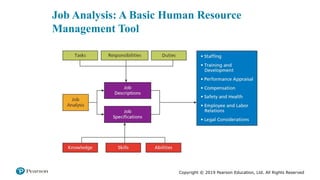
#3 Job analysis provides a summary of a job’s duties and responsibilities, its relationship to other jobs, the knowledge and skills required, and working conditions under which it is performed. Job analysis is conducted after the job design, worker training, and performance of the job is underway. With job analysis, the tasks needed to perform the job are identified. Traditionally, it is an essential and pervasive HR technique and the starting point for other HR activities. In today’s rapidly changing work environment, the need for a sound job analysis system is critical. New jobs are being created, and old jobs are being redesigned or eliminated. A job analysis that was conducted only a few years ago may now be obsolete and must be redone. Some have even suggested that changes are occurring too fast to maintain an effective job analysis system.
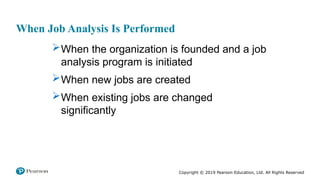
Job analysis is performed at three specific times:
When the organization is founded and a job analysis program is initiated for the first time,
When new jobs are created, and
When jobs are changed significantly as a result of new technologies, methods, procedures, or systems. This includes changes due to increased emphasis on teamwork, empowerment of employees, or managerial interventions, such as quality management systems.
Job analyses provide data that forms the basis of the job description and job specification, both of which impact virtually every aspect of human resource management.
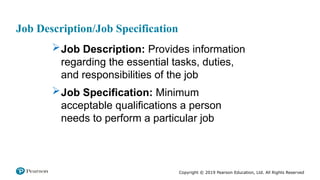
The job description is a document that provides information regarding the essential tasks, duties, and responsibilities of the job.
The job specification is incorporated into the job description document and spells out the minimum acceptable qualifications a person needs to perform a particular job.
In practice, both the job description and job specification are combined into one document with the job specification presented after the job description.
#4 A job is a group of tasks that must be performed for an organization to achieve its goals. It may require the services of one person or many.
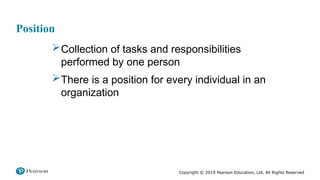
#5 A position is the collection of tasks and responsibilities performed by one person. In a work group consisting of a supervisor, two senior analysts, and four analysts, there are three jobs and seven positions.
#6 Job analysis is performed at three specific times:
When the organization is founded and a job analysis program is initiated for the first time,
When new jobs are created, and
When jobs are changed significantly as a result of new technologies, methods, procedures, or systems. This includes changes due to increased emphasis on teamwork, empowerment of employees, or managerial interventions, such as quality management systems.
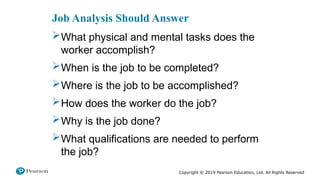
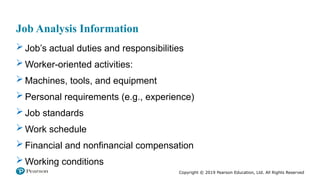
#7 Facts about the job as it currently exists are gathered by asking questions similar to those posed in this slide. Then, the answers are analyzed and recorded.
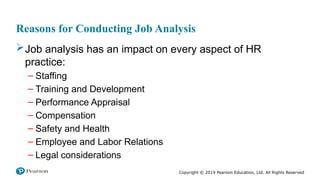
#8 Ultimately, job analysis can help inform the array of HR decisions in each of the functional areas. For example, staffing involves selecting and placing individuals who possess the required knowledge, skills, and ability, which differ from job to job. Job analysis helps identify training and development needs such as informing HR professionals about the kind of training that is needed to help employees gain the required knowledge, skills, and abilities required to perform the job. Job analysis helps establish the performance criteria that vary with different jobs. In the area of compensation, it is helpful to know the relative value of a particular job to the company before a dollar value is placed on it. Information derived from job analysis is also valuable in identifying safety and health considerations. Job analysis is helpful in the employee and relations area by identifying the standards for promotion, transfer, or demotion. The need for job analysis is well documented in the Uniform Guidelines. Job analysis can help defend decisions involving termination, promotions, transfers, and demotions.
#9 In today’s rapidly changing work environment, job analysis is critical to meet company objectives. As new jobs are created, old jobs may need to be redesigned or eliminated. Also, data derived from job analysis in the form of the job description/specification can have an impact on virtually every aspect of HR management. In practice, both the job description and job specification are combined into one document with the job specification presented after the job description.
Ultimately, job analysis can help inform the array of HR decisions in each of the functional areas. For example, staffing involves selecting and placing individuals who possess the required knowledge, skills, and ability, which differ from job to job. Job analysis helps identify training and development needs such as informing HR professionals about the kind of training that is needed to help employees gain the required knowledge, skills, and abilities required to perform the job. Job analysis helps establish the performance criteria that vary with different jobs. In the area of compensation, it is helpful to know the relative value of a particular job to the company before a dollar value is placed on it. Information derived from job analysis is also valuable in identifying safety and health considerations. Job analysis is helpful in the employee and relations area by identifying the standards for promotion, transfer, or demotion. The need for job analysis is well documented in the Uniform Guidelines. Job analysis can help defend decisions involving termination, promotions, transfers, and demotions
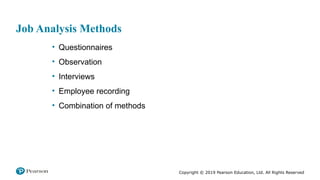
#10 Job analysis is conducted in different ways according to an organization’s needs and resources.
At the minimum, the employee and the employee’s immediate supervisor should participate in job analysis. Large organizations may have one or more job analysts, small organizations may use line supervisors, and other organizations my hire consultants. Regardless of approach, the analyst should—before conducting job analysis—learn as much as possible about the job by reviewing organizational charts and talking with individuals acquainted with the jobs to be studied.
Selecting a specific method should be based on how the information will be used, such as for job evaluation, pay increases, development, etc.
The most common methods of job analysis are discussed in the following slides.
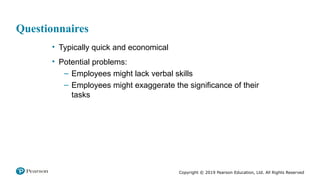
#11 Questionnaires are typically quick and economical to use. The job analyst administers a structured questionnaire to employees, who identify the tasks they perform.
But some employees lack the verbal or written skills to provide the desired information and others exaggerate their tasks by suggesting more responsibility than actually exists.
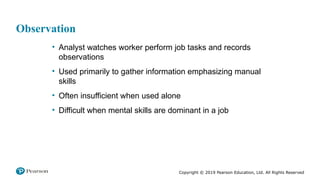
#12 Job analysts use the observation method to watch the worker perform job tasks and records their observations. This method is used primarily for jobs emphasizing manual skills, although it can help identify interrelationships between physical and mental tasks. Observation alone is not sufficient for conducting job analyses where mental skills are dominant.
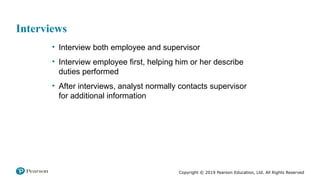
#13 Interviewing both the employee and supervisor provides a good understanding of the job. The analyst first interviews the employee to describe the duties performed.
Then, she contacts the supervisor for additional information, to check the accuracy of the information obtained from the employee, and to clarify certain points.
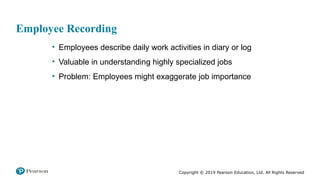
#14 Sometimes, job analysis information is gathered by having employees describe their daily work activities in a diary or log. With this method, the problem of employees exaggerating job importance may have to be overcome. Even so, valuable understanding of highly specialized jobs, such as recreational therapist, may be obtained in this way.
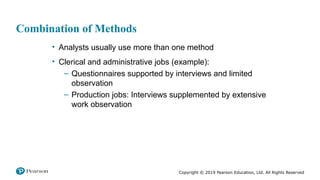
#15 An analyst usually combines methods to produce accurate job descriptions and specifications. For example, a questionnaire may be supported by interviews and limited observation.
#17 Job analyses provide data that forms the basis of the job description and job specification, both of which impact virtually every aspect of human resource management.
The job description is a document that provides information regarding the essential tasks, duties, and responsibilities of the job.
The job specification is incorporated into the job description document and spells out the minimum acceptable qualifications a person needs to perform a particular job.
In practice, both the job description and job specification are combined into one document with the job specification presented after the job description.
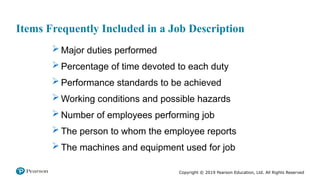
#18 The job description details major duties, the percentage of time devoted to each duty, performance standards, working conditions and potential hazards, the number of employees performing the job and to whom they report, and the equipment used on the job.
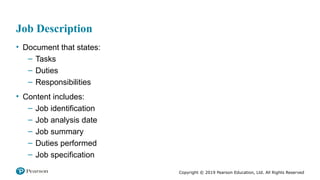
#19 Information obtained through job analysis is crucial to developing job descriptions. This document should provide accurate, explicit, and concise statements of what employees are expected to do, how they are to do it, and the conditions under which the duties are performed.
The job description frequently includes major duties, the percentage of time devoted to each duty, performance standards, working conditions and potential hazards, the number of employees performing the job and to whom they report, and the equipment used on the job.
The job description contains several components.
The job identification section includes the job title, department, reporting relationship, and job number or code. Job titles can be misleading, especially between one company and another.
The job analysis date is placed on the job description to identify job changes that would make the description obsolete. Some firms have placed an expiration date on the document to ensure periodic review of job content and minimize the number of obsolete job descriptions.
The job summary is a short paragraph that states job content.
The body of the job description delineates the major duties to be performed. Essential functions may be shown in a separate section to aid in complying with the Americans with Disabilities Act.
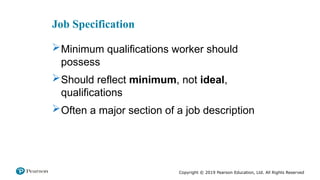
The job specification documents the minimum acceptable qualifications that a person should possess to perform a particular job.
#20 The job specification documents the minimum acceptable qualifications that a person should possess to perform a particular job.
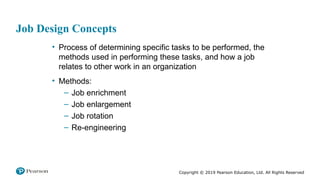
#21 New jobs are rapidly being created, so job design is the necessary process of determining the specific tasks to be performed, the methods used in performing these tasks, and how the job relates to other work in the organization.
Job enrichment consists of basic changes in the content and level of responsibility of a job so as to provide greater challenges to the worker.
Job enrichment provides a vertical expansion of responsibilities. The worker has the opportunity to derive a feeling of achievement, recognition, responsibility, and personal growth in performing the job. Although job enrichment programs do not always achieve positive results, they have often brought about improvements in job performance and in the level of worker satisfaction in many organizations. Today, job enrichment is moving toward the team level, as more teams become autonomous, or self-managed.
There is a clear distinction between job enrichment and job enlargement. Job enlargement is defined as increasing the number of tasks a worker performs, with all of the tasks at the same level of responsibility.
Job enlargement, sometimes called cross-training, involves providing greater variety to the worker. For example, instead of knowing how to operate only one machine, a person is taught to operate two or even three, but no higher level of responsibility is required. Workers with broad skills may become increasingly important as fewer workers are needed because of tight budgets. Some employers have found that providing job enlargement opportunities improves employee engagement and prevents stagnation.
Job rotation (cross-training) moves employees from one job to another to broaden their experience. Higher-level tasks often require this breadth of knowledge. Rotational training programs help employees understand a variety of jobs and their interrelationships, thereby improving productivity. Job rotation is often used by organizations to relieve boredom, stimulate better performance, reduce absenteeism, and provide additional flexibility in job assignments. Also, if the task to be accomplished is boring or distasteful, job rotation means that one person will not be stuck with it for all time.
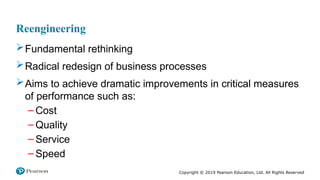
Reengineering is “the fundamental rethinking and radical redesign of business processes to achieve dramatic improvements in critical contemporary measures of performance, such as cost, quality, service, and speed.”
It emphasizes the radical redesign of work in which companies organizes around process instead of by functional departments.
#22 The worker has the opportunity to derive a feeling of achievement, recognition, responsibility, and personal growth in performing the job. Although job enrichment programs do not always achieve positive results, they have often brought about improvements in job performance and in the level of worker satisfaction in many organizations. Today, job enrichment is moving toward the team level, as more teams become autonomous, or self-managed.
#23 There is a clear distinction between job enrichment and job enlargement. Job enlargement is defined as increasing the number of tasks a worker performs, with all of the tasks at the same level of responsibility.
Job enlargement, sometimes called cross-training, involves providing greater variety to the worker. For example, instead of knowing how to operate only one machine, a person is taught to operate two or even three, but no higher level of responsibility is required. Workers with broad skills may become increasingly important as fewer workers are needed because of tight budgets. Some employers have found that providing job enlargement opportunities improves employee engagement and prevents stagnation.
#24 Job rotation (cross-training) moves employees from one job to another to broaden their experience. Higher-level tasks often require this breadth of knowledge. Rotational training programs help employees understand a variety of jobs and their interrelationships, thereby improving productivity. Job rotation is often used by organizations to relieve boredom, stimulate better performance, reduce absenteeism, and provide additional flexibility in job assignments. Also, if the task to be accomplished is boring or distasteful, job rotation means that one person will not be stuck with it for all time. Individuals who know how to accomplish more than one task are more valuable both to themselves and the firm. Staffing then becomes more flexible and these multi-skilled workers are then more insulated from layoffs. If job rotation is to be effective, management must be sure to provide sufficient training so that each individual in the rotation can perform the task in a similar manner.
#25 Reengineering is “the fundamental rethinking and radical redesign of business processes to achieve dramatic improvements in critical contemporary measures of performance, such as cost, quality, service, and speed.”
Reengineering essentially involves the firm rethinking and redesigning its business system to become more competitive. It emphasizes the radical redesign of work in which companies organizes around process instead of by functional departments. Incremental change is not what is desired; instead, deep-seated changes are wanted that will alter entire operations at one time. Essentially, the firm must rethink and redesign its business system from the ground up.
Reengineering focuses on the overall aspects of job designs, organizational structures, and management systems. It stresses that work should be organized around outcomes as opposed to tasks or functions. Reengineering should never be confused with downsizing even though a workforce reduction often results from this strategy. Naturally, job design considerations are of paramount concern because as the process changes, so do essential elements of jobs.